The silence inside the chambers of a United States Federal Judge is not merely the absence of noise; it is a physical weight. It is a heavy, velvet-draped quiet designed to swallow the chaotic murmurs of the outside world and distill them into the cold, hard clarity of the law.
I sat behind my desk, the mahogany surface cool under my fingertips. To my right sat a stack of case files regarding a multi-state racketeering indictment I had been overseeing for six months. To my left, a half-empty cup of lukewarm coffee. Behind me, the golden seal of the United States hung upon the wall—an eagle with its wings spread, watching over my shoulder like a silent guardian.
I signed the final order on the RICO case. My signature was sharp, practiced, and final. With that stroke of the pen, three crime bosses would spend the rest of their natural lives in a supermax facility.
I capped my pen, the click echoing in the room.
Then, my personal phone buzzed on the corner of the desk.
It was a jarring sound, an intrusion of the personal into the professional. I glanced at the screen, expecting a text from my clerk or perhaps a notification from my bank. Instead, a name flashed across the glass that I hadn’t seen in ten years.
Richard Vance.
My father. Or, more accurately, the biological donor who had contributed fifty percent of my genetic code before fleeing to the French Riviera the week after my sixteenth birthday.
I stared at the phone. My heart didn’t race. My hands didn’t tremble. The little girl who used to cry by the window waiting for his car to come up the driveway was long dead. In her place sat Judge Evelyn Vance, the youngest appointment to the district bench in two decades.
I let it ring three times. Four. On the fifth, curiosity—cold and analytical—got the better of me.
I swiped the screen and brought the phone to my ear.
“Judge Vance,” I answered. My voice was a flatline.
“Evelyn! Darling!” Richard’s voice boomed down the line, smooth as aged scotch and just as intoxicatingly fake. It was the voice of a man who could sell sand to a nomad. “Judge? Oh, that’s right, I heard through the grapevine you were… dabbling in the legal field. Listen, sweetheart, your mother and I are back in the States! We’re settling into a charming new estate in Connecticut. We miss you terribly.”
I swiveled my high-backed leather chair to look out the window. The D.C. skyline was a jagged row of gray teeth against a darkening winter sky. Snow was forecasted for later tonight.
“What do you want, Richard?” I asked.
“Direct as always,” he laughed, a nervous, fluttery sound. “We just want to see you! It’s Christmas Eve tomorrow. Come over for dinner. We want to bury the hatchet, Evie. We want to help you get back on your feet. We know how crippling law school loans can be, and we heard… well, we assumed you might be struggling.”
I frowned, glancing down at my bespoke Italian wool suit and the Cartier tank watch on my wrist. They clearly hadn’t bothered to do a simple Google search. To them, I was still the twenty-year-old waitress they had abandoned to fend for herself, not a woman who held the power of the federal government in her hands.
“I’m busy,” I said, moving to hang up.
“Henry is here,” Richard said quickly, his voice dropping an octave.
My finger hovered over the disconnect button.
Grandpa Henry.
My heart, previously a stone in my chest, skipped a beat. Henry Vance was the man who had actually raised me. He was a carpenter with rough hands and a soft heart, the one who taught me that integrity was the only currency that didn’t devalue.
I had been trying to reach him for three months. His landline had been disconnected. My letters had been returned to sender, stamped Moved, No Forwarding Address. I had hired a private investigator just last week, terrified that he had passed away in a state facility somewhere, alone.
“Is he alright?” I asked, my grip on the phone tightening until my knuckles turned white.
“He’s… confused,” Richard sighed, the sound heavy with theatrical pity. “Old age, Evelyn. Dementia is a cruel mistress. You know how it is. He asks for you, when he’s lucid. Just come for dinner, Evie. For him.”
I closed my eyes, inhaling a slow, steady breath.
I knew this was a trap. Richard and my mother, Martha, did not do “family dinners.” They did transactions. They did leverage. They did cons. If they were calling me after a decade of silence, it was because they needed something, and they were using Henry as the bait.
But if Henry was there, I had no choice.
“Send me the address,” I said. “I’ll be there at six.”
I hung up before he could offer more platitudes.
I sat there for a moment, the silence of the room rushing back in to fill the void Richard’s voice had left. Then, I stood up and walked to the wall safe hidden behind a portrait of Lincoln. I spun the dial—left, right, left—and the heavy steel door swung open.
Inside lay two items of significance.
The first was a small, velvet-wrapped gift box—a vintage Patek Philippe watch I had restored for Henry months ago, hoping I’d find him to give it to him.
The second was my gold badge and my service weapon, a compact Glock 19.
As a Federal Judge, I carried authorized protection, though I rarely felt the need for it outside of high-risk trials. Tonight, however, a cold instinct—a lizard-brain warning system that had kept me alive in the foster system before Henry took me in—screamed that the law might need a physical presence.
I clipped the gold badge onto my belt, positioned at the small of my back, and holstered the weapon next to it. I threw my heavy charcoal trench coat over my suit, effectively concealing the hardware.
I wasn’t going to a family reunion. I was going to a crime scene; I just didn’t know what the crime was yet.
————
The address Richard sent led me away from the city, deep into the wealthy, manicured suburbs of Connecticut. The snow had begun to fall, large, wet flakes that turned to slush on the windshield of my modest, reliable sedan.
I pulled up to the gate of 42 Oakwood Lane. It was a sprawling estate, a monstrosity of stone and glass that screamed “new money.” As I drove up the long, heated driveway, I took inventory of the vehicles parked in front of the four-car garage.
A Bentley Continental GT. A brand new Porsche 911 Turbo.
I did the mental math as I put the car in park. My parents were “socialites,” which was a polite term for professional grifters. They lived on credit, charm, and the stupidity of others. But cars like that required liquidity. Significant liquidity. And I knew for a fact, based on the background check I’d run on them years ago, that they were destitute.
Where did the money come from?
I walked up the stone path, the wind biting at my exposed face. The house was blazing with light, every chandelier lit, a towering monument to excess in the middle of a winter storm.
I rang the doorbell.
Martha opened it.
She looked exactly as I remembered, perhaps even younger, thanks to the miracles of plastic surgery and fillers. She wore a silk evening gown that likely cost more than my first year of law school, and she held a crystal flute of champagne in a hand manicured to perfection.
Her eyes scanned me from head to toe, lingering with disdain on my plain wool coat and sensible, weather-proof boots. A smirk, cruel and familiar, touched her lips.
“Oh, Evelyn,” she purred, the sound grating against my nerves. “You made it. And look at you… still so practical. Thrift store chic? Or are things really that tight?”
“Hello, Martha,” I said, stepping past her before she could block the threshold. “Where is Grandpa?”
Richard appeared from the living room, wearing a velvet smoking jacket that looked like a costume from a bad period drama. The house smelled of expensive pine, roasting meat, and the cloying scent of lilies. It was warm—stiflingly so.
“Evelyn!” Richard spread his arms as if to embrace me, but I stood rigid, my hands in my pockets. He dropped his arms awkwardly, clearing his throat. “He’s around. Relax, darling. Let’s have a drink first. We have some news to celebrate.”
“I’m not thirsty,” I said, my voice cutting through the warmth of the room. “Where is he?”
Richard exchanged a glance with Martha. It was a look I recognized—a shared annoyance, a silent communication between co-conspirators.
“He’s… occupied,” Richard said, his tone hardening. “Look, Evelyn, let’s cut to the chase. We know you’re probably barely scraping by. We’re generous people. We’re willing to offer you a deal.”
“A deal?” I asked, raising a skeptical eyebrow.
“We’re moving,” Martha said, taking a long sip of her champagne. “To Florida. A very exclusive community called The Golden Palms. It’s strictly no-children, and more importantly… no dependents.”
“Meaning what?” I asked, though the bile was already rising in my throat.
“Meaning Henry can’t come,” Richard said bluntly. “He’s a burden, Evelyn. He’s senile, he’s messy, and quite frankly, he ruins the aesthetic of the new life we’re building. We sold his old dilapidated house six months ago—got a surprisingly good price for the land—and that money funded our new start. But we can’t take the baggage with us.”
I froze. The room seemed to tilt.
“You sold Henry’s house?” I whispered. “The house he built with his own hands? The house he promised to me in his will?”
“It was in his name,” Richard shrugged, pouring himself a drink. “We just… guided his hand on the paperwork. He wanted to help his family. It’s our inheritance, really. We just accessed it a bit early.”
I stared at them. They had liquidated the only asset my grandfather possessed—his sanctuary—to fund their mid-life crisis toys.
“So,” Richard continued, oblivious to the dangerous look in my eyes, “since you’re young and single, we figured you could take him. Consider it your inheritance. You get the old man; we get the Florida house. Fair trade.”
I felt the weight of the badge on my hip. It felt hot against my skin, a brand of justice waiting to be revealed.
“Where is he?” I asked again, my voice dangerously quiet.
“Oh, don’t look so sour,” Martha sighed, waving a hand dismissively. “He’s fine. We just didn’t want him wandering around during the party. He spills things. He drools. It’s embarrassing.”
“Where?” I barked, the command echoing off the high ceilings.
Richard flinched. He gestured vaguely toward the back of the house.
“He’s in the back,” Richard muttered. “We put him in the garden shed for the evening. It’s quiet there. He likes the quiet.”
The world stopped.
“The shed?” I whispered. “Richard, it’s twenty degrees outside. It’s a blizzard.”
“He has a blanket!” Richard shouted defensively, his veneer of charm cracking. “Stop being so dramatic! Go get him if you want him so bad. Just don’t drag any mud onto the Persian rugs.”
I didn’t say another word. I turned on my heel and sprinted toward the back door, leaving them standing in their golden cage.
————
I burst out the back door onto the patio. The cold air hit me like a physical blow, a wall of ice that took my breath away. The wind had picked up significantly, and the snow was coming down in blinding sheets, swirling in violent gusts around the yard.
The backyard was expansive, landscaped to perfection, but pitch black. At the far end of the garden, about fifty yards away, stood a small, dilapidated wooden structure. There were no lights on inside.
“Grandpa!” I screamed, the wind tearing the sound from my throat.
I ran. My boots sank into the accumulating snow, but I didn’t care. I slipped, scrambled back up, and kept running.
I reached the shed. The door was locked from the outside with a heavy iron sliding bolt.
Panic, cold and sharp, spiked in my chest. I ripped the bolt back, the metal freezing against my bare hand, and threw the door open.
The smell hit me instantly—the stench of mildew, old gasoline, and the unmistakable, sharp odor of human urine. It was freezing inside, somehow colder than the outside air because the dampness had settled into the rotting wood.
“Grandpa?” I choked out, pulling my phone from my pocket and activating the flashlight.
The beam cut through the dusty darkness and landed on a pile of dirty painter’s drop cloths in the corner, nestled between a rusted lawnmower and a stack of old tires.
The pile moved.
“Grandpa!” I fell to my knees in the dirt, ruining my suit trousers instantly.
Henry shielded his eyes from the harsh light. He was curled into a tight fetal ball, shivering so violently that his teeth were audibly clicking together, a rhythmic chatter of bone on bone. He was wearing thin cotton pajamas—no coat, no socks. His skin was translucent, pale blue around the lips.
“Evie?” he whispered. His voice was a dry rattle, like dead leaves skittering on pavement. “Is… is that you?”
“I’m here, Grandpa. I’m here.” I ripped off my heavy wool trench coat and wrapped it around him, tucking the ends under his shaking frame. He felt like a block of ice. His body had stopped generating heat; he was in the late stages of hypothermia.
“You have to go, honey,” he wheezed, clutching my arm with a grip that was terrifyingly weak. “Richard… he’s angry. About the money. He said if I told anyone… he’d stop feeding me again.”
Tears streamed down my face, hot and fast, freezing on my cheeks. “He starved you?”
“Just… just for a few days,” Henry stammered, his eyes darting to the door in terror. “I messed up the papers… my hand was shaking… he got mad.”
I pulled him closer, trying to transfer my body heat to him, rocking him gently. “They sold your house, Grandpa. Did you know?”
“They said… they said they’d put me in a nice home,” he cried softly. “They promised, Evie. But then they brought me here. Said I smelled. Said I was… broken furniture.”
Broken furniture.
Something inside me fractured. The sadness, the fear, the shock—it all evaporated. In its place, a cold, hard fury solidified. It was the same feeling I got when I looked into the eyes of a remorseless predator in my courtroom, but magnified a thousand times. This wasn’t just a crime; it was a desecration.
I checked his pulse. It was thready and slow. Too slow.
“I’m going to get you out of here,” I promised.
“No, don’t!” Henry panicked, trying to push me away. “Richard will hurt you. He has a gun… in the safe. He said he’d use it if you caused trouble. He said he’d kill us both.”
“Let him try,” I whispered.
I stood up. I took out my phone. I didn’t call 911. The local police would take ten minutes to navigate the storm. I needed immediate, overwhelming force.
I dialed a number I had saved for “Code Red” emergencies.
“Marshal Davis,” a gruff voice answered on the first ring.
“This is Judge Vance,” I said, my voice steady, betraying none of the tears on my face. “I am at 42 Oakwood Lane. I have a confirmed Code 3. Hostage situation. Active domestic torture. Wire fraud. Immediate threat to life.”
“We’re two minutes out, Judge. We’ve been tracking the wire transfers on Richard Vance for months. We were just waiting for you to verify the location of the victim.”
“They are in the kitchen,” I said. “Move in. Bring everyone.”
“Understood. Keep your head down, Judge.”
I hung up.
I looked down at Henry, wrapped in my coat. “Stay here, Grandpa. I’m going to go clear the way.”
“Evie, be careful,” he begged, his eyes wide with fear. “You’re just a girl against them.”
I touched the badge on my hip, concealed now only by my suit jacket.
“No, Grandpa,” I said softly. “I’m the law.”
———–
I walked back across the lawn. The snow was a blizzard now, whipping my hair across my face, but I didn’t feel the cold. I felt only the fire in my chest.
I stepped onto the patio. Through the sliding glass doors, I could see Richard and Martha in the kitchen. They were laughing. Richard was refilling his champagne glass, gesturing expansively. They were celebrating their freedom, their Florida retirement, bought with the suffering of the man freezing in their backyard.
I slid the door open and stepped inside.
The warmth of the house felt offensive, like a physical insult.
“Did you get the old bag of bones?” Martha called out without looking, chopping a lime for her drink. “Don’t bring him inside yet! Put him in your car. I don’t want fleas on the sofa.”
“Turn around, Martha,” I said.
My voice wasn’t loud. But it carried the weight of a gavel striking wood. It was the voice that silenced courtrooms and commanded respect from hardened criminals.
Martha turned. Richard looked up from his drink.
They saw me standing there, snow melting in my hair, my coat gone, wearing a sharp grey suit that highlighted the athletic build I hid under loose clothing. But mostly, they saw the look in my eyes. It was a look of absolute, terrifying calculation.
“Where’s your coat?” Richard asked, annoyed. “Did you leave it with him? God, Evelyn, you’re soft. Just like him.”
“You sold a property located at 15 Fairview Drive on July 4th,” I stated, my tone devoid of emotion. “You forged the signature of Henry Vance, a dependent adult with diminished capacity. You wire-transferred the proceeds, amounting to 1.2 million dollars, to a shell corporation in the Cayman Islands.”
Richard dropped his glass. It shattered on the travertine tile floor, shards of crystal exploding outward.
“What?” he whispered, his face draining of color. “How… how do you know that?”
“You then used those funds to purchase this property and these vehicles,” I continued, stepping forward, measuring the distance between us. “And tonight, you imprisoned Henry Vance in sub-zero temperatures without food or heat. That is False Imprisonment. Elder Abuse in the First Degree. Wire Fraud. And Attempted Manslaughter.”
Martha laughed nervously, a high-pitched, hysterical sound that bordered on madness. “Evelyn, stop it. You sound crazy. You’re a waitress! What do you know about wire transfers?”
“Who do you think you are?” Richard shouted, stepping toward me aggressively, his face flushing red with rage. “Get out of my house! You ungrateful little brat! I’ll call the police!”
“Please do,” I said.
I reached to my hip. With a slow, deliberate movement, I pulled back my blazer.
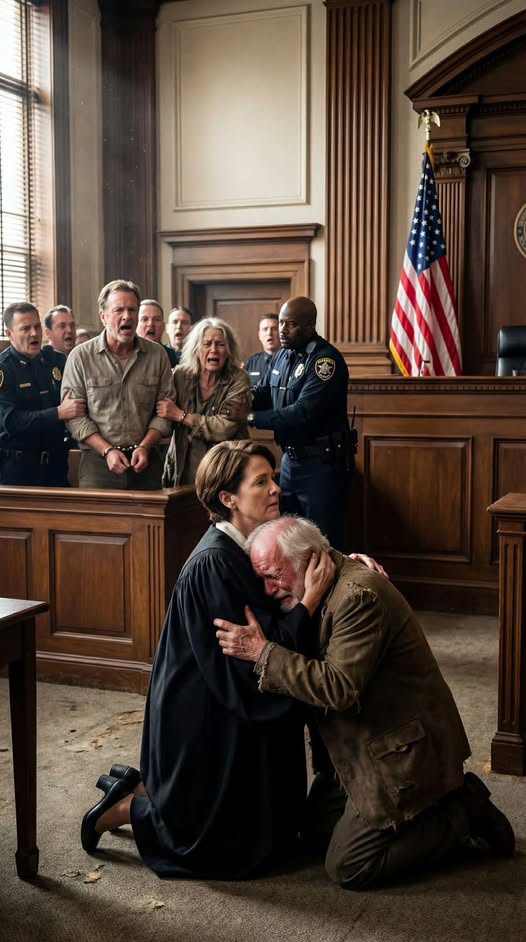
The gold badge of a United States Federal Judge caught the kitchen light. It gleamed with terrifying authority. Beside it, the matte black grip of the Glock 19 was unmistakable.
Richard stopped dead. His eyes bulged.
“I am Federal Judge Evelyn Vance,” I said. “And for the last six months, I have been building a RICO case against a ring of identity thieves operating out of Connecticut. I just didn’t realize until tonight that the ringleaders were my own parents.”
“Judge?” Martha whispered, clutching the counter for support. “No… that’s a lie. You’re lying!”
“This badge isn’t a lie,” I said. “And the hypothermia my grandfather is suffering right now isn’t a lie. You wanted to discard him like trash? Well, I’m afraid I’m taking out the trash.”
I tapped the earpiece I had slipped in during my walk from the shed.
“Execute.”
The world exploded into noise.
The front door was smashed open with a battering ram. The sound was like a thunderclap that shook the foundations of the house.
“FEDERAL AGENTS! GET ON THE GROUND! NOW!”
Dozens of heavily armed US Marshals in tactical gear swarmed into the hallway. Red and blue lights from the cruisers outside flashed through the windows, painting the kitchen in a chaotic strobe of justice.
Richard tried to run. He bolted toward the hallway, his eyes wild, perhaps thinking of the gun in his safe.
“Don’t!” I yelled.
A Marshal tackled him before he made it three steps. Richard slammed face-first into the hardwood floor, screaming as his arms were wrenched behind his back.
Martha stood frozen, screaming. “You can’t do this! We’re your parents! Evelyn! Tell them to stop!”
Two agents grabbed her, spinning her around and cuffing her hands behind her back.
“Martha Vance, you are under arrest,” an agent barked.
I stood in the center of the chaos, perfectly still, a calm eye in the storm.
Richard lifted his head from the floor, blood trickling from his nose where it had met the wood. He looked at me with pure, distilled hatred.
“You planned this!” he spat. “You set us up!”
“I didn’t plan for you to put him in a shed,” I said, looking down at him with cold detachment. “That was your choice. And now, you’re going to live with the consequences.”
I walked over to the patio door and opened it for the paramedics who were rushing in from the side gate, escorted by two Marshals.
“He’s in the shed,” I told them, pointing into the dark. “Go. Now.”
Chapter 5: Justice and Warmth
The next hour was a blur of flashing lights, static radio chatter, and the controlled chaos of a federal crime scene.
I stood by the ambulance as the paramedics worked on Henry. They had him wrapped in thermal blankets and were administering warm fluids intravenously. His shivering had stopped—a good sign, or a very bad one.
“His core temp is up,” the lead medic told me, pulling off his gloves. “He’s going to make it, Judge. But another hour out there… well, we’d be having a different conversation.”
He didn’t finish the sentence. He didn’t have to.
I walked back toward the house as the Marshals escorted Richard and Martha out. They were both in handcuffs, looking small and pathetic in the swirling snow. The bravado was gone, replaced by the terrified realization that their game was over.
Martha saw me and lunged against the agent holding her.
“Evelyn!” she wailed, mascara running down her face in black streaks. “Please! It was a misunderstanding! We just wanted to be free! We gave you life! You owe us!”
I signaled for the agents to stop. I walked up to her, close enough that I could smell the stale champagne on her breath.
“You didn’t give me life,” I said quietly. “You gave me biology. Henry gave me life. He taught me to read. He paid for my books. He taught me that right and wrong aren’t negotiable concepts.”
“We’re your family!” she sobbed.
“A misunderstanding is a parking ticket, Martha,” I said, repeating the thought that had been burning in my mind. “Locking a 90-year-old man in a shed to freeze to death so you can buy a Porsche is a felony. It’s depraved. And it’s over.”
I leaned in closer, my voice dropping to a whisper.
“I’m recusing myself from your case, obviously. But the prosecutor is a close friend of mine. I’m going to make sure he asks for the maximum sentence. You wanted a retirement home? The state will provide one. It has bars on the windows, and the heat is controlled by the warden. You’ll fit right in.”
I nodded to the agents. “Get them out of my sight.”
They dragged her away, her screams fading into the wail of the sirens.
I watched them go. I waited for the guilt to hit me. I waited for the sadness of seeing my parents arrested to crush me. But it never came. Instead, I felt only the immense, light-headed relief of a tumor being excised from my body.
I walked back to the ambulance.
“Ready to go, Judge?” the medic asked.
“Yes,” I said. “Take him to St. Mary’s. I’ll follow.”
I climbed into the back of the ambulance, sitting beside the stretcher. Henry was awake, his eyes groggy but focused. He reached out a shaking hand.
“Evie?” he whispered. “Are they gone?”
I took his hand in both of mine, warming his cold fingers. “They’re gone, Grandpa. They’re never coming back. You’re safe.”
“Where are we going?” he asked, looking around the ambulance with confusion. “I don’t have a house anymore.”
“Yes, you do,” I said, kissing his forehead. “You’re coming home with me. I have a guest room. It has a fireplace. And a big bed. And no one will ever lock a door on you again.”
He squeezed my hand. A single tear rolled down his weathered cheek.
“My little Judge,” he smiled weakly.
—————
One Year Later
The fireplace in my Georgetown townhouse crackled warmly, casting a golden glow over the living room. Outside, the snow was falling again, blanketing D.C. in white silence, but inside, the air was thick with the smell of cinnamon and pine.
The Christmas tree in the corner was decorated with ornaments that Henry and I had made when I was a child—crooked stars made of cardboard and pasta angels that Richard and Martha would have thrown in the trash without a second thought. Here, they were treasures.
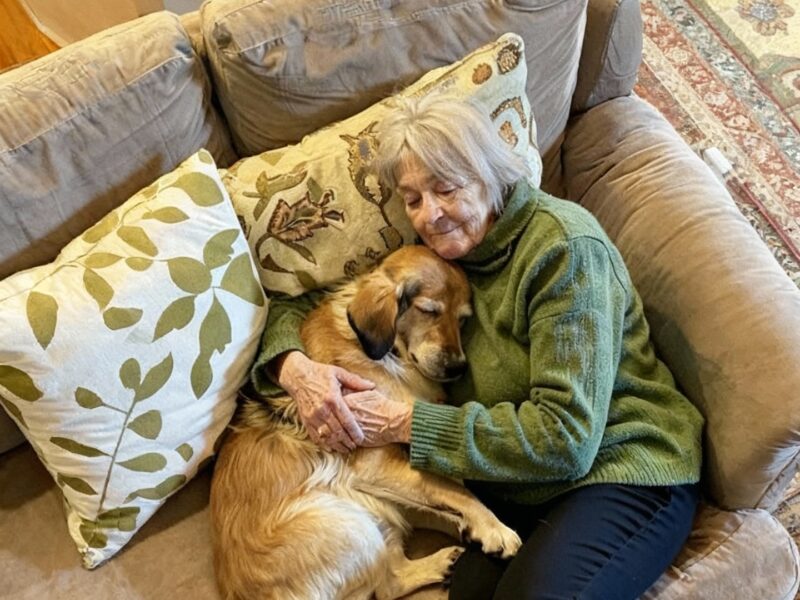
Henry sat in the large leather armchair by the fire. He looked different now. He had gained twenty pounds. His skin was rosy. He was wearing a thick cashmere cardigan I had bought him for his birthday. He held a mug of hot cocoa in his hands, watching the flames dance.
“You know,” he said, breaking the comfortable silence. “I got a letter today.”
I looked up from the legal brief I was reading on the rug. “Oh?”
“From the prison,” he said. “From Richard. He wants me to put money on his commissary account. Says the food is terrible and he needs toiletries.”
I laughed. It was a genuine, unburdened laugh that bubbled up from my chest. “What did you do with it?”
“I used it to start the fire,” he grinned, gesturing to the fireplace where the flames licked at a piece of crumpled paper. “Seemed appropriate.”
I smiled and shook my head. “Very appropriate.”
My parents had pled guilty to avoid a public trial that would have humiliated them further. They were both serving fifteen years for wire fraud, embezzlement, and elder abuse. They had lost everything—the cars, the house, the money. The assets had been seized by the Marshals and liquidated. The proceeds were returned to Henry, along with significant damages for pain and suffering.
Henry was a wealthy man again. But he didn’t care about the money. He cared that he was sitting by a fire, safe.
“I was thinking,” Henry said, looking at me with serious, watery eyes. “I always worried I hadn’t done enough for you. After they left you with me. I was just an old carpenter. I couldn’t give you the world, Evie.”
I closed my folder and moved to sit on the ottoman by his feet. I rested my head on his knee, feeling the warmth of the fire on my face.
“Grandpa,” I said softly. “You fed me when they forgot. You sat through my plays when they were in France. You told me I was smart when they told me I was plain. You didn’t just give me the world. You gave me the armor to survive it.”
He stroked my hair with his rough, gentle hand.
“I’m proud of you, Evie,” he whispered. “Not because you’re a Judge. But because you’re good.”
I looked out the window. The snow looked just like it did that night in the garden. But inside, there was no fear. There was no cold.
I reached under the tree and pulled out a small box.
“Merry Christmas, Grandpa,” I said.
He opened it. It was the vintage Patek Philippe, fully restored. On the back, I had engraved a message.
To the only father who matters. Love, The Law.
He chuckled, wiping his eyes with the back of his hand. “Merry Christmas, Judge.”
I looked at the fire, and for the first time in my life, I felt completely whole. The broken furniture had been restored. The discarded child had become the protector. And the verdict—the final, unappealable verdict of our lives—was peace.