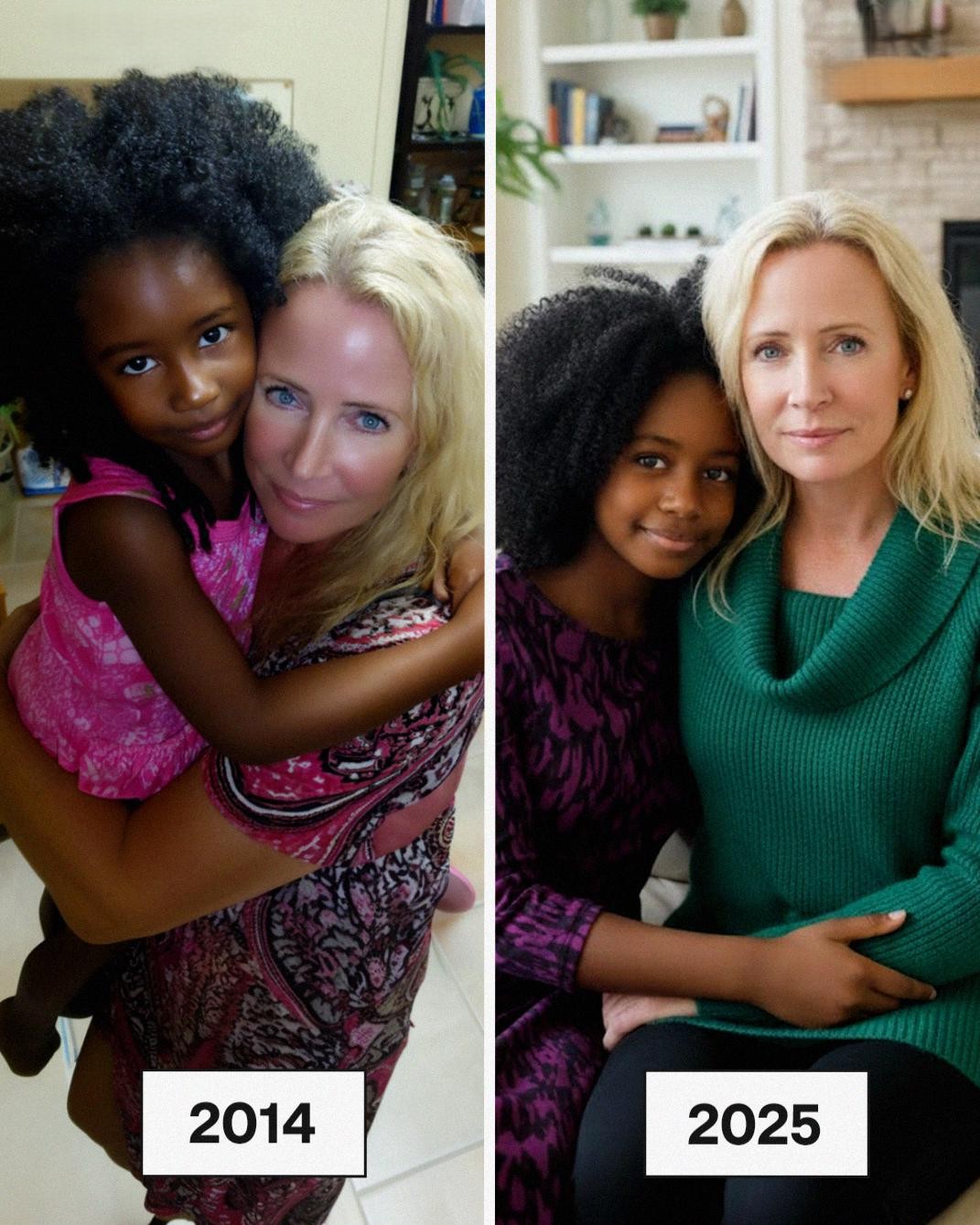
The journey into step-motherhood is rarely a path paved with clear directions. For many, it is a gradual, often precarious trek through territory that belongs to someone else. When I first met Daniel, he came with a seven-year-old daughter named Lily. She was a child of profound stillness, possessing a watchful quality that suggested she was constantly measuring the safety of her environment before committing to a word or a smile. Her biological mother had exited the frame years prior, pursuing a life of perceived better prospects, leaving a void that I never intended to fill with force. I understood early on that love in a blended family isn’t about replacement; it is about consistent, reliable presence.
For eleven years, my life was a series of quiet devotions. I learned the specific geometry of cutting crusts off sandwiches and the exact tension required to braid hair without causing a wince. I was the silent fixture in the bleachers of soccer games and the back row of school concerts. When Lily’s teeth came in crooked, I worked the overtime shifts required for braces; when the complexities of algebra became a wall she couldn’t climb, I found the tutors to help her over it. My husband used to tell me how lucky Lily was to have me, but I always felt the scales tipped in the other direction.
The rhythm of our lives was shattered by the sudden, silent violence of Daniel’s heart attack. Overnight, I became Lily’s sole parent, a role I held with every fiber of my being but without a single shred of legal documentation. I had never officially adopted her—not out of a lack of desire, but out of a respect for the space her biological mother technically occupied. I believed that the reality of our bond didn’t require the validation of a courtroom. We navigated the jagged edges of grief together, through the screams of the initial shock and the long, hollow silences that followed. I became the person who sat by her bed until she took a single bite of toast, the one who listened for her footsteps in the dark to ensure she wasn’t drowning in the weight of her loss.
As Lily transitioned into adulthood, our relationship evolved. She was eighteen now, working at a bookstore and eyeing a future in graphic design. She was independent, a fact that made me both immensely proud and quietly nostalgic for the little girl who used to fall asleep on my shoulder. On her eighteenth birthday, a Tuesday in mid-January 2026, I noticed a flicker of nervous energy in her smile as I left for work. I dismissed it as the typical jitters of reaching legal adulthood, promising we would celebrate properly over the weekend.
The world I had spent over a decade building seemed to collapse when I pulled into the driveway that evening. My large suitcase—the one usually reserved for the “someday” trips I never took—sat prominently on the porch. Taped to the handle was a printed photo of me, topped with a note in Lily’s familiar, careful handwriting. The message was a brutal economy of words: “I packed your things. You’re not allowed in the house anymore.”
The physical sensation of reading those words was like a sudden drop in altitude. I tried my key in the lock with hands that refused to steady themselves, only to find the door bolted. A second note lay on the mat: “I knew you wouldn’t listen. Call me ASAP.” My mind became a frantic archive of every parental failure, real or imagined. I wondered if my lack of legal status had finally caught up with me, or if I had overstepped a boundary that had been simmering for years. I called her, my voice thick with the threat of tears, begging for an explanation. Her response was cryptic and firm, demanding I meet her at a specific address two towns over.
The drive was a blur of panic and rehearsed apologies. I arrived at the coordinates to find a small, upscale salon tucked away near a regional airport. Lily was standing by the entrance, looking small against the glass doors. When I stepped out of the car, she didn’t offer an indictment; she offered a hug that felt like a homecoming. She handed me an envelope that contained the truth: two boarding passes and a letter explaining that she hadn’t evicted me from her life, but from my own self-imposed cycle of sacrifice.
For eleven years, she had watched me put every one of her needs before my own. She had seen me postpone vacations, decline promotions that required travel, and ignore my own health and well-being to ensure her stability. She had used a portion of her father’s inheritance and a year’s worth of her own savings to book a trip to the coast—to the tiny town with the lighthouse I had admired in magazines for years. “I packed your things,” she explained, her voice cracking, “because it’s finally your turn to be taken care of. I wanted you to leave the house for yourself, for once.”
The “eviction” was actually a liberation. Lily had realized that while I was busy holding her world together after Daniel’s death, I had forgotten how to hold my own. She saw the double shifts, the missed haircuts, and the “good parent” philosophy that had become a cage of perpetual labor. She declared herself an adult, no longer a child in need of a shield, but a daughter capable of being a mirror. She called me her mother—not by law or blood, but by the daily, deliberate choice of eleven years.
After a morning spent in the unaccustomed luxury of the salon, we sat in the parking lot as I called my boss to claim the first two-week vacation of my career. The request was granted instantly, a sign that perhaps the only person standing in the way of my rest had been me. As we arrived at the airport, Lily’s planning became even more evident. She had packed the clothes I loved but rarely wore—sundresses and sandals—and the books I had bought but never found the time to open.
The statistics of blended families often focus on the friction; studies suggest that approximately 60% of second marriages involving children end in divorce, often cited due to the complexities of step-parenting roles. However, our story defied the numbers. We weren’t a statistic of failure; we were a testament to the fact that parental love, when practiced with patience and intellectual honesty, creates a bond that transcends biological or legal definitions.
As we walked through the security line together, Lily squeezed my hand with the same grip she used as a seven-year-old crossing a busy street. The roles had shifted, not in a way that diminished my position, but in a way that elevated hers. She wasn’t just my stepdaughter; she was my family. For the first time in over a decade, I didn’t feel the need to look back and check if the house was still standing. I looked forward, toward the coast and the lighthouse, finally believing that the work I had done was enough. I had raised a daughter who knew how to love, and in doing so, she had taught me how to finally be at ease.