Chapter 1: The Cost of Conscience
They say that grease stains are permanent, that once they settle into the fibers of your clothes or the ridges of your fingerprints, they become a part of you. For years, I believed that. I wore the black smears on my hands like a badge of shame, a constant reminder of my station in life. I was Luis, the mechanic with the magic touch but the empty pockets. But looking back now, from the vantage point of a legacy I never thought I’d build, I realize those stains were never about shame. They were the ink with which I wrote my own destiny.
It was a Tuesday in mid-July, the kind of heat that sits on your chest like a wet wool blanket. The air inside Don Ernesto’s Auto Repair was thick with the smell of vaporized oil, stale sweat, and the underlying metallic tang of frustration.
“Luis! That transmission isn’t going to drop itself!”
The voice of Don Ernesto cut through the din of the impact wrenches like a whip crack. He was a man who managed by fear, a tyrant of the lift bays who believed that kindness was a defect in the manufacturing of a man.
“I’m on it, boss,” I yelled back, wiping sweat from my eyes with a rag that was dirtier than my face.
I worked non-stop. I had to. At home, my mother, Maria, was fighting a battle her body was slowly losing. Every peso I scraped together, every extra hour of overtime, went straight to the pharmacy. Her lungs were weak, but her spirit was iron. She was the reason I endured Ernesto’s insults; she was the reason I kept my head down and my hands moving.
That morning, the shop was chaotic. But around 11:00 AM, the noise seemed to lull for a brief second as a shadow fell across the bay door.
A car rolled in. It was a relic—a dusty, faded sedan that wheezed and sputtered like a dying animal. It barely made it over the threshold before the engine gave a final, mournful shudder and died.
Stepping out of the driver’s seat was a woman who looked as fragile as the vehicle. She moved with slow, deliberate steps, gripping her purse with white-knuckled tension. Her clothes were clean but threadbare, the fabric worn thin by years of washing.
I saw the other mechanics look away. They knew the drill: if the customer looks poor, the commission isn’t worth the grease. But when she looked up, her eyes caught mine. They were watery and tired, but there was a gentleness there that stopped me cold.
“Good morning, son,” she said, her voice trembling slightly. “My car… it’s making a terrible noise. It sounds like stones in a tin can. Honestly, I have no idea what I can do. I need it to get to the clinic.”
I wiped my hands on my jumpsuit and walked over, ignoring Ernesto’s glare from the office window.
“Don’t worry, Ma’am,” I said, forcing a smile I didn’t feel. “Let me take a look. I’m sure it’s nothing serious.”
I popped the hood. The engine was a mess of neglected maintenance, but the problem itself was simple—a loose tensioner pulley and a belt that was hanging by a thread. A ten-minute fix if you knew what you were doing. A two-hundred-dollar job if you were Don Ernesto.
As I worked, tightening the bolts and replacing the belt with a spare I had in my personal kit, she stood by the safety line, watching me.
“You have gentle hands,” she noted softly. “You treat the machine with respect.”
“It’s not the car’s fault it’s old,” I murmured, leaning deep into the engine block. “Everything deserves a little care.”
We started talking. She told me she lived alone in a small house on the outskirts, that her husband had passed years ago. There was a loneliness in her voice that echoed the hollow silence of my own house when my mother was sleeping.
“I live with my mom,” I confessed, tightening the final bolt. “She’s sick. I work here to keep her going. When I see you… well, you remind me of her.”
The elderly woman’s eyes shone with sudden moisture. She didn’t speak, but she reached out and patted my arm. It was a mother’s touch—warm, reassuring, and heavy with unspoken gratitude.
“Start her up,” I said, closing the hood.
The engine roared to life. No squeals, no rattles. Just the steady hum of a machine made whole again.
Then came the moment I dreaded. She opened her purse, her hands shaking as she rummaged through it. The panic on her face was unmistakable. She looked up at me, pale.
“Oh, son… how embarrassing,” she whispered, her voice cracking. “I… I think I left my wallet at home. Or maybe I lost it. I don’t…”
She was about to cry. I could see the humiliation rising in her throat, choking her. I looked at the car, then at the office where Ernesto was tallying receipts. If I charged her, she wouldn’t eat this week. If I didn’t, I was risking my neck.
But then I thought of my mother. If she were stranded, scared, and alone, what would I want a stranger to do?
“Don’t worry, Ma’am,” I said firmly, lowering my voice. “It’s fine. You don’t owe me anything. It was just a loose screw.”
“But… your boss…” she glanced nervously at the glass window.
“It’s okay,” I interrupted, giving her a sad smile. “Some things are more important than money. Just promise you’ll drive carefully.”
She looked at me as if I had just handed her a diamond. “You are a good man, Luis. Better than you know.”
She drove away, and for a moment, I felt a warmth in my chest that the workshop’s heat couldn’t replicate.
Then, the thunder struck.
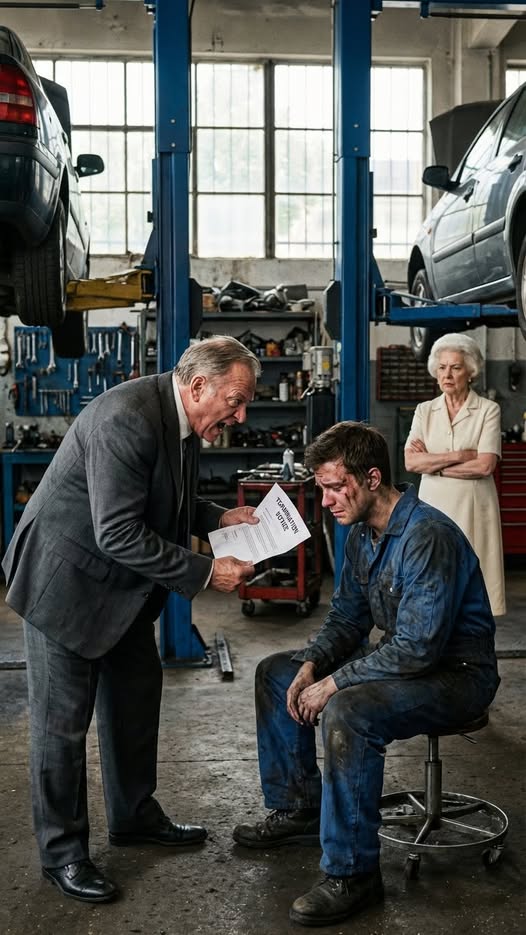
“WHAT DID YOU SAY?”
Don Ernesto was standing behind me. His face was a mask of purple rage, veins bulging in his neck like cords. He had been watching.
“Did you just let a job walk out the door? Did you just give away my parts and my time?”
“Boss, it was a loose bolt. She’s an old lady, she didn’t have—”
“I don’t care if she’s the Virgin Mary!” Ernesto screamed, spitting on the concrete floor. “That is why you are still poor, Luis! That is why you live in the gutter! Because instead of thinking like a businessman, you act like a sentimental beggar! This shop is not a charity!”
The other mechanics stopped working. The silence was absolute, heavy with the weight of my humiliation. I looked at my boots, fighting back the sting of tears.
“I didn’t do it for charity,” I said, my voice shaking but audible. “I did it because it was the right thing to do.”
“The right thing doesn’t pay my electric bill!” Ernesto snapped, pointing a grease-stained finger at the exit. “Get out. You’re fired. Take your trash and get out of my sight.”
I stood there, paralyzed. Fired. The word echoed in my skull. No paycheck. No medicine.
“Thank you for the opportunity,” I whispered, simply because I didn’t know what else to say. I placed my gloves on the workbench—my only act of defiance was to leave them clean—and walked out into the blinding afternoon sun.
Behind me, the shop doors rolled down, but the real storm was just beginning.
Chapter 2: The Shadow of Despair
The walk home was a blur. By the time I reached our small neighborhood, the sky had turned a bruised purple, and the clouds burst open. It wasn’t just rain; it was a deluge, a tropical downpour that turned the dirt roads into rivers of mud.
I walked through it, letting the water soak me to the bone, hoping it would wash away the shame. But the shame stuck. It was heavier than the grease.
When I entered our small, two-room house, my mother was sitting in her armchair, wrapped in a shawl. She looked up, her eyes bright with fever.
“Luis? You’re home early,” she wheezed. Then she saw my face. She saw the lack of groceries in my hands, the slump of my shoulders. “What happened?”
I sat on the floor beside her chair and rested my head on her knees, sobbing like a child. I told her everything. The old woman, the repair, Ernesto’s rage.
She stroked my wet hair, her fingers gnarled but gentle.
“Don’t give up, son,” she whispered, her voice weak but steady. “You did good. God sees everything. Good people always find their reward, even if the road is long.”
“Integrity doesn’t buy inhalers, Mama,” I said bitterly.
“No,” she replied. “But it buys peace. And that is worth more.”
The next three days were a descent into hell. I went to every garage in the city. Small shops, dealerships, tire centers. But word travels fast in a small town. Don Ernesto had poisoned the well.
“Sorry, Luis. We heard what happened. We can’t afford guys who give away inventory.”
“Ernesto says you’re a thief. I can’t take the risk.”
Door after door slammed in my face. By the third night, I was sitting by the window, watching the rain streak the glass, calculating how many days of medicine we had left. Four days. After that, I didn’t know what I would do. I was planning to sell my tools—my livelihood—just to buy her a month of breath.
I felt entirely alone. The world felt like a machine that was rigged to crush the weak.
Then, the phone rang.
It was an unknown number. I almost didn’t answer, fearing it was a bill collector.
“Hello?”
“Is this Luis?” A woman’s voice. Professional, crisp, but with an undercurrent of warmth.
“Yes. Who is this?”
“I have a job offer for you. But you need to come in for an interview immediately. Tonight.”
“I… I can’t. I don’t have a ride, and it’s late.”
“We will send a car. Be ready in ten minutes.”
“Wait, what shop is this? Did Ernesto send you?”
“Just be ready, Luis.”
The line went dead. I looked at my mother. She nodded, a strange knowing look in her eyes. “Go,” she said.
Ten minutes later, a black town car pulled up to my shack. The neighbors peered out from behind their curtains as I stepped into the leather interior, smelling of air conditioning and expensive cologne.
We drove out of the slums, past the industrial district, into the heart of the commercial zone where the lights were bright and the streets were paved. The car slowed down in front of a building I had seen under construction for months. It was a prime location, a corner lot with floor-to-ceiling glass windows.
It looked like a showroom for Ferraris.
The driver opened my door. “Go inside.”
I walked toward the glass doors, confused. The lights were on. Inside, the floor was polished white epoxy. The lifts were brand new, gleaming red hydraulic systems. The tool chests were stainless steel, unopened.
And there, hanging above the reception desk, was a sign in bold, silver letters:
LUIS ANCO AUTO SHOP
I froze. I rubbed my eyes. I thought the stress had finally caused me to hallucinate. That was my name.
“Excuse me…” I called out to the empty room. “There must be a mistake.”
“There is no mistake, son.”
I spun around. Standing by the entrance to the office was the elderly woman.
But she wasn’t wearing the threadbare dress anymore. She wore a tailored suit of charcoal gray, her silver hair pulled back in an elegant chignon. She stood tall, radiating an aura of power that I hadn’t seen beneath the frailty of the other day.
“Ma’am?” I stammered. “I… I don’t understand.”
She walked toward me, the click of her heels echoing in the cavernous shop.
“My name is Elena Vargas,” she said softly.
The name hit me like a physical blow. Elena Vargas owned half the real estate in the city. She was a ghost, a recluse billionaire who was rumored to have vanished after a tragedy years ago.
“You?” I gasped. “But the car… the wallet…”
“A test,” she smiled, but her eyes were misty. “My son… he was a mechanic, just like you. He loved cars. He loved the grease and the noise. He died ten years ago in an accident. Since then, I have been looking for someone to take over this property. I didn’t want a businessman. I didn’t want a shark like your Don Ernesto.”
She stopped in front of me and took my rough, calloused hands in her smooth ones.
“I wanted a human being. I wandered into shops all over the city playing the part of a helpless old woman. I was cheated, ignored, and laughed at. Until I met you.”
“You… you built this for me?” I asked, my voice barely a whisper.
“No,” she shook her head. “I built this for the man who was willing to lose his job to help an old woman get home. You reminded me that honor still exists, Luis. This isn’t a gift. It’s an investment in a good heart.”
She reached into her pocket and pulled out a set of keys.
“The business is yours. The deed is in your name. There is enough operating capital in the account to run for a year without profit. But I suspect,” she winked, “you won’t need that long.”
I fell to my knees. I’m not ashamed to admit it. I collapsed right there on the pristine white floor and wept. For the medicine, for the shame, for the vindication.
Elena knelt beside me and hugged me, indifferent to the grease on my old clothes.
“Promise me one thing,” she whispered fiercely. “Never change. Never let the money turn you into them.”
I looked at her, tears streaming down my face. “I promise.”
But as I held the keys to my future, I realized the hardest part wasn’t getting the shop. It was keeping it. And I knew Don Ernesto wasn’t going to let this happen without a war.
Chapter 3: The War of Wrenches
News of Luis Anco Auto Shop spread through the town like a wildfire fueled by gasoline. A poor mechanic, fired for kindness, gifted a palace by the city’s wealthiest ghost? It was the stuff of telenovelas.
People came just to see if it was true. But they stayed because we were good.
I hired a team within a week. I didn’t look for the guys with the fanciest certifications. I went to the technical schools in the rough neighborhoods. I hired the kids with tattoos, the ones with records who were trying to go straight, the ones other shops wouldn’t look at. I hired Mateo, a kid with a stutter who could diagnose an engine by ear. I hired Carla, a single mom who could rebuild a transmission faster than any man I knew.
We had a rule: Honesty First. We showed customers the broken parts. We explained the fix. We didn’t upsell.
And that was a problem for Don Ernesto.
His shop was only ten blocks away. As my bays filled up with Toyotas, Fords, and eventually Mercedes, his lot began to empty.
Three weeks after we opened, on a busy Saturday, a truck screeched into our parking lot. Don Ernesto stepped out. He looked smaller than I remembered, his face gaunt, his eyes darting around my gleaming workshop with a mixture of greed and disbelief.
He marched right up to me while I was speaking with a customer.
“So,” he sneered, his voice loud enough to turn heads. “The charity case won the lottery. How long until you run this into the ground, Luis? You don’t know numbers. You don’t know business.”
I handed my clipboard to Carla and turned to face him. I wasn’t the scared employee anymore. I was standing on my own floor.
“I know enough, Ernesto,” I said calmly. “I know that people don’t like being cheated.”
“You think you’re special?” he spat. “You’re a fraud. And this old witch who bought you,” he gestured vaguely to the air, “she’s senile. She threw her money away on a gutter rat.”
The shop went silent. My mechanics gripped their wrenches, stepping forward. I held up a hand to stop them.
Before I could speak, a voice rang out from the waiting area.
“I invest in people, Ernesto. Not in numbers.”
Elena was sitting there, drinking an espresso. She stood up, smoothing her skirt, and walked over to us. She didn’t look angry; she looked bored, which was far worse for him.
“Mrs. Vargas,” Ernesto stammered, the color draining from his face. “I… I didn’t know you were…”
“You lost the best worker you had because of your arrogance,” she said, her voice cutting like a diamond blade. “And now you are losing your customers because of your reputation. Go home, Ernesto. Before you say something that makes me buy your building and turn it into a parking lot.”
Ernesto looked at her, then at me, then at the bustling shop. He realized he was outgunned, outclassed, and outnumbered. He swallowed hard, lowered his head, and walked away. He looked defeated, a man crushed by the weight of his own greed.
From that day on, he was a ghost. His shop closed six months later.
But my victory wasn’t watching him fail. It was what happened next.
My shop became more than a business; it became a sanctuary. On Sundays, we hosted barbecues for the employees and their families. Elena would come, sitting at the head of the table like the matriarch she was.
She and my mother became inseparable. It was a strange sight—the wealthy businesswoman and the humble washerwoman—sitting together, laughing, sharing stories of their sons. Elena had found the son she lost, and I had found the second mother I never knew I needed.
My mother got her medicine. She got the best doctors. She lived another five years—five years of comfort, dignity, and joy that I was able to give her because of that one rainy Tuesday.
But time, unlike engines, cannot be overhauled.
Chapter 4: The Final Repair
A year later, Elena fell ill. It was a rapid, aggressive decline. The woman who had seemed immortal, made of steel and will, began to fade.
I left the shop in Mateo’s hands and spent my days at her estate. I sat by her bedside, reading to her, holding her hand, just as she had held mine when she gave me the keys.
One afternoon, the sunlight was filtering through the sheer curtains, casting a golden glow on her pale face. She opened her eyes and looked at me.
“Luis,” she whispered. Her voice was thin, like paper.
“I’m here, Elena.”
“I knew…” she paused to breathe. “I knew you would do something great. Look at what you built. Not the shop. The people.”
I choked back a sob. “None of this would have happened without you. You saved me.”
“No, son,” she smiled weakly, squeezing my hand with the last of her strength. “You saved yourself the moment you decided to help an old woman for free. I just opened the door. You walked through it.”
She took a breath, her eyes drifting to the window where the garden was in bloom.
“True wealth,” she murmured, “is in the heart. Never forget.”
She closed her eyes in peace. And in that quiet room, the richest woman in the city died holding the hand of a mechanic.
The funeral was the largest the city had ever seen. Not because of her money, but because of the lives she had touched through me. My entire staff came, dressed in their best. The customers came. Even the guys from the old neighborhood came.
Months later, I stood in front of the shop. The sign was still there, gleaming: Luis Anco Auto Shop.
But I had added something.
On the main wall of the reception, right where everyone would see it when they walked in, hung a large bronze plaque. It didn’t list sales figures or awards. It had a picture of Elena, smiling that mysterious, gentle smile.
Beneath it, the inscription read:
“Dedicated to Elena Vargas. Who taught me that being good is never a mistake.”
Customers often ask me who she was. They ask if she was an investor, or a celebrity.
I always smile, looking at the grease on my hands—the same grease, the same hands, but a different life.
“She was the reason,” I tell them. “She is the reason we don’t charge for a loose bolt. She is the reason I believe in second chances.”
Sometimes, when the shop is quiet and the sun hits the glass just right, I swear I can smell her perfume mixed with the scent of engine oil.
You never know who is behind the mask of a stranger. A beggar might be a queen; a tyrant might be a coward. Appearances deceive, but the heart… the engine of the soul… that never lies.
Respect is the only currency that matters. And kindness? Kindness is the one investment that always returns with interest.
Epilogue
I am older now. My hands are slower, and I let the young ones handle the heavy lifting. But every morning, I unlock the doors, I look at that plaque, and I whisper a thank you.
To the broken car.
To the rain.
To the woman who saw a son in a stranger.
Don’t forget to tell me where you are reading this from. The world is big, but good people are everywhere. You just have to be willing to get your hands a little dirty to find them.