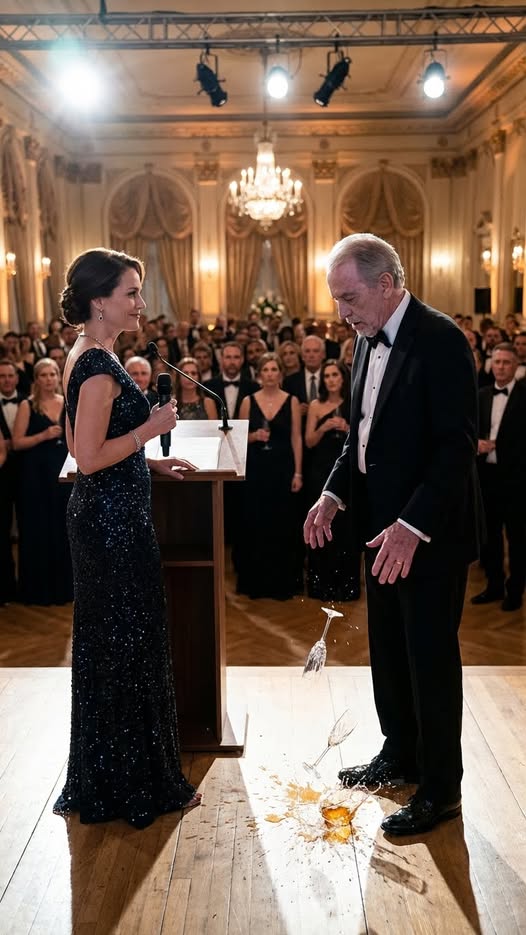
“Ladies and gentlemen, meet my daughter. A total waste of good genetics.”
The words echoed through the opulent ballroom of the Grand Plaza Hotel, amplified by a ten-thousand-dollar sound system. My father, Dr. Marcus Sterling, stood center stage, bathed in a spotlight that made his white tuxedo glow like the shell of a pearl. He held a glass of Château Margaux in one hand and a microphone in the other, pointing the crystal flute toward the back of the room where he assumed I was cowering in the shadows.
“She crawls around in filth, taking care of society’s garbage instead of carrying on my legacy,” he continued, his voice dripping with performative sorrow. “A tragedy, really.”
Three hundred guests laughed. It was a polite, wealthy titter that rippled through the room like a breeze through a field of dry wheat. They thought it was a joke. A charmingly self-deprecating roast from the city’s most renowned plastic surgeon.
They didn’t know I had a wireless microphone hidden in the sleeve of my blazer.
And they definitely didn’t know I was about to turn his twenty-five-million-dollar fundraising gala into a federal crime scene.
I stepped out of the shadows.
The sharp click-clack of my heels on the polished marble floor cut through the lingering laughter like a serrated knife. Heads turned. The laughter died, replaced by a confused murmur. The silence that followed felt heavy, pressurized, dangerous.
I walked straight up the center aisle, past the tables laden with lobster tails and caviar, past the donors in their sequined gowns and bespoke suits. I didn’t look at them. My eyes were locked on the man on stage.
Dr. Marcus looked down at me, his eyes narrowing. He was expecting a tantrum. He was expecting a tearful plea for respect, or perhaps a drunken outburst he could dismiss with a wave of his hand. He expected the daughter he had bullied for two decades—the disappointment, the failure, the ghost.
He didn’t get her.
I walked up the stairs to the stage. He was too stunned to move. I reached out and plucked the microphone from his hand. His fingers were cold.
I turned to face the crowd. Three hundred faces, waiting for the punchline.
“My father is right about one thing,” I said, my voice steady and cold, amplified perfectly by the speakers. “I do work with the state’s most vulnerable populations. But he left out my job title.”
I paused. I let the silence stretch until it was suffocating, until I could hear the hum of the air conditioning and the clink of ice in a glass somewhere in the back.
“I am the Senior Program Officer for the State Health Fund,” I announced. “And I am the sole signatory with veto power over the twenty-five-million-dollar grant Dr. Marcus has been begging for since January.”
The room didn’t just go quiet; it froze. It was as if the air had been sucked out of the ballroom.
My father’s face went from flushed arrogance to ash gray in a single second. His hand spasmed, and the glass of Château Margaux slipped from his fingers. It shattered on the stage, red wine bleeding across the white floor like a fresh wound.
I didn’t look at the mess. I opened the thin black folder I had carried under my arm.
“Let’s talk about this proposal, shall we?” I said, flipping the cover open. “‘A Center for Dignity Recovery.’ Sounds noble.”
I looked directly at the wealthy donors in the front row—the people whose pockets my father had been picking for years.
“I did a line-item audit this morning,” I continued. “Eighty percent of the budget is allocated for ‘facility upgrades.’ Specifically, imported Italian leather furniture for the executive offices and marble flooring for the private lobby. Not a single cent is allocated for patient beds.”
I flipped another page. The sound was like a gunshot in the silent room.
“Section Four: Administrative Transport. Three hundred thousand dollars for two luxury SUVs for a nonprofit serving the homeless.”
I turned to my father. He was trembling. His mouth opened and closed like a fish on a dock, gasping, realizing the water was gone.
“This isn’t a medical facility,” I said into the microphone, my voice ringing with finality. “It’s a retirement plan disguised as charity.”
I closed the folder with a snap.
“Dr. Marcus, your application is formally rejected due to gross financial mismanagement and attempted fraud. You will never see a dime of state funding as long as I hold a pen.”
I dropped the microphone.
It hit the floor with a heavy, resonant thud that echoed through the speakers and into the bones of everyone present.
I turned and walked off the stage. I didn’t look back. I didn’t need to. I could feel the shock radiating off the crowd like heat from a blast furnace.
For twenty-nine years, I had been the invisible girl. But tonight, under the lights he paid for with money he didn’t have, I was the only thing anyone could see.
Ten years ago, in the mahogany library of his estate, my father held my acceptance letter to the state’s top social work program. He didn’t smile. He didn’t congratulate me. He walked over to the fireplace, crumpled the paper in his fist, and tossed it onto the burning logs.
“You want to be a janitor for human refuse?” he had asked, dusting the ash off his hands as if touching my future had soiled him. “Go ahead. But don’t expect me to pay for you to ruin your life. You are dead to me the moment you walk out that door.”
He thought he had incinerated my future that night. He thought that by cutting me off, by refusing to speak my name for a decade, he had erased me.
But fire doesn’t just destroy things; it forges them.
While he was building his empire of plastic surgery and vanity projects, I was working double shifts. I put myself through night school. I earned my Master’s in Public Administration while living on ramen and spite. I rose from a caseworker to a district manager and finally to the State Board.
He never knew. He never asked. To him, I was just a ghost, a failure he occasionally used as a punchline to make himself feel superior.
That blindness was his fatal mistake.
The truth is, I saw his grant application land on my digital desk six months ago. I saw the inflated numbers. I saw the shell companies listed as contractors. I recognized the names—friends of his, cronies from his country club.
I could have rejected it then. I could have sent a quiet, professional email denying the funds. It would have been efficient. It would have been easy.
But it wouldn’t have been justice.
If I had rejected him quietly, he would have spun a story. He would have blamed “bureaucracy” or “politics” or “bad luck.” He would have found another donor to charm, another way to keep his house of cards standing.
I needed to cut the head off the snake.
So, I waited. I approved the preliminary rounds. I let him believe he had already won. I watched him book the Grand Plaza. I watched him order the lobster and the vintage wine. I waited until he had gathered every important person in the city, every witness he needed to validate his massive ego.
I let him build his own courtroom, hire his own jury, and pay for his own execution.
You didn’t just build a gala, Dad, I thought as I walked toward the exit. You built a trap, and you walked right into it.
I pushed through the heavy service doors, leaving the murmurs of the ballroom behind. The air in the staff corridor was cold and smelled of industrial cleaner. I didn’t run. I walked with the steady, measured pace of someone who had just finished a job.
I just wanted to get to my car. To the silence. To the end of this long, ugly chapter.
But monsters don’t just die because you cut off their food supply. Sometimes, they get hungry.
I heard the door slam open behind me. It wasn’t a normal entrance; it was a collision. I didn’t need to turn around to know who it was. The heavy, frantic breathing gave him away.
“You stop right there!”
His voice echoed off the concrete walls, stripped of all its public polish. It was raw, ugly, and wet with rage.
I stopped. I turned slowly.
Dr. Marcus stood ten feet away. The impeccable tuxedo was rumpled. His face was a mottled map of red fury and sweat. The veins in his neck bulged against his collar. He didn’t look like a brilliant surgeon anymore. He looked like a cornered animal.
“You think you can walk away?” He lunged forward, closing the distance before I could step back. He grabbed my wrist. His fingers dug into my skin hard enough to bruise. “You think you can come into my house, in front of my peers, and humiliate me?”
I looked down at his hand on my arm, then up at his eyes. I didn’t pull away. I just stared at him with absolute clinical detachment.
“Let go,” I said.
“Or what?” he hissed, leaning in close. I could smell the vintage wine on his breath, sour and stale. “You’ll write another report? You’ll tattle on me, you ungrateful, treacherous little brat? I gave you life! I put a roof over your head! And this is how you repay me? By destroying my reputation?”
And there was the truth, naked and ugly.
For years, I thought he hated my career because it didn’t make money. I thought he despised my choices because they weren’t prestigious enough. But looking at the sheer panic in his eyes, I realized I had been wrong.
It wasn’t about the money. It wasn’t even about the grant. It was about the hierarchy.
In his mind, he was the Sun. And I was just a Moon, meant to reflect his light or fade into the darkness. But tonight, the Moon had eclipsed the Sun. The “waste of genetics” had exercised power over the genius. The babysitter had fired the surgeon.
It was a narcissistic injury so deep it was fracturing his reality. He wasn’t angry because he was broke. He was angry because I had proven I was stronger than him.
“Your reputation?” I asked, my voice calm, contrasting sharply with his hysteria. “I didn’t destroy your reputation, Dad. I just turned on the lights. If you don’t like what people see, that’s not my fault. You ruined everything yourself.”
He shook my arm, spit flying from his lips. “Do you know who I am? Do you know who I know? I will bury you! I will make one phone call and you will never work in this state again! I will sue you for defamation until you’re begging on the streets with the junkies you love so much!”
He wasn’t hearing me. He was doubling down, retreating into the only thing he had left: threats. He thought he still held the cards.
I wrenched my arm free with a sharp jerk. He stumbled back, surprised by the physical resistance.
“You’re not listening,” I said, stepping into his space, forcing him back against the wall. “You think this is over? You think I just came here to embarrass you?”
He glared at me, panting, his eyes darting around the empty hallway.
“You have no idea what you’ve done,” he snarled. “But I have an insurance policy. You think you’re smart? You think you can take my money? I still have something you care about.”
A cold knot formed in my stomach. The rage in his eyes shifted into something sharper, something cruel. He reached into his pocket and pulled out his phone.
“You want to play the villain, Chinmayi? Fine. Let’s see how much you love your grandmother when she’s sleeping on a park bench tonight.”
He smiled then—a wet, slick grin that made my skin crawl. He lowered the phone slowly, letting the threat hang in the air like smoke.
He thought he had won. He thought he had found the one button he could press to make me heel.
“You see,” he said, his voice dropping to a conspiratorial whisper. “You have your little title. You have your clipboard and your self-righteousness. But I have the one thing that actually matters in this world.”
He stepped back, spreading his arms wide to gesture at the opulent hallway, at the memory of the ballroom behind us.
“I have resources. I have power. You think rejecting one grant stops me? I have a black fund, darling. A rainy-day reserve that you and your little bureaucrats can’t touch.”
He laughed, and it was a jagged, ugly sound. He walked over to a service cart that had been abandoned in the hallway, grabbing a half-empty bottle of the Château Margaux. He poured a splash into a water glass and swirled it.
“Look at this wine. Two thousand dollars a bottle. Look at the lobster tails on the buffet. Do you know who paid for all of this? The Foundation. My foundation. I can write off a hundred-thousand-dollar party as ‘donor cultivation.’ I can fly to Paris on ‘research trips.’ I live in a world where the rules are suggestions and money is the only law. You can’t hurt me. I am the institution.”
He took a sip of the wine, his eyes locked on mine, daring me to challenge him.
I didn’t blink. I didn’t flinch. I just reached into my pocket and pulled out my phone again.
I tapped the screen three times and turned it around so he could see.
It wasn’t a recording. It was a photo. A high-resolution image of the gala’s catering invoice, the wine list, and the consulting fees paid to a shell company registered in his name.
“You’re right, Dad,” I said, my voice cutting through his arrogance like a scalpel. “You are the institution. And that is exactly why you’re going to prison.”
He frowned, the glass halting halfway to his mouth. “What are you babbling about?”
“It’s called self-dealing,” I said. “And under IRS Code 4941, it is strictly prohibited for a private foundation manager to use charitable assets for personal benefit. No luxury dinners. No vintage wine. And certainly no ‘donor cultivation’ parties that function as ego-stroking for the chairman.”
I swiped to the next photo—a screenshot of the federal statute.
“You just admitted—boasted, actually—that you used foundation money to pay for this night. That isn’t a loophole, Dad. That’s tax fraud. It’s embezzlement. And when you combine it with the inflated construction contracts I found in your grant proposal… it’s a RICO case.”
The color drained from his face so fast it looked like the blood had simply evaporated. He lowered the glass, his hand shaking so hard the wine sloshed over the rim, staining his white cuff red.
“I took photos of the menu,” I continued relentlessly. “I took photos of the wine bottles. I have the invoices. And thirty seconds ago, while you were bragging about your ‘black fund,’ I uploaded all of it to a secure server shared with the IRS Criminal Investigation Division.”
“You wouldn’t,” he stammered.
“I already did. This isn’t a party anymore, Dad. It’s a crime scene. And you just gave me the confession.”
He stared at the phone like it was a weapon. The swagger vanished. The King of Surgery was gone. All that remained was a greedy old man, terrified of consequences.
“You traitor,” he whispered.
“No,” I said. “You committed the crime. I just turned on the lights.”
Panic twisted into rage. Instead of surrendering, he grabbed his own phone and hovered over a contact.
“Delete the photos,” he snarled. “Or I stop paying for your grandmother’s nursing home. Tonight. They’ll roll her bed onto the street.”
He flashed the screen. Shady Pines.
I didn’t flinch.
“Call them,” I said. “Speakerphone.”
He dialed. The line clicked.
We’re sorry. The number you have dialed is disconnected.
He looked up, confused.
“She’s not there,” I told him. “I moved her last Tuesday. To The Kensington. One year paid up front.”
His face collapsed. The story he’d invented about me—broke, naive, beneath him—disintegrated.
“You never saw me,” I said softly. “You were too busy admiring your own reflection. I earned my degrees. I managed budgets bigger than your hospital. And I saved half my salary for five years. You assumed I was weak because I refused to worship you.”
He slid to the floor, the tuxedo crumpling like discarded wrapping paper.
“Please,” he begged, the word foreign on his tongue. “I have money hidden. I can pay you.”
I turned my screen to him again. It showed an active call.
Call in Progress: Special Agent Miller, IRS Criminal Investigation.
“He’s been listening for the last three minutes,” I said.
The phone dropped from his hand. The fight was over.
I walked out through the service hallway as federal agents closed in. Behind me came shouting, then sirens, then the small, panicked voice of a man who finally understood gravity.
Outside, the air smelled like rain. It was crisp, clean, and real.
I got into my modest car and dialed my grandmother.
“It’s done,” I said.
“And him?” she whispered.
“He can’t hurt us anymore.”
For the first time in my life, the noise in my head—his voice, his judgment, his shadow—was gone. It wasn’t joy exactly. It was more like the ache after cutting out a tumor. A clean pain.
As I drove away, I didn’t look back at the Grand Plaza.
People like him think power makes them untouchable. They think wealth is a shield. But truth always lands eventually.
If someone is treating you like you’re invisible right now, let them. Ghosts walk through walls. Ghosts see everything. And by the time they notice you, the checkmate is already set.
Sometimes, being overlooked is your greatest advantage.