My Daughter Was Told to Eat Beside the Trash Cans in the School Cafeteria — “Those Tables Are for Families Who Donate,” the Staff Said, But When I Set Her Lunch Down, the Entire Room Fell Silent
I wasn’t trying to make a statement that day. I wasn’t looking for a confrontation, or a lesson, or anything that would ripple beyond a quiet moment between a father and his child. I was just trying to surprise my daughter on her birthday.
Her name is Sophie.
She was turning ten, which felt like one of those ages that sits awkwardly between magic and reality. Old enough to notice when things are unfair, young enough to still hope they won’t be. Money had been tight for a long time—tight in the way that makes you count groceries and delay haircuts—but I wanted her birthday to feel gentle. Thoughtful. Like someone had paused the world for her, even if only for a lunch period.
So I made her favorite sandwich that morning. Turkey, extra pickles, mustard spread all the way to the edges of the bread. I wrapped it carefully, like it mattered, and tucked a small folded note inside the bag. I’d drawn a crooked heart at the bottom and written, I’m proud of you every day. I didn’t know if she’d save it or lose it or forget about it entirely, but I knew I wanted her to have it.
I took a long lunch break from work and walked into the elementary school cafeteria just as the bell rang. The place was loud in that chaotic, harmless way—plastic trays clattering, sneakers squeaking, kids laughing too loudly at jokes that made no sense. The smell of food and disinfectant mixed in the air.
I spotted Sophie immediately. She had her hair pulled back in a ponytail that leaned slightly to one side, the way it always did no matter how carefully we fixed it. She was standing in line, gripping her tray with both hands like it was an anchor. When she saw me, her face lit up—not with a shout, not with jumping excitement, but with that quiet, soft smile she had always had. The kind that feels private. Like it’s just for you.
She waved once, small and quick, then started walking toward the tables by the windows—the ones everyone liked. The sunny ones where the light spilled across the floor and kids traded snacks and stories.
She didn’t make it.
A woman stepped into her path. I hadn’t noticed her before—cafeteria staff, judging by the apron and hair covering. She didn’t raise her voice, but her tone was sharp enough that it cut through the noise around them.
“No, not there,” the woman said, holding up a hand.
Sophie stopped so abruptly her tray tilted.
“These tables are reserved,” the woman continued, her words practiced, almost bored. “For families who contribute to school programs.”
I didn’t understand yet. I was still walking closer, still smiling, still holding the lunch bag behind my back like a secret.
Sophie stood frozen.

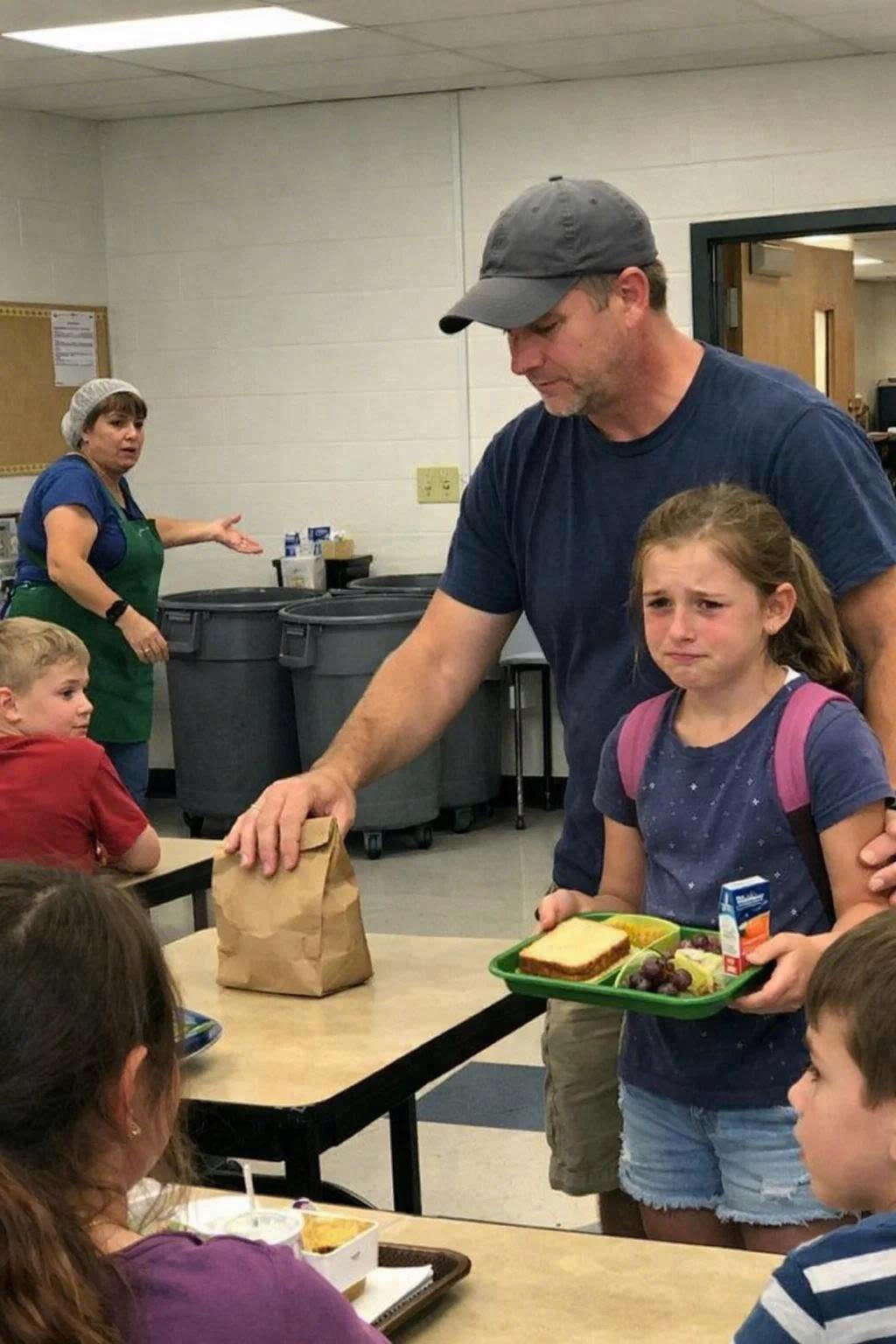
The woman placed a hand on my daughter’s shoulder. Not rough, not gentle either. Just enough to guide. She pointed across the cafeteria, past the bright tables, past the kids laughing and unwrapping snacks.
To a small, unsteady table near the swinging kitchen doors.
Right beside the trash cans.
“You can sit over there,” she said.
The room didn’t go quiet, but something changed. A few kids looked over. Someone laughed, sharp and quick. Sophie’s face crumpled in that way that happens when a child is trying very hard not to cry. Her eyes filled first. Her mouth pressed into a thin line. She nodded once, like she understood, like she accepted it.
That moment hit me harder than anything else could have.
I walked forward before I fully realized I was moving. I set the lunch bag gently on the table the woman had just declared “reserved.” The sound was small, but in my ears it echoed.
She turned toward me, irritation already written across her face. “Sir, this area is for—”
“For children,” I said calmly. “Which my daughter is.”
Her lips tightened. “These tables are reserved for families who donate. It’s school policy.”
Sophie stood behind me, her tray trembling slightly in her hands.
“Today is her birthday,” I said. “And you just told her she belongs next to the trash.”
A few parents nearby slowed their conversations. Someone stopped mid-bite. The woman scoffed lightly, as if I were being dramatic.
“I don’t make the rules,” she said.
“That’s interesting,” I replied, my voice steady in a way that surprised even me. “Because I’ve never seen that rule written anywhere. And I’ve never seen it enforced like this.”
Sophie tugged at my sleeve. “Dad,” she whispered. “It’s okay. I can sit there.”
That nearly broke me.
I knelt down so we were eye to eye. “No,” I said softly. “You don’t sit where people try to make you feel small. Not today. Not ever.”
I stood up and looked around the cafeteria. I didn’t raise my voice, but I didn’t whisper either. “Is this really what we’re teaching our kids?” I asked. “That kindness is something you earn with money?”
The room grew quieter. Not silent—but attentive.
“You’re causing a scene,” the woman snapped.
“No,” I said. “You did. I’m just refusing to pretend it’s normal.”
That was when the principal walked in.
Her name was Mrs. Reynolds, and she took in the scene in seconds—the table, the trash cans, my daughter’s red-rimmed eyes. Her expression tightened.
“What’s going on?” she asked.
Before anyone else could answer, Sophie spoke. Her voice was small, but clear.
“She said I had to eat by the trash,” she said. “Because my family doesn’t give money.”
Mrs. Reynolds’ jaw set immediately.
“That is not a policy,” she said firmly. “And even if it were, it would never be handled this way.”
The cafeteria worker stammered something about misunderstandings, about rules, about instructions.
“We’ll discuss this privately,” the principal said. “Right now.”
She turned to Sophie and smiled gently. “You may sit wherever you like.”
Sophie looked up at me. I nodded.
She chose the window table.
I sat with her. We opened the lunch bag together. When she unfolded the note and saw the crooked heart, she smiled—really smiled—and leaned against my arm.
Around us, something shifted. A parent moved closer. Another child waved at Sophie. The room slowly returned to normal, but it wasn’t the same normal as before.
Later that afternoon, I got a call from the school. Apologies were offered. Policies were reviewed. Promises were made.
I listened. I thanked them.
But that wasn’t the part that stayed with me.
That night, as I tucked Sophie into bed, she asked quietly, “Did I do something wrong?”
“No,” I said immediately. “You didn’t do anything wrong.”
“Then why did she do that?”
I thought for a long moment. “Sometimes people forget that rules are supposed to protect, not hurt,” I said. “And sometimes, grown-ups need to be reminded.”
She nodded slowly.
Before I turned off the light, she whispered, “I’m glad you were there.”
So am I.
Because no child should ever be told they belong beside the trash.
And no parent should ever stay silent when they are.