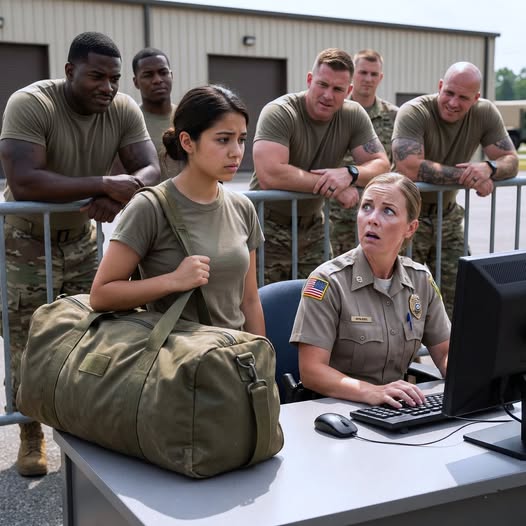
The mid-morning Kentucky sun glared off the pavement at the Fort Campbell transport depot as Sarah Martinez stepped off the Greyhound bus. She gripped the handle of her worn, olive-drab duffel bag, her knuckles whitening under the strain of the heavy gear. At twenty-eight, nature had played a deceptive trick on her; with her petite frame and soft, rounded features, she looked barely old enough to have graduated high school, let alone to have served in the theater of war.
Nearby, a group of seasoned soldiers towered over her, their postures radiating the casual, muscular confidence of veterans. To them, she was a “fresh recruit,” a “rookie” who looked like she’d never seen the inside of a barracks. Sergeant Thompson, leaning against a railing, watched her stumble momentarily under her pack and muttered to his companions, “She won’t last a week.” Sarah heard him, but she didn’t flinch. She had learned long ago that in her world, underestimation was a tactical advantage.
At the intake desk, the processing officer barely looked up from her clipboard. “Name?” she barked.
“Sarah Martinez, ma’am,” she replied. Her voice was melodic but carried a surprising clarity that cut through the terminal’s din.
“Specialty?”
“Combat medic, ma’am.”
The officer’s eyebrows shot up. Combat medics were usually a gritty, battle-hardened breed. Looking at Sarah’s delicate appearance, the officer saw someone better suited for filing paperwork than treating trauma in the mud. “Previous deployments?”
Sarah hesitated. “Multiple, ma’am. Five tours. Three in Afghanistan, two in Iraq.”
The clipboard nearly slipped from the officer’s hands. Five tours was an anomaly, even among career Special Forces. To rack up that much combat time by age twenty-eight, Sarah would have had to spend almost every waking moment since enlistment in a war zone. Skepticism rippled through the depot as word of the “rookie’s” claims spread. Staff Sergeant Rodriguez, a twenty-year veteran with jagged scars tracing down his arm, spat on the ground. “Command must be desperate if they’re sending us kids who lie about their service records,” he told his squad.
However, in the base medical facility, Dr. Jennifer Walsh, the chief medical officer, was seeing a different story. Reviewing Sarah’s digital file, she found certifications that were off the charts—battlefield amputation, emergency thoracotomy, and trauma response scores higher than soldiers with documented PTSD. “There is more to this one than meets the eye,” Walsh murmured.
That night, Sarah sat alone in the mess hall, picking at her food. A young private named Jackson approached her, flushed with embarrassment. “Ma’am, the guys… they’re saying you might be exaggerating. You just seem so… normal. Vets have a certain look in their eyes. But you don’t.”
Sarah set down her fork and looked directly at him. For a split second, her facade slipped. Jackson caught a glimpse of something ancient and weary behind her dark eyes—a profound depth that made him unconsciously step back. “I’ve seen things too, Private,” she said quietly. “I just choose not to wear them on my face.”
The next morning, the “rookie’s” true mettle began to emerge during a fifteen-mile march with full packs. While larger men began to groan under the weight, Sarah maintained a steady, rhythmic pace. At mile ten, Private Johnson began to stagger. His face was flushed, his skin dry. Sarah noticed the signs of heat exhaustion instantly.
“Sergeant, medical situation!” she called out to Rodriguez.
“He looks fine, Martinez,” Rodriguez dismissed her.
“Sergeant, his pulse is 140 and thready,” Sarah countered, her voice suddenly carrying a sharp, clinical authority. “He’s showing early signs of altered mental status. He’ll collapse in ten minutes.”
Exactly as she predicted, Johnson’s knees buckled. Sarah moved with practiced efficiency, administering electrolytes and cooling his core. Her movements were a blur of competence that left the onlookers silent. Later that afternoon at the rifle range, the silence deepened when Sarah, the “inexperienced medic,” placed twenty consecutive rounds into the bullseye from five hundred yards away. When asked about her training, she mentioned sniper school at Camp Pendleton with the same nonchalance one might use to discuss the weather.
The secret she carried was fully unmasked three weeks later during a catastrophic training accident at a mountain facility. A mortar misfire had resulted in multiple casualties. The rapid response team, including Sarah and Dr. Walsh, was flown into a landing zone that mirrored the chaos of a battlefield.
Among the wounded was Corporal Adams, who was suffering from severe abdominal trauma. The senior medic on site froze, overwhelmed by the sight of internal hemorrhaging. “I’ve never seen anything this bad,” he stammered.
“Permission to speak freely, ma’am?” Sarah asked Dr. Walsh. When granted, she provided a lightning-fast diagnosis of Class III hypovolemic shock. “He needs damage control surgery. Now.”
“Here? In the dirt?” the senior medic gasped.
Sarah didn’t wait for an argument. She laid out surgical instruments with surgical precision. Her hands, which looked so small and delicate, were suddenly the steadiest in the field. She performed a controlled incision, located the source of the bleeding, and barked orders to the senior medics. “Pierce, give me better light. Wilson, prepare two units of blood for rapid transfusion.”
In the dim, flickering light of emergency floodlights, the “rookie” saved Adams’ life. As the evacuation helicopter lifted off, Dr. Walsh turned to her. “Martinez, how many times have you done that in the field?”
“Forty-seven times, ma’am,” Sarah replied, her voice finally showing a slight tremor. “You adapt, or you don’t come home.”
The aftermath brought Sarah to the office of Colonel Hayes. He sat behind his desk with her unredacted file—the version marked “Classified.” He read through her commendations: sixty-two confirmed saves under fire, three Silver Stars, and five Purple Hearts.
“Why do you hide this, Martinez?” Hayes asked. “Why let them think you’re a fraud?”
“Because every Purple Heart represents a day I couldn’t save everyone, sir,” she whispered. “I remember the names of the forty-three I lost. I don’t think about the ones I saved.”
Hayes looked at the petite woman across from him. He saw the five scars she carried—shrapnel in her shoulder from Kandahar, blast injuries from Iraq, mortar wounds in her leg. He saw a warrior who had refused battlefield commissions five times because she felt she wasn’t “good enough.”
“Martinez,” Hayes said, closing the file. “Your record shows over three hundred confirmed saves. Those soldiers went home because of you. It’s time you start remembering those numbers, too.”
The secret was out. Sarah Martinez was no rookie; she was a legend. As she walked back to the barracks, the soldiers who had once mocked her pack weight now stood a little straighter as she passed. They no longer saw a girl; they saw the steady hands and the ancient eyes of a medic who had walked through hell five times and brought the rest of her team back with her.