The world at 0500 hours is honest. There are no shadows to hide in, only the stark, gray reality of the pre-dawn light filtering through the barracks window. At Fort Moore, Alabama, my universe was condensed into the sharp, chemical bite of Kiwi shoe polish and the hypnotic, rhythmic friction of a horsehair brush against black leather.
Swish. Swish. Swish.
That disciplined silence shattered when the phone vibrating on the cold metal table began to dance toward the edge. The screen lit up, piercing the gloom with a name that hadn’t graced my notifications in a decade.
Commander Arthur.
That was how I had saved my grandfather’s number when I was twelve. My hand froze in midair, knuckles bleaching white from my grip on the brush. A familiar nausea coiled in my gut—the specific, acidic dread that usually precedes a deployment into a hot zone. He never broke the rules of time. He respected the silence.
Had he fallen? Had his weak heart finally stuttered to a halt?
I answered, my voice raspy with sleep but steady with training. “Sergeant Jada Mosley reporting.”
The voice on the other end wasn’t the dying wheeze I expected. It was sharp, granular, and commanding—a tone I had never heard from the pensioner living on social security checks and canned soup.
“Get home, Sergeant. Now. The squad is assembling. The screening operation commences at 1800 hours.”
The line went dead.
Why would a poor old man, despised by his descendants for a lifetime of perceived mediocrity, suddenly order a formation? And what the hell was waiting for me in Birmingham? A funeral or a battlefield?
I steered my battered, rust-eaten Ford F-150 into the driveway of the two-story colonial house in the suburbs. The gravel crunched under my tires—a harsh, blue-collar sound that felt violently out of place amongst the silent, gleaming fleet parked ahead of me. A black Mercedes, a silver BMW, and a cherry-red Range Rover blocked the entrance like sentries.
I knew for a fact every single one of them was leased. It was a showroom of debt, polished to a high shine to impress neighbors they didn’t even like.
My mother, Nancy, opened the front door before I even cut the engine. She didn’t step out to hug me. She stood in the frame, her eyes scanning me from my dusty tactical boots up to my olive-drab T-shirt. Her expression wasn’t one of maternal warmth. It was the look someone gives when they spot a nasty red wine stain on a white Persian rug.
“I told you to change, Jada,” she hissed as I walked up the concrete steps. “Aunt Patricia is here. Can you please not let everyone think we have an unemployed daughter playing soldier? It’s embarrassing.”
The words hit me with the precision of a sniper round, but I didn’t flinch. Ten years in the Army teaches you to absorb impact without breaking formation.
“I am a Sergeant, Mom,” I said, my voice flat, holding my ground. “This is a uniform, not a pair of coveralls.”
She rolled her eyes, already turning her back on me to inspect a microscopic smudge on the doorframe. “Just try not to embarrass us. And for God’s sake, wipe those boots before you step on the hardwood.”
Inside, the air was thick with the cloying, floral assault of Chanel No. 5, masking the underlying scent of spiritual rot. The living room looked like a catalogue page—pristine, beige, and utterly soulless.
My father, Robert, stood by the fireplace holding a glass of scotch he likely couldn’t afford. He was animatedly explaining some new cryptocurrency scheme to my cousin Ethan.
“It is all about the yield farming, son,” Dad said, chest puffed out like a peacock. “Passive income. That is how the big boys play. You leverage the debt to buy the coin.”
Ethan, a twenty-something with bleached tips and zero ambition, nodded while admiring his pristine sneakers. “For sure, Uncle Rob. These Jordans were like five hundred on resale. Got to spend money to look money, right?”
I walked past them, my heavy boots thudding softly on the rug. Dad gave me a curt nod—the kind you give a delivery driver you want to leave quickly—then turned back to Ethan.
No “How are you?” No “Thank you for your service.”
I was a ghost in the house I grew up in. A spectre of reality haunting their fantasy life of easy riches.
Then, a distinct sound cut through the room’s chatter—the sputtering, wheezing cough of an engine that had seen better decades. A car horn, weak and raspy, honked outside.
Dad’s face twisted in annoyance. He rushed to the window, peeling back the curtain. “Oh, God. The old man is here. I hope he didn’t park that rust bucket next to my Merc. What will the HOA think?”
A moment later, the front door opened again.
Grandpa Arthur stepped in. He was leaning heavily on a wooden cane, wearing a faded khaki jacket that I recognized from the Goodwill bins. The scent of Tiger Balm and old peppermint candy drifted in with him, instantly battling the expensive perfume.
Aunt Patricia, sitting on the plush velvet sofa, visibly recoiled. She waved her manicured hand in front of her nose, not even trying to hide her disgust.
“Dad,” she whined, her voice high and grating. “Could you not have showered before coming? Honestly, it smells like a nursing home in here now.”
Nobody moved. Robert, Nancy, Patricia, Ethan—they all stayed frozen, terrified that poverty might be contagious if they touched him. They were terrified of dirtying their brand-name outfits.
I was the only one who moved.
I crossed the room in three long strides and took his elbow to support his weight. His arm felt frail under the fabric, like a bird’s wing. But when he looked at me, his eyes were sharp, devoid of the cloudiness I expected.
“Welcome to the Area of Operations, Commander,” I whispered.
He squeezed my hand—a secret signal, firm and deliberate. “At ease, Sergeant.”
We guided him to a stiff wooden chair in the corner, far away from the “good furniture.” He sat there, an island of unwanted history in a sea of shallow ambition.
Arthur cleared his throat. The sound was wet and rattled. “I… I do not think I have much time left,” he said, his voice trembling with a frailty that, in hindsight, seemed almost rehearsed. “I wanted to use my entire life savings to invite the whole family to Hawaii.”
The room went dead silent. You could hear the ice melting in Dad’s scotch glass.
Then the transformation happened. It was visceral, immediate, and absolutely disgusting.
Dad’s sneer melted into a predatory grin. Mom, who had just insulted his hygiene, practically sprinted across the room to kneel beside him.
“Oh, Dad!” Nancy gushed, grabbing his calloused hand with her manicured claws. “You are so generous! Hawaii? Are we talking the Four Seasons? The one on Maui?”
“Whatever is best,” Arthur murmured, looking down at the floor.
“I can look up flights right now!” Ethan shouted, phone already in hand, the five-hundred-dollar shoes forgotten. “First Class has those lie-flat seats, Grandpa. You would need that for your back, right?”
“We deserve a vacation,” Aunt Patricia added, suddenly forgetting the smell of Tiger Balm. “It has been so stressful lately with the bills.”
They swarmed him. They talked over him, discussing resorts, rental convertibles, and shopping sprees. Not one of them asked about his health. Not one asked, “What do you mean you don’t have much time?” To them, he wasn’t a dying father. He was a broken ATM that needed to be smashed open for the last few bills.
I stood back, leaning against the wall, watching the feeding frenzy. I felt a wave of nausea, remembering the verse from Proverbs: The greedy bring ruin to their households.
I looked at Grandpa Arthur. He wasn’t looking at them. He was looking at me over their heads.
His trembling had stopped. There was a cold, hard glint in his eye that I had never seen before. It was the look of a man who had just confirmed the enemy’s position coordinates.
I realized then that I wasn’t going on a vacation. I was deploying. My family wasn’t family anymore. They were hostiles. And my mission was to ensure the Commander completed his final operation.
Whatever the hell it was.
“I am in,” I whispered to myself, watching my father calculate flight costs on his phone with greedy fingers. “Let’s go to war.”
Hartsfield-Jackson Atlanta International Airport was a chaotic hive of motion, a sprawling beast of glass and steel. My family moved through the terminal like an entourage of B-list celebrities, their heels clicking sharply on the polished terrazzo floors. They dragged an armada of Louis Vuitton rolling suitcases—monogrammed, shiny, and likely purchased on a credit card that maxed out three months ago.
Trailing twenty feet behind them was Grandpa Arthur.
He was struggling. His posture was crooked, his shoulder dipped low under the weight of an ancient, olive-drab canvas duffel bag. It was the kind of luggage that hadn’t been sold since the seventies. Sweat beaded on his forehead, his breath coming in shallow rasps.
“Pick up the pace, old man!” my father, Robert, shouted over his shoulder, not even breaking his stride. He had one hand in his pocket, the other holding a Starbucks latte. “We are going to miss the flight because of you.”
He didn’t offer to help. Neither did Ethan, whose biceps were purely decorative, sculpted for Instagram selfies rather than actual labor.
The blood rushed to my face, hot and sharp. I stopped, turned around, and jogged back to Arthur. I gently pried the heavy strap from his trembling fingers.
“I have got it, Commander,” I said softly, swinging the bag onto my own shoulder. It was heavy—suspiciously heavy for a week in Hawaii.
Arthur looked at me, wiping his brow with a handkerchief. “Thank you, Sergeant,” he whispered, catching his breath. “Just remember, Jada… the heaviest backpack always holds the most valuable lesson.”
We reached the TSA security checkpoint. It was the great equalizer, or so I thought.
“Shoes off! Belts off! Laptops out!” the TSA agent barked.
My family breezed through the Pre-Check lane, which they had paid for with Arthur’s money. But Arthur and I were in the standard lane. He was slow. His arthritic fingers fumbled with the buckle of his leather belt. He struggled to untie his worn-out dress shoes. Behind us, a businessman in a suit let out a loud, impatient sigh, checking his Rolex.
I knelt down to untie Arthur’s laces. As I did, I felt a shadow fall over us. I looked up and saw Olivia and Ethan standing on the other side of the glass partition.
They weren’t waiting anxiously. They were holding up their iPhones. Olivia was giggling, doing a mock “sad face” for the camera. I could practically see the caption she was typing: POV: When you travel with a caveman. OMG so embarrassing. #BoomerProblems #HolidayDisaster.
They were turning his physical pain into digital entertainment.
I stood up slowly. I locked eyes with Olivia. I didn’t yell. I just gave her the look I used on new recruits who flagged me with a loaded weapon. A look that promised absolute destruction.
Olivia flinched. She lowered the phone, her smile faltering. But I knew it was too late. The story was already posted.
At the boarding gate, the final humiliation was revealed.
Robert stood with a fan of boarding passes. “Okay, listen up,” he announced. “First Class for me, Nancy, Patricia, Frank, and the kids. We need the legroom to rest up for the itinerary.”
He flicked two tickets toward me. They fluttered down like dead leaves.
“These are for you and the old man. Economy. Row 42. Way in the back.” Robert smirked, adjusting his blazer. “He is small. He doesn’t need the space. Plus, I saved three thousand dollars doing this. Smart investing, right?”
Arthur had paid for every single ticket. He had paid for the champagne they were about to drink. And they were shoving him into the cattle car.
My fists clenched at my sides. I opened my mouth to tear Robert apart, but Arthur’s hand clamped onto my wrist. His grip was surprisingly strong.
“Silence,” he ordered softly. “Let them go.”
We boarded last. To get to Row 42, we had to walk through the First Class cabin. It was the walk of shame. I saw my mother sipping a mimosa, laughing at something Aunt Patricia said. My father was already reclined, an eye mask on his forehead. They didn’t even look up as Arthur shuffled past them, his cane tapping rhythmically on the carpet. They acted as if we didn’t exist.
Six hours later, we landed in Maui. The heat hit us like a physical blow, thick with the scent of plumeria and jet fuel.
A stretch limousine, long and white, was idling at the curb. The driver held a sign that said HAN FAMILY.
My family shrieked with delight, rushing forward like a swarm of locusts. They piled in, fighting for the best seats near the minibar. I guided Arthur to the curb. He was exhausted, his face a pale gray.
As I reached for the door handle, Uncle Frank blocked the way. He stood inside the car, filling the frame.
“Hey, bad news,” Frank said, not looking sorry at all. “The car is full. Too many bags. It is going to be tight.” He looked at Arthur, then at me. “Jada, you know how to use Uber, right? Just grab a cheap car and meet us at the hotel. It will save us having to sit on each other’s laps.”
“Are you kidding me?” I snapped. “This is his car. He paid for it!”
“And he would want us to be comfortable,” Frank said, and he slammed the heavy door shut in my face.
The tinted window rolled up. I saw my mother inside, raising a toast. The limousine peeled away from the curb, disappearing into the tropical traffic, leaving an eighty-year-old man standing on the hot asphalt in the blazing sun.
I looked at Arthur, expecting to see tears.
But Arthur wasn’t crying. He watched the white limousine fade into the distance. He reached into his pocket, pulled out a handkerchief, and wiped his face.
Then he smiled.
It wasn’t a nice smile. It was a cold, calculating smile. The smile of a tactician who had just successfully lured the enemy into a kill box.
“Note for the log,” Arthur whispered, his voice steady as steel. “Enemy formation has dispersed. Phase One is complete. Prepare for Phase Two.”
The lobby of the Four Seasons Resort was a cathedral of open-air luxury, smelling of expensive orchids and sea breeze. But our reality was far from the brochure.
My father tossed a plastic key card through the air. “Your grandfather’s room is on the first floor,” Robert said, checking his reflection in a glass pane. “Garden View. We are in the Penthouse on the eighth floor. Do not disturb us unless it is an emergency.”
In hotel speak, “Garden View” is a polite euphemism. The reality was a damp, dark room at the very back of the property. When I opened the curtains, there was no garden. There was the concrete wall of the loading dock, a row of overflowing dumpsters, and the deafening hum of the hotel’s industrial air conditioning units.
It was a storage closet with a bed.
Arthur sat on the edge of the mattress. The springs creaked loudly. He placed his cane between his knees and looked at the wall.
“I am sorry, Commander,” I said, my voice thick. “I will go back up there. I will make them switch.”
“It is fine, Sergeant,” he said, his voice raspy but calm. “Compared to a sandbag bunker at Khe Sanh in ’68, this is a palace. At least the roof doesn’t leak.”
The real test came that night at Le Perle.
It was the kind of restaurant that smelled of old money and silent judgment. Crystal chandeliers, massive and dripping with diamonds of glass, hung from the vaulted ceiling. The waiters moved like ghosts in tuxedos, speaking in hushed French accents.
My family, however, had no concept of “hushed.” We sat at a large circular table in the dead center of the room, loud as a construction site.
“Bring us the Chateau Margaux!” Robert shouted, snapping his fingers at the sommelier. “I figure if the IRS is going to audit me next year, I might as well drink their money now, right?”
In the corner of this display sat Grandpa Arthur, wearing his best flannel shirt—the red and black plaid faded from years of washing. Amidst the sea of silk evening gowns and Italian suits, he looked like a relic from a forgotten world.
He held the leather-bound menu close to his face, hands trembling. “I… I cannot make out these words,” Arthur whispered.
Olivia snatched the menu out of his hands. “Oh, give it here,” she sighed, rolling her eyes at Ethan. “You wouldn’t know what escargot was if it bit you, Grandpa. Just bring him the pumpkin soup, pureed like for a baby. He doesn’t have the teeth for steak.”
The table erupted in laughter. My mother covered her mouth with a napkin, giggling. “Oh, Olivia, you are terrible.”
I gripped my silver fork so hard the metal dug into my palm. Hold the line, Sergeant. Wait for the signal.
Halfway through the meal, Arthur stood up. “Excuse me. Restroom.”
He grabbed his cane and shuffled away. The floor was polished marble, slick and unforgiving. As he navigated around a decorative display in the center of the room—a magnificent six-foot tower of champagne glasses stacked in a pyramid—his bad knee buckled.
He lurched forward. He tried to catch himself, but his cane slipped.
CRASH!
The sound was deafening, like a bomb going off in a library. Hundreds of crystal glasses shattered at once. Champagne exploded outward in a frothy wave. The entire restaurant went instantly, terrifyingly silent.
Arthur lay sprawled on the wet marble amidst the shards. A jagged piece of glass had sliced his forearm. Bright red blood began to mix with the golden champagne on the white floor.
“Oh my God!” my mother shrieked. But she didn’t rush to help. She grabbed her menu and held it up to hide her face. “This is so humiliating. Don’t look at him. Useless old man.”
My father stood up then. He marched over to where Arthur lay, his expensive Italian loafers splashing in the puddle of wine and blood. He reached into his back pocket, pulled out his wallet, and ripped out a single hundred-dollar bill. He crumpled it into a ball and threw it at his own father.
The ball of paper hit Arthur in the chest.
“Take that for the damage and get back to your room!” Robert screamed, his face a violent shade of red. “Why do you have to be such a burden? Why don’t you just die and save us all the trouble?”
The air left the room. The cruelty hung in the silence like toxic smoke.
The safety on my internal weapon clicked off.
I stood up, kicking my heavy chair back. I marched through the puddle, glass crunching under my boots, and stepped between my father and my grandfather. I stood at parade rest, shielding Arthur.
“You just violated the most basic rule of humanity,” I said, my voice low and icy. “You are not worthy of the name Mosley.”
Robert froze. Then, blind rage took over. “How dare you lecture me?”
He swung. Smack.
The slap caught me square on the cheekbone. My head snapped to the side. A sharp metallic taste flooded my mouth. The room gasped. I stood perfectly still. I could have broken his arm in three places. Instead, I took the hit like a soldier taking shrapnel for a civilian.
I slowly turned my head back. I spat a mouthful of bloody saliva onto the floor next to his polished shoes.
“Noted,” I said. “We are finished here.”
I knelt down and helped the Commander to his feet. As we reached the lobby, my family chased us, screaming about ruined reputations.
Suddenly, the General Manager of the resort came sprinting across the floor. My father pointed an accusatory finger. “Hey! Throw this old beggar out! He’s bleeding all over your floor!”
The Manager ignored Robert completely. He skidded to a halt in front of Arthur and bowed—a deep, ninety-degree bow of absolute subservience.
“Chairman Hannot,” the manager gasped, trembling. “Sir, we did not know you were dining downstairs. I am so terribly sorry.”
The world froze.
“Chair… Chairman?” my mother stammered.
Arthur removed my hand from his waist. He stepped forward. The frail old man vanished. In his place stood a lion.
“Manager Henderson,” Arthur said, his voice a deep baritone that commanded the room. “Show them.”
Henderson pulled a cord on a massive velvet curtain nearby. Revealed underneath was a ten-foot oil painting of Arthur Hannot, founder of the Hannot Luxury Group.
My family stared. The man they had humiliated owned the floor they were standing on.
“Manager Henderson,” Arthur declared, his voice cold. “These people are trespassing. Effective immediately, their reservation is terminated. Remove them from my barracks.”
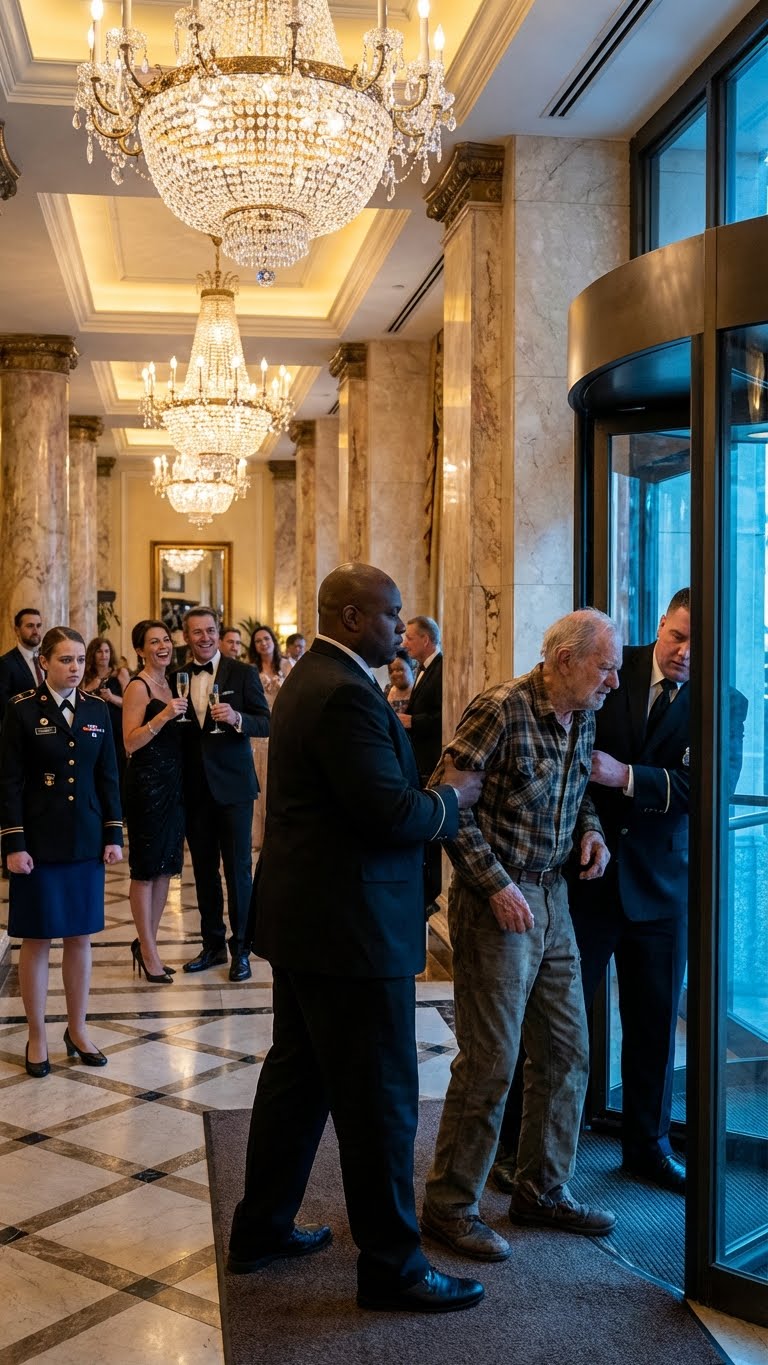
Security moved in. My father was hoisted by his armpits, screaming, while my mother was dragged toward the revolving doors.
Arthur watched them go. He didn’t smile. He just let out a long sigh.
“General Manager,” Arthur said softly. “Bring the Sergeant a medical kit for her face. And bring me a bottle of the Chateau Margaux. The real one.”
Seventy-two hours after our expulsion from paradise, we were back in the humid, suffocating heat of Alabama.
Arthur insisted on returning to his small, weathering wooden house. But the dynamic had shifted. It was no longer a home; it was a command post. Attorney Harlon, a man in a razor-sharp suit, sat at the kitchen table.
Outside the chain-link fence, my family huddled like wet rats. They had driven straight from the airport, desperate.
“Read the draft, Harlon,” Arthur ordered. “Make sure the window is open just a crack.”
Harlon began to read the “preliminary will”—a tactical decoy.
“To my granddaughter, Jada Mosley, I bequeath this property and a yearly stipend of one million dollars… To my children, I leave nothing.”
One million dollars. A lifeline.
The reaction from beyond the fence was feral.
“That little witch!” my mother shrieked. “She brainwashed him! She drugged him!”
They realized yelling wouldn’t work. So, they deployed the weapon of the modern coward: social media.
That evening, my phone exploded. Olivia had re-edited the videos from Hawaii. She cut out the part where I helped Arthur with the bag, only showing me pulling the strap. Caption: She forces him to carry her luggage. Elder Abuse. She edited the restaurant clip to look like I was attacking Robert.
Headline: Sergeant Jada Mosley exposes as abuser stealing dementia patient’s fortune.
The internet swallowed the bait. Within four hours, the video had two million views. My address was doxed. News vans parked on the lawn. Red paint was splashed on the driveway: GOLD DIGGER.
Then came the call. “Sergeant Mosley, you are placed on administrative leave pending an inquiry. Do not come to post.”
I sat on the floor in the dark, stripping my service pistol. Click. Slide. Snap.
Arthur put a hand on my shoulder. “Do not engage, Sergeant. Silence is the loudest noise you can make right now. Let them exhaust their ammunition.”
Commander Arthur Hannot passed away on a Tuesday night as a thunderstorm rolled across the state line. There were no dramatic last words. He simply squeezed my hand.
“Jada,” he whispered. “You are my pride.”
And then he was gone.
I didn’t cry. My watch wasn’t over. I dressed him in his old service uniform, treating his body with the reverence of a national treasure.
The next morning, I texted the family group chat: Grandpa passed away. Funeral is Thursday at 1000 hours at St. Jude’s Chapel.
Three minutes later, the replies came.
Nancy sent a selfie from a yacht in Miami. Good. The old man is finally dead. Don’t expect me to come back to that depressing town. You handle it.
Robert: Just cremate him. It is cheaper. I am busy fixing the mess you made with the press.
Thursday morning arrived gray and wet. St. Jude’s Chapel was a cavernous space designed for two hundred mourners. At 10:00 sharp, the doors closed.
The room was empty.
There were no flowers. No cousins. No weeping widow. There was only me, standing in my Army Dress Blues, medals weighing heavy on my chest. The silence was suffocating, broken only by the rain drumming a relentless beat on the metal roof. Tap. Tap. Tap.
We moved to the cemetery. The red clay was slick mud. I picked up the shovel. I didn’t wait for the workers. One shovel for the father who raised them. Two for the grandfather who paid their debts. Three for the man they left to die alone.
When the grave was filled, I snapped a crisp salute. “Mission accomplished, Commander. You are relieved of duty.”
I turned my heel. I walked away from the grave and away from the people who shared my blood. I was alone, but I felt a steel-like strength hardening in my chest.
The morning was over. The judgment was about to begin.
Three weeks later, I received a summons from Attorney Harlon. Top floor of the Wells Fargo Tower.
Harlon was waiting. He looked at me with profound respect.
“Please sit, Miss Mosley,” he said.
“Is this about the stipend? My mother is threatening to sue.”
Harlon smiled enigmatically. “We will get to your mother. But first, the final protocol.”
He pressed a button. A screen showed black-and-white footage of the empty chapel. Just me, saluting the coffin.
“Arthur left a classified order,” Harlon explained. “If, and only if, a blood relative stood by his grave, was I authorized to open the Red File.”
He opened a safe and pulled out a crimson leather folder.
“The million-dollar stipend was a decoy. A test. Your family failed.” Harlon opened the document. “I, Arthur Hannot, declare: Only the soldier who stands the watch when no one is looking deserves to hold the command.“
Harlon looked at me. “Therefore, I name Jada Mosley as the sole beneficiary of the Hannot Estate.”
“Sole?” I whispered.
“Everything,” Harlon confirmed. “The Hannot Luxury Hotel Group. The resorts. The real estate. Total estimated value: $4.2 billion.”
The room spun. I gripped the leather chair.
“And my family?”
Harlon flipped to the last page. “The Disinheritance Clause. To Robert, Nancy, and their offspring: You chose to abandon me in life, and you abandoned me in death. You are legally severed from this family. You shall receive zero dollars and zero cents.“
Arthur hadn’t just given me money. He had given me a nuclear weapon.
“What are your instructions?” Harlon asked.
I thought about the hot dog on the bench. I thought about the slap.
“Freeze everything,” I said, my voice sharp. “Cut off the stipend. Send eviction notices for any property owned by the trust.”
The press release hit at 0600 Monday. POVERTY-STRICKEN SOLDIER INHERITS $4 BILLION EMPIRE.
My family, attempting to check out of a Miami resort, found their cards declined. Then they saw the news on the lobby TV. My mother fainted right next to her Louis Vuitton bags.
They drove back to Alabama like maniacs, arriving at my gate as the sun rose. They stumbled out of their cars, disheveled, crying, begging.
Robert threw himself on the grass. “Jada! Baby! Daddy is home! I knew you were the special one!”
Nancy sobbed, “It was the medication! I didn’t mean it!”
I stood on the porch, holding a cup of coffee. I felt nothing. No anger. Just the clinical detachment of a surgeon looking at a tumor.
“Who are you people looking for?” I asked.
“Our family!” Robert cried.
“My family died last Thursday at 10:00 AM,” I said. “I waited for them. Nobody came.”
“We are blood!” Aunt Patricia shrieked.
“You are not blood,” I replied. “You are cancer. And I have surgically removed the tumor.”
I checked my phone. “You have three minutes before the Sheriff arrests you for trespassing.”
Sirens began to wail in the distance. The love evaporated instantly.
“You bitch!” Robert spat, scrambling up. “You’ll rot in hell!”
They scrambled into their cars and peeled away, fleeing the consequences of their own greed.
I turned back to the door. Click. It was the sound of a vault closing.
The alarm buzzed at 0500.
I didn’t move into a mansion. I stayed in Arthur’s renovated cabin. On the kitchen table lay the blueprints for the Arthur Hannot Foundation—a community of tiny homes for homeless veterans. We were giving them what my family denied Arthur: dignity.
My parents lost everything. They now live in a cramped apartment, fighting over scraps. Olivia works the morning shift at a diner, scrubbing ketchup stains for tips.
They chose money over loyalty, and now they have neither.
I drove to the cemetery as the sun set. I placed a single white rose on the stone, along with my new business card: CEO, Hannot Industries.
“Report to Commander,” I whispered to the wind. “The hostiles have been neutralized. The legacy is secure.”
I stood up, brushed the grass from my knees, and walked toward the sunset. I was finally free.
Real wealth isn’t what you have in the bank. It’s who shows up when you have nothing to offer but your company. Be the person who stays.