Rain didn’t just fall on Manhattan that night; it assaulted it. It was a relentless, vertical ocean that turned the gutters of Tribeca into rushing rivers and blurred the city lights into streaks of neon and gray.
Inside Velvet Iris, however, the storm was just a rumor. The air here was climate-controlled perfection, scented with roasted garlic, expensive wine, and the distinct, metallic tang of old money. It was the kind of establishment where the marble floors were polished to a mirror shine and the patrons spoke in hushed tones, pretending that the prices on the menu didn’t matter, even while they spent money like it was water.
But in the narrow service corridor behind the kitchen, the atmosphere was frantic.
“He’s here,” the manager, Mr. Sterling, hissed, his face drained of color. He looked like a man who had just seen a ghost, or perhaps an executioner. “Do not talk to him. Do not ask questions. You pour water, you drop bread, and you vanish. Do you understand?”
I nodded along with the other servers, though my hands were already trembling beneath my apron. I was tired in the way that only rent-and-groceries tired feels—a bone-deep exhaustion that lives behind the eyes and makes you smile at strangers while your heart quietly begs for a moment of silence.
Velvet Iris wasn’t my dream. It was my survival. A good tip meant a full tank of gas. A full tank meant I could get to my second job at the diner in Queens without praying my beat-up Honda didn’t die on the FDR Drive.
“Evelyn,” Sterling snapped, grabbing my elbow. “Your section. The corner booth.”
My stomach dropped. “Me? But Sarah usually takes the VIPs.”
“Sarah is hyperventilating in the walk-in fridge,” he muttered. “You’re quiet. You don’t gossip. Just serve the man and don’t make eye contact.”
I swallowed the lump in my throat and smoothed the front of my black dress. Just breathe, I told myself. It’s just dinner. It’s just plates and forks. Get through the shift.
Then I walked out onto the floor, and I saw him.
Damian Caruso didn’t walk into a room; he occupied it. He moved with the lethal grace of a apex predator, wearing a dark wool coat with rain still beading on the shoulders. He wasn’t loud—he didn’t need to be. He was the kind of man who carried his own gravity, pulling the attention of the entire room without saying a word. Two men in suits followed him like shadows that had learned to wear Italian leather shoes, scanning the perimeter with dead eyes.
But the tension that rippled through the restaurant wasn’t actually about Damian.
It was about the toddler at his side.
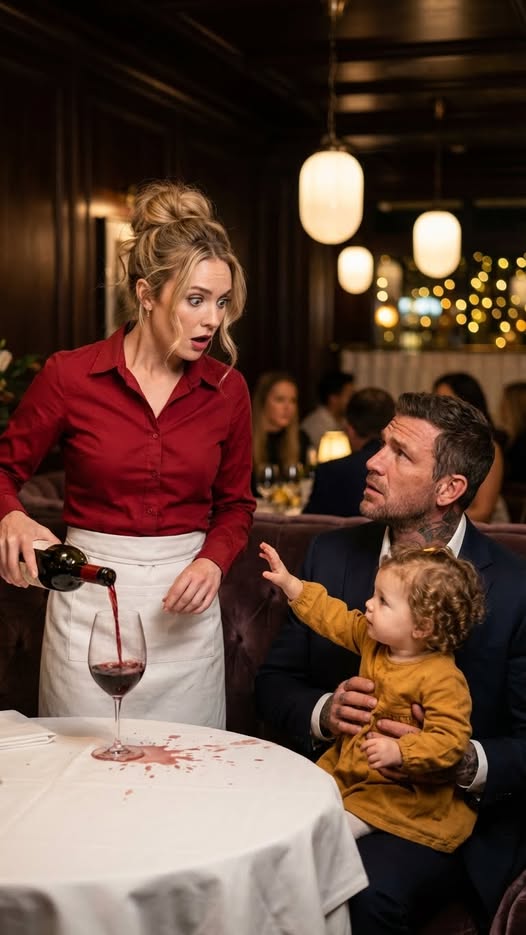
A little girl—maybe two years old—sat quietly in a high chair the host had scrambled to find. She was clutching a worn, velvet bunny with an ear missing, holding it like it was the only solid thing in a dissolving universe. Her eyes were wide, green, and terrifyingly cautious, possessing the haunted look of a combat veteran rather than a child.
And her mouth… her mouth stayed pressed into a thin, flat line.
I watched the other servers exchange nervous glances near the bar.
“That’s Leah,” someone whispered.
“She doesn’t talk,” another replied, their voice tinged with pity and fear. “Not a word. Ever.”
I swallowed hard. I’d seen wealthy Manhattanites bring children to restaurants like accessories, dressed in clothes that cost more than my rent. But Damian Caruso didn’t look like he’d brought Leah to show her off. He looked exhausted. Not tired like me—but tired like a man who had been fighting an invisible war for two years and was slowly realizing he was losing.
I approached the table. The booth was situated like a stage, or perhaps a bunker. Damian sat with his back to the wall, a position that made it impossible to surprise him. Leah sat beside him, the bunny tucked under her arm like a secret.
“Good evening,” I said, my voice soft, practiced. “Welcome to Velvet Iris. Can I start you off with—”
I stopped.
Not because Damian spoke. But because his gaze shifted—sharp, sudden, like a blade turning to catch the light—and landed on my wrist as I reached for the water glass.
My sleeve brushed the linen tablecloth. A faint scent rose up between us, warmed by the heat of my pulse.
It was cheap vanilla soap. Lavender lotion from a drugstore bottle with a cracked pump. The kind I bought in bulk because it was three dollars and didn’t make my skin itch.
Damian went rigid.
It was a visceral reaction, like he’d been struck physically. His pupils dilated, swallowing the iris. He looked at me, then at the air around me, as if he were trying to catch a ghost.
My heart skipped a beat. Had I spilled something? Was I offending him?
Then, Leah lifted her head.
Just an inch. Just enough for me to see her eyes clearly.
Green. With flecks of gold.
She stared at my face with an intensity that stole the breath from my lungs. It wasn’t the blank stare of a child zoning out. It was recognition. She looked at me like she had been searching for my face in her dreams and had finally woken up.
A strange, jagged pain moved through me—sharp and sudden. It felt like a door inside my chest, one I had welded shut years ago, was being yanked open by a rusty crowbar.
A hospital smell. White lights blinding me. A monitor beeping too fast, escalating into a flatline tone. A voice saying words I had spent two years trying to scrub from my brain.
“There were complications. The baby didn’t survive.”
Leah’s bunny slipped from her arms. It hit the floor with a soft, muffled thump.
The sound was small, but Leah reacted as if the world had cracked in half.
Her tiny hand shot out, frantic, desperate. She grabbed the ties of my apron, her fingers latching on with a strength that turned her knuckles white.
I froze. My training said to step back, to apologize, to maintain boundaries. My instinct screamed to lean in.
“Sweetie,” I whispered automatically. It was muscle memory. It was a biological imperative I didn’t know I still possessed. “It’s okay…”
Leah’s mouth opened.
At first, the sound was barely there. Rusty. Like a hinge that hadn’t moved in a lifetime.
“Ma…”
Damian’s hand moved—fast—toward the inside of his jacket. The guards near the door took a step forward.
My stomach turned to ice.
Leah’s voice cracked, but this time it pushed through the silence, louder, strong enough to slice the atmosphere of the restaurant in half.
“Mama.”
Every fork in the restaurant stopped moving. The silence that followed was absolute.
My vision tunneled. The amber lights of the dining room seemed to stretch and warp.
Damian stood slowly. He didn’t explode. He didn’t flip the table. He rose with the terrifying control of a man who knows that if he lets go, he will burn the city down.
“Leah,” he said, his voice low. “Look at me.”
Leah didn’t look at him. She refused to acknowledge the man who held the world in his fist. She only had eyes for me. She was staring at me like I was the only real thing in a room full of smoke.
And then she whispered again—clearer now, urgent, a plea from the bottom of a well.
“Mama… up.”
A full phrase. A child who supposedly never spoke had just spoken twice.
Damian’s face changed. The mask of the ruthless businessman dissolved, replaced by something far more dangerous: realization. He looked like a man discovering that the foundation of his house was built on sand.
My hands wouldn’t stop shaking. “Honey…” I stammered, my voice broken. “I’m… I’m just your server.”
Damian’s hand closed around my wrist.
It wasn’t brutal, but it wasn’t gentle either. It was desperate. An anchor looking for a seabed.
“My daughter has never spoken,” he said. His voice didn’t rise, yet it carried the weight of a death sentence. “Not one word. Since the day she was born.”
My pulse hammered against his palm. “I don’t know why she—”
Leah started to cry.
This wasn’t the quiet, restrained whimpering of a child who has learned to be invisible. This was a guttural, full-body sob. It was the sound of a dam breaking.
“Mama! Mama!”
She reached for me, her arms straining against the high chair straps.
Mr. Sterling appeared, his smile plastered on like a bandage over a bullet hole. “Mr. Caruso,” he began, his voice trembling. “We can bring anything you need. Perhaps a private room? The girl seems distressed…”
Damian’s gaze sliced toward him. Sterling stopped mid-sentence, his mouth clicking shut.
Damian didn’t yell. He simply lifted two fingers.
The response was immediate. The two shadows in suits moved. Chairs scraped. Guests began to stand, abandoning half-eaten risottos and glasses of vintage Bordeaux. There was no official announcement, no fire alarm. Just a quiet, terrified evacuation powered by the sheer force of Damian Caruso’s reputation.
Within three minutes, Velvet Iris was empty.
Damian unbuckled Leah and lifted her. Her crying slowed, but only because she reached out and grabbed a fistful of my shirt, anchoring herself to me.
“You’re coming with us,” Damian said.
The blood drained from my face. I backed up until the cold marble of the bar pressed against my spine. “That’s kidnapping,” I whispered. “I didn’t do anything. I don’t even know you.”
Damian looked down at the child in his arms, then back at me. The look in his eyes wasn’t malice. It was a chaotic mix of confusion and hope.
“Until I understand why my daughter thinks you are her mother,” he said, “you won’t be out of my sight.”
“You can’t just—”
“I can,” he interrupted, his tone final. “And I will.”
He turned. The guards closed in around me—not touching, but forming a wall of bodies that guided me toward the exit.
Outside, the wind whipped the rain into stinging needles. A black SUV idled at the curb like a hearse. I was ushered into the back seat, sandwiched between leather and silence.
Leah fell asleep almost immediately against Damian’s chest, her hand still reaching across the console to grip the fabric of my coat.
The car moved through the slick streets of Manhattan, heading north. Every time we hit a pothole, Leah mumbled in her sleep.
“Mama…”
And with every repetition, a crack formed in the wall of my memory.
Zurich. The clinic. The promise of money to save my dying father. The contract. The darkness.
We drove through iron gates that looked like they were guarding a kingdom. The house—no, the estate—was a fortress disguised as a mansion. Stone lions, security cameras, windows that gleamed like black ice.
I was led to a guest room that was larger than my entire apartment. The door clicked shut behind me, the sound of the lock sliding home echoing like a gunshot.
I slid down the wall until I hit the floor, gasping for air.
No. No, no, no.
I had buried it. I had spent two years shoveling dirt over that memory, drowning it in double shifts and exhaustion.
I pressed my palms against my eyes, trying to stop the images.
The doctor’s face. The way he wouldn’t look at me. The empty bundle.
But down the hall, a little girl was asleep, whispering “Mama” like she had been waiting her whole life to say it. And she had my eyes.
I don’t know how long I sat there before the door opened again.
Damian stepped in. He had discarded his jacket and rolled up his sleeves, revealing forearms corded with tension. He held a manila folder in his hand. He didn’t sit. He paced, stopping by the window to look out at the storm.
“You said you lost a baby,” he said, not turning around.
My throat felt like it was filled with glass shards. “How do you know that?”
“I have resources,” he said simply. “I know everything about you, Evelyn Harper. Born in Queens. Father died of heart failure two years ago. Heavy debt. And a medical trip to Switzerland.”
He turned then, his eyes boring into mine. “Where in Switzerland?”
I swallowed, my hands shaking in my lap. “Zurich.”
“What clinic?”
“Genesis Life,” I whispered. “Genesis Life Institute.”
Damian went very still. It was the stillness of a predator before the strike, or perhaps a man realizing he has been poisoned.
“October 14th,” he said.
I froze. “That was…”
“The date,” he finished. “Two years ago.”
My heart slammed against my ribs so hard I thought it might crack them. I knew what he was going to say before the words left his lips. The air in the room grew heavy, charged with the electricity of a coming storm.
“That is the day my wife died giving birth,” Damian said. His voice was controlled, but beneath the surface, I heard the tectonic plates of his grief shifting. “She went into labor early. We were in Zurich for a specialist. Complications. She didn’t make it.”
He took a step closer, tossing the folder onto the bed between us.
“And Leah was born.”
Two timelines. One location. One child.
And one lie so cruel, so elaborate, that it had reshaped three lives.
“No,” I whispered, shaking my head. “They told me… they showed me…”
“Did you hold her?” Damian asked. “Did you hold the body?”
“No,” I choked out. “They said it was best if I didn’t. They took her away.”
Damian’s jaw flexed, a muscle jumping in his cheek. “You’re going to do a DNA test,” he said. “Tonight. My private doctor is already on his way.”
“And if it says I’m her mother?” I asked, my voice barely audible.
Damian looked away, staring at the rain-lashed window as if he wanted to shatter it.
“Then someone stole my daughter’s mother,” he said, his voice rough. “And someone stole your child.”
“Why?” I asked, tears finally spilling over. “Why would anyone do that?”
Damian looked back at me, his eyes dark pools of cynicism.
“In my world, Evelyn,” he said, “people don’t steal babies because they are cruel. They steal babies because babies are leverage.”
The wait was agonizing.
The technician came and went—a silent man who took swabs from Leah and me with clinical efficiency. Leah didn’t cry this time. She sat on my lap, playing with my fingers, tracing the lines of my palm as if reading a map she had memorized in the womb.
Damian stayed in the room. He watched us. He watched the way Leah molded her body to mine, the way her breathing synchronized with my own.
I saw the conflict in his eyes. He wanted it to be true, and he was terrified it was true. If I was her mother, his wife hadn’t just died; she had been betrayed. If I was her mother, everything he knew about his family was a lie.
The call came three hours later.
Damian put the phone on speaker and set it on the mahogany desk.
“We ran the markers three times to confirm,” the voice on the other end said. It was dry, factual, devoid of the emotional bomb it was dropping. “There is no error. Ninety-nine point nine percent probability.”
My knees gave out. I sank onto the edge of the bed, covering my mouth to stifle a sob.
“The woman is the biological mother,” the voice finished.
Damian closed his eyes and exhaled—a long, shuddering breath that seemed to carry years of tension out with it. He didn’t shout. He didn’t smash anything. He just looked like a man realizing that the gravity he stood on had been artificial all along.
Leah, sensing the shift in the room, padded over to me. She climbed into my arms, burying her face in my neck.
“Mama,” she sighed, closing her eyes.
Damian watched us. And for the first time, the hardness in his eyes cracked. I saw grief there, raw and bleeding. But underneath the grief, I saw something else hardening.
Purpose.
“You weren’t a stranger,” he said quietly, more to himself than to me. “You were the vessel they discarded.”
The architect of our pain arrived the next afternoon.
Dr. Hale.
He wore a cashmere coat and a smile that cost more than my car. He entered Damian’s library with the confident stride of a man who believed he held the leash.
“Damian,” he said lightly, rubbing his hands together. “You sounded concerned on the phone. Is Leah unwell?”
Damian was standing behind his desk. He didn’t offer a handshake. He didn’t offer a drink.
On the desk sat the manila folder. And beside it, a tablet playing the recording of the DNA results on a loop.
Dr. Hale’s smile flickered, then died.
“Explain,” Damian said. The word was soft, but it landed like a hammer. “Explain why my daughter shares her DNA with a waitress from Queens instead of my late wife.”
Dr. Hale opened his mouth, then closed it. He adjusted his collar. “Selective mutism can cause children to project attachment onto strangers—”
“Stop,” I said.
My voice surprised me. It was steady. Sharp. Alive.
I stepped out from the shadows of the bookshelf, holding Leah’s velvet bunny. My hands weren’t shaking anymore. Fear had burned away, leaving only cold, hard anger.
“You told me my baby died,” I said, locking eyes with the man who had haunted my nightmares. “You wouldn’t let me hold her. You sedated me. You took her while I was unconscious.”
Dr. Hale’s gaze darted between Damian and me, looking for an exit.
“What did you do?” Damian asked.
Dr. Hale’s mask shattered. “I did what I was paid to do!” he snapped, his voice pitching high with panic.
My chest burned. “I carried her,” I said, stepping closer. “I felt her kick. I bled for her. And you sold her like she was a product.”
Damian moved around the desk. The sound of his footsteps on the hardwood was deliberate, terrifying.
“Who ordered it?” Damian asked.
Dr. Hale swallowed, backing up until he hit the door. “Damian, please—you have to understand—”
“Who?” Damian repeated. He stopped inches from the doctor.
Dr. Hale looked at the window, as if contemplating jumping. Then, the name fell out of his mouth like poison.
“Salvatore Caruso.”
The room seemed to drop ten degrees.
Damian’s face went blank. Not shock. Not anger. Something worse.
Salvatore. His uncle. The patriarch. The man who sat at the head of the table at Sunday dinners. The man who kissed Leah’s forehead and called her his “little miracle.”
My stomach twisted. “Why?” I whispered. “Why would he do that?”
Dr. Hale let out a dry, nervous laugh. “Because power doesn’t care about innocence, my dear. It cares about inheritance.”
He looked at Damian. “Your wife… she couldn’t conceive. You didn’t know. She hid it from you because she was afraid of your uncle. Salvatore found out. He knew the terms of your grandfather’s trust. If you didn’t produce a blood heir within five years of taking over, control would shift to the board. To him.”
Damian’s fists clenched at his sides.
“He needed a child with your bloodline,” Dr. Hale continued, speaking faster now, desperate to unburden himself. “Fast. And he needed you distracted by grief so you wouldn’t ask questions. So he found a donor. A surrogate. He arranged the ‘complications’ for both women. He switched the babies. He gave you an heir to secure the empire, and he killed your wife to break your spirit.”
Silence thundered in the library.
It was a plot so Shakespearean, so vile, that it defied modern logic. Yet, it was the only thing that made sense.
Damian stared at the doctor. “You helped him steal my life.”
“I helped you keep your company!” Dr. Hale argued.
Damian didn’t strike him. He didn’t need to. He simply pulled his phone from his pocket and tapped the screen.
“Get out,” Damian said.
Dr. Hale blinked. “What?”
“Get out of my house. The FBI is waiting at the end of the driveway.”
Dr. Hale turned pale. He scrambled for the door, fleeing the judgment he couldn’t outrun.
When the door clicked shut, Damian turned to me. He didn’t look like a billionaire. He didn’t look like a monster. He looked like a man standing in the wreckage of a burning building.
“My uncle knows,” Damian said quietly. “And if he knows that we know… you are in danger. Leah is in danger.”
My fear surged again, choking me. “So what now?” I whispered. “Do I run? Do I take her and hide?”
Damian’s gaze steadied. He looked at the door where Leah was playing in the hall, then back at me.
“No,” he said. “You don’t run. We don’t hide.”
He walked over to me, stopping just short of touching my arm. “We burn him down.”
We didn’t confront Salvatore in a dark alley. We didn’t do it with guns.
We did it with light.
Three days later, the Caruso Foundation Gala was held at the Metropolitan Museum of Art. It was the event of the season—champagne, diamonds, and the flash of a thousand cameras.
Salvatore Caruso walked in like a king. He wore a tuxedo that cost more than my childhood home. He shook hands, he smiled, he basked in the adoration of the city’s elite.
He expected applause. He didn’t expect the outcome of Damian’s rage.
I watched from the balcony of the Temple of Dendur, hidden in the shadows. Damian stood beside me, holding Leah.
When the federal agents walked in, the music didn’t stop immediately. It faded, awkward and discordant, as people realized something was wrong.
Salvatore saw them coming. He frowned, confused, until his eyes drifted up to the balcony.
He saw Damian.
And he saw me.
The color drained from his face. In that moment, he didn’t look like a titan of industry. He looked like an old, pathetic man who had underestimated the strength of a mother.
I held Leah’s hand. She pointed down at the commotion.
“Bad man?” she asked.
“Yes,” I whispered. “But he can’t hurt us anymore.”
As they handcuffed Salvatore, cameras flashed—not for his glory, but for his ruin. Damian didn’t smile. He just watched, his face carved from stone, as the rot was cut out of his legacy.
Epilogue: The Echo of a Lullaby
The court case took months. It was messy. It was loud. The papers called it the “Scandal of the Century.” They splashed my face on the front page, calling me the “Cinderella Mother.”
I hated it. Damian hated it more.
But we endured it. Because the truth was the only shield we had.
Genesis Life was raided and shut down. Dr. Hale turned state’s witness and is currently serving twenty years. Salvatore died in prison awaiting trial, his heart giving out before he could ever see freedom again.
And Leah?
Leah bloomed.
She wasn’t the silent ghost in the high chair anymore. She was a tornado of energy. She spoke in paragraphs. She sang songs off-key. She demanded pancakes at 3:00 a.m.
She called me “Mama” a hundred times a day, as if making up for lost time.
And Damian…
He remained.
He didn’t try to buy me off. He didn’t try to push me out.
One afternoon, six months later, we sat on the terrace of his estate—no, our home, though we were still figuring out what exactly “we” were. The rain had passed, leaving the garden smelling of wet earth and blooming jasmine.
Leah was chasing a butterfly near the fountain, shrieking with laughter.
Damian sat across from me, watching her. The lines of exhaustion were gone from his face, replaced by a quiet peace.
“She has your laugh,” he said.
I smiled, sipping my tea. “She has your stubbornness.”
He looked at me then. Really looked at me. The barrier of class, of money, of the bizarre circumstances that brought us together—it had all thinned out, leaving just two people who loved the same little girl.
“Thank you,” he said softly.
“For what?”
“For saving her,” he said. “And for saving me.”
I reached across the table and took his hand. It was warm. It was real.
“We saved each other,” I said.
Leah ran over, breathless and beaming, and threw herself into my lap.
“Mama! Daddy! Look!” she yelled, pointing at a rainbow arching over the city skyline.
I pulled her close, smelling the rain and the vanilla soap in her hair.
“I see it, baby,” I said. “I see it.”
The silence was gone. And in its place, life was loud, messy, and absolutely beautiful.