My name is Riley Maddox. I’m thirty-two years old. And up until five minutes ago, I was eating roast beef at my grandmother’s dining table, trying to look like any other daughter visiting home.
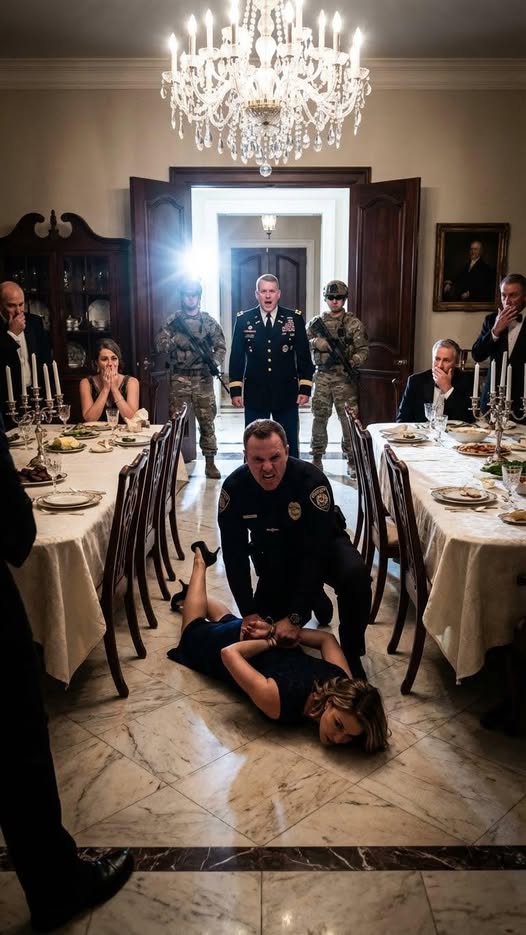
Now, I’m face down on the hardwood floor, the smell of lemon polish and dust filling my nose. My wrists are locked behind me in cold steel, and my brother’s knee is digging into my back with the force of an accusation he’s been rehearsing for years.
“You’re under arrest,” Ethan says, his voice loud enough for the crystal chandelier to tremble. “Impersonating a military officer. Theft of government property. Fraud.”
The room, filled with twenty-three relatives who once knew how to spell my name, goes silent. Forks freeze mid-air. Aunt Sharon gasps, a sharp intake of breath that sucks the oxygen out of the room. Grandma Eleanor, wheelchair-bound and barely seventy-five pounds of bird bones and iron will, grips her linen napkin like it’s the last shred of dignity left in the house.
And me? I don’t resist. I don’t beg.
I stare at the ceiling fan slowly spinning above the peach cobbler and wonder how many more seconds I have before the backup Ethan smugly called arrives to drag me out.
I used to think silence was the price of ambition. That if I worked hard enough, rose high enough, the noise of judgment would fall away on its own. But silence isn’t the absence of noise. It’s the weight of what people think they know about you, pressed down so hard it squeezes the breath out of your own truth.
Growing up in northern Carolina, I was the one nobody could quite figure out. My brother Ethan was the obvious choice for admiration—star athlete, class president, went straight into the police academy with a scholarship and a smile that made our father proud.
I, on the other hand, was the intense child. Too curious. Too quiet. Too precise. I kept notebooks filled with maps of global conflicts, read military field manuals under my blanket with a flashlight, and practiced Morse code instead of playing dress-up.
My mother used to whisper to her sister during church picnics, “Riley’s just… different. She doesn’t make things easy for herself.”
My father thought I was going through a phase. Right until the day I told him I’d been accepted into the Western Tactical Academy, one of the toughest military academies in the country.
He looked up from his coffee, blinked twice, and said, “You don’t need to prove anything to anyone, Riley. Especially not in a uniform.”
Ethan had just come home from his second year in police school. He laughed without looking at me, stabbing a sausage link. “She’ll quit before the second week. That place isn’t for girls who overthink things.”
That was the last summer I stayed home.
I left quietly. No big send-off. No family dinner. Just a rideshare to the airport at dawn and a bag packed with military precision. I didn’t look back.
What they didn’t know, what I never explained, was that I wasn’t running away to prove anything. I was running toward the only place that made sense. Somewhere rules meant something. Somewhere duty wasn’t a punchline.
I trained hard. I learned fast. And while Ethan was pinning on his sergeant badge in Greenville, I was crossing borders my family couldn’t even point to on a map, let alone comprehend.
They stopped asking about my work after a while. I stopped offering. And that silence grew between us like vines over something once living, choking it out.
Until the Sunday I came back.
Not for Ethan. Not for our parents. But because Grandma Eleanor sent me a handwritten invitation. And I owed her more than silence.
Grandma’s letter was written in the same soft cursive I remembered from childhood birthday cards—blue ink, steady hand, paper that smelled faintly of talcum powder and lemon oil.
Dinner at two sharp, sweetheart. Everyone will be there. I miss hearing your voice.
So, I booked a flight, pulled two days of leave, and chose my outfit like I was planning for a ceasefire. No uniform. No insignia. Just a simple black dress, sleeves to the elbow, and a string of pearls small enough to pass as modest. I tied my hair back and packed light.
I didn’t expect this to be easy, but I owed her kindness, even if the rest of them never earned it.
The house hadn’t changed. White brick, green shutters, the same ceramic frog on the porch that I used to hide keys under. What had changed was the weight in the air as I stepped inside.
Conversations paused mid-sentence. Glasses clinked awkwardly. I kissed Grandma’s cheek and tried to ignore the way Ethan’s eyes followed me across the room like a slow-burn security camera.
The table was set for twenty-four. Roast beef, green bean casserole, cornbread, peach cobbler cooling near the window. It looked perfect, just like it did every holiday growing up. And somehow, more dangerous than any foreign embassy I’d ever entered.
I sat between Aunt Carla and my teenage cousin Eli, who immediately asked if I’d been somewhere cool. I smiled and said, “Just D.C.,” which was true if you counted the sub-base war room at Fort Moss.
The small talk didn’t last. Halfway through the meal, Ethan cleared his throat.
“So, Riley,” he said carefully, dabbing his mouth with a napkin. “Still doing that… consulting gig?”
His voice was casual, but I felt the shift in the room. The way all heads tilted slightly toward me, waiting.
“Still at it,” I said, cutting my beef. “Same contracts, different problems.”
He chuckled once. A dry, humorless sound. “Strange. I looked up your company last week. Couldn’t find a single record of it. Not a website, not a phone number, not even a LinkedIn profile. You’d think a professional consultant would at least have a business card.”
Someone snorted quietly. Maybe cousin Rachel. Grandma stiffened but didn’t speak.
I forced a polite smile. “Some clients prefer discretion.”
Ethan leaned back, his expression sharpening. “Or maybe it’s easier to pretend to have a job when no one can verify anything. No colleagues, no supervisors. Just Riley and her endless classified excuses.”
My stomach clenched. Not out of guilt, but because I knew this was no longer dinner. This was the opening statement of a case he’d been building. And every guest at that table—they were his jury.
He stood up. The chair slid back with the scrape of finality. Ethan rose from his seat like a prosecutor stepping into closing arguments.
“I’ve spent the last four months looking into her,” he said, pulling a manila folder from beneath his blazer like a magician revealing the final trick. “Photos. Surveillance. Witness accounts.”
He laid it on the table, opened the flap, and began passing pictures down the line. Grainy shots of me entering secure buildings, leaving nondescript vehicles, picking up my dry cleaning with military dress blues visible under the plastic.
My mother looked at them with a slow-blinking frown. My father stared straight ahead at the centerpiece. Eli’s fork froze mid-air.
“Ethan,” Grandma’s voice was thin but sharp. “What is this?”
“Evidence, Grandma,” he said smoothly. “Of fraud. Of stolen valor. Of a fabricated life built to deceive this entire family.”
He turned to me, his eyes gleaming with righteous indignation. “You wear medals you didn’t earn. You lie about where you go. And you think we’re all too stupid or sentimental to call you on it. But I’m not. Not anymore.”
He pulled his badge from his pocket and laid it next to the folder.
“As a sworn officer of Greenville County, I’m placing you under arrest.”
I didn’t move. The room tilted just slightly, the way it sometimes did when a bomb threat wasn’t confirmed but was still likely.
“You don’t have jurisdiction over me,” I said calmly. My voice didn’t shake. My hands stayed folded in my lap.
“You’re not in a combat zone now, Riley,” he said, stepping around the table. “You’re in Grandma’s house. My jurisdiction. And this… this is real life, not your fantasy.”
The handcuffs clicked open in his hands. Aunt Carla gasped.
I stood slowly. Not because I feared what was coming, but because I refused to give him the theater he wanted. My chair didn’t screech. My face didn’t change.
When he reached for my wrists, I gave them to him.
The metal was cold and tight. He made sure of that.
“Riley Maddox,” he said, voice rising with triumph. “You have the right to remain silent.”
“Don’t do this,” Grandma said, standing with effort, her hands trembling on the table. “Ethan, this is not how we handle things.”
He didn’t even look at her.
The cuffs locked. My arms ached from the angle. Twenty-three people watched the girl they used to know become a criminal in their minds. Watched her be stripped of identity and dignity in one sweep of noise and certainty.
And I? I didn’t resist. Because some wars aren’t fought with fists.
They’re won in what happens next.
The front door blew open like it had been waiting for its cue.
No knock. No announcement. Just six sets of combat boots pounding across Grandma Eleanor’s hardwood floor, their cadence crisp, their silence louder than any siren.
The first man through was tall, silver-haired, and wearing more ribbons than anyone in that room had likely seen in real life. His dress blues were immaculate, his posture rigid with purpose.
I knew that walk. I knew that face. I knew that voice.
Major General Sterling Cross.
He didn’t look at Ethan. Not at first. He looked at me, standing there, face pressed against the floorboards, arms behind my back, wrists cuffed and skin already bruising.
His expression changed in an instant from controlled neutrality to something sharp and cold.
“Lieutenant Montgomery,” he said, his voice cutting through the dining room like an order across a war zone. “Step away from the General right now.”
Ethan blinked, one hand still gripping my elbow. He looked up, confused. “Excuse me,” he said, half-laughing, a nervous sound. “Who are you?”
General Cross didn’t repeat himself. He stepped forward. The other officers fanned out behind him, a wall of blue and gold. Their uniforms gleamed under the chandelier. My brother’s badge suddenly looked like a plastic toy in a grown-up’s game.
Ethan cleared his throat, trying to regain his footing. “Sir, with all due respect, this is police business. This woman is—”
“What she is,” General Cross interrupted, his voice dropping an octave, “is a decorated officer of the United States Army with active clearance above your entire department combined. She has served in four theaters, led two joint intelligence task forces, and briefed the National Security Council.”
He turned his gaze toward the man who had handcuffed me. His voice was lethal now.
“And what you’ve done, Lieutenant, is detain a federal asset in the middle of an ongoing classified operation.”
The words didn’t hit Ethan all at once. I watched them break over his face in waves. First disbelief. Then confusion. Then the beginning of something like horror.
“I… I didn’t know,” he stammered, stepping back. “She never said…”
“You never asked,” I said quietly from the floor.
The cuffs were removed with swift precision by a junior officer named Captain Vance. I stood up, brushing the dust from my dress. I rotated my wrists once, slowly, letting the red marks show.
I turned toward Ethan. And for the first time in my life, I watched my older brother look at me and finally see me. Not the misfit. Not the mystery. Not the shadow behind his promotions.
But the woman who outranked everyone in that house.
General Cross saluted. Sharp. Crisp.
“Brigadier General Maddox,” he said, loud and clear for all twenty-three relatives to hear. “Ma’am, we’re here to extract you.”
The dining room froze. The only sound was the hissing of Grandma’s oxygen tank and the quiet clink of Ethan’s badge falling from his numb fingers onto the rug.
And just like that, the trial Ethan had prepared for me became his own reckoning.
Ethan stepped back like the air had betrayed him. His lips parted, but no words came.
Around us, the silence was no longer stunned. It was heavy, accusatory, suffocating. My cousin Laurel dropped her fork; it clattered onto her plate like a gunshot. Uncle Mason leaned forward, squinting, as if trying to convince himself he wasn’t witnessing a hallucination.
My father looked like he might be sick. And my mother… my mother had covered her mouth with one trembling hand, as if that could hide the fact that for years she’d nodded along to every doubt Ethan ever voiced about me.
Ethan’s eyes locked on mine. Panic flickered behind them.
“You… you let me do this,” he said hoarsely. “You knew who you were. You could have stopped this.”
I tilted my head, rubbing my wrist. “You didn’t want the truth, Ethan. You wanted a confession.”
He opened his mouth again, but General Cross stepped between us, a monolith of authority.
“You conducted unauthorized surveillance on a federal officer,” Cross said coldly. “Including staking out her residence, photographing her movements, and hiring private investigators with no security clearance. You jeopardized multiple operations in the field.”
“I thought she was lying!” Ethan shouted, desperate now. “She never told us anything! We all thought—”
“You all thought I was less because I stayed silent,” I cut in. My voice wasn’t loud, but it stopped him cold. “Because I didn’t need your approval to matter.”
He stared at me, stripped now of every ounce of certainty. “You could have just told me.”
“No,” I said, stepping closer until I was inches from his face. “You don’t get to weaponize curiosity and then demand honesty. You weren’t asking questions, Ethan. You were digging graves.”
Behind me, Major Blackwell, my second-in-command, handed General Cross a slim dossier. His expression shifted as he scanned its contents.
“Three compromised operations,” he muttered, almost to himself, but loud enough to be heard. “Two agents dead in extraction. Communications breach confirmed.”
Ethan swayed slightly on his feet. The blood drained from his face.
“I didn’t mean to…”
“But you did,” Blackwell snapped. “You thought you were exposing a fraud. What you exposed was a General. And in the process, you got good people killed.”
I turned back toward the table. Twenty-three faces still frozen in place. No one moved. No one made a sound.
Except for Grandma Eleanor.
She lifted her eyes, her voice barely above a whisper.
“Riley… is this true? You’ve been serving… all this time?”
I looked at her. The only one who had asked without judgment in her voice.
“Yes, Grandma,” I said. And for the first time in years, I let the truth be seen. “Every single day.”
Three weeks later, I sat at the head of a steel conference table inside Fort Wexler’s secure intelligence wing. The blinds were drawn. The seal of the Department of Defense gleamed behind me. I wore my dress uniform—stars on my shoulders, ribbons on my chest. Not for show, but for clarity.
The door opened. Two federal marshals escorted Ethan in.
No badge. No belt. Just a gray suit that hung loose on a body that had lost the weight of arrogance.
He didn’t look like the man who’d shoved me to the floor in front of our entire family. He looked like someone who’d finally realized the gravity of the hole he’d dug.
“Mr. Montgomery,” I said, keeping my tone flat. “Please sit.”
He obeyed without a word. He didn’t look at me. He looked at his hands, folded on the table.
I slid a document across the steel surface toward him. A full summary of the surveillance operation he had conducted against me. Every photo. Every conversation he’d had with private contractors. Every point of failure.
“This is the scope of what you did,” I said. “You didn’t just humiliate me in front of our family. You compromised federal operations. You exposed me, and by extension, my team. Two of our assets were pulled out of position the night after your little performance. One didn’t make it out.”
He flinched. A tear tracked down his cheek.
“I didn’t know,” he whispered. “I thought… I thought you were lying.”
“Because the truth didn’t fit the story you needed,” I finished for him.
Ethan looked up. There was no more bravado in his eyes. No courtroom voice. No smirk.
“I was jealous,” he said softly. “Of your silence. Of your confidence. Of the fact that Grandma looked at you like she knew there was more to you. I wanted to drag you down so you’d look human again.”
I sat back, letting the words hang in the air.
“And now?”
He swallowed hard. “I know I was wrong.”
I nodded once. Cold and clean.
“I’m recommending prosecution,” I said. “No family interference. No special considerations. You’ll face sentencing like anyone else who compromises national security.”
He didn’t argue. For the first time in his life, Ethan had nothing left to say.
The call came two nights later.
“Grandma Eleanor.”
Her voice was steadier than I expected.
“I know what he did,” she said. “I don’t want to excuse it. But I need to ask you something.”
I closed the file I’d been reviewing and leaned back in my chair. “I’m listening.”
“I’m not calling for Ethan,” she said. “I’m calling for you.”
I waited.
“I watched my grandson humiliate you,” she continued. “And I watched you stay still. Composed. Quiet. Not because you were weak, but because you knew who you were. I’ve never been more proud.”
My throat tightened.
“But Riley… I don’t want this family to disappear. Not completely.”
I let the silence stretch. Let it settle between us like the dust of an old war neither of us asked for.
“I’m not coming back for Christmas dinners, Grandma,” I said gently.
“I didn’t think you would,” she whispered. “But I wanted to hear your voice. To say it plainly. You deserved better than we gave you.”
My eyes stung, not with grief, but with something quieter. Something that had waited thirty-two years to be heard.
“I know whatever happens with Ethan,” she added, “he’ll live with it. But I hope someday you’ll let yourself live, too. Not just serve.”
It was the only thing anyone had said to me in months that didn’t sound like an apology or damage control. Just love.
“I’m trying,” I said.
“I know,” she replied. “I always knew.”
And for once, I believed her.
Now, when people ask me about that night—about the dinner, the arrest, the boots marching into Grandma’s house—I don’t tell them about the chaos. I don’t talk about the cuffs or the folder, or the way silence dropped over that table like a guillotine.
I tell them this.
There is power in patience. There is clarity in choosing not to perform for people who’ve already decided who you are. And there is freedom in truth, even if it comes late. Even if it costs you something.
Ethan once thought he was saving the family from a fraud. But what he really exposed was a legacy no one in that room was ready to face.
Mine.
Not the loudest. Not the most praised. But the one who kept the country safer day after day without asking for applause.
And if I had to do it again—fly in quietly, sit down at that table, feel the cuffs snap around my wrists—I would.
Because now, when people hear the name General Riley Maddox, they don’t see a mystery. They see a woman who endured. A woman who served. And a woman who refused to be erased, even by her own blood.
That’s the legacy I chose. And I wear it better than any badge ever could.