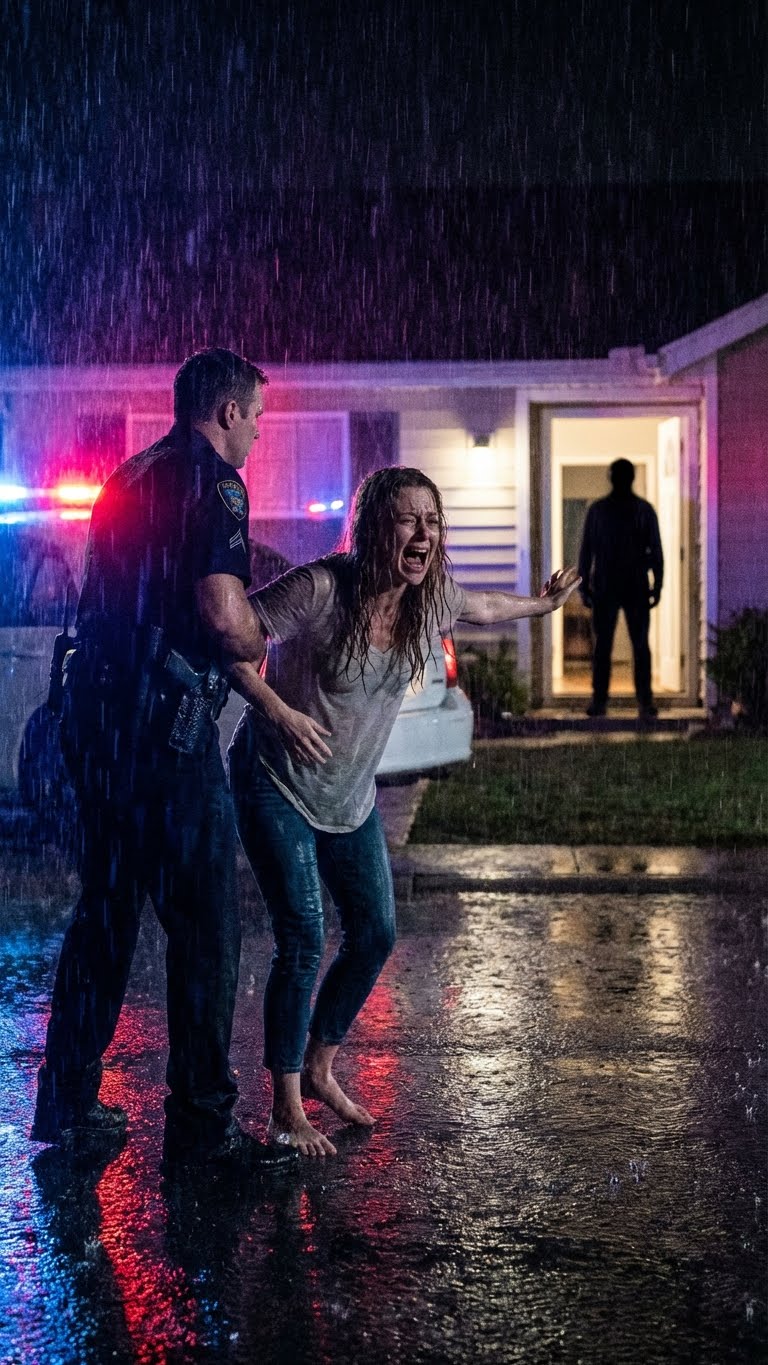
A heavy, calloused hand rested firmly on my shoulder, halting my desperate stride toward the porch. It was a tactile barrier between me and the nightmare waiting beyond the threshold.
“Ma’am, you shouldn’t look.”
The officer’s voice was gravelly, laced with a pity that turned my stomach. I ignored him, my eyes locked on the front door of my sister’s house. It was standing wide open, a dark, gaping maw in the afternoon sun. From the depths of that shadow, a sound drifted out—a low, rhythmic keening that scraped against the walls of my heart.
Crying. My daughter’s crying.
“Why?” The word clawed its way out of my throat, sounding foreign, brittle. “What happened to my daughter?”
The officer didn’t answer verbally. He didn’t have to. The grim set of his jaw and the way he shifted his weight told me everything I needed to know, yet everything I refused to accept.
If this had been three weeks ago, none of this would have happened. The regret washed over me, a bitter, acidic tide. Three weeks ago, I was packing my bags, flushed with the excitement of a career-defining opportunity. Five years into my tenure as a music teacher—a job I had taken to escape the burnout of my previous life in social work—I had been selected for a prestigious exchange program in Boston. It was my chance to breathe, to create, to be more than just a single mother surviving the grind.
But there was the logistical mountain: Who would watch Sophia, my five-year-old anchor?
I had turned to James, my ex-husband. Despite our divorce, we operated as a seamless unit regarding Sophia. But fate was cruel; James was booked for an overseas business trip for those exact three weeks. We were at an impasse.
That was when Amy stepped in.
“I’ll take Sophia,” my sister had said, her voice bright and eager over the phone. “I’d love to spend time with her. It’s been so long.”
I hadn’t seen much of Amy lately. Our lives had drifted onto different currents—me with the divorce and the teaching, her with her turbulent relationships and financial struggles. But she was my sister. She was the one who called me when her world fell apart, and I was the one who always picked up the pieces. I thought I knew her heart.
“Really? That would be a lifesaver,” I had replied, relief flooding my chest.
“She’s adorable,” Amy had smiled, a visual I clung to now. “I’m looking forward to it.”
There had been only one hesitation, a small, nagging splinter in my mind. Kevin. Amy’s new boyfriend. When I met him, he had radiated a cold, jagged energy. His eyes were flat, devoid of warmth, and he spoke in monosyllables. But Amy had squeezed my hand and insisted, “Kevin is sweet. He says he likes Sophia.”
I wanted to believe her. I needed to believe her. So, I boarded that plane to Boston.
Two weeks ago, the silence began. I tried video calling. Only Amy appeared, her face pale, deep shadows carved under her eyes. “She’s sleeping,” she had whispered, glancing nervously off-camera. “I don’t want to wake her.”
Ten days ago: “She’s playing outside. I’ll have her call you back.” The call never came.
A week ago: “She’s at the park with Kevin.”
Anxiety had bloomed in my chest like a dark flower, but I pruned it back with rationalizations. Amy was family. She would never hurt Sophia.
Three days ago, I finally heard my daughter’s voice. “Mama.” It was small, stripped of its usual vibrant color.
“Are you okay, baby? Are you having fun?”
“Yeah.” That was it. A hollow affirmative.
“Sophia, is something—”
“Sorry, dinner time!” Amy had interjected, ending the call abruptly.
That silence had haunted me until today. When I landed at the airport and my calls went straight to voicemail, anxiety hardened into terror. I took a taxi straight here. I found the lock changed. I saw the chaos through the window—the overturned furniture, the holes in the drywall.
And now, here I was.
I pushed past the officer, the primal need to see my child overriding his authority.
“Ma’am, wait!”
I crossed the threshold. The smell hit me first—a copper tang of old blood mixed with the sour stench of unwashed dishes and stale fear. The living room looked like a war zone. The sofa was eviscerated, stuffing spilling out like guts. The coffee table was splintered. In the kitchen, shards of ceramic crunched under my boots. On the refrigerator, a brownish smear. Blood.
“Miss Parker, please wait here!” Detective Sarah Chen appeared from the hallway. She was a woman in her forties with eyes that had seen too much darkness.
I ignored her. I ran toward the sound of the weeping.
The bedroom door was ajar. As I reached for it, a young uniformed officer stepped in my path. “Ma’am, please. You shouldn’t look.”
“Get out of my way,” I hissed, shoving the door open.
In the corner of the dim room, a small shadow was huddled against the wall.
It was Sophia.
She was curled into a ball, knees pulled to her chest. Her favorite pink dress was grey with grime and torn at the hem. Her hair, usually a halo of curls, was matted and tangled. But it was her face that stopped my heart.
A massive, purple bruise dominated her left cheek. Her lip was split and swollen. Her right eye was sealed shut, the skin around it black and blue. On her exposed arm, five distinct, circular bruises stood out—finger marks. The grip of someone who wanted to hurt.
“Sophia!” My voice trembled, cracking under the weight of my horror.
My daughter flinched violently. She pressed herself harder against the wall, covering her head with her arms. She didn’t recognize my voice. She only recognized the threat of an adult.
“Sophia… it’s Mama.” I moved slowly, dropping to my knees. I approached her like one would a wounded, cornered animal. “It’s okay. You’re safe.”
When I reached out to touch her, she winced, bracing for a blow. That small, instinctive reaction shattered whatever remained of my composure. My daughter was afraid of my touch.
“Sophia, look at me. It’s Mama.”
Slowly, she lowered her arms. Her one good eye tried to focus. Recognition sparked through the fog of trauma.
“Mama?”
“Yes, baby. It’s Mama. I’m here.”
Her face crumpled. “Mama!” The wail that tore from her throat was pure agony. I gathered her into my arms. She was so light. Too light. She clung to my neck, burying her face in my shoulder, sobbing my name over and over as if it were a prayer.
“There’s another one here,” an officer called out from the adjacent room.
Detective Sarah Chen emerged, supporting a woman who could barely walk. Amy.
My sister was a mirror of my daughter’s pain. Her face was swollen, her lip cut, her left arm cradled against her chest in a makeshift sling. Blood had seeped through her sleeve. She looked at me, her eyes swimming with tears and guilt.
“I’m sorry,” Amy sobbed, stumbling toward me. “I’m so sorry. I couldn’t stop him.”
I stood up, holding Sophia tightly against my hip. “Amy… what happened?”
“Kevin,” she choked out. “He… he just snapped.”
Detective Chen guided her to a chair. “The ambulance is on its way. They both need a hospital. Now.”
Fifteen minutes later, the interior of the ambulance was a blur of lights and static. Sophia sat on my lap, her small hand gripping my shirt so hard her knuckles were white. Amy lay on the stretcher opposite us, weeping silently.
At the hospital, Dr. Lisa Martinez, a pediatrician with gentle hands and eyes of steel, took Sophia away. The wait was an eternity. When Dr. Martinez finally emerged, her expression was grave.
“Miss Parker,” she said, leading me to a quiet corner of the hallway. “This is abuse. Severe abuse.”
“I know,” I whispered, leaning against the cold wall.
“There are multiple contusions,” she listed, her voice clinical but tight. “Face, arms, back. But there is also signs of an old fracture. The ulna in her left arm was broken about a week ago. It’s already begun to knit together without being set.”
“A week ago?” The world spun. A week ago, I had spoken to Sophia via text. She had a broken arm then. She was suffering then.
“Who?” I bit my lip until I tasted iron. “Who did this?”
“Your sister says it was her boyfriend,” Dr. Martinez said. “And looking at the severity… it takes significant force.”
I went back to the room. Sophia was sedated, sleeping fitfully. I sat beside her, holding her uninjured hand. From the hallway, through the cracked door, I heard Amy giving her statement to Detective Chen.
“He’s been getting violent lately,” Amy was saying, her voice trembling. “About two weeks ago. Work stress. He started punching walls. Then… then he hit me.”
“And Sophia?” Chen asked.
“He started hitting her too. I tried to stop him! I swear! But he hit me harder. He said if I told anyone, he’d kill us.”
I listened, fury building in my veins like molten lead. Kevin. That cold-eyed man.
“Do you know where he is?” Chen asked.
“He left last night after… after he went crazy again. I don’t know where he went.”
“We will find him,” Chen promised.
Two days later, they did. Kevin was arrested at a friend’s apartment. Detective Chen called me with the news.
“He’s denying everything, naturally,” Chen said. “But we have your sister’s testimony, the injuries, and the flight risk behavior. We have him.”
I should have felt relieved. I should have felt a sense of closure. But as I sat there watching the yellowing bruises on Amy’s face as she recovered in her own room down the hall, something gnawed at me. A persistent, itching wrongness.
I visited Amy. She cried again. “I was so scared, sis. He was sweet at first, but he changed.”
I hugged her, but my body remained rigid. I was crying, yes, but not just for the tragedy. I was crying because my gut—the instinct honed by five years of walking into broken homes and smelling lies—was screaming at me.
On the third day, I walked into Dr. Martinez’s office.
“Doctor, can I see the charts again? Detailed photos.”
Dr. Martinez paused, adjusting her glasses. “Is something wrong, Miss Parker?”
“I used to work for CPS,” I said, my voice steady. “For five years before I taught music. I’ve seen hundreds of abuse cases. Something isn’t sitting right.”
She blinked, surprised, then nodded. She spread the files on her desk.
I studied the diagrams. The map of pain on my daughter’s body.
“This injury,” I pointed to the large bruise on Sophia’s upper arm. “The size… the spacing of the fingers. That’s a large hand. An adult male, likely.”
“Yes,” Dr. Martinez agreed.
“But this,” I pointed to the bruising on her back and the shape of the impact on her cheekbone. “Look at the pattern. It’s a fist. But measuring the impact radius… it’s small. Too small for a man of Kevin’s size. I met him. He has hands like shovels.”
Dr. Martinez leaned in, her brow furrowed. She picked up a caliper and measured the bruise on the photo. She went pale. “You’re right. This is consistent with a much smaller hand. A woman’s hand.”
My heart began to hammer against my ribs. “Doctor… show me Amy’s chart.”
“Miss Parker, are you suggesting—”
“Show me.”
We opened Amy’s file. I looked at the photos of her face. The bruise on her right cheek.
“Kevin is right-handed,” I said, my voice dropping to a whisper. “I saw him write down his number for me. When a right-handed man punches you facing him, he hits your left cheek. Amy’s injury is on the right.”
I turned the page to the cuts on her arm. Parallel. Shallow. Uniform depth.
“Hesitation marks,” I said, the bile rising in my throat. “These are self-inflicted. She did this to herself.”
Dr. Martinez stared at me, horror dawning in her eyes. “My god.”
I left the office, the world tilting on its axis. The missed calls. The changed locks. The evasion. It wasn’t fear. It was control.
I called Detective Chen. “Sarah, I need to search Amy’s house. Again.”
“Why? We have Kevin.”
“Kevin is a scapegoat,” I said, my voice turning to ice. “My sister is the monster.”
The house was still a ruin, frozen in the violence of the police raid. But this time, I wasn’t looking at it as a victim. I was looking at it as a caseworker.
Abusers keep trophies. They keep records. They need to justify their narrative.
I ignored the staged chaos of the living room—the overturned chairs meant to look like a struggle. I went straight to Amy’s bedroom. It was too neat. The bed was made. Photos of us and our mother lined the walls—a shrine to a happy family that never really existed.
I began the search. Under the mattress. Behind the dresser. Inside the hollow curtain rod.
I knelt by the bed. There, taped to the underside of the bed frame, was a thin, battered notebook.
My hands trembled as I peeled it off. I sat on the floor and opened it.
October 14, 2010. Mom chose Nicole again. Nicole gets the scholarship. Nicole has the ‘potential.’ What am I? Just the spare part. Dad didn’t want me either.
I flipped forward.
Dad’s funeral. Nicole cried for ten minutes then left for her ‘important job.’ She left me with the debt. $30,000. I paid it. Me.
I turned to a page from three weeks ago.
Nicole wants me to watch Sophia. The Golden Child. The symbol of her perfect, successful life. She gets the money, the looks, the career. And now she dumps her brat on me? This is it. This is my chance. I’ll destroy her perfect little world. If I break Sophia, I break Nicole. It’s only fair.
The diary slipped from my fingers,
hitting the floor with a dull thud that sounded like a gavel sealing a verdict.
“Miss Parker?” Detective Sarah Chen’s voice drifted in from the living room, laced with concern. “Are you alright?”
I didn’t answer immediately. I couldn’t. The air in the room felt suddenly thin, sucked dry by the vacuum of my sister’s hatred. My hands, which had been trembling with shock moments ago, went perfectly still. A cold, clinical clarity washed over me—the same detachment I used to wear like armor when I walked into houses filled with screaming parents and neglected children.
I picked up the diary. Then, I resumed the search.
“Not yet,” I called back, my voice sounding strange to my own ears—flat, metallic.
I moved to the dresser. I pulled the bottom drawer out completely, feeling along the underside of the wood. My fingers brushed against something cool and smooth. Duct tape. I peeled it back. A smartphone dropped into my palm. A burner phone.
I powered it on. No passcode.
The screen illuminated, casting a ghostly blue light on the photos of my mother on the wall. I opened the messages. A thread with “K” dominated the inbox.
Two weeks ago.
Amy: “She’s crying again. That whining voice. It reminds me of Nicole. I can’t stand it.”
Kevin: “Just ignore her. I’m going out.”
Amy: “I can’t ignore it. I want to make it stop. I want to hurt her.”
Kevin: “Do what you want. Just don’t get me involved.”
Amy: “If I bruise her, I can say she fell. Or that you did it. You have a temper, Kevin. Everyone knows that.”
Kevin: “Don’t push me, Amy.”
Amy: “I own you. Remember the debt? You do what I say. We break the brat, we break Nicole. Then we get the money.”
I gripped the phone so tightly I thought the screen might crack. The narrative shifted violently. Kevin was a violent man, yes—indifferent and cruel—but he wasn’t the architect. He was the weapon. Amy was the hand that wielded him.
Everything had been a lie. Her tears in the ambulance, her trembling fear, her apology. It was a performance. A masterpiece of manipulation designed to cover a crime fifteen years in the making.
I walked out of the bedroom. Detective Chen looked up from a pile of papers. When she saw my face, she reached for her holster instinctively.
“What did you find?”
“Evidence,” I said, handing her the diary and the phone. “Kevin is guilty of abuse, but he’s not the primary aggressor. My sister is.”
Sarah read the texts, her expression hardening into stone. She looked at the diary entry. “Jesus.”
“I’m going to the hospital,” I said. It wasn’t a request.
“Nicole, you can’t. We need to process this. If you go in there angry—”
“I’m not angry, Sarah,” I interrupted. And I wasn’t. Anger is hot. Anger is messy. What I felt was absolute zero. “I’m a caseworker now. I need to close this file.”
“I’m coming with you,” Sarah said, grabbing her radio. “And we’re recording everything.”
The hospital room smelled of antiseptic and dying flowers. Amy was sitting up in bed, staring out the window. The sunlight caught the yellowing bruise on her cheek—the one she had inflicted on herself.
When the door clicked shut behind me, she turned. Her face instantly crumpled into that practiced mask of misery.
“Nicole,” she whimpered, reaching out with her good hand. “You came back. I was so scared you were mad at me for not protecting her.”
I didn’t take her hand. I pulled a chair to the foot of her bed and sat down, crossing my legs. I stared at her, silence stretching between us like a tightwire.
“Nicole?” She faltered, her hand dropping. “What’s wrong?”
“Stop it,” I said softly.
“Stop what?”
” The act. The victimhood. It’s exhausting, Amy. You must be tired.”
She blinked, confusion flickering in her eyes. “I don’t understand. I am a victim. Kevin—”
“Kevin is a brute and a coward,” I cut in. “But he didn’t break Sophia’s spirit. You did. And you did it to get to me.”
Amy’s expression shifted. The corners of her mouth tightened. “You’re talking crazy. Trauma does this, I know, but—”
“I found the diary,” I said.
The silence that followed was heavy, suffocating. The color drained from Amy’s face, leaving her looking like a wax doll.
“And the phone,” I added. “Under the dresser drawer. ‘We break the brat, we break Nicole.’ That was the plan, wasn’t it?”
Amy stared at me. For a long, terrifying moment, she didn’t move. Then, slowly, the trembling stopped. Her posture straightened. The tears evaporated as if they had never existed.
When she looked up, the eyes that met mine weren’t my sister’s. They were cold, dead voids.
She let out a short, dry laugh. “You always were the nosy one.”
“Why?” I asked, the question hanging in the sterile air. “I helped you. I paid your rent. I listened to you. Why Sophia? She’s a child, Amy. She’s innocent.”
“Innocent?” Amy spat the word like poison. “She’s a symbol, Nicole. She’s the trophy of your perfect, golden life. The scholarship, the career, the perfect daughter. Mom looked at her and saw an angel. She looked at me and saw a mistake.”
“That’s in your head,” I said, my voice shaking slightly despite my resolve.
“Is it?” She leaned forward, her voice rising to a hiss. “When Dad died, you walked away. You went back to your fancy school. I stayed with the debt. I stayed with the mess. And then the will… $150,000 for you. For Sophia’s education. $50,000 for me. Even from the grave, he loved your daughter more than he loved me.”
“I didn’t know about the debt,” I said. “You never told me.”
“I shouldn’t have had to tell you!” she screamed, the facade shattering completely. “You should have known! But you were too busy being perfect. So I decided… if I can’t have the perfect life, I’ll ruin yours. I wanted to see you break. I wanted to see you look at your broken daughter and feel exactly how I felt for fifteen years. Helpless. Worthless.”
“So you beat a five-year-old,” I said, disgust curling in my gut. “To settle a score with a ghost.”
“It was fairness, Nicole. Just fairness.”
I stood up. I looked at the stranger in the bed—a woman I had shared a room with, shared secrets with. I realized then that I wasn’t looking at family. I was looking at a tragedy of her own making.
“You’re insane,” I whispered.
“No,” she smiled, a chilling, triumphant curve of her lips. “I’m just the sister you left behind.”
The door burst open. Detective Chen strode in, two uniformed officers behind her.
“Amy Parker,” Chen said, her voice booming. “You are under arrest for conspiracy to commit child abuse, assault, and child endangerment.”
Amy didn’t fight as they handcuffed her good wrist to the bed rail. She didn’t scream. She just kept her eyes on me.
“Were we ever really sisters, Nicole?” she asked softly as the officers read her rights.
I paused at the door, my hand on the frame. I looked back at her one last time.
“I thought we were,” I said. “But you threw that away fifteen years ago. You chose hatred. And today, I choose my daughter.”
I walked out. I didn’t look back.
The legal system is a slow, grinding machine, but the evidence was overwhelming.
Kevin, faced with the text messages, turned state’s witness against Amy to save his own skin. He was sentenced to seven years.
Amy refused to plead guilty. She maintained she was the victim until the very end. But the diary—her own handwriting detailing the calculated destruction of a child—damned her. The judge, a stern woman who barely looked at Amy during the sentencing, gave her twelve years.
I never visited her. I blocked the calls from the prison. Every letter that arrived with her handwriting on the envelope went straight into the shredder, unopened. I didn’t need her apologies, and I certainly didn’t need her justifications.
My focus was entirely on the small, broken girl in the pediatric ward.
The physical wounds healed relatively fast. The broken bone knitted. The bruises faded from purple to yellow to nothing. But the invisible wounds were deep.
For the first three months, Sophia woke up screaming every night. She would thrash in her bed, crying out, “Don’t hit me! I’ll be quiet!”
Each time, I would rush in, gathering her sweating, trembling body into my arms. “You’re safe,” I would whisper into her hair, over and over, until my voice was hoarse. “Mama is here. No one will ever hurt you again.”
We started therapy with Dr. Patel, a child psychologist who used play to draw out the poison. Slowly, very slowly, the light began to return to Sophia’s eyes. She started to speak louder. She started to laugh without looking over her shoulder.
One year later.
The backyard was filled with the sounds of chaos—the good kind. Streamers fluttered in the breeze, and a banner reading “Happy 6th Birthday Sophia!” was draped between two oak trees.
I watched from the patio as Sophia chased a soccer ball, her laughter ringing out clear and bright like a bell. She was faster now, stronger. The shadows under her eyes were gone.
“She looks happy,” a voice said beside me.
I turned to see James, my ex-husband. He was holding a tray of cupcakes. Over the past year, our relationship had shifted. We weren’t lovers, and we weren’t just co-parents. We were allies. He had dropped everything when the news broke, flying back from overseas, standing by me in court, holding me up when I thought I would collapse.
“She is,” I smiled. “We made it.”
“You made it,” he corrected gently. “You saved her.”
Across the yard, Detective Sarah Chen was trying—and failing—to juggle three balloons, making Sophia giggle. Dr. Martinez sat on a bench, clapping along. Dr. Patel was manning the grill.
I looked at them. This mismatched group of people. Police, doctors, ex-husbands.
That night, after the cake was eaten and the guests had gone, I tucked Sophia into bed. She was clutching a new stuffed bear Sarah had given her.
“Mama?” she asked, her voice sleepy.
“Yes, baby?”
She hesitated, her fingers twisting in the bear’s fur. “Will Aunt Amy ever come back?”
My heart stuttered, but I kept my face calm. “No, sweetie. She won’t. She’s in a place where she can’t hurt anyone ever again.”
Sophia nodded, seeming satisfied. “Good. I was scared.”
“You’re safe now,” I smoothed the hair back from her forehead. “Mama will always protect you.”
She looked up at me, her large eyes serious. “Mama, I can’t forgive her. Is that bad? Dr. Patel says forgiveness is good.”
I lay down beside her, pulling the duvet up over us both.
“No, Sophia. You don’t have to forgive. Forgiveness is something you give when you are ready, and only if the other person deserves it. You did nothing wrong. You don’t owe her anything.”
I kissed her forehead. “But I learned something important from Aunt Amy.”
“What?”
“That family isn’t blood,” I said softly. “Blood is just biology. It’s just DNA. Real family is choice.”
“Choice?”
“Yes. It’s the people who choose to love you. Papa chose to fly home. Sarah chose to fight for us. Dr. Martinez chose to heal you. I choose you, every single morning when I wake up.”
Sophia’s eyes lit up, reflecting the glow of the nightlight. “Then I choose Mama too.”
Tears pricked my eyes, but they were happy tears. “I choose you too. Forever.”
“I love you, Mama.”
“I love you too. Forever.”
The next morning, the sun was shining with a brilliance that felt like a promise. I walked into the Child Protective Services office, the familiar smell of coffee and photocopier toner greeting me.
Six months ago, I had resigned from the music academy. I loved music, but my purpose had shifted. The fire that Amy had ignited in me hadn’t burned me down; it had forged me into something stronger.
I walked to my desk. My nameplate was there: Nicole Parker, Senior Case Worker.
I sat down and opened the first file on my stack. Case #4092. Female, age 5. Suspected neglect.
I took a deep breath. I picked up the phone.
Amy had chosen hatred, and it had consumed her. I chose to move forward. I chose to heal. And most importantly, I chose to stand between the monsters and the children they tried to break.
We survived. And now, we were truly living.
I dialed the number.
“This is Nicole Parker from CPS,” I said, my voice steady and strong. “I’m here to help.”