October rain in Connecticut doesn’t simply fall from the sky. It attacks. It presses down, cold and relentless, soaking through bones before it even reaches the ground. That Tuesday evening felt especially heavy, the kind of day that makes an older woman’s joints ache long before the storm begins. The sky was dark and bruised, thick with tension, as if it was holding back something violent.
I was driving my silver sedan along I-95, the windshield wipers moving wildly against sheets of rain. I had just finished a long volunteer shift at the small clinic in Ridgefield. My hands—rough and steady after forty years of nursing—rested firmly on the steering wheel. Those hands had closed the eyes of the dying and held the tiny fingers of newborns. I was sixty-five years old, and for the first time, I truly believed I had earned peace.
My house waited for me at the end of that road. A Craftsman-style home on a quiet stretch of land. It wasn’t just a building. It was my life in physical form. Every double shift, every missed holiday, every sacrifice I made while raising Julian alone was built into those walls. The smell of old books and lavender filled the rooms. It was my safe place. My refuge.
Then came the lights.
Blinding white lights exploded through the rain, erasing everything. A semi-truck lost control, sliding across the highway like a wounded animal. Steel screamed against steel. There was no time to react. No time to pray. Just the violent impact, the explosion of the airbag, and then silence.
As darkness swallowed me, my final thought wasn’t fear. It was Julian. I hoped he remembered where I kept the spare key to the safety box. I hoped he would water the hydrangeas David, my late husband, had planted. And then there was nothing.
For four months, I existed in a place between life and death.
It wasn’t peaceful. It was heavy, suffocating, like being buried under wet earth. I heard voices far away but couldn’t reach them. Machines breathed for me. Cold hands touched my skin. Sometimes a warm hand held mine. I knew it was Julian. I screamed his name in my mind, begging him not to leave.
Other times, the warmth vanished, replaced by sharp footsteps. High heels. Vanessa. Even in that dark place, her presence felt cold. Her voice was loud, sweet in a way that felt false. She spoke about numbers, timelines, and chances—not about me, not about hope.
When I finally woke up, the light hurt. My body felt wrong, heavy and weak. My throat burned with dryness. The room smelled of disinfectant and despair.
Julian sat by the window, staring at his phone. He looked older. Tired. Guilty. When I made a small sound, he froze. He didn’t rush to me. He stood slowly, like I wasn’t fully real.
“Mother,” he whispered.
I asked for water. He gave it to me. I asked how long it had been.
“Four months,” he said. “They told us you might never wake up.”
I searched his face for the boy I raised. The boy I worked myself to exhaustion for. But he wouldn’t meet my eyes.
“Where is Vanessa?” I asked.
Julian shifted nervously. “At the house. Things have changed. We had to make decisions.”
My stomach tightened. “What decisions?”
The door opened.
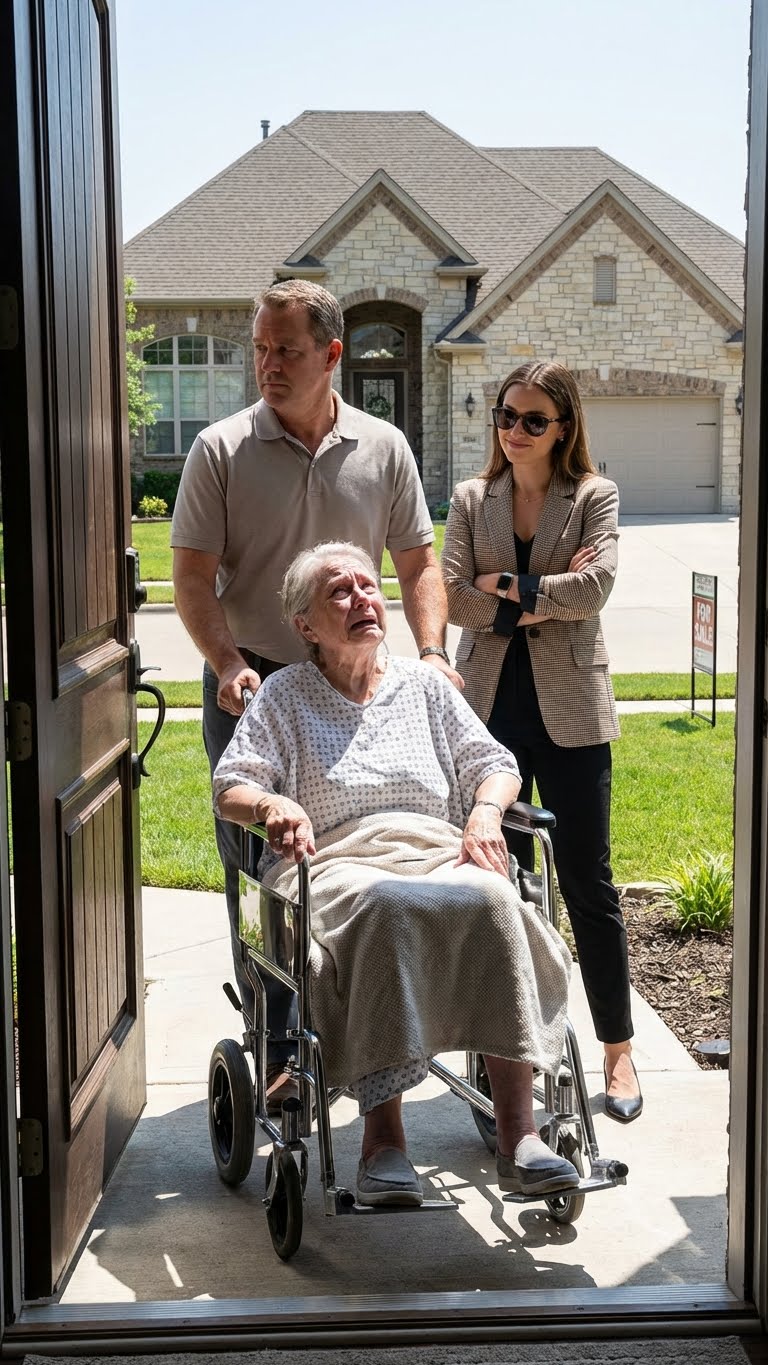
Vanessa walked in wearing an expensive trench coat, holding a latte and my Chanel handbag. The one David gave me for our anniversary. She smiled like nothing was wrong.
“Maggie! Back from the dead,” she said cheerfully.
“Why do you have my bag?” I asked.
She laughed. “We cleared out the master bedroom. We didn’t think you’d need it.”
My heart raced. “Who is in my house?”
Vanessa stepped closer. Her perfume filled the air. “You were in a coma. Medical bills were piling up. My parents lost their place. The house was empty. So we made a practical choice.”
“You sold my house?”
“We transferred the deed,” she said coldly. “We had power of attorney. My parents moved in. They fixed it up. It looks better now.”
I turned to Julian. “Tell me she’s lying.”
He looked down. “We thought you were dying. It seemed like the right thing.”
“The right thing?” I cried. “You gave away my home while I was still alive!”
Vanessa snapped. “You can’t live there anymore. You need care. We arranged everything.”
They told me about Silver Pines.
I knew that place. Everyone did. It was a warehouse for the forgotten.
The next day, I was taken there. The building was falling apart. The air smelled of neglect. I shared a room with three women. My bed was thin. On the table sat one photo—Julian as a child. That was all they brought.
Weeks passed. My body healed. My anger sharpened.
Julian visited rarely. He talked about work. About Vanessa’s parents. He never asked how I was.
One day, I asked about my garden.
“It’s gone,” he said. “Frank put gravel there.”
Something broke inside me.
When he mentioned a New Year’s gala at my house, I knew it was time.
I used the phone. I called Arthur Sterling.
Arthur Sterling wasn’t just a lawyer; he was a relic of a time when a handshake meant more than a contract. We had dated briefly in college before I met David, and over the decades, he had remained a steadfast friend, handling my will and David’s estate. He arrived at Silver Pines within the hour, wearing a wool coat that smelled of pipe tobacco and winter air.
He sat on the edge of my flimsy bed, his face hardening as I spoke. He didn’t interrupt. He listened as I detailed the power of attorney I had granted Julian years ago—meant for emergencies, not theft. He listened as I described the deed transfer, the eviction of my belongings, the erasure of my life.
“They made a mistake,” Arthur said finally, his voice low and dangerous. “A big one.”
“Can we get it back?” I asked.
“Maggie,” he said, taking my hand. “We’re not just going to get it back. We’re going to remind them who built it.”
Arthur began his work. He dug into the filings. He found the irregularities. The deed transfer had been rushed, sloppy. But more importantly, he found the clause in the original trust David and I had set up—a clause Julian had either forgotten or ignored. The house wasn’t just an asset; it was part of a living trust that required my explicit, conscious consent for any transfer while I was alive. The power of attorney had limits. Vanessa and her parents had bulldozed right over them.
But we needed the timing to be perfect. We needed them to feel safe.
December arrived, bringing snow that blanketed the grime of the nursing home yard. I focused on my recovery. I did my physical therapy with a vengeance. I walked the halls until my legs stopped trembling. I ate the tasteless food to build my strength. I was preparing for war.
Julian came to visit on Christmas Eve. He brought a poinsettia and a box of chocolates. He didn’t stay long.
“We’re having a big party for New Year’s,” he mentioned, checking his watch. “Vanessa’s parents are really going all out. They’ve invited the mayor.”
“That sounds lovely,” I said, my voice smooth as glass. “I hope you all have a wonderful time.”
He looked relieved. He thought I was broken. He thought I had accepted my fate as a discarded relic in a room that smelled of urine and bleach.
“I’ll come see you after the holidays,” he promised.
“I’ll be waiting,” I said.
And I would be. Just not here.
The plan was simple. Arthur had prepared the legal injunctions. He had contacted the local sheriff, an old friend of his who had no patience for elder abuse. We had the element of surprise.
On New Year’s Eve, Arthur arrived in a black town car. He brought a garment bag. Inside was my black silk dress—the one I had worn to Julian’s graduation, the one I had hidden in a box at the back of my closet that Vanessa had apparently missed. It fit a little looser now, but it still looked elegant.
I walked out of Silver Pines without looking back. The snow crunched under my boots. I breathed in the cold, clean air. It tasted like freedom.
“Ready?” Arthur asked, opening the car door.
“More than you know,” I said.
The drive to my house was surreal. I watched the familiar landmarks pass by—the old library, the bakery where I used to buy eclairs, the turnoff to the lake. My heart hammered against my ribs, not with fear, but with anticipation.
We pulled into the driveway. The house was lit up like a beacon. Cars lined the street. Music thumped from inside, a bass beat that felt alien to the old walls.
I saw Vanessa’s parents, Frank and Linda, standing near the front door, greeting guests as if they were the lords of the manor. They had repainted the front door a garish red.
Arthur offered me his arm. “Shall we?”
We walked up the path. The cold wind bit at my cheeks, but I felt nothing but heat.
The front door was unlocked. We walked right in.
The interior had been transformed. My cozy living room was now a stark, modern lounge. My books were gone. The fireplace David built with his own hands was painted white. Strangers in tuxedos and gowns milled about, drinking champagne, laughing.
I scanned the room. There, by the buffet table, stood Vanessa. She was wearing a silver sequined dress that caught the light, laughing at something a man was saying. Julian stood next to her, looking uncomfortable in a velvet blazer.
I took a step forward. The crowd parted instinctively, sensing the shift in the room’s energy.
Vanessa saw me first. Her eyes went wide. The champagne flute slipped from her fingers and shattered on the floor. The sound was like a gunshot.
The music stopped. The laughter died.
“Maggie?” Vanessa whispered. “What are you doing here?”
Frank and Linda rushed over, their faces flushing with indignation. “Who let her in?” Linda demanded. “This is a private party!”
“It certainly is,” Arthur said, his voice booming. “And you are trespassing.”
Julian stepped forward, pale as a sheet. “Mom? Arthur? What’s going on?”
“We’re here to correct a misunderstanding,” Arthur said, opening the leather folder he carried. “Specifically, the fraudulent transfer of this property and the illegal eviction of its owner.”
“That’s ridiculous!” Frank shouted. “We have the deed! Julian signed it over!”
“Julian signed a document he didn’t have the authority to execute,” Arthur countered calmly. “And you, Frank, accepted stolen property. That’s a felony.”
The word hung in the air. Felony.
Guests began to whisper. Some started moving toward the door.
“You can’t do this,” Vanessa hissed, her composure cracking. “It’s New Year’s Eve! We have the mayor here!”
“I don’t care if the President is here,” I said, my voice steady and loud. “Get out of my house.”
“Julian!” Vanessa screamed. “Do something!”
Julian looked from her to me. He looked at the house he had grown up in, the house he had betrayed. He opened his mouth, but no sound came out.
“It’s over, Julian,” I said softly.
Then, the flashing lights appeared outside. Blue and red, painting the walls through the windows. The sheriff walked in, followed by two deputies.
“Frank and Linda Miller?” the sheriff asked. “We have a warrant for your arrest. Fraud, elder abuse, and grand larceny.”
Linda screamed as the handcuffs clicked. Frank tried to argue, but the deputies weren’t listening. They were led out past the stunned guests.
Vanessa was sobbing now, clutching Julian’s arm. “Fix this! You have to fix this!”
Julian pulled his arm away. He looked at me, tears streaming down his face. “Mom, I…”
I walked up to him. I was small compared to him now, but in that moment, I felt ten feet tall. I leaned in close, so only he could hear.
“You knew,” I whispered. “You watched them throw away your father’s books. You watched them pave over my garden. You knew I was alone in that place, and you let it happen because it was easier than fighting her.”
He sobbed, a broken sound. “I’m sorry. I’m so sorry.”
“I know,” I said. “But sorry doesn’t buy back the house.”
I stepped back. “Arthur, please show them out.”
The house cleared out quickly after that. The guests fled like rats from a sinking ship. Vanessa left in a taxi, screaming into her phone. Julian left last, walking into the snow with his head bowed.
I stood in the center of the living room. It was quiet now. The mess was still there—the shattered glass, the half-eaten food, the garish decorations. But the air felt different. It felt lighter.
Arthur stayed to help me clean up the glass. We didn’t talk much. We didn’t need to.
“You okay, Maggie?” he asked as he put on his coat to leave.
“I will be,” I said.
He nodded. “Call me if you need anything. The legal process will take time, but the house is yours. The judge signed the emergency order this afternoon.”
“Thank you, Arthur. For everything.”
He left, and I was alone.
I walked through the rooms. My bedroom was unrecognizable. They had turned my sewing room into a walk-in closet for Linda. The kitchen had been stripped of my copper pots.
It hurt. It hurt to see the erasure of my life. But the walls were still standing. The foundation was still strong.
I went to the back door and looked out at the yard. The garden was gone, just as Julian had said. Covered in gray gravel. A fire pit sat where my hydrangeas used to be.
I closed my eyes and imagined the flowers. Blue and purple and pink. I could see them. I could smell the damp earth.
I slept on the sofa that night. I didn’t want to sleep in the bed strangers had used.
The next morning, I started work.
It took weeks to fix the damage. I hired a crew to rip out the gravel. I spent hours at the nursery, picking out new hydrangeas. I painted the front door back to its original deep green. I scoured antique shops to replace the furniture they had thrown away.
I found a new rhythm. I woke up early, drank my coffee on the porch, and worked until my muscles ached. It was a good ache. An honest ache.
Julian wrote letters. Long, pleading letters. He explained that Vanessa had left him. He explained that he was in therapy. He begged for forgiveness.
I read them. I folded them. I put them in a box. I never answered.
Forgiveness is a heavy thing. Sometimes, you have to set it down to keep moving. I wasn’t angry anymore. I was just… done. I had spent my life carrying him. It was time for him to walk on his own.
One year later, I sat on my porch as rain fell gently.
It was October again. The air was crisp. The leaves were turning gold and crimson. My garden was blooming, the new hydrangeas strong and vibrant against the rain.
I held a cup of tea, the warmth seeping into my hands. The house was quiet behind me, filled with the smell of old books and lavender again.
A car drove past slowly. I thought for a moment it might be Julian. But it kept going.
I took a sip of tea. I watched the rain.
I was sixty-six years old. I had lost everything and taken it back. I was alone, but I wasn’t lonely.
I was home.
And that was enough.