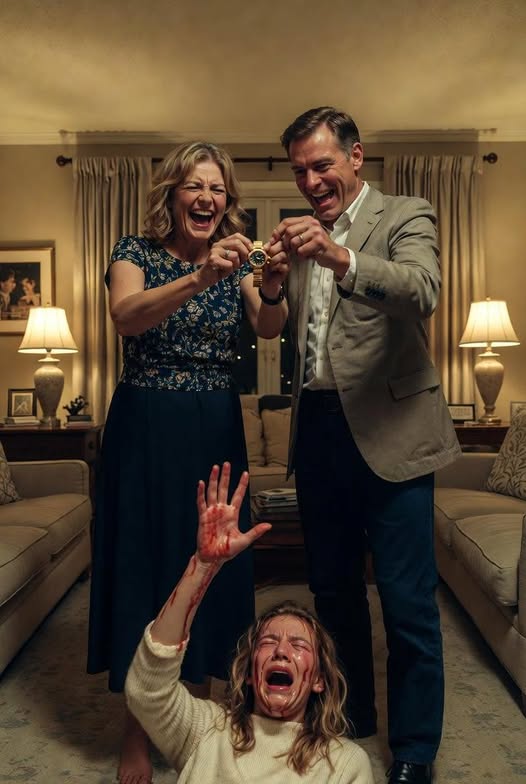
The phone call came on a Tuesday afternoon while I was reviewing quarterly reports in my gray, fabric-walled cubicle. It was an unknown local number, the kind I usually let go to voicemail, assuming it was a telemarketer or a political campaign. But something—maybe the oppressive silence of the office, maybe a flicker of intuition—made me answer.
“Is this Amelia Chin?” A gruff voice, carefully professional, scratched through the receiver.
“Yes. Who’s calling?”
“My name is Frank DeMarco. I own DeMarco’s Pawn & Gold on Riverside. I believe I have something that belongs to you. A Rolex Submariner.”
My heart stopped. The world tilted on its axis.
“That’s impossible,” I stammered. “I have my father’s watch right here.”
I yanked open my top desk drawer, the designated safe spot where I kept it during work hours to avoid scratching the crystal.
Empty.
A cold dread pooled in my stomach.
“Ma’am? You still there?”
“The watch…” I whispered, my voice barely audible. “It’s gone.”
“I was afraid of that,” Frank said, his tone heavy with sympathy. “Look, can you come down to the shop? There’s something you need to see, and I’d rather not discuss it over the phone.”
I left work immediately, feigning illness. My hands shook so violently I had to grip the steering wheel until my knuckles turned white. Dad’s watch was the only thing he had left specifically to me. I had checked it yesterday morning, running my fingers over the inscription on the back like a daily prayer: To my daughter Amelia, may time always be on your side. Love, Dad.
He had worn it every day of my childhood. Through his dusty construction jobs, during our quiet Sunday dinners, at every one of my school plays. Even during chemo, when his wrist became skeletal and we had to adjust the band, he kept it on. On his deathbed, he had pulled me close, his strength failing, and pressed the cool metal into my palm.
“This is yours, Mia. Only yours.”
That was three years ago. Two years before Mom married Richard. Eighteen months before Richard’s son, Tyler, moved in with his “big dreams” and an even bigger appetite for other people’s money.
DeMarco’s Pawn & Gold was wedged between a discount nail salon and a check-cashing place that charged predatory rates. It was the kind of strip mall where desperation had a permanent address.
Frank DeMarco looked exactly like a pawn shop owner should: thick neck, suspicious eyes that cataloged everything, a gold pinky ring that caught the light. But his expression when he saw me was unexpectedly kind.
“You look like him,” he said simply. “Your dad. He used to come in here sometimes, back in the day.”
“He did?”
“Construction guys always need tools. He was one of the good ones. Always paid back his loans. Never tried to pull a fast one.”
Frank disappeared into the back room, returning a moment later with a familiar, scuffed leather box.
“This came in yesterday. Guy said it was his to sell. But when I opened it up for inspection…”
He set the box on the glass counter and flipped the lid.
There it was. Dad’s watch. It looked smaller than I remembered, naked and vulnerable under the harsh fluorescent lights.
“Normally, I don’t question sellers too hard if the merchandise looks legitimate,” Frank continued, leaning forward. “But this watch… I knew your dad. I knew he’d never let this go. So, I did some digging in our old system. Your father pawned this watch exactly once, fifteen years ago. Paid it back with interest within a month.”
Frank’s eyes met mine, dark and serious. “The loan was for three thousand dollars. Records show it was right around the time you started at that fancy private high school.”
My throat tightened, a lump forming that made it hard to breathe. I had gotten into St. Mary’s Academy on an academic scholarship, but there were still fees, uniforms, books, activities. Dad had told me he picked up overtime work. He had never mentioned pawning his most precious possession.
“That’s when I knew something wasn’t right with this sale,” Frank said. “But that’s not why I called you.”
He picked up the watch with surprising delicacy, turning it over.
“When I was examining it, checking authenticity, I noticed something.”
He pressed a tiny release mechanism on the side of the casing, and the back popped open in a way I had never seen before.
“This isn’t standard,” Frank explained. “Someone modified this watch to create a hidden compartment.”
Inside the hollowed-out space lay a thin piece of paper, folded impossibly small.
“I haven’t read it,” Frank said, stepping back. “Figured if your dad hid it that carefully, it was meant for specific eyes.”
With trembling fingers, I unfolded the paper. Dad’s handwriting was smaller than usual, cramped but unmistakably his.
Mia, if you’re reading this, something has happened to the watch. Check the safe deposit box at First National. Box 447. The key is in my toolbox, inside the level. The watch is yours, but what’s in that box is your future. Don’t let anyone tell you different.
“Dad… you okay?” Frank asked gently.
“I… I need to buy the watch back,” I stammered, folding the note. “How much?”
Frank shook his head. “The guy who brought it in—tallish, maybe mid-twenties, kept talking about his ‘app startup’…”
Tyler. Of course.
“…he took cash for it. Eight thousand, five hundred dollars. But here’s the thing. I never filed the paperwork. Technically, this transaction hasn’t happened yet.”
“What do you mean?”
“I mean, I’ve been in this business thirty years. I know stolen goods when I see them, even when the thief has a key to the house.”
He slid the watch across the counter toward me.
“Take it. If anyone asks, it was never here.”
“I can’t just—”
“Your dad helped me once,” Frank interrupted, his gruff voice softening. “My kid needed surgery, and I was short on rent. He did a roofing job for me at cost. Let me pay him over six months. Man never mentioned it again. This is me settling up.”
I left the pawn shop clutching the watch to my chest, my mind racing. Dad’s toolbox was in the garage. Mom had wanted to throw it out during her “cleaning purge” when Richard moved in, but I had insisted on keeping it. The level he had mentioned was his favorite, an old Stanley brass-bound level he had taught me to use when I was eight.
But first, I had questions that needed answering.
I found Mom in the kitchen with Richard. They were hunched over coffee mugs and what looked like bank statements, whispering in hushed tones. They looked up when I walked in, and I saw it immediately—the guilt, quick and unmistakable—before Mom rearranged her face into a mask of confusion.
“Mia? What are you doing home so early?”
I set the watch on the granite counter between us. The heavy thud echoed in the kitchen.
“Looking for this?”
The silence stretched like taffy, thick and sticky.
“Where did you…” Mom started, her voice faltering.
“Where did I find the watch you stole from my desk drawer?” I cut in. “The watch you pawned for Tyler’s ridiculous app idea? The watch that was the only thing my father left me?”
My voice was steady, calmer than I felt. Inside, a storm was raging.
“Is that what you were going to ask?”
“Now, Mia,” Richard stood up, smoothing his polo shirt and using his mediator voice—patronizing and slick. “Let’s not be dramatic. Tyler needed capital for his business. It’s a bridge loan.”
“His third business,” I shot back. “After the food truck that never got off the ground and the cryptocurrency disaster.”
“This one’s different!” Mom interjected, desperate. “He has a partner. A business plan! It’s funded by… by assets.”
“Funded by stealing from me!”
“It’s not stealing,” Richard said firmly, crossing his arms. “We’re a family. Family shares resources.”
“Like Tyler shared his trust fund with me? Oh, wait. He spent that on a Mercedes and a trip to Cabo.”
“That’s different!”
“How? How is it different?”
Mom stood, her face hardening into that familiar look of disappointment she reserved for me. “Because Tyler has potential, Mia. He’s building something. You… you just sit on valuable things while people with vision need resources.”
There it was. The truth she had been dancing around since marrying Richard. I had a steady job, a boring life, no grand ambitions. Therefore, I deserved less. Tyler had dreams, loud and flashy ones; therefore, he deserved everything, including things that weren’t his.
“I want the money back,” I said quietly. “Every penny of the eight thousand five hundred dollars.”
Richard laughed, a short, barking sound. “We don’t have it. It’s already invested in TechnoSolutions. It’s illiquid.”
“Then liquidate it.”
“You can’t just—”
“Watch me.” I picked up the Rolex. “This was reported stolen this morning. I have the police report number. Either I get the money back, or I press charges.”
“You wouldn’t,” Mom gasped, hand to her throat. “Tyler could go to jail!”
“Tyler committed a felony. That’s not my fault.”
“After everything we’ve done for you!” Mom’s voice went shrill. “We let you live here!”
“I pay rent! Above market rate, actually!”
“We’re your family!”
“Dad was my family,” I said, my voice dropping to a whisper. “This watch was his legacy to me. And you let your husband and his son steal it like it meant nothing.”
I left them sputtering in the kitchen and went straight to the garage.
Dad’s toolbox sat under his old workbench, covered in a layer of dust but otherwise untouched. The Stanley level was in its usual spot. I picked it up, feeling the weight of it, the memories of sawdust and Saturday mornings flooding back. I checked the bubble chamber.
Inside, wrapped tightly in plastic, was a small, silver key.
First National Bank was downtown, a grand old building with marble floors that Dad had helped renovate back in the nineties. The safe deposit box required two keys—mine and the bank’s master key. The manager, an older woman named Mrs. Higgins who remembered my father, didn’t ask questions.
Box 447 was larger than I had expected. I carried it to a private viewing room, my hands trembling.
Inside were three things: A manila envelope, a leather-bound journal, and another letter.
I read the letter first.
Mia, if you’re reading this, then you found my little insurance policy. Your mother doesn’t know about this box. I started it when you were born because I knew, even then, you were going to be special.
The envelope has bonds—bearer bonds from my father—worth about $100,000 now, maybe more. The journal has all the details of the contracting business: client lists, contacts, and outstanding invoices that were never collected. There’s probably another $50,000 there if you want to pursue it.
But here’s what I really want you to know. I didn’t leave you just a watch. I left you time.
Time to choose your own path without worrying about money. Time to leave if you need to. Time to be yourself without apology.
Your mother is a good woman, but she sees the world in terms of who deserves what based on who makes the most noise. You are quiet, like me. That doesn’t make you less deserving. It makes you observant. Smart. Careful.
Use this wisely. And remember, the watch isn’t just jewelry. It’s a reminder that time is the only real currency we have. Don’t let anyone steal yours.
All my love, Dad.
P.S. If that boyfriend of yours is still around—the one who borrowed money and never paid it back—dump him. You deserve better.
I laughed through my tears. Even the boyfriend line—Dad had been dead on about Marcus, who I had dumped six months after Dad passed.
The bonds were there, as promised. The journal was filled with Dad’s meticulous records, including several big contractors who still owed him money. One name jumped out: Richardson Construction, which owed $15,000 for a job Dad completed a month before his diagnosis. They were still in business, still prominent. They probably hoped the debt had died with him.
They were wrong.
I spent that evening at a hotel, making plans. I couldn’t go back to that house. Not tonight.
The next morning, I hired a lawyer, Diane Vasquez, who specialized in estate recovery. She looked at Dad’s journal and smiled like a shark smelling blood in the water.
“Your father kept impeccable records,” she said, tapping the leather cover. “This is all actionable. The bonds are clean. And these debts? They don’t just disappear because someone dies. Statutes of limitations vary, but we have a strong case for most of these.”
“How long to recover it all?”
“The bonds? Immediately. The debts? Give me three months.”
I gave her the retainer and drove back to Mom’s house. I couldn’t think of it as home anymore.
They were in the living room. Tyler was there, gesticulating wildly about his app—some “revolutionary integration of blockchain and social media.” He stopped mid-sentence when he saw me.
“Amelia,” he said with his practiced charm, flashing a smile that didn’t reach his eyes. “Look, about the watch…”
“Save it,” I said, walking past him.
I turned to Mom and Richard. “I’m moving out today.”
“Don’t be ridiculous,” Mom started, rolling her eyes. “Over a watch?”
“Over a betrayal,” I corrected. “Over you choosing them over me, again and again. Over you letting them steal from me because you think I don’t deserve what’s mine.”
“Where will you go?” Richard asked, his eyes narrowing. He was probably calculating if they could rent my room for more money.
“That’s not your concern anymore.”
Tyler stood up, trying to look imposing. “I’ll pay you back when the app takes off. Seriously, Mia, you’re overreacting.”
“No,” I said, meeting his gaze. “You’ll pay me back now. Eight thousand, five hundred dollars. Plus interest. My lawyer will be in touch.”
“Lawyer?” Mom went pale. “Mia, you can’t!”
“I can. I am.”
Dad always said, “The best time to stand up for yourself is the moment you realize you’re being stood on.”
I packed my things. Not much, really. Most of what mattered fit in two suitcases. The watch went back on my wrist, where it belonged.
As I loaded my car, Mom came out one last time. She stood on the porch, arms crossed against the chill.
“Your father would be ashamed,” she said coldly. “Turning on family like this over money.”
I looked at her—really looked at her—and saw the woman who had stood by while her new family dismantled my old one, piece by piece.
“My father,” I said clearly, “left me more than you ever knew. And the only thing he’d be ashamed of is that it took me this long to see you for what you really are.”
I drove away and didn’t look back.
The bonds cashed out at
127,000∗∗.TheyhadaccruedmoreinterestthanDadhadcalculated.Dianerecovered∗∗127,000∗∗.TheyhadaccruedmoreinterestthanDadhadcalculated.Dianerecovered∗∗43,000 of the outstanding debts within six weeks. Richardson Construction paid in full to avoid a lawsuit that would have exposed their pattern of stiffing contractors.
Tyler’s app failed within three months. He blew through the watch money on office space and logo design, never actually building the product. Richard called me once, asking if I could “help out with a small loan” to cover Tyler’s legal fees for something unrelated. I hung up.
Mom tried reaching out through relatives, painting me as the ungrateful daughter who abandoned family over material possessions. I sent them all the same response: a photo of the police report for the stolen watch, with Tyler’s name highlighted.
The calls stopped.
I used Dad’s money to buy a small house in the neighborhood where he had grown up. Nothing fancy, but solid. “Good bones,” he would have said. I kept his toolbox in my garage, his level still in its place of honor.
The watch sits on my nightstand at night, ticking steady as a heartbeat. Sometimes I open the secret compartment just to make sure the note is still there, to reassure myself that Dad really did think ahead. That he really did protect me, even after he was gone.
Time is the only real currency we have. Dad knew that. He knew that the watch would matter to me, not for its monetary value, but for what it represented: all the time we had together, all the time he had worked to give me a future.
He also knew something else: that eventually, someone would try to steal it from me.
So, he made sure that even if they took the watch, they couldn’t take what really mattered.
The time to choose my own life. The time to stand up for myself. The time to realize I had always been worthy of every second.
The watch is mine again. But more importantly, so is my time. And I’m not wasting another minute of it on people who think they deserve it more than I do.