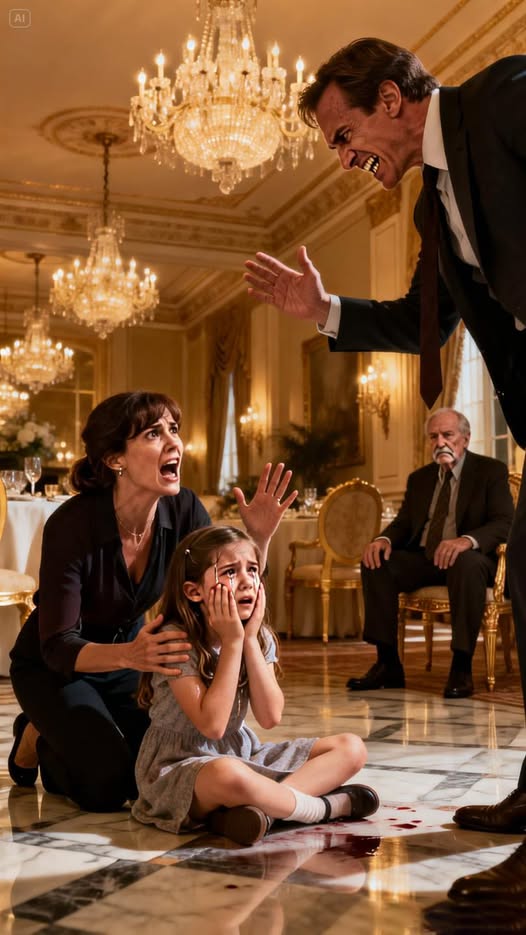
I didn’t turn around when the sound landed. It wasn’t a thud or a dull impact; it was a sharp, wet crack—skin colliding with skin at a velocity born of pure, unfiltered malice.
The noise froze the room. It rearranged the rhythm of my heartbeat, skipping a cycle and then hammering against my ribs like a trapped bird. For a second, the air in the private banquet hall of the Meridian Club seemed to crystallize, suspending the dust motes in the stage lights.
My daughter, Maya, didn’t cry immediately. She blinked. Her small hand rose slowly to her cheek, her eyes wide and confused, processing a betrayal she didn’t have the vocabulary to name.
That silence was worse than any scream.
Then came the laughter. It was a bark, sharp and jagged. My brother, Julian, stood over her, shaking his hand as if he were the one who had been stung.
“Like mother, like daughter,” Julian sneered, his voice booming in the empty hall. He adjusted his silk tie, the movement fluid and practiced. “Both of you are useless. Can’t even hold a ribbon straight for the ceremony.”
I tasted iron. I had bitten the inside of my cheek so hard I’d drawn blood.
I turned then, my movements slow, underwater. My father, the great patriarch, sat ten feet away in the front row. He didn’t stand. He didn’t rush to his seven-year-old granddaughter. He didn’t even look surprised. He sat with his legs crossed, studying the scene with the detached amusement of a critic grading a mediocre performance.
“Well,” my father said, his voice slow and thick with smug satisfaction. “She needed to learn some shame, Elena. Discipline is the backbone of character.”
They thought we were alone. They thought the rehearsal was over, the technicians gone for lunch. They were so drunk on their own untouchability that they missed the detail that would eventually bury them.
No one noticed the lavalier microphone still clipped to the podium where Julian had been practicing his speech. No one noticed the small, unblinking red light on the console in the shadows of the sound booth.
I did.
That was the moment something old, patient, and terrifying woke up inside me. It wasn’t rage. Rage is hot; it burns out. This was cold. This was absolute. It was resolve.
“Get in the car, Maya,” I said. My voice sounded foreign to my own ears—hollow, metallic, stripped of all tremor.
“Elena, don’t be dramatic,” Julian scoffed, turning his back to me to admire his reflection in the darkened glass of the window. “It was a tap. She needs to toughen up if she’s going to carry the Hawthorne name.”
I didn’t answer. I walked to my daughter, picked her up—she was too big to be carried, really, but she curled into me like an infant—and walked out.
As the heavy oak doors swung shut behind me, sealing them in their echo chamber of arrogance, I knew two things. First, I would never let them touch her again. And second, I wasn’t just leaving. I was going to war.
We weren’t always like this. That is the part people don’t understand. Betrayal only cuts deep when there was once loyalty; otherwise, it’s just combat.
I grew up believing blood meant protection. The Hawthorne family was an institution in our coastal city, a name plastered on library wings and hospital wards. My father, Richard Hawthorne, built my brother like a monument. Julian was the Golden Boy—loud, charismatic, athletic, the kind of man who failed upward with a safety net woven from our father’s money and influence. He was dared by the world to disagree with him, and the world, largely, declined the challenge.
I was the quiet one. The Fixer.
While Julian was being groomed for photoshoots, I was in the back office learning the tax codes. When Julian crashed his car in college, I was the one who spoke to the police, smoothed over the insurance, and drove him home in silence. I was the one who cleaned the messes, buried the secrets, and kept the machinery of the Hawthorne legacy oiled and humming.
I thought that was my value. I thought being useful was the same thing as being loved.
When my marriage imploded three years ago—a quiet, sad implosion of drift rather than explosion—I moved back to the estate temporarily.
“Family supports family,” my father had said, opening the door. He looked benevolent then. “Bring Maya. We’ll take care of you.”
I believed him. I shouldn’t have.
The toxicity didn’t start with a slap. It started with the slow drip of poison. It was the jokes at Sunday dinner that landed just a little too hard. Elena’s let herself go. Elena’s too soft on the girl. No wonder her husband left.
It was Julian correcting my parenting in front of guests, his tone patronizing, treating me like a hired nanny rather than a sister. It was my father nodding along like an approving judge, reinforcing the hierarchy: Men rule, women serve, and Elena endures.
I told myself it was stress. I told myself it was just their way—old-school, rough around the edges. I told myself to endure because I had nowhere else to go, and because I was saving money to buy a house for Maya.
That is how abuse survives. It camouflages itself as tradition. People call it patience; victims call it survival.
But the slap? The slap wasn’t the beginning. It was the confirmation. It was the physical manifestation of what they had been doing to my spirit for three years.
I buckled Maya into her booster seat in the parking lot. She was quiet, rubbing her cheek.
“Did Uncle Julian mean to hurt me?” she asked, her voice small.
“Yes,” I said. I wouldn’t lie to her. Not anymore. “But he will never do it again.”
” Is Grandpa mad at me?”
“No, baby. Grandpa is broken. And we aren’t going to let his broken pieces cut us anymore.”
I drove to a motel three towns over. I didn’t go to a friend’s house; I didn’t want the questions yet. I needed silence. I needed to think.
Inside the sterile room, smelling of industrial lemon cleaner and old cigarettes, I started counting. I replayed everything I had ignored. The way Julian bragged about “handling” the zoning commission for his new development. The casual cruelty he showed to waiters. The way my father excused it all as discipline, as “the cost of doing business.”
I opened my laptop. I didn’t cry. I didn’t scream into a pillow. I logged into the cloud server I had set up years ago for the family business—the one only I managed because Julian couldn’t be bothered with passwords and my father still typed with two fingers.
I checked the audio files from the Meridian Club first.
The system was set to auto-upload from the rehearsal console for archival purposes. I downloaded the file. I put on my headphones.
It was all there. Clear. Clean.
The crack.
The silence.
The laugh.
“Like mother like daughter. Both are useless.”
My father’s slow, smug approval.
I listened to it three times. I didn’t smile. Not yet. This was just the ammunition. Now I needed the gun.
For the next three weeks, I was a ghost.
I moved us into a small rental apartment on the other side of the city. I blocked their numbers, but I didn’t block their emails. I needed to see them spiral. They sent threats first—You’re cutting yourself off from the money, my father wrote. Then came the gaslighting—You’re overreacting, you’re mentally unstable, Julian texted.
I didn’t respond. I was too busy digging.
I had been the family bookkeeper for a decade. I knew where the bodies were buried because I had been the one handed the shovel, though I had never looked under the tarp. Now, I lifted it.
I spent my nights surrounded by spreadsheets and bank statements, illuminated only by the blue light of my monitor. Maya slept in the next room, finally breathing easy, while I dismantled my father’s legacy line by line.
I found the trust accounts first. The educational trusts set up by my late mother for all the grandchildren—Maya included. My father had been draining them. He wasn’t even clever about it. He treated them like a personal piggy bank to cover Julian’s gambling debts and failed investments. Maya’s college fund was gone. Replaced by a promissory note that wasn’t worth the paper it was printed on.
Then I found the business licenses. Julian had been borrowing contractor licenses for his development firm because his own had been revoked after a DUI incident two years ago—an incident I had helped hush up. He was building high-end condos using a license that belonged to a man who had been dead for six months.
And finally, the nonprofit. The Hawthorne Community Foundation. The jewel in my father’s crown. I had attended those board meetings silently, recording minutes that no one else bothered to read. I pulled the transcripts. I matched them against the bank withdrawals.
They were funneling donations. Money meant for the local children’s hospital was being routed through a shell company to pay for the maintenance of the yacht and the renovation of the Greenwich house.
Patterns emerged. So did leverage.
It was sickening. It was undeniable. It was enough to put them both in prison for a very long time.
But I didn’t want to just call the police. The police take time. Lawyers make deals. Wealthy men like Richard and Julian Hawthorne knew how to survive a legal battle. They could spin it, delay it, bury me in motions until I ran out of money.
No. I needed something faster. I needed something that couldn’t be spun.
I met with a lawyer, a shark named Sarah who had a reputation for hating men like my father. I didn’t mention my feelings. I didn’t cry in her office. I laid out the facts. Dates. Amounts. Audio files. Witnesses.
Sarah looked at the stack of evidence, then at me. She took off her glasses.
“You realize,” she said, her voice quiet with awe, “that this is a nuclear option? If we file these, there is no going back. You will be burning the house down with them inside.”
“The house is already rotten, Sarah,” I said. “I’m just lighting the match.”
“We can file the fraud reports with the SEC and the DA tomorrow,” she said. “But these things take time to become public. They might try to smear you in the interim.”
“Let them try,” I said. “I have one more thing to do before the filings hit the news.”
“What’s that?”
I looked at the calendar. “The Annual Hawthorne Gala is this Saturday. At the Meridian Club.”
Sarah smiled. It was a sharp, dangerous thing. “I see.”
The night everything collapsed, the air was thick with expensive perfume and the false camaraderie of the elite.
I arrived at the Meridian Club ten minutes after the speeches began. I wasn’t on the guest list, but the security guard, old Mr. Henderson, knew me. He’d known me since I was a child. He waved me through, thinking I was there to fix a seating chart or calm a donor.
“Good to see you, Miss Elena,” he nodded. “They’re already on stage.”
“Thanks, Arthur,” I said. “I won’t be long.”
I slipped into the back of the ballroom. It was a sea of black ties and sequins. At the front, bathed in the golden glow of the spotlights, stood my family.
Julian was center stage, holding a crystal award, looking every inch the benevolent prince. He was handsome, I’ll give him that. He radiated a confidence that came from a lifetime of never being told ‘no’.
My father sat behind him on a velvet chair, looking like a king on a throne. He was nodding as Julian spoke about “integrity,” “family values,” and “protecting the innocent.”
The hypocrisy was so physical it nearly made me gag.
I moved through the shadows, skirting the edge of the room until I reached the sound booth. The door was unlocked.
The technician, a young guy named Dave with headphones around his neck, jumped when I entered.
“Miss Hawthorne? I thought you weren’t coming.”
“Change of plans, Dave,” I whispered. “My father wants me to queue up a special audio clip for the tribute section. It’s a surprise for Julian.”
Dave didn’t hesitate. Why would he? I was the Fixer. I was the one who paid his invoices. I handed him a USB drive.
“Track one,” I said. “It needs to play loud. Over the PA system. Interrupt him right… now.”
“Now?”
“Trust me,” I said. “It’s part of the show.”
Dave shrugged and plugged it in. He slid the fader up. He pressed play.
I stepped back, leaning against the cold wall of the booth, and watched through the glass.
On stage, Julian was mid-sentence. “…and that is why the Hawthorne name stands for—”
CRACK.
The sound was deafening over the club’s concert-quality speakers. It wasn’t just a slap; amplified, it sounded like a gunshot.
The room froze. Julian stopped talking, looking confused, checking his microphone.
Then came the whimper. Maya’s confusion.
Then the voice. Julian’s voice.
“Like mother, like daughter. Both are useless.”
The crowd rippled. You could see the confusion turning to shock. People glanced around, wondering if this was some avant-garde performance art.
Then my father’s voice filled the cavernous hall, booming from the rafters like a twisted deity.
“Well… She needed to learn some shame. Discipline is the backbone of character.”
The recording ended.
The silence that followed was heavier than the slap had been. It was a vacuum. It sucked the oxygen out of the room. No one gasped. No one whispered. It went dead.
Silence is louder than outrage.
On stage, Julian’s smile drained away like bad watercolor in the rain. He looked at the sound booth, his eyes wild. My father stood up, knocking over his chair. He looked small. For the first time in his life, he looked exposed.
I stepped out of the booth and walked down the side aisle toward the stage. I didn’t run. I didn’t shout. I walked with the calm, terrifying centering of a woman who has nothing left to lose.
Every head turned to me. Five hundred people. The mayor. The donors. The neighbors who had whispered about my divorce.
I stopped at the foot of the stage. I looked up at them.
“Is that real?” someone from the front table asked. It was Mrs. Gable, the head of the hospital board.
I turned to her. I didn’t need a microphone. In the silence, a whisper would have carried.
“Yes,” I said. “That was three weeks ago. That was my daughter.”
“Is there more?” a man asked from the back.
I looked at my father. He was gripping the podium, his knuckles white. He was shaking his head at me, a silent, desperate plea. Don’t. Don’t do this.
I smiled. It didn’t reach my eyes.
“There is,” I said to the room. “The fraud reports regarding the charity funds and the trust thefts were filed with the District Attorney this morning. This was just the introduction.”
I turned and walked out. I didn’t look back. Behind me, the dam broke. I heard the murmurs turn to shouts, the scraping of chairs as people stood up, the frantic, high-pitched voice of my brother trying to regain control of a narrative that had just incinerated.
The fallout wasn’t dramatic in the way movies are. There were no high-speed chases or screaming matches in the rain. It was surgical. It was clinical.
It turns out, respectability is a currency, and my family had just gone bankrupt.
Sponsors pulled out within forty-eight hours. The local papers, usually so deferential to the Hawthorne name, smelled blood. The audio recording leaked online—I might have helped that along—and became the most shared file in the state.
Board members resigned in droves, desperate to distance themselves before the audits began. The investigations I had triggered didn’t start because I demanded them; they started because now, with the public watching, the authorities had no choice.
My brother lost his contractor licenses first. Then the bank called his loans. Then his “friends”—the entourage of hangers-on who drank his scotch and laughed at his cruel jokes—vanished into the ether.
I saw Julian once more, months later, outside the courthouse where he was being arraigned for fraud and embezzlement.
He didn’t yell. He didn’t threaten. He looked deflated. His expensive suit hung loosely on him, and his hair was thinning, as if the stress was eating him from the inside out. He looked like someone had unplugged the myth he lived inside.
“You ruined us,” he said, stopping on the sidewalk. He didn’t sound angry. He sounded confused, like a child who couldn’t understand why the game had changed.
I tilted my head, looking at him. I saw the bully who had terrorized my childhood, the man who had struck my daughter, and I felt nothing. No fear. No pity. Just a vast, cool indifference.
“No, Julian,” I replied softly. “I just let you speak.”
I walked past him. He didn’t follow.
My father never apologized. That would require a level of self-reflection he was biologically incapable of. Instead, he sent a letter. It arrived at my new house—a small cottage I bought with the settlement from the civil suit I won against the estate for the mismanagement of Maya’s trust.
The letter was ten pages of excuses, history, and blame disguised as wisdom. He talked about “burden of leadership” and “ungrateful children.” He tried to frame his cruelty as a necessary evil to build the empire.
I didn’t read it twice. I walked to the kitchen sink, struck a match, and burned it over the stainless steel basin. I watched the heavy, cream-colored paper curl into black ash and wash away down the drain.
Some people confuse forgiveness with forgetting. They think “moving on” means pretending the wound never happened. I don’t. I remember every moment. I just refuse to carry the weight of it anymore.
Tonight, the wind is coming off the ocean, rattling the wind chimes on my porch. Maya is asleep in the next room.
She is eight now. She takes karate lessons on Tuesdays. Last week, a boy at school pushed her on the playground. She didn’t cry. She didn’t shrink. She told him firmly to stop, and when he didn’t, she went to the teacher and filed a report.
She stands taller. She laughs louder. She knows her worth because I showed her how to protect it—not by shouting, not by striking back in blind rage, and not by becoming what hurt us.
We protect it with truth.
I sit on the porch with a glass of wine, listening to the quiet. It’s a different kind of silence than the one I grew up with. That was the silence of repression, of secrets held tight in the throat. This is the silence of peace.
My family is gone. The Hawthorne estate was sold to pay off the legal debts. The name, once a golden ticket in this town, is now a cautionary tale about hubris.
They called me vengeful. They called me a traitor to my blood. I let them. I don’t care about the labels they paste on the woman who burned down the castle to save the princess.
I didn’t destroy my family. I exposed it. I stripped away the veneer of wealth and tradition to show the rot underneath.
And in the end, that microphone didn’t just catch a moment of abuse. It caught the truth. And the truth is merciless when you give it a stage.
I take a sip of wine and look at the moon. The air tastes clean. No iron. Just salt and freedom.
I am not the Fixer anymore. I am the Architect of my own life. And the foundation is solid.