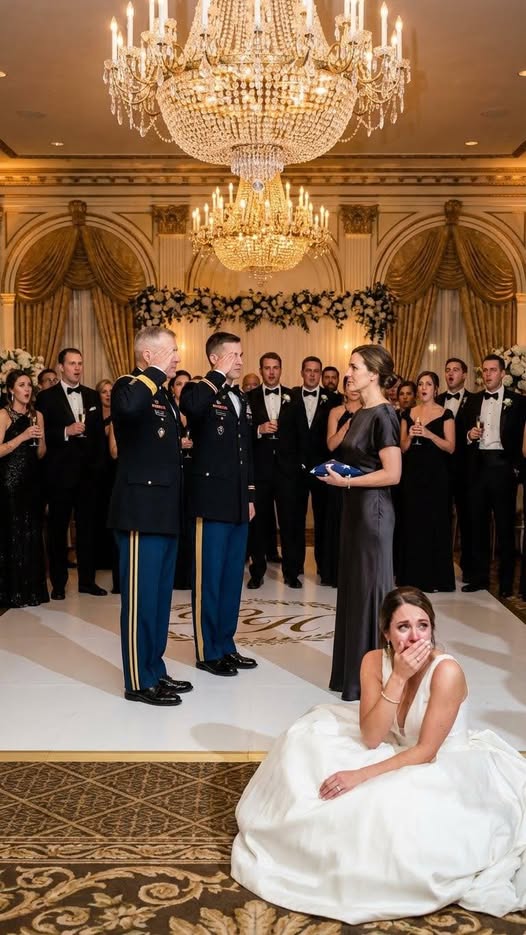
The air in the reception hall was aggressive, thick with the cloying scent of Stargazer lilies and the sharp, crystalline chimes of champagne flutes meeting in celebration. It was a perfect symphony for a perfect wedding. To the untrained eye, the scene was a masterpiece of marital bliss. But I wasn’t looking with an untrained eye. I was looking for cracks in the foundation.
Then, a sudden, suffocating silence fell from the head table.
General Marcus Thompson, the groom’s father and a decorated four-star general, rose to his feet. He moved with a quiet, hydraulic purpose that instantly commanded the attention of the entire room. His gaze wasn’t on the bride, nor his son. It was locked directly onto me.
Sitting in the back, near the kitchen doors where my mother had suggested I would be “more comfortable,” I watched him approach. He walked past the head table, his stride eating up the distance, stopping just three feet before my secluded table. The sound of his heels clicking together echoed in the dead air like a pistol shot.
He rendered a salute so sharp, so precise, it was a work of art. A kinetic sculpture of respect.
His voice, trained to command armies, rang with absolute clarity. “Ma’am, it is an honor to stand in your presence.”
I could only offer a short, professional nod in return. The only acknowledgment protocol allowed.
As the General held that salute, a silent, unshakable statue of reverence, I watched my sister’s world shatter. Her flawless practice smile dissolved into a mask of slack-jawed disbelief. Her new husband, Kevin, went pale, a sheen of sweat suddenly visible on his forehead like morning dew. And my parents… their faces were a slow, agonizing masterpiece of confusion twisting into dawning horror. They were witnessing a reality they had refused to believe was possible.
It had all started just twenty-four hours earlier, at the rehearsal dinner.
The mood at the restaurant had been a fragile bubble of manufactured joy, and I was doing my best to remain inconspicuous. My sister, Jessica, the family’s radiant golden child, was soaking up the adoration like a sponge. She was marrying Captain Kevin Thompson, a man from a prestigious military family, representing the absolute pinnacle of our parents’ social climbing ambitions.
I found myself cornered near the bar, nursing a club soda, engaged in a quiet conversation with Kevin. He seemed genuinely curious about my life, a rarity in my circle. He was asking about my government job in D.C. when Jessica swooped in, a vision in white silk and malice.
“Oh, don’t let her bore you, sweetie,” she said, waving a dismissive hand, her laughter a beautiful, brittle thing. “Sarah does paperwork. Very important spreadsheets, I’m sure.”
She then turned that icy smile on me. Her voice dripped with condescension, pitched loud enough for everyone at the nearby tables to hear.
“Honestly, Sarah, why are you even here? You don’t fit in with any of this. You look like a librarian who got lost on the way to a book club.”
The words hung in the air, a public branding. It wasn’t just another casual jab. It was the echo of every forgotten birthday, every dismissed achievement, all served up in front of the one family—Kevin’s military family—I couldn’t afford to have misunderstand me.
Thinking I was a nobody, I saw the discomfort flash across Kevin’s face before he looked away, unwilling to challenge his bride. Jessica thought it was just another reminder of my place in the family hierarchy: the bottom.
She had no idea she had just dismissed me in front of the one person who knew exactly how dangerous my “paperwork” was.
To understand the reckoning that followed her wedding, you have to understand the two lives they forced me to live. To my family, my life was a closed book written in a language they had no interest in learning. Their world revolved around Jessica and her ever-expanding list of achievements.
The day she got engaged to Captain Thompson was treated like a national holiday. My father, Robert, a man who had sold insurance for forty years but fetishized military honor he never experienced, was ecstatic. He had finally bought his way into the world he so admired. And Jessica was the currency he used. He saw her engagement as founding a dynasty, a legacy for the family name.
I remember one Sunday dinner not long after, when I tried to carve out a small space for myself in that narrative. I had just received a commendation at work—a significant one. Holding the small, heavy box in my hands under the table, I’d felt a flicker of pride. I thought, Maybe this time they’ll see.
I waited for a lull in the conversation about wedding venues and floral arrangements and said, “I received a commendation for a project I led last month.”
My father looked over, a polite but distant smile on his face. He reached across the table and patted my hand, the way one pats a slow child.
“That’s nice, sweetie,” he said, his eyes already drifting back to Jessica. “But Jessica is building a legacy for this family. Real connections.”
And just like that, my achievement was gone. It dissolved into the background noise, another casualty of their selective hearing. I saw it then, not as a single moment, but as the culmination of a thousand others. The science fair trophy that was never displayed. The academic scholarships that were nice but not as exciting as Jessica’s Prom Queen victory. It was the quiet, crushing weight of being perpetually secondary.
Later that evening, my mother, Linda, a woman who treated family peace as a religion, found me in the kitchen.
“You know your sister is under a lot of pressure,” she whispered, as if sharing a state secret. “Her new life is going to be so demanding. Your job is so… stable. And quiet. It’s just different. Just be happy for her.”
Different. That was the word she used to build a wall around my life. Stable, quiet, small. They called me “Mouse” because I was always quiet. Always hiding behind a computer screen in my locked room as a teenager. They thought it was because I was shy, an introvert, lost in my own little world.
The truth is, I was hiding a universe they couldn’t possibly comprehend. And the lock on my door was the first security protocol I ever established.
But as I stood there at the rehearsal dinner, watching Jessica laugh at my expense while Kevin looked at his shoes, I realized something shifted. The “Mouse” was no longer a disguise; it was a cage they had built for me. And Jessica had just rattled the bars one time too many.
While Jessica was at her bridal shower three months ago, laughing as she unwrapped crystal vases and silverware, I was a thousand miles away in a different kind of room.
It was a soundproof, windowless vault known as a SCIF—a Sensitive Compartmented Information Facility. It is a place where secrets are processed. A sterile environment with no connection to the outside world, where the air hums with the silent, electric power of servers and encrypted data streams.
In that world, I wasn’t the quiet, overlooked daughter. I wasn’t “Mouse.”
In that world, I was known by a single codename: Athena.
As a strategic analyst for the Defense Intelligence Agency, my job was to see the future. I lived in a world of satellite imagery, human intelligence reports, and signal intercepts. I connected dots that no one else could see, predicting geopolitical threats and outlining their consequences. My reports didn’t go to a regional manager. They went directly to the Joint Chiefs of Staff at the Pentagon.
I was the ghost in the machine, the quiet voice that shaped world events from a dark, silent room. The weight of it was immense, a constant pressure that I had learned to carry in silence.
I remember one briefing in particular. I was standing at the head of a long, polished table in a secure conference room. The air was cold, the silence heavy. Around me sat a dozen stern-faced colonels and a two-star general. Men who commanded armies and fleets. They weren’t looking at me with dismissal or pity. They were looking at me with focused, absolute attention.
“My assessment is that the asset is compromised,” I stated, my voice even and calm, devoid of the hesitation I showed my parents. “We recommend initiating Operation Sundown within the next twenty-four hours. The political blowback is manageable. A failure to act is catastrophic.”
No one questioned me. No one patted my hand. They just nodded. The gravity of my words settled over the room like a physical weight.
After the briefing, my commanding officer, Director Evans, a sharp civilian who valued intellect over pedigree, caught me in the hall. He was a man of few words, but his respect was a shield against the indifference I faced at home.
“Your analysis prevented a diplomatic crisis last month, Athena,” he said quietly. “The people who matter know your worth.”
The people who matter.
For a decade, I had built a wall between my two worlds. I let them call me “Mouse” so I could be Athena in peace. But when Jessica used her wedding to publicly brand me as worthless, she broke the protocol that kept my world separate.
It was time for a formal correction.
After Jessica’s insult at the rehearsal dinner, I didn’t storm out. I didn’t make a scene. I simply apologized and returned to the quiet solitude of my hotel room. The door clicked shut behind me. In the silence, I waited for the familiar sting of tears. The hot flush of anger. But it never came.
Instead, a deep, cold clarity washed over me. Crying was an emotional response, and my mind had already shifted into a mode my family could never understand: Analysis.
Problem: The insult itself was irrelevant. I had weathered a lifetime of them. The problem was the audience. Kevin, a Captain in the Army, had now been publicly instructed to view me as a harmless, irrelevant clerk. In my world, perception is a critical layer of security. An unknown variable is a dangerous one. And my sister had just labeled me as insignificant.
A mistake that could create complications I couldn’t afford. She had, in her own petty way, created a breach in my operational security.
In that sterile hotel room, I made a decision. For years, I had compartmentalized my life as a survival tactic, allowing them to see only the mouse because showing them Athena was too complicated, too dangerous. But they had taken that gift of privacy and turned it into a weapon of humiliation. The passive strategy was no longer viable.
This was never going to be about revenge. That was too emotional, too messy. This was about a formal correction. It was about enforcing a boundary using the only language my father—and now his new military in-laws—truly understood: Protocol. Rank. Authority.
My original plan had been a simple navy blue dress, something designed to blend into the wallpaper. That plan was now obsolete.
I picked up my phone and dialed my commander. Director Evans answered on the second ring. I didn’t waste time on emotion or family drama.
“Director,” I said, my voice clipped and professional. “I am attending a personal event where a four-star general will be present. Given the circumstances, I believe it is appropriate to attend in my formal capacity.”
There was a pause, and I knew he was reading between the lines. He understood everything I wasn’t saying.
“Consider it approved, Athena,” he said, his voice firm. “It’s been a long time since they understood who you are.”
After the call, I unlocked my garment bag and laid out my Class A uniform on the bed. Preparation was a ritual, a silent meditation. I spent an hour polishing my shoes until I could see my own focused reflection in the leather. Then, with meticulous care, I began pinning my service ribbons onto the pristine jacket.
Each one was a silent testament to a hidden life. This small, colorful bar? It represented a covert operation that saved dozens of lives. This one, the Defense Superior Service Medal, was for a strategic forecast that had altered foreign policy. Each pin was a ghost, a secret, a victory they had never once acknowledged.
Jessica had chosen her dress to be the center of attention. I chose my uniform to be a statement of fact. She was about to find out that in some rooms, legacy isn’t about who you marry. It’s about what you’ve earned.
I stood in front of the full-length mirror. The “Mouse” was gone. The woman staring back was dangerous, competent, and done hiding. I grabbed my cover, placed it perfectly on my head, and opened the door.
I arrived at the wedding ceremony just as the music began to swell. My footsteps were silent on the stone floor of the church, but my presence was loud.
Walking down that aisle felt like crossing a border into new territory. On one side, the groom’s guests—a sea of decorated officers, politicians, and their families—registered my uniform instantly. A subtle ripple went through their ranks. Postures straightened. Whispers ceased.
I saw quiet, respectful nods from men whose own service records I knew by heart. They didn’t know me personally, but they knew what the fruit salad on my chest signified. They recognized the language of sacrifice and achievement.
Across the aisle was my family’s world. They saw only betrayal.
My father’s jaw tightened with annoyance, his face a thundercloud of disapproval. My mother looked mortified, her expression pleading with me to simply disappear, to go back to being the mouse in the corner. And from the altar, where she stood radiant in white, my sister Jessica shot me a look of pure, unadulterated venom.
In her mind, I had committed the ultimate sin. I had dared to draw a sliver of attention away from her on her perfect day.
I took my seat, a soldier on hostile ground, and waited for the ceremony to conclude.
The reception was the pinnacle of my family’s social climbing. The ballroom was draped in silk and crystals. My parents were glowing, seated at the head table next to General Thompson. Jessica was holding court, a queen in her meticulously crafted kingdom.
I was seated at a table near the back, next to the kitchen entrance—an afterthought, a ghost at their victory feast. I ate my dinner in silence, observing the triumphant spectacle they had orchestrated.
Finally, Jessica stood, tapping her champagne glass with a silver fork. The room quieted. She thanked her new family, her voice dripping with practiced sincerity. She praised their values, their service, their legacy.
Then, she turned her gaze towards our parents’ side of the room, a saccharine smile playing on her lips. She locked eyes with me.
“It’s so wonderful,” she said, her voice carrying across the silent hall, “to finally be a part of a family that truly values strength and honor. To be surrounded by people who actually do things.”
The dig was as subtle as a razor blade and aimed directly at my throat. It was the final entry in a long and painful ledger.
But before the insult could even fully land, I saw a flicker of movement at the head table.
Kevin, the groom, was staring at me. His fork was frozen halfway to his mouth. His eyes, wide with shock, were scanning the rows of colorful ribbons on my chest—details he had missed in the dim light of the church but were now blazing under the chandeliers.
I saw his face pale as the pieces clicked into place in his mind. He knew the stories. The whispers in the intelligence community about a legendary analyst whose briefings were treated as gospel. An analyst known only as Athena.
He leaned frantically towards his father, General Thompson. His whisper was urgent and raw. I couldn’t hear the words, but I didn’t need to. I could read his lips.
Dad. Look at her service rack. The commendations. Dad, that’s her. That’s Athena.
Everything seemed to happen in slow motion. I watched General Thompson’s gaze shift from his son’s panicked face to mine. His convivial “father of the groom” expression evaporated, replaced by something I recognized instantly: the profound, professional gravity of a commander assessing a tactical situation.
He squinted, verifying the ribbons. The Defense Superior Service Medal. The Joint Meritorious Unit Award. The ribbons that shouldn’t be on a civilian “mouse.”
He understood.
He placed his champagne glass on the table with a soft, deliberate click. The sound was like a gavel in the quiet room. He rose to his feet, a towering figure of authority, interrupting his new daughter-in-law’s toast without a second thought.
Jessica’s voice faltered. “General?”
He didn’t even look at her.
The General’s path was direct and purposeful as he walked away from the head table and directly towards me. A wave of silence followed him, a gravitational pull of pure command presence. The entire reception held its breath.
Jessica stood frozen at the microphone, her mouth slightly open, watching the most important man in the room walk away from her to approach the sister she had just called useless.
He stopped three feet in front of me. His posture was immaculate, the result of forty years of discipline. He clicked his heels together.
Then, he delivered the sharp, perfect salute.
“Ma’am,” his voice boomed, clear and resonant, cutting through the stunned silence. “It is an honor to stand in your presence.”
Jessica’s toast died in her throat. The microphone in her hand seemed to weigh a thousand pounds. Her face, moments before flushed with triumph, had become a bloodless mask of confusion. She looked at me, then at the four-star General saluting me, then back again.
The fundamental laws of her universe—the one where she was the sun and I was a forgotten moon—were breaking apart in real time, right in front of everyone she had wanted to impress.
My sister had spent her whole life collecting compliments. I had spent mine collecting intel. And in that moment of silent, stunned humiliation, she finally received the one piece of intelligence that mattered: She had underestimated the wrong person.
The General held his salute for a moment longer before dropping it and gesturing to the chair beside him. The stunned silence in the room slowly gave way to a confused murmur as I sat down. He didn’t return to the head table. He pulled up a chair at my outcast table.
He leaned in, his voice low and devoid of all ceremony, speaking to me not as a guest, but as a respected colleague.
“Ma’am,” he began, “your analysis on Project Chimera last year… it saved my men in the field. We received the intelligence just hours before a planned ambush. We never knew who to thank. The reports were just signed ‘Athena.’”
I looked at this powerful man, and for the first time in my life, I felt truly seen by someone my family was desperate to impress.
I simply nodded, keeping my voice steady. “I was glad the intel was actionable, General. Your team’s execution was textbook.”
Across the room, the head table had become a black hole of silence, a vortex of social horror. My parents and my sister sat frozen, isolated in a spotlight of public humiliation. Other guests, who had been fawning over them just minutes before, now gave the table a wide berth. They would glance over, whispering, their eyes not on the bride, but on the quiet woman in uniform holding a serious strategic conversation with a four-star General.
Kevin looked like he wanted to crawl under the tablecloth. My father looked as if he were having a stroke. He kept looking at the General, then at me, trying to reconcile his “mouse” daughter with the woman commanding the attention of the man he idolized.
Jessica’s perfect wedding wasn’t ruined by a scene I had made. It was ruined by a truth she had tried to bury. Her meticulously constructed fantasy had collided with an undeniable reality, and the fantasy had shattered.
The memory of that wedding faded, not because I tried to forget it, but because my real life moved forward with an unstoppable momentum.
Six months later, I was no longer briefing from a sterile, windowless SCIF. I was standing at the head of the most famous conference room in the Pentagon—a secure, wood-paneled sanctum known as The Tank.
In that room, surrounded by the Joint Chiefs of Staff, I was outlining a global threat assessment. My voice was calm and steady as I pointed to satellite maps, my analysis flowing with a confidence born from years of silent, meticulous work.
This, I realized, was my true family. A family built not on blood and obligation, but on competence, trust, and mutual respect.
The admirals and generals around that table didn’t need to love me. They needed to trust my intelligence. They didn’t care who I married. They didn’t care about my dress size or my social standing. They cared about the clarity of my thinking.
In the back of the room, I saw Director Evans watching me, a look of immense pride on his face. In this room, I wasn’t a mouse. I wasn’t an inconvenient daughter. I was Athena. And I was exactly where I belonged.
After the briefing, as I gathered my papers, my phone buzzed with a text from an unknown number. I opened it.
It was from my father.
The message was stilted, awkward, each word a testament to his discomfort. It read:
Sarah, we didn’t understand. Jessica is having a hard time. Kevin is… distant. Maybe you could come over for dinner? Explain your job to us sometime. We’d like to know.
I read the words again. It wasn’t an apology. It was a request. A request for me to manage their confusion, to soothe Jessica’s bruised ego, to once again make myself smaller and more digestible for their comfort. It was a summons back to a role I no longer played.
A flicker of an old, familiar sadness passed through me—the ghost of a daughter who had once desperately craved her father’s approval. It was a faint, tired ache. But then it was gone, replaced by a profound and unshakable sense of peace.
My validation didn’t live in their understanding anymore. It lived in rooms like The Tank. It lived in the quiet respect of people like General Thompson. It lived within me.
I didn’t reply to the text. I didn’t block the number. I simply pressed Archive.
The conversation was, in every sense of the word, over. My family had wanted a daughter who would fit in. They got one who stood out. They finally saw my rank, but they would never understand my worth.