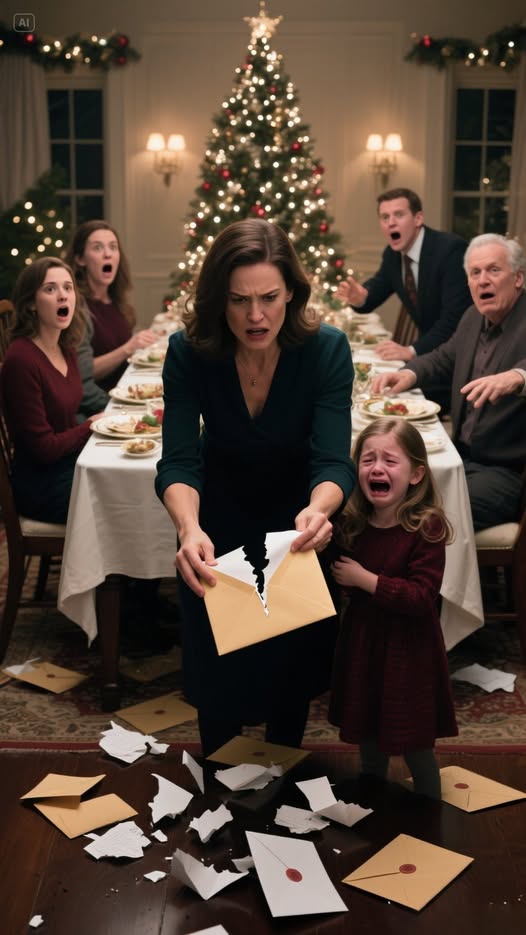
Technically, I didn’t even get to finish my meal. There was still gravy congealing on my plate, a pool of brown slowly developing a skin, and a fork hovering in my hand like it had forgotten its purpose.
Across the table, my seven-year-old daughter, Mia, sat perfectly still. She had taken two polite bites of her dinner roll and was now quietly counting the peas on her plate with the tip of her knife—one, two, three—the way kids do when the air in a room gets sharp enough to cut glass. Around us, my sister’s children bounced in their chairs, a chaotic chorus of demands and laughter that no one bothered to silence. Mia knew better. She always knew which kids were allowed to be loud and which ones were expected to be invisible.
Across from me, my sister Eliza was smiling. It was a smile she must have practiced in the mirror, that special kind that says, “I’m being reasonable,” while her eyes scream, “I’m about to ruin your life and call it boundaries.”
Connor, Eliza’s husband, sat beside her, nodding along at nothing like a human screensaver. He had been hovering around our family for years, always a little too comfortable in my parents’ house, always acting like the guest room had his name etched on the doorframe. Connor was the kind of man who could watch a building burn down and ask where the marshmallows were.
My mother dabbed the corner of her mouth with a linen napkin, as if we were at an elegant holiday gala and not a slow-motion family car crash. My father stared at his mashed potatoes with the intensity of a man negotiating a hostage release.
The evening had been tense from the start—a minefield of little comments and veiled digs.
“Oh, Rachel, you look… tired,” Mom had said the second I walked in, making fatigue sound like a moral failing.
Eliza had glanced at Mia’s dress—a simple red velvet I’d found on sale—and said, “Cute. Very… simple.” As if a seven-year-old needed couture for pot roast.
Connor had asked, straight-faced, over appetizers, “So, are you still in that phase where things are tight?”
I’d smiled through it all. I’d done what I always do: swallow, nod, pretend. Because it was Christmas. Because Mia was watching. Because I’d promised myself that this year would be different.
And then, somewhere between the green beans and Eliza’s third passive-aggressive compliment about her own centerpiece, she decided she was done pretending. She set down her fork. It hit the china with a finality that silenced the room.
“We need to talk,” she said.
My stomach sank. Not because I didn’t expect it—I did—but because I knew exactly what kind of talk this was going to be. The kind where I’m not allowed to have feelings, and if I do, they get labeled “dramatic.”
Eliza leaned back in her chair, crossing her arms. “It’s just… it’s been a lot. And Mom and Dad agree.”
My father didn’t look up. My mother didn’t protest. Connor chewed slowly, like he’d been waiting for this course all night.
“Eliza,” I said, keeping my voice even, though my heart was hammering against my ribs. “What are you doing?”
She tilted her head, feigning sympathy. “We’ve all decided you should leave. And never return.”
There it was. Clean. Practiced. Like she’d rehearsed it with a ring light.
Mia looked up from her peas, her eyes wide and fearful.
My mother chimed in immediately, unable to let Eliza hold the spotlight for more than two seconds. “Christmas is so much better without you, Rachel.” She said it softly, almost kindly, as if she were talking about a bad candle scent she was removing from the room.
I blinked once, twice. I looked at Dad. He finally lifted his eyes, and for a second—just a fraction of a second—I thought he might say something. Anything. A protest. A correction. A simple “Hold on.”
But he didn’t. He just looked tired, silent, and complicit.
Mia’s little hand tightened around her fork until her knuckles turned white.
I felt something in my chest crack. Quietly. Politely. Like a plate slipping off a counter in another room.
I knew I had two choices. I could beg. I could explain. I could do the whole humiliating routine where I try to prove I deserve to exist in my own family.
Or, I could stop auditioning.
I set my fork down.
“Mia,” I said gently, keeping my eyes on her face. “Honey, can you go grab your coat and your little backpack? We’re leaving.”
She didn’t hesitate. She slid out of her chair like she’d been waiting for permission to escape.
“Okay,” she whispered. No argument. No tears. Just relief wrapped in a child’s voice.
She walked out of the dining room toward the hallway, and something about how quickly she went, how easily she accepted the rejection, made me feel sick. Like she’d been carrying this discomfort longer than I wanted to admit.
The moment she disappeared around the corner, the room shifted. Eliza uncrossed her arms, looking satisfied.
“Good. That’s settled,” she said.
Connor gave a little sigh, like we’d just resolved a scheduling conflict.
My mother’s mouth tightened. “Rachel, don’t make this harder than it has to be.”
I stared at them. All of them. And I felt my face do something unexpected. It smiled. Not a warm smile. Not a friendly one. The kind of smile you make when you realize you’ve been trying to win a rigged game.
“Okay,” I said calmly.
Eliza looked smug. “Finally.”
I stood up slowly, pushing my chair back. “Then you won’t mind me doing this.”
They watched me, waiting for a tantrum, for tears, for a dramatic speech. instead, I walked past the dining room doorway into the kitchen and stopped at the cupboard near the end of the counter.
I’d put them there earlier, tucked away, hidden behind the stack of holiday platters like some pathetic little secret. I’d told myself I was being careful, thoughtful, waiting for the right moment.
Turns out, the right moment was the moment they told me I didn’t belong.
I opened the cupboard and pulled out three envelopes. Plain, crisp, heavy cardstock. Each one had a name scrawled on the front in thick black marker: Mom & Dad, Eliza, Connor.
Eliza’s brows lifted. “What is that?”
Connor scoffed. “Are those cards? Seriously?”
My mother actually laughed, a short, sharp sound. “Rachel, what are you doing? This is ridiculous.”
I looked at her. “Is it?”
Dad finally spoke, his voice flat. “If you’re trying to guilt us…”
“Oh no,” I said, still smiling that cold, terrible smile. “This isn’t guilt. This is just consequences.”
Eliza stood up, exasperated. “You think we need your gifts? You think we’re going to miss whatever little—”
I didn’t let her finish. I took the envelope labeled Mom & Dad and tore it straight down the middle.
The sound was soft. Paper ripping shouldn’t be that loud, but in that silent, tension-filled room, it felt like a gunshot.
My mother’s smile faltered. “Rachel?”
I tore the one labeled Dad next. Slow. Clean. Deliberate. The heavy paper resisted, then gave way.
Dad’s face tightened. Connor sat up a little straighter, like his brain had finally finished buffering. Eliza’s smugness cracked at the edges.
“Stop it,” she hissed. “What are you…?”
I tore the one labeled Eliza last. That one? I didn’t even hesitate. I shredded it into quarters.
I dropped the pieces onto the counter in three neat piles, like offerings to a god that had stopped listening.
There was a beat of silence where none of them moved. Then Connor barked out a laugh, too loud and too forced. “Okay. Wow. That’s insane.”
Eliza’s voice went sharp. “You’re proving our point! This drama is exactly why we want you gone!”
Mom shook her head, looking at me like I was a stranger. “This is exactly why, Rachel.”
I didn’t argue. I didn’t explain. I just turned.
Mia was in the hallway, already in her coat, tiny backpack slung over her shoulder. She looked up at me with wide eyes, but she didn’t look surprised.
I took her hand. “We’re going,” I said.
We walked out the front door. The cold December air hit my face, the kind of cold that makes your lungs wake up and remember to breathe. As we stepped down the porch steps, I glanced back through the bay window without meaning to.
I saw them staring at the counter. Then moving. Not angry anymore. Curious.
Mom leaned forward and picked up a torn piece of the heavy cardstock. Dad came closer, putting on his reading glasses. Eliza snatched something from the pile and started pressing the halves together like a puzzle.
Their faces changed in real-time. Smug to confused. Confused to pale. Pale to panicked.
And then, through the glass, I saw my mother’s mouth open wide, like she was screaming. I couldn’t hear it clearly at first. Then I could.
The door flew open behind me.
“Rachel!”
Footsteps fast. Clumsy. Running.
Eliza’s voice was higher than I’d ever heard it. “Wait! Wait! Come back!”
Mia’s hand tightened in mine as we reached my car.
“Rachel!” Mom’s voice cracked, desperate. “Please! Please! You can’t!”
Dad sounded different too. Not calm. Not silent. “Rachel, stop! Just… just stop and talk!”
I opened the car door, still holding Mia’s hand. I looked at their faces—pale, frantic, transformed. Five minutes ago, they’d told me Christmas was better without me. Now they were begging me to reverse something they still couldn’t admit out loud.
I slid into the driver’s seat. Mia climbed in beside me. I started the engine.
And I drove away.
My sister Eliza is six years older than me. That matters more than you’d think. Six years is the difference between being the baby everyone fusses over and the kid who’s old enough to know better. Six years is the difference between being precious and being useful.
Eliza was the golden child before she had a full set of teeth. My mom used to say she was a miracle, like she’d personally negotiated with the universe for a daughter who could smile on command. Holidays were where it really showed. Eliza would open gift after gift while everyone watched. I’d get something practical—pajamas, a sweater. Then I’d get handed a trash bag and told to clean up the wrapping paper.
I met my husband, Daniel, in my mid-twenties. He wasn’t loud. He wasn’t flashy. He was the kind of man who would quietly hand you a cup of coffee without making a big deal about it. On our third date, I mentioned my family dynamic, laughing like it was normal.
Daniel didn’t laugh back. “That’s not normal,” he said. “That’s not okay.”
Daniel died six months ago. A workplace accident. Preventable. Tragic.
After the funeral, everything got practical in the worst way. Bills didn’t pause because I was grieving. Groceries didn’t become free. The $200 a month I had been quietly sending my parents for years stopped immediately. I could barely keep my own lights on.
My family noticed the missing money faster than they noticed my grief.
And I kept quiet about the one thing that might have changed everything: the payout.
It didn’t come right away. There were lawyers, delays, investigations. But right before Christmas, it finally came through. A life-changing amount. A settlement for Daniel’s death.
I stared at the account balance like it was a stranger. I didn’t spend it. Not really. But the first thing I thought, because I am apparently committed to learning lessons the hardest possible way, was: I should help them.
Mom and Dad were drowning in debt they never admitted. Eliza was always “between opportunities.” Connor had big plans and empty pockets.
So, I took a massive chunk of it and prepared three gifts. Three checks.
Check 1: $150,000 for Mom and Dad. enough to pay off the mortgage.
Check 2: $50,000 for Eliza. A fresh start.
Check 3: $50,000 for Connor. Investment capital for his “big idea.”
I drove to their house with Mia, telling myself this was a fresh start. Telling myself they would finally see me.
Instead, they saw the broke widow who showed up at Christmas to ask for more.
I drove until Mia whispered, “Where are we going?”
We ended up at a nice hotel off the highway. Not a motel. A real hotel with a warm lobby. I booked a room with two beds.
Mia kicked off her shoes. “Grandma doesn’t like me,” she said softly.
My throat tightened. “That’s not your fault, baby.”
“I know,” she said. “She likes Eliza’s kids. It’s okay.”
My phone buzzed non-stop on the nightstand. Mom. Dad. Eliza. Connor.
I answered Mom once. Her voice burst into my ear, too bright, too high. “Rachel! Oh, finally. Where are you? We didn’t mean it. You know we didn’t mean it.”
In the background, I heard Eliza: “Tell her to come back! She can’t just leave!”
“You told me to leave and never return,” I said.
“We were upset! Emotions were high! Rachel, you need to fix this. You can redo the checks. You can write them again right now.”
There it was. Not apology. Not love. Panic.
“No,” I said. “Not tonight.”
For a few days, it went quiet. Then, Eliza posted on Facebook. A photo of her in my parents’ living room, smiling like she’d won an award.
The caption read: Rachel showed up on Christmas looking for sympathy. And when we finally set boundaries, she humiliated our parents and stormed out. Some people will take everything and still demand more. And yes, before anyone asks, Rachel got a huge payout from Daniel’s death, and she won’t give her own family a penny. She’d rather punish us than act like a decent human being.
Comments poured in. Ungrateful. Selfish.
She was implying I profited off my husband’s death. That I owed them a cut of my grief.
By the end of the day, I was done being quiet. Quiet had never protected me.
I opened my bank app. I pulled up the transfers I’d been making for years. $200 a month. Every month. I took screenshots. I found the post my mother made after Daniel died, bragging about sending me a small amount of money “because family steps up.”
I typed a new post.
Not a rant. Not a novel. Just the truth.
“Eliza, you told me to leave and never return on Christmas in front of my seven-year-old. Mom agreed. Dad stayed silent.”
Then I posted the receipts. Years of monthly payments. Quiet help I never bragged about.
“Here’s what family looked like before Daniel died. We supported Mom and Dad every month for years. I never posted about it. I never asked for applause.”
“Here’s what happened the one time I needed help. They posted about it like I’d robbed them.”
“And for the record: I didn’t storm out. I left when my parents and sister told me Christmas was better without me.”
I hit post.
Within an hour, the tide turned. People started commenting on Eliza’s post.
Wait, she was sending YOU money?
So you kicked her out and now you want her cash?
This is disgusting.
Eliza deleted her post.
The next day, the doorbell rang.
I looked through the peephole. Mom, Dad, Eliza, Connor. Mom was holding a cake.
I opened the door just enough to step into the frame.
“Rachel,” Mom said, voice sugar-sweet. “Hi, sweetheart.”
“We just want to talk,” Eliza said, smiling the smile she wore when she wanted something. “We’ve all had time to cool down.”
“We didn’t mean what we said,” Mom rushed. “You know that.”
“You meant it enough to say it,” I said.
“That was a moment,” Eliza said.
“A moment where you looked at my kid and decided she didn’t belong.”
Connor leaned forward. “Rachel, come on. Mia needs cousins. Family.”
Mia appeared behind me, peeking around my leg. Mom’s face lit up instantly—predatory joy. “Mia! Hi, baby! Come give Grandma a hug!”
Mia didn’t move. Her little hand curled into my shirt.
“See?” Eliza said. “We can fix this. We just need to be together.”
We just need access, I heard. We just need the door open.
“No,” I said.
Mom blinked. “Rachel, no?”
“No,” I repeated. “You don’t get to throw us out and then show up with cake. You don’t get access to my daughter after you proved you don’t even see her as family.”
Dad’s jaw clenched. “You’re being cruel.”
“You taught me,” I said.
Eliza’s mask slipped. The anger flashed. “Rachel, don’t do something you’ll regret.”
I smiled just a little. “I already did something I regret. And it wasn’t tearing up paper.”
I stepped back and closed the door. I locked it. And for the first time in my life, locking someone out didn’t feel like cruelty. It felt like protection.
Eight months have passed.
The settlement was two million dollars. I never said it out loud back then because I knew it would stop being about grief and start being about entitlement. I had planned to give them $500,000.
They didn’t get a single dollar.
Instead, I bought a modest house outright. Nothing flashy. Just solid, quiet walls. Most of the money went into long-term savings and conservative investments. Mia has a college fund now, a trust, and an emergency cushion. Her future will never depend on people who decide her worth based on convenience.
Money didn’t erase the grief. Daniel is still gone. But the grief isn’t tangled up with fear anymore. We’re sad, but we’re safe.
Mia doesn’t ask about Grandma now. She laughs more. She sleeps better. She knows this house is hers.
My parents sold their house. Retirement fell apart. Relationships fractured. That $500,000 haunts them. They tell people about it, complain about it, replay it.
I thought keeping the money might haunt me too. It doesn’t.
What would have haunted me is teaching my daughter that cruelty deserves rewards. I still grieve the family I hoped I had, but I chose my child’s safety over their approval.
And that choice finally chose me back.