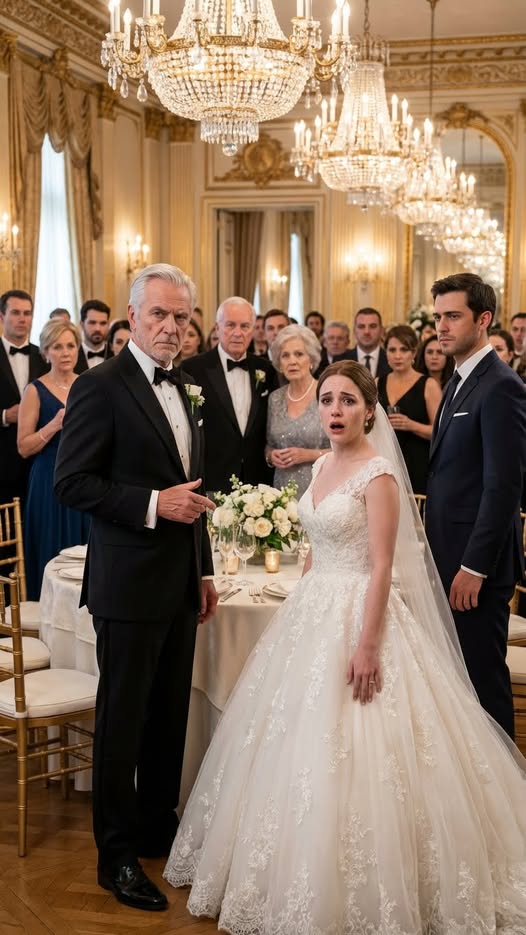
At my sister’s wedding, she smirked and introduced me to her boss.
“This is the embarrassment of our family,” she said, her voice dripping with the kind of saccharine cruelty only a sibling can perfect.
My parents laughed. It was a reflex for them, a conditioned response to Vanessa’s wit. Her boss, however, stayed silent. He watched them, his gaze sharp and unreadable, dissecting the dynamic with the precision of a surgeon. The room went tense, the air suddenly thin.
Then he smiled, a slow, dangerous expression that didn’t reach his eyes. “Interesting,” he said to Vanessa. “Because you’re fired.”
Let me back up.
Vanessa’s fingernails were digging into my forearm as she dragged me across the marble floor of the Grand Meridian Hotel ballroom. Her wedding dress cost $18,000. I knew because I’d negotiated the final price down from twenty-two thousand, a favor she had demanded and then promptly forgotten. Her smile was too wide, too sharp. It was the kind of expression that meant someone was about to bleed, and I knew, with weary certainty, that the someone was me.
“Mr. Harrington!” she called out, her voice cutting through the jazz quartet and champagne-fueled chatter. “I absolutely need you to meet someone very special.”
The conversations around us stuttered to a stop. Heads turned. My stomach dropped into my shoes.
Richard Harrington was fifty-three, the Vice President of Operations at Caldwell Financial Group. He was wearing a charcoal Tom Ford suit that probably cost more than my monthly rent and my car combined. He had flown in from Boston specifically for Vanessa’s wedding. She had been his executive assistant for two years, and she never shut up about how important he was, how prestigious her position was, how indispensable she had become to the firm.
“This is my brother, Elliot,” Vanessa announced, squeezing my arm tighter.
Then came the line. The embarrassment of our family.
The words landed like a physical blow. Heat crawled up my neck, painting my face in shades of humiliation.
She laughed—high, cruel, practiced. “Still single at thirty-eight, still working some tiny consulting business nobody understands. We keep hoping he’ll amount to something eventually, but…” She shrugged, the gesture devastating in its casualness. “Some people just never figure their lives out.”
My father chuckled from his seat at the head table, swirling his scotch. “We stopped expecting much from Elliot about a decade ago.”
My mother covered her mouth with a napkin, giggling like Vanessa had told the funniest joke she’d ever heard. “At least we have one successful child,” she murmured loud enough for the nearby tables to hear.
I stood frozen. My hands trembled at my sides. Thirty-eight years of being invisible, of being the quiet one who handled everything while Vanessa took credit. And now this. Public humiliation at her wedding. The wedding I had practically planned.
But Mr. Harrington didn’t laugh.
He sat perfectly still, a champagne flute suspended halfway to his lips. His eyes moved from Vanessa to my parents, analyzing their mirth, before settling on me. His expression was unreadable, carved from granite.
“Elliot,” he said quietly.
The silence was absolute. Even the jazz band seemed to hold its breath.
“What kind of consulting do you do?”
I blinked, surprised he was addressing me at all. My voice felt rusty. “Financial consulting. Corporate restructuring. I help small to mid-size businesses avoid bankruptcy when they’re in crisis.”
“How long have you been doing this?”
“Fourteen years.”
He nodded slowly, set down his champagne without drinking, and stood up. “Fascinating.”
He turned to Vanessa. All warmth drained from his face like water through broken glass.
“Vanessa, I need to see you in my office first thing Monday morning. 8:00 A.M. sharp. Don’t be late.”
He adjusted his cufflinks, nodded once to me, and walked toward the exit without another word.
The silence left in his wake was suffocating. Vanessa’s smile flickered, confusion crossing her face like a shadow. My parents exchanged glances—Dad’s forehead creased, Mom’s mouth hanging slightly open. Nobody understood what had just happened.
Neither did I.
I excused myself twenty minutes later, claiming a headache. I drove home to my small house on the outskirts of Riverside, my hands still shaking on the steering wheel.
I had been the invisible son for as long as I could remember. Vanessa was younger by four years, but she’d always been the star. Drama club lead, homecoming queen, full scholarship to Boston University. My parents had her picture in every room: Vanessa at graduation, Vanessa at her first day at Caldwell Financial, Vanessa receiving an award from the Chamber of Commerce.
My own college degree—earned while working three jobs—got a congratulations card that my mother forgot to sign.
Three months before the wedding, Vanessa had called asking for “small favors.”
“Elliot, I need you to handle a few vendor issues. You’re good at boring logistics stuff.”
The “few vendor issues” turned into me negotiating with twelve different vendors, comparing quotes, and catching a catering company trying to charge for services they hadn’t provided. I caught the florist attempting to upcharge by $900. I renegotiated the venue contract, saving her $4,200 on the deposit. When she forgot her checkbook two weeks before the wedding, I advanced $3,000 to secure the photographer.
She promised to pay me back immediately. She never did.
My parents praised her endlessly. “Vanessa’s so organized. She’s handling this wedding beautifully, so professional.”
Not once did they mention my name.
At the reception, they had seated me at Table 14, shoved in the back corner near the kitchen doors, surrounded by distant cousins I’d met maybe twice. Vanessa sat at the head table with her new husband, Connor, my parents, and Connor’s family.
I was an afterthought. A placeholder. The embarrassment.
Or so they thought.
Monday morning, I arrived at my office—a modest suite in a professional building I shared with an insurance agent and a CPA—to find a black Mercedes S-Class parked in my reserved spot.
Richard Harrington stepped out carrying a leather portfolio. He wore a navy suit, his expression serious.
“Mr. Chen,” he said, walking toward me. “Do you have time to talk?”
I let him inside. My office was small but professional. Clean desk, filing cabinets, framed credentials on the wall: Bachelor’s in Economics from State, MBA from Northeastern, fourteen years of client testimonials.
He looked around with what appeared to be genuine respect.
“Do you remember a furniture business about twelve years ago?” he asked, sitting across from my desk. “Harrington Home Furnishings in Hartford.”
The name hit me like a freight train.
“I remember,” I said. “The owner was an older man, maybe late forties. About to lose everything.”
“That was me.”
He set the portfolio on my desk.
“Twelve years ago, I was drowning in debt. My father had just died and left me a business that was hemorrhaging money. I was two weeks from bankruptcy. Then a young man walked into my store, looked at my books without charging me a dime, and told me exactly what I was doing wrong.”
My throat tightened.
“You spent six weeks working completely free,” he continued. “When I tried to pay you, you said you couldn’t take money from someone who reminded you of your grandfather.” He paused, his eyes softening. “You saved my business, Elliot. I sold that store three years later for enough profit to get my MBA, build my career. Everything I’ve accomplished started because a stranger decided to help me when he had no reason to.”
I had forgotten about Harrington Home Furnishings. It had been one of my first clients when I was just starting out, still idealistic, still thinking hard work and helping people would earn me respect.
“When your sister introduced you at the wedding,” Harrington said, his voice hardening, “when she called you the ’embarrassment of the family,’ I recognized your name immediately. Elliot Chen. The man who saved my life.”
He opened the portfolio.
“I didn’t fire Vanessa because of what she said Saturday night. I’ve been investigating her for eight months. She’s been falsifying expense reports, taking credit for work performed by junior associates, and using company email for questionable personal transactions. The wedding just confirmed something I’d already suspected about her character.”
He spread documents across my desk: spreadsheets, email printouts, highlighted sections showing discrepancies in reported hours, falsified client meetings, expenses charged to the company for personal items.
“Sharon Vega, twenty-two years in corporate forensic accounting, discovered the pattern six months ago,” Harrington said. “Vanessa claimed to have negotiated a contract with Patterson Industries. The contract was actually negotiated by Daniel Kim, a junior analyst. Vanessa added her name to the final documentation and took the commission. Forty-seven thousand dollars.”
I stared at the papers.
“There’s more. She’s been charging personal expenses as business costs. Gym memberships, clothing, a vacation to Turks and Caicos she claimed was a ‘client development trip.’ All told, roughly eighty-three thousand dollars in fraudulent charges over eighteen months.”
“Why are you telling me this?” I asked.
“Because I’m offering you a consulting position. We’re restructuring our subsidiary operations. Three companies, combined revenue of forty million dollars. I need someone I trust. Someone with integrity.”
He slid a contract across the desk. Six-month project. Two hundred thousand dollars.
I couldn’t speak.
“There’s one more thing,” Harrington said carefully. “During the investigation, Sharon noticed unusual patterns in Vanessa’s personal finances. Large deposits from accounts shared with your parents. If I were you, I’d look into any family financial arrangements very carefully.”
I spent the next week digging. I went through old documents, bank statements I’d saved from college, letters from my grandfather before he died.
And finally, I found the truth.
My grandfather’s education fund had contained $95,000 when he died sixteen years ago. The will specified it be split equally between his two grandchildren: $47,500 each.
Vanessa had received her full amount. It paid for her entire college education, her apartment in Boston, her first car.
My share had been “invested” by my parents in a business venture that didn’t work out. Or so they had told me. I had spent ten years paying off student loans—loans I only had because they had stolen my inheritance.
The bank records were clear. My $47,000 had been withdrawn by my father, then transferred into Vanessa’s account three months later.
She had graduated debt-free. I had worked three jobs and ate ramen for dinner six nights a week.
I sat in my office, staring at the documents until my vision blurred.
Two weeks after the wedding, Vanessa called. Her voice was sweet, desperate, nothing like the cruelty at the reception.
“Elliot, we need to talk. This thing with Mr. Harrington… it’s a misunderstanding. You know how these corporate investigations blow things out of proportion.”
“Do I?”
“Just tell them you helped me with some of those reports. That we collaborated. We’re family, Elliot. Family protects each other.”
“You called me the embarrassment of the family in front of a hundred people,” I said.
“That was a joke! God, you’re so sensitive. I was just trying to be funny.”
“Funny.”
“Look, if you don’t help me, this could destroy my entire career. They’re talking about criminal charges, Elliot. I could go to prison.”
“You committed fraud, Vanessa.”
“Because I was under so much pressure! Do you have any idea how stressful my job is? I made mistakes. That’s all. Mistakes.”
“I’m not going to lie for you.”
“You owe me!” Her voice turned sharp, the mask cracking. “I let you be part of my wedding. I introduced you to important people. You owe me!”
I hung up.
Three days later, Richard Harrington called me into a conference room at Caldwell Financial Group’s regional office. He was joined by Sharon Vega, mid-fifties, silver hair, sharp eyes behind designer glasses, and Marcus Reeves, the company’s Director of Legal Affairs.
“We found something else,” Sharon said, sliding a folder across the conference table. “During the forensic audit, we discovered emails in Vanessa’s sent folder that appeared to come from your email address.”
My stomach dropped.
“They’re fake,” Marcus said immediately. “Created to look like you were advising her on how to manipulate expense reports and client documentation. She was setting you up as a co-conspirator.”
Sharon opened her laptop, showing me the emails. They had my name, an email address similar to mine but with a slightly different domain. The content was damning: detailed instructions on how to falsify reports, how to claim credit for others’ work.
“The metadata tells the real story,” Sharon continued. “Every single one of these emails was created from Vanessa’s work computer. The IP address traces back to her desk. The timestamps show they were all created in a three-hour window last Tuesday night. After she knew we were investigating.”
“She tried to frame you,” Marcus said. “If this had worked, you’d be facing criminal charges alongside her.”
I couldn’t breathe. My own sister had tried to destroy me to save herself.
The company hearing was held on a Friday afternoon. I wasn’t required to attend, but Harrington invited me to observe from an adjoining room with one-way glass.
Vanessa sat across from a panel of four executives. Harrington, the CFO, the Chief Legal Officer, and Patricia Carmichael, the head of HR.
They presented the evidence methodically. The falsified expense reports. The stolen work. The fabricated emails. The metadata proving she had created them herself.
Vanessa tried to charm them. She tried tears. She tried anger. Nothing worked.
“Vanessa Chen,” Patricia Carmichael said, her voice cold and professional. “You are terminated effective immediately. The company will be pursuing full restitution for fraudulent expenses totaling eighty-three thousand dollars. We will also be reporting this matter to law enforcement for potential criminal prosecution.”
“You can’t do this!” Vanessa stood up, her face red. “My family has connections! My father—”
“Your father has no connections that matter here,” Harrington said quietly. “You’re done, Vanessa. Security will escort you out.”
I watched her leave through a back elevator, a security guard on each side carrying her personal items in a banker’s box.
That evening, I called my parents for the first time since the wedding.
“Elliot!” Mom’s voice was bright, oblivious. “We were just talking about you. Did you hear about poor Vanessa? She’s going through something difficult at work. I told her you might be able to help her find a new job.”
“I know about Grandfather’s education fund,” I said.
Silence.
“I know you took my forty-seven thousand dollars and gave it to Vanessa. I have the bank records. I have the transfer receipts. I know everything.”
More silence. Then my father’s voice, defensive. “That money was invested…”
“It was stolen,” I cut him off. “You stolen my inheritance and gave it to your favorite child. While I worked three jobs and ate ramen, she was living in a luxury apartment with my money.”
“Vanessa needed opportunities,” Mom said, her voice weak. “She had so much potential.”
“And I had nothing? I had no potential? I was just the embarrassment?”
“We were going to pay you back,” Dad said. “Eventually. When things were better.”
“Sixteen years,” I said. “You had sixteen years. Instead, you laughed when she humiliated me at her wedding. A wedding I planned. That I paid three thousand dollars for.”
I hung up before they could respond.
Four weeks later, the family held a dinner at my Aunt Margaret’s house. I almost didn’t go, but Aunt Margaret had called me personally. “Please come. It’s important. Trust me.”
I walked in to find the entire family gathered. Aunts, uncles, cousins. My parents sitting stiffly at one end of the table. Vanessa wasn’t there. Neither was Connor.
Aunt Margaret stood at the head of the table, seventy-two years old, steel in her spine.
“I invited everyone here tonight because I have something to say,” she announced. “For thirty-eight years, I have watched this family treat Elliot like he doesn’t exist. Like he doesn’t matter. I’m done being silent.”
My father started to interrupt. She held up a hand. “Sit down, Thomas. You’ll listen for once.”
She turned to the room.
“Let me tell you about the nephew you’ve all ignored. Ten years ago, I was diagnosed with breast cancer. The treatment cost more than I had. I was going to sell my house. Elliot paid my medical bills anonymously. Eleven thousand dollars. I didn’t find out it was him until three years later.”
My mother’s face went pale.
“When Thomas and Patricia’s son, Daniel, needed help applying for colleges, who spent hours helping him write essays, prep for tests, navigate financial aid? Elliot. Daniel got a full scholarship. Never once did any of you acknowledge Elliot’s help.”
She pulled out documents. Printed emails. Letters.
“When Thomas and Patricia lost their jobs during the 2009 recession, who co-signed their car loan so they could get to job interviews? Elliot. When their mortgage was about to default, who gave them eight thousand dollars, interest-free? Elliot.”
My parents looked at the table.
“This is the man you called the embarrassment of the family,” Aunt Margaret said, her voice breaking. “The man who’s been quietly saving all of you for decades while you praised Vanessa—who, it turns out, is a criminal.”
The room was silent.
“Maybe,” Aunt Margaret said softly, “it’s time you took a good look at who actually matters in this family.”
Six months later, Richard Harrington and I launched a program through Caldwell Financial Group providing pro bono restructuring services to small businesses in crisis. We called it the Second Chance Initiative.
The first business we saved was a family-owned bakery in Hartford that reminded me of Harrington Home Furnishings. The owner cried when I told her the consultation was free.
“Why would you help me?” she asked.
“Because someone helped me once,” I said. “And I’m paying it forward.”
When the local paper wrote about the initiative, my parents sent me the article with a note: Proud of you.
I put it in a drawer. Not because I needed their approval, but because I no longer depended on it.
Three months after that, Vanessa sent me a card. She’d taken a job as a junior accountant at a small firm, making a quarter of what she’d earned before. The card was simple.
You were never the embarrassment. We were. Thank you for showing me what integrity looks like. V.
I put that card on my desk. Not because I’d forgiven her. Not yet. But because for the first time, she’d finally seen me.
And maybe, eventually, that would be enough.