I returned to the restaurant for a phone I didn’t actually need. That singular, mundane mistake—a lapse in memory I initially blamed on the fog in my brain—saved my life.
The dinner had already drained me. My head felt unmoored, light as a dandelion seed, while my body felt heavy, hollowed out by a gravity that seemed to pull harder on me than anyone else. Even after stepping outside into the cool night air, the pavement seemed to sway beneath my Italian loafers. I told myself it was exhaustion. Sixty-four years of relentless work, the crushing weight of legacy, and the constant friction of responsibility eventually catch up with even the strongest constitution.
That was, after all, what my son kept telling me.
I am Elellanar Whitmore. For more than three decades, I have built a luxury fragrance house, Whitmore Atelier, with my own two hands. I trained my nose the way an Olympian trains a muscle—with discipline, agony, and precision. To me, scent is not merely a cosmetic accessory; it is the architecture of memory. Jasmine is the humidity of a summer evening in Savannah. Vetiver is the smell of wet soil after a hard rain. Cedar is the scent of safety.
I trusted my instincts. I trusted my craft. And, god help me, I trusted my family.
That night was scripted to be a celebration, a quiet family dinner to discuss “transition strategies.” Nothing dramatic. Nothing worth archiving in the library of my mind. But when I pushed the heavy oak door open and stepped back inside the restaurant, the atmosphere had curdled.
The noise was gone. There was no clinking of crystal, no soft jazz, no polite hum of bourgeois conversation. The dining room was nearly empty, a cavern of shadows. The lights were dimmed to a dull amber, and chairs were already being stacked upside down on tables near the walls. It was closing time, the hour when the magic of hospitality dissolves into the reality of labor.
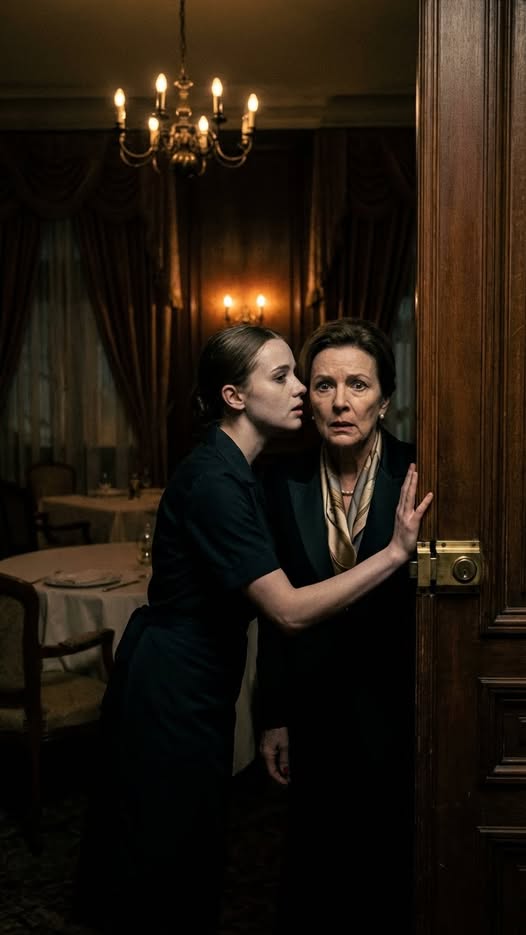
I had barely taken three steps across the plush carpet when a young waitress rushed toward me. I recognized her vaguely—she had poured my water earlier, her hand trembling slightly. Now, her face was pale, drained of blood, looking almost gray in the low light.
She didn’t ask what I wanted. She grabbed my sleeve, her grip desperate and tight.
“Please,” she whispered, the word sharp with panic. “Mrs. Whitmore. You need to come with me right now.”
I tried to pull back, my dignity bristling. “I only came for my phone,” I said, my voice sounding thick and foreign to my own ears. “I am tired. I just want to go home.”
She did not answer. Instead, she reached behind her and threw the deadbolt on the front door. The sound of the metal sliding into place echoed like a gunshot in the empty room.
My heart began to hammer a frantic rhythm against my ribs. The girl leaned closer, the scent of stale coffee and fear radiating off her uniform.
“I know this sounds strange,” she said, her voice dropping to a breath. “But I need to show you something from the security camera feed above your table.”
She looked straight into my eyes, her pupils dilated. “You have to promise me you will not faint.”
In that moment, the fog in my brain cleared for a fraction of a second. I understood that this was no longer about a misplaced iPhone. This was about what had happened while I was sitting at table four. It was about what my own son did when he thought I wasn’t looking.
Before that night, I believed I knew the geography of my own life. I was not a fragile woman losing her grip on reality. I was not confused. I was not fading into the twilight of senility. I was the founder of a dynasty built on nothing but grit and stubborn belief.
I did not inherit wealth. I did not marry into power. I started in a rented workspace with cracked windows and second-hand beakers, writing formulas in stained notebooks while my peers slept. My sense of smell was my livelihood. It was how I paid my staff. How I fed my child. How I survived in a world that wanted to crush me.
I could smell fear in a boardroom. I could smell dishonesty on a supplier long before they breached a contract. And for years, that gift had never failed me.
I raised my son, Jason, alone after his father passed. He grew up in my lab, playing under worktables, learning the difference between Neroli and Orange Blossom before he could properly write his name. I believed exposure alone would breed respect for the craft.
I was wrong. As he grew, Jason lost interest in the creation. He fell in love with the boardroom, the titles, the applause. He loved the image of success far more than the labor it required. Still, I trusted him. He was my blood.
When the symptoms started six months ago, I blamed myself. First, it was a bone-deep fatigue. Then, a persistent congestion. Then, terrifying moments of vertigo where the world would tilt on its axis. I dismissed them. Stress does strange things to the body. Everyone told me so. Jason told me so.
But when I failed to recognize a familiar blend of Bergamot and Patchouli in the lab, panic clawed at my throat. When my morning coffee smelled like hot water and nothing else, shame followed. When my own signature perfume felt empty on my wrist, fear finally arrived.
I began to wonder if my time was over.
That was when Jason stepped in. His concern grew louder, his suggestions more persistent. He spoke softly, patiently, the way one speaks to a child or a dying relative.
“Mom,” he would say, leaning forward at dinner, lowering his voice as if sharing a sacred secret. “You don’t need to prove anything anymore. You built something incredible. Let us help you protect it.”
Protect it. That word stayed with me.
His wife, Melissa, played her role with Oscar-worthy precision. She never raised her voice. She wrapped every poisoned suggestion in layers of concern.
“Stress accelerates aging, Elellanar,” she would say, touching my arm with her cold fingers. “You have nothing left to fight. Why carry the burden alone when family is here?”
They spoke of Power of Attorney the way one talks about insurance—a practical safeguard. “It is only in case something happens,” Jason promised. “Nothing happens without intent.”
They framed my removal as mercy.
I felt myself shrinking. Not because they pushed, but because they waited. They let my own doubt do the heavy lifting. And slowly, dangerously, I began to believe them.
The waitress led me down a narrow hallway behind the kitchen, the smell of grease and sanitizer heavy in the air. My legs felt like lead, but my mind was strangely alert. Fear has a way of sharpening the senses.
She stopped in front of a supply closet and opened the door. It was cramped, smelling of bleach. A small monitor glowed on a metal shelf.
She shut the door and locked it. My phone lay on the table beneath the monitor, but she didn’t hand it to me. She pointed to the screen.
“This is from twenty minutes ago,” she said. “From the camera directly above your table.”
The image was grainy, black and white, but the clarity of the action was undeniable. I saw myself on the screen, rising from my chair, excusing myself to the restroom. I watched myself walk out of the frame.
Jason and Melissa remained seated.
The moment I disappeared, the transformation was instant. The gentle posture of the concerned son vanished. Jason leaned back, scanned the room with the eyes of a predator, and reached into the inner pocket of his jacket.
My breath caught in my throat.
He pulled out a small, clear vial. Not a prescription bottle. A laboratory ampule.
I watched, frozen, as he uncapped it with practiced ease. Melissa shifted in her chair, blocking the view from the passing servers. She threw her head back and laughed at something he said—a distraction.
Jason tilted my wine glass. He poured the clear liquid into the Merlot. It vanished instantly.
I grabbed a shelf to keep from collapsing. My own son had just poisoned my drink.
But the footage continued. Jason leaned forward, hunching his shoulders. He began to shake his hands, mimicking my tremors. He touched his head, mimicking my dizziness. His face twisted into a cruel caricature of my weakness.
Melissa laughed. Not a nervous laugh. A laugh of pure, unadulterated enjoyment.
“Turn the sound on,” I commanded. My voice sounded like grinding stones.
The waitress clicked a button. The hum of the restaurant filled the tiny closet.
“…thinks it’s old age,” Jason’s voice came through the tinny speakers, calm and amused. “The poor woman. A couple more doses of the blocker, and she’ll forget what a rose smells like.”
Melissa leaned in. “What if she hesitates on the sale again?”
Jason smiled—a smile I had never seen before. “She won’t. Where would she go? She’s terrified of losing her gift. And the best part is, she doesn’t even realize she’s losing the company, too.”
My knees finally gave out. I sank to the linoleum floor, surrounded by mops and buckets. The grief was a physical blow, a knife twisting in my gut. The woman who had raised him, who had sacrificed everything, was dead to him. In her place stood an obstacle to be removed, one dose at a time.
But as I sat there, inhaling the sharp scent of bleach, something shifted. The grief didn’t leave, but it hardened. It crystallized into something cold and sharp.
My body wasn’t failing. My mind wasn’t slipping. I was being poisoned. Methodically. Intentionally.
The realization hit me like a splash of ice water. The dizziness? The congestion? The loss of smell? It was a synthetic receptor blocker. I knew the chemistry. I knew how it worked. And I knew it was reversible.
I stood up.
I walked out of that restaurant a different woman than the one who had entered. I thanked the waitress, pressing all the cash I had into her hand, not as a bribe, but as a lifeline. I asked her to keep the footage safe. To tell anyone who asked that I had simply retrieved my phone and left.
I went straight to my private lab—the sanctuary Jason avoided because it “smelled like work.”
I scraped the residue from my scarf where a drop of wine had spilled. I ran the mass spectrometer. The results confirmed my theory within the hour: a high-grade synthetic neuro-blocker. It dulled the olfactory nerves temporarily. Whoever had chosen it assumed I would be too proud to see a doctor, too terrified to investigate.
They were right about the pride. They were wrong about the surrender.
I looked at the glowing green numbers on the screen, and for the first time in months, I smiled. They wanted a weak, confused old woman? I would give them the performance of a lifetime.
The next morning, I called Jason. I let my voice quaver. I breathed unevenly into the receiver.
“Jason,” I whispered, pitching my voice to the edge of hysteria. “I think… I think it’s worse. I woke up and I can’t smell the coffee. I can’t smell the soap. It’s all gone.”
There was a silence on the line. Not of shock, but of calculation.
“Mom, it’s alright,” he said, his voice smooth as silk. “We knew this might happen. You’ve been pushing yourself too hard.”
“I can’t live like this,” I sobbed. “I don’t want to wait until next week. Bring the papers today. Bring the Blackidge people. I’ll sign everything. I just want it to be over.”
I heard the exhale of relief. “Of course, Mom. Melissa and I will set it up. We’ll take care of everything.”
When the call ended, my hands were steady as granite.
Speed was my weapon now. I had to remove their time to think. People make mistakes when they believe they have already won.
I spent the day purging my house. I threw out every supplement Jason had given me. I found the stash in the back of a guest bathroom cabinet—small vials identical to the one in the video. I documented them, photographed them, and then called the one man I trusted: Henry Cole.
Henry had supplied my raw materials for forty years. He was a man of the earth, loyal to the bone.
“Henry,” I said. “I need trucks. Tonight. Unmarked.”
“How many?” he asked, hearing the steel in my voice.
“Enough to empty the main vault.”
That night, under the cover of a moonless sky, we moved the soul of Whitmore Atelier. Every barrel of vintage Oud, every sealed canister of Rose de Mai, every irreplaceable formula was quietly transported to a secure, climate-controlled facility known only to Henry and me.
In the warehouse, we left the barrels. But we filled them with water, tinted with caramel and food coloring. Sealed with wax. Indistinguishable to the eye. Useless to the nose.
By the time Jason and Melissa arrived to pick me up on Friday morning, the switch was complete.
I greeted them wrapped in a heavy shawl, hunched over. I dropped a pen. I confused their names. I apologized profusely for my clumsiness.
They exchanged glances of triumphant pity. They thought they were escorting a corpse to a funeral. In reality, they were walking into a slaughter.
The conference room at the headquarters of Blackidge Industrial Group was a monument to corporate sterility. A long, polished mahogany table reflected the faces of men who smelled of expensive aftershave and impatience.
These were not artisans. They were asset strippers. To them, I was not a creator; I was a signature on a deed.
Jason ushered me to the head of the table, pulling out my chair with performative tenderness. He laid the contract in front of me, placing a heavy fountain pen in my trembling hand.
“Just sign here, Mom,” he whispered. “Then you can go home and rest. We’ll handle the legacy.”
I looked down at the papers. I saw the clauses transferring full control, the pitiful payout, the dismantling of my life’s work.
I didn’t move.
“Before I sign,” I said, my voice low and scratchy. “There is something I must do.”
Jason stiffened. “Mom, we talked about this. No speeches.”
“It is not a speech,” I said. “It is a tradition. My father followed it, and his father before him.”
I reached into my bag and pulled out a small leather case. I opened it to reveal professional scent blotters and two crystal decanters filled with an amber liquid.
“We call it the Founder’s Test,” I lied smoothly. “Before any transfer of ownership, the successor—and the buyers—must identify the core notes of the house’s most valuable asset.”
The lead executive from Blackidge, a man named Mr. Sterling, sighed audibly. “Mrs. Whitmore, with all due respect, we have done our due diligence.”
“You are purchasing a fragrance house for eighty million dollars,” I said, my voice suddenly gaining a fraction of its old power. “If you cannot identify the scent, you are buying blind. Surely, you aren’t afraid of a simple test?”
Reluctantly, Sterling nodded. “Fine. Let’s get this over with.”
I dipped a blotter into the liquid and handed it to Jason first.
“You grew up in the lab, Jason,” I said. “Tell them what this is.”
Jason took the strip. He held it to his nose. He hesitated. I watched his eyes dart. He couldn’t smell anything—not because he was sick, but because he had never bothered to learn. He was faking it.
“It’s… complex,” he stammered. “Floral. Definitely floral.”
I handed a strip to Sterling. He took a confident sniff, acting the part of the connoisseur.
“Yes,” Sterling agreed, eager to close the deal. “Sweet. Rose, perhaps? With a hint of sandalwood?”
Jason nodded vigorously. “Exactly. Our signature blend.”
I let the silence stretch. I let it fill the room until it was uncomfortable. Then, I sat up straight. I threw off the shawl. I dropped the hunch.
“Interesting,” I said, my voice crisp, commanding, and loud.
The sudden change in my demeanor made Jason flinch.
“Gentlemen,” I said, looking Sterling in the eye. “What you have just described… is industrial floor solvent mixed with a synthetic neuro-blocker and a touch of vanilla air freshener.”
The room froze.
“This is not perfume,” I continued. “This is not oil. This is not art. This is garbage.”
Jason shot to his feet, his chair scraping loudly against the floor. “She’s confused! She’s been ill! Don’t listen to her, just sign the damn papers!”
“I am not confused, Jason,” I said.
I picked up a small remote from the table and pointed it at the wall-mounted screen.
“And neither were you.”
I pressed play.
The footage from the restaurant storage room filled the high-definition screen. Jason’s voice, amplified and clear, echoed off the mahogany walls.
…thinks it’s old age. The poor woman. A couple more doses… she’ll forget what a rose smells like.
Then came Melissa’s laughter. Sharp. Cruel.
The color drained from the faces of the Blackidge executives. Sterling looked at the screen, then at Jason, then at me. He looked like a man who realized he was holding a live grenade.
“This meeting is over,” Sterling said, standing abruptly.
“No,” I replied, staying seated. “This is the beginning.”
I turned to Jason. He was staring at the screen, his mouth opening and closing like a fish on dry land.
“The oils you planned to acquire today are gone,” I told him. “Moved legally. Secured permanently. What remains in the warehouse is colored water. You brought these men here to buy a legacy. Instead, you brought them to a crime scene.”
The chaos that followed was absolute, but it was no longer mine to manage.
The Blackidge executives scrambled to distance themselves, their lawyers already whispering into phones. To them, Jason was now radioactive.
Jason turned to me, sweat beading on his forehead, the mask of the dutiful son shattered. “Mom, please. You don’t understand. We can explain. It was… it was a stress test. We were testing your resilience!”
“I understand perfectly,” I said.
The double doors opened. Two uniformed officers entered, followed by a detective holding a thick file folder. I had submitted the evidence—the video, the lab results, the stolen vials—twelve hours ago.
“Jason Whitmore,” the detective said. “Please stand up.”
They handcuffed him in front of the empty contract. He didn’t look like a mastermind then. He looked small. Cornered. A boy who had tried to play god and found he was only a mortal.
Melissa never even made it into the building. She saw the police cars arriving and fled. She was arrested at the airport two days later, trying to board a flight to Nice.
Blackidge Industrial Group withdrew their offer within the hour. Their stock dipped as rumors of the scandal leaked. They called it a “misunderstanding.” The courts called it conspiracy to commit fraud and assault.
I did not attend my son’s sentencing.
Some doors, once closed, do not need to be reopened. I did not need to see him in an orange jumpsuit to know that justice had been served. It did not bring me peace—no mother finds peace in the destruction of her child—but it brought me truth. And truth is the only foundation upon which you can build.
I returned to the lab the following Monday. The air was different. The phantom scent of betrayal was gone, replaced by the crisp smell of ethanol and possibility.
I ran my fingers over the glassware, the beakers, the old notebooks filled with my handwriting.
That was where Lily—the waitress—found me.
She wasn’t wearing a uniform. She stood awkwardly in the doorway, clutching her purse.
“Mrs. Whitmore?” she asked. “You said to come by?”
I turned to her. I saw the fear in her eyes, but I also saw the steel. She had risked her job, perhaps her safety, to save a stranger.
“Come in, Lily,” I said.
I didn’t offer her money. I offered her an apron.
“You have a good nose for truth,” I told her. “Let’s see if you have a nose for Jasmine.”
I took her on as an apprentice. Not out of charity, but because legacy is not about blood. Legacy is about values. It is about who you trust to carry the flame when your own hands are too tired to hold it.
Together, we rebuilt. We released a new line the following year called Veritas. It smelled of sharp citrus and deep, grounding cedar. It was a scent that said: I see you.
People often ask me if I regret it. They ask if a mother’s love should be unconditional, if I should have protected him despite his sins.
Here is the truth I have distilled from sixty-four years of life:
Love without boundaries becomes permission. Forgiveness without accountability is merely a betrayal of the self. What Jason did was not a mistake. It was a choice, repeated daily, with planning and pleasure.
I did not ruin his life. He did.
What I saved was my name, my work, and my right to finish my story on my own terms.
Now, I ask you: If you were in my place, sitting at that table with the glass of poisoned wine, what would you have done? Would you have swallowed the lie to protect your child? Or would you have chosen the truth, even if it broke your heart?
Tell me in the comments. And if this story resonated with you, share it. Because sometimes, revenge isn’t about destruction. Sometimes, it’s the only way to survive.