In the deep, biting chill of a December night, just days before the world would pause for Christmas, my life took a turn I could never have anticipated. At twenty-five, I was a school bus driver—a job that felt like a placeholder, something to pay the rent while I figured out the rest of my existence. I was driving an empty bus back to the depot, the heater humming a low, rattling tune against the frost on the windows, when a flash of movement caught my eye.
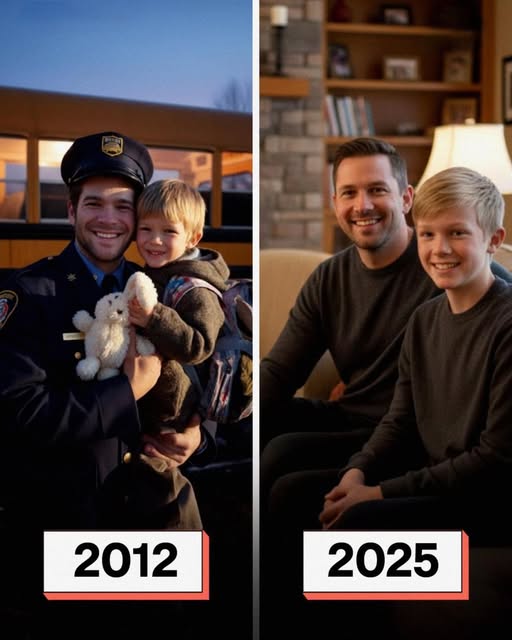
Under the sickly, flickering glow of a lone streetlight stood a small figure. He was perhaps six years old, bundled in a jacket that had seen better days and a backpack that looked far too heavy for his slight frame. He clutched a tattered stuffed bunny to his chest as if it were a shield against the world. He wasn’t playing; he was moving with a frantic, desperate purpose. I hissed the bus to a stop, the air brakes sighing in the silence of the empty road.
When I opened the doors, the cold rushed in, and the boy looked up with eyes that had seen far too much for someone so young. “My mom died today,” he whispered. His voice was flat, devoid of the hysterics one might expect, as if he had already reached the end of his emotional rope. He explained that people—strangers in suits—had tried to take him away, so he had run out the back door.
I sat him in the front seat, draped my own jacket over his shivering shoulders, and promised him he was safe. His name was Gabriel. As I waited for dispatch to coordinate with social services, I watched him curl into a ball around that stuffed bunny. He didn’t cry; he simply stared into the middle distance, his spirit seemingly miles away.
The trauma of that night forged an immediate, unbreakable bond. I followed him into the foster care system, visiting him the very next day. When he saw me, he didn’t just smile—he ran to me as if I were a piece of land in a rising tide. The truth of his situation was bleak: his mother had died of an aneurysm at work, and there was no extended family to claim him.
But there was a deeper reason why I couldn’t let him go. Gabriel reminded me of my twin brother, whom I had lost to a river current when we were children. For decades, I had carried the guilt of not being fast enough to grab my brother’s hand. In Gabriel’s eyes, I saw a second chance. I saw a way to finally “get it right.” I filed the adoption papers with a frantic intensity, and before the new year had fully taken hold, Gabriel was officially my son.
The thirteen years that followed were a blur of hard work and quiet victories. I drove the bus by day and a taxi by night, eventually saving enough to start a small car-rental business. I was always exhausted, always chasing the next bill, but I took immense pride in the fact that Gabriel never lacked for anything. He was the center of my universe, the reason I worked eighteen-hour days. I thought I knew everything about him. I thought our bond was built on a foundation of absolute transparency.
That illusion shattered on an ordinary Tuesday evening. I came home early to find Gabriel sitting on the couch, his face buried in his hands. Next to him sat a woman in professional attire—Patricia, a school counselor I had never met. The air in the room felt heavy, charged with a secret that had finally reached its breaking point.
“Dad, I have to go,” Gabriel said, his voice thick with tears. “I love you, but I can’t stay here anymore.”
My heart felt as though it were being squeezed by a cold hand. I turned on Patricia, demanding to know what she had told my son. She looked at me with a mixture of pity and resolve. “You’ve been living a lie for thirteen years, Marcus,” she said quietly. “And Gabriel has been the one maintaining it.”
She opened a folder and spread a series of papers across the coffee table. They were letters from teachers, academic awards, and invitations to prestigious summer programs—all of which Gabriel had hidden from me. For years, he had been the top student in his class. He had been offered opportunities to travel, to lead debate teams, and to attend elite camps. He had declined every single one of them.
“Why?” I asked, my voice barely a whisper.
Gabriel finally looked at me, his eyes red and swollen. “Because I saw how you looked at me, Dad. I saw how much you feared losing me. Every time I thought about leaving for a program or a camp, I pictured you alone in this house, and I knew it would break you. I couldn’t betray you by growing up and moving away.”
The realization hit me like a physical blow. In my desperation to protect him from the “currents” that had taken my brother, I had inadvertently built a cage around him. My love hadn’t just been a shield; it had been an anchor, holding him back from the very life he was meant to lead. He had spent his entire adolescence managing my trauma instead of pursuing his own dreams.
Patricia reached into the folder and pulled out a final document. “Last month, Gabriel was awarded a full scholarship to Stanford University. Everything is covered—tuition, housing, books. He was going to turn it down. I told him that if he didn’t tell you the truth, I would.”
The room was silent. I looked at the boy I had found on the side of the road—the boy who was now a man of incredible intellect and even greater compassion. I realized that my greatest mistake wasn’t in adopting him, but in failing to see that he was strong enough to navigate the world without me. By clutching him so tightly, I was repeating the very tragedy I had tried to avoid: I was losing the real Gabriel to a version of him that existed only to keep me comfortable.
I crossed the room and pulled him into a fierce embrace. “You’re going,” I told him, my tears wetting his hair. “You’re going to Stanford, and you’re going to be the man you were meant to be. Don’t you dare worry about me. I found my way to you on a dark road thirteen years ago; I can find my way through a quiet house now.”
He broke then, the thirteen years of careful, guarded secrecy dissolving into a sob of pure relief. In that moment, the lie we had both been living—the lie that he was fragile and that I was the only thing keeping him whole—was finally over.
As the months passed and we prepared for his departure, the atmosphere in our home shifted. The air felt lighter. We talked more, laughed more, and finally began to discuss the future without the shadow of fear looming over us. I realized that letting him go wasn’t an act of loss; it was the ultimate act of fatherhood.
When I finally dropped him off, seeing him walk toward his future with that same backpack—now filled with books instead of a stuffed bunny—I felt a profound sense of peace. I hadn’t lost a brother, and I hadn’t lost a son. I had gained the privilege of watching a life unfold in its own brilliant way. Love, I finally understood, isn’t about holding on until your knuckles turn white. It’s about having the courage to open your hand and watch them fly.