The journey of motherhood is often paved with a persistent, quiet anxiety, especially when you are navigating that path entirely on your own. For thirty-four years, my life has been a singular devotion to my son, Liam. I had him when I was barely more than a child myself, facing the world without the safety net of my parents’ approval or the presence of his father. Ryan, the man who had occupied the center of my teenage world, evaporated the moment the word “pregnant” left my lips. In the vacuum he left behind, I had to build a fortress for Liam and me. Yet, despite our closeness, I lived with the gnawing fear that I wasn’t enough—that the absence of a father figure would leave a hollow space in his character that I could never fill.
Liam was never the kind of child who demanded attention. He was quiet, observant, and possessed a sensitivity that often made my heart ache. He felt the world with a profound intensity, but he kept his emotions under lock and key, hidden behind the steady gaze of his dark eyes. As his high school graduation approached, that habitual reserve deepened into an impenetrable secrecy. He began disappearing for hours after school, offering only vague explanations about “helping a friend.” He guarded his phone with a newfound intensity, and the air between us grew thick with the weight of things unsaid.
One evening, shortly before the ceremony, Liam approached me with a restless energy I hadn’t seen since he was a toddler. He was fidgeting with his hoodie strings, his eyes downcast as he spoke. “Mom,” he whispered, “at graduation tonight, I’m going to show you something. I need you to just trust me. You’ll understand everything then.” I wanted to press him for details, to soothe the knot of anxiety tightening in my stomach, but the look of desperate, nervous hope on his face stopped me. I simply nodded and promised I would be there.
Graduation night arrived with all the typical fanfare. The auditorium was a sea of buzzing energy, flashbulbs, and the rustle of polyester gowns. I found a seat near the front, my pride battling a strange sense of forethought. When the double doors finally opened and the procession began, the atmosphere changed in an instant. The rhythmic clapping faltered, replaced by a sudden, sharp intake of breath that rippled through the room.
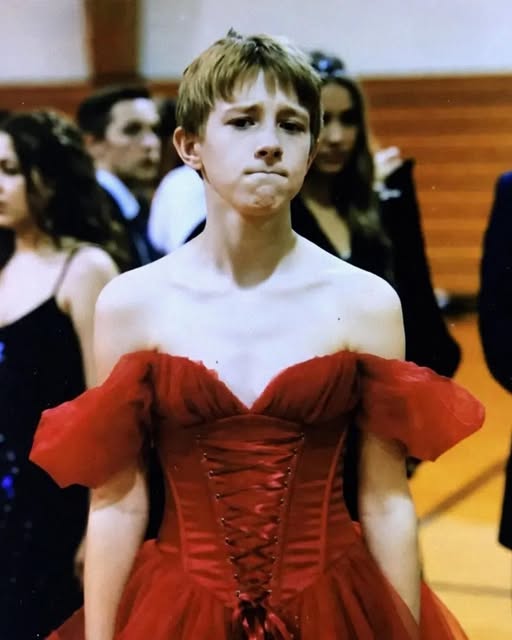
Liam walked through the doors, but he wasn’t wearing the traditional cap and gown. Instead, he was dressed in a vibrant, puffy red dress that shimmered under the harsh stage lights. For a moment, my world went silent. Then, the explosion happened. Laughter, cruel and unrestrained, erupted from the bleachers. “Is he serious?” a student shouted. “Look at the girl in the red dress!” mocked another. I saw parents leaning into each other, their faces twisted in smirks or masks of judgmental shock. “What is wrong with that boy?” a woman behind me hissed.
My first instinct was a primal urge to protect. I wanted to run to him, to wrap my arms around his shoulders and shield him from the caustic derision of the crowd. I wanted to drag him away before the world could break the spirit I had worked so hard to cultivate. But as I looked at my son, I saw something that stopped me in my tracks. Liam wasn’t flinching. He walked toward the stage with his head held high, his expression calm and resolute. He didn’t look like a boy playing a joke; he looked like a soldier on a mission.
He reached the microphone at the front of the stage, and as he adjusted the stand, the room slowly succumbed to a tense, expectant silence. He looked out at the sea of faces—the people who had just been laughing at his expense—and began to speak. His voice was steady, though it carried a slight tremor of emotion.
“I know why you’re laughing,” he said, his words cutting through the stillness. “I know how this looks. But tonight isn’t about me. It’s about a promise.” He took a breath, his eyes finding a specific spot in the crowd. “Most of you know Emma. And most of you know that her mother passed away three months ago after a long battle with illness. What you don’t know is that they had been practicing a special dance for tonight for years. It was supposed to be their moment together.”
The mocking smiles in the audience began to fade, replaced by a heavy, uncomfortable realization.
“Emma told me she wasn’t going to come tonight,” Liam continued. “She said it hurt too much to be here without her mom to do that dance. This dress… it’s a replica of the one Emma’s mom was going to wear. I didn’t want Emma to be alone. I didn’t want her to lose that memory just because her mother couldn’t be here in person.”
He turned toward the wing of the stage and held out his hand. “Emma? Will you dance with me?”
A young girl stepped out from the shadows, her face wet with tears. She looked at Liam, then at the red fabric of the dress, and a small, broken sob escaped her. She walked toward him and placed her hand in his. The music began—a soft, melodic piano piece. As they began to move, the auditorium was transformed. Every turn, every graceful spin, was a tribute to a love that transcended the room. It wasn’t a boy in a dress; it was a display of radical empathy that defied every social convention in the room.
The laughter was gone, replaced by an awe so thick it felt like it was pressing against the walls. Students who had been recording for social media put their phones away, their faces flushed with shame. Teachers and parents alike were openly weeping. In that dance, Liam had taken the ridicule meant for him and transformed it into a shield for someone else’s grief.
When the music faded, the applause was deafening—a standing ovation that seemed to shake the foundations of the building. Liam walked off the stage and came straight to me. He was trembling now, the adrenaline fading to reveal the vulnerability underneath. “I just wanted her to feel like her mom was still part of the night,” he whispered as I pulled him into a fierce embrace.
In that moment, every doubt I had ever harbored about being “enough” vanished. I realized that while I had worried about Liam lacking a traditional male role model, he had been busy learning something far more profound. He hadn’t learned how to be “tough” in the way the world expects; he had learned how to be brave in the way the world desperately needs. He had watched me struggle, survive, and prioritize kindness every day of his life, and he had turned those lessons into an act of legendary compassion.
The aftermath was a whirlwind. Liam’s story went viral, held up as a beacon of what true heroism looks like. But for us, the real change happened in the quiet moments. Emma’s father thanked Liam with a hug that said more than words ever could. Emma herself brought over a photo of the dance, noting that Liam had given her her mother back for just one song.
As we sat on our porch a week later, the graduation dress tucked away, I looked at my son and saw a man. Not because of his age or his strength, but because of his heart. I had spent eighteen years wondering if I was doing it right, only to realize that the best kind of parenting isn’t about following a script. It’s about showing up, being kind, and raising a human being who knows that the loudest thing you can ever do is stand up for someone else in silence. Liam didn’t need a father to teach him how to be a man; he just needed a mother to teach him how to love, and as it turned out, that was more than enough.