I always start my mornings slow, treating the quiet like a fragile antique I’m afraid to break. I sat at the granite island, nursing a cup of coffee in my favorite ceramic mug—the one with a spiderweb crack near the handle that I’ve never bothered to replace. The kitchen window allowed just enough sunlight to make the dust motes dance, illuminating the remnants of my husband’s departure: a trail of expensive sandalwood aftershave and a half-eaten banana turning brown on a napkin.
My name is Marjorie. To the world, I am a successful logistics entrepreneur. To the Preston family, I am a clerical error they keep forgetting to correct.
I was scrolling through my phone, thumb hovering over emails and calendar alerts, when a notification from my niece, a “boomerang” video, snagged my attention. It was a looping snippet of clinking crystal flutes, a blur of manicured hands, and the unmistakable sleek white hull of a superyacht in the background.
My thumb froze. The air in the kitchen seemed to drop ten degrees.
The annual Preston family yacht trip. It was a pilgrimage, a sacred rite of passage for my husband’s lineage. I had been invited exactly twice in the five years since marrying Lyall. The first time, I made the fatal error of suggesting we rotate destinations, earning a collective gasp that sucked the oxygen out of the room. The second time, Valora, my sister-in-law and the self-appointed guardian of the family image, made it painfully clear I was a guest, not a member. “Plus-ones over there, dear,” she had said, pointing to the overflow tender.
I clicked on the post. Then another. I saw faces I knew intimately. Flora, with her tight-lipped smile that never reached her eyes. Her twin husband, Tom. Ophelia, my mother-in-law, looking regal and oblivious, holding a mimosa like a scepter. Even Lyall’s younger cousin with his brand-new fiancée.
Everyone was there. Except me.
There was a family group chat, pompously titled Preston Legacy Voyagers. Lyall had added me years ago, then I was quietly removed after an “incident” involving a dinner seating chart where I dared to sit at the head. I checked my phone anyway. No chat notifications. No direct messages. Not a single email about the itinerary.
I stared at the black screen of my phone, the coffee cooling rapidly beside me. My pulse wasn’t racing. It wasn’t rage, exactly. It was something far more dangerous: stillness. A sinking, calcified confirmation that this wasn’t an administrative oversight. It was an amputation.
That afternoon, while I was rinsing a glass in the sink, the water running cold over my hands, my phone buzzed. A message from Valora. But it wasn’t meant for me.
It was a screenshot of a group text, evidently forwarded by mistake. It showed a photo of the finalized cabin assignments under the heading Portside Guest Rooms.
A name had been crossed out in red digital ink: Marjorie.
Next to it, typed in bold, cheerful font: Confirmed for Belle.
Belle. Valora’s yoga instructor. The woman who had once handed me her empty wine glass at a gala, mistaking me for Lyall’s assistant.
The next message in the screenshot was a voice note. I pressed play, my hand trembling slightly. Valora’s voice, mid-laugh, echoed through my empty kitchen.
“Well, at least the energy on board won’t be so… tight this year. We can finally breathe.”
Tight.
I set the phone down on the counter. I didn’t scream. I didn’t throw the glass. I just stood there, listening to the hum of the refrigerator, feeling the jaw muscle feather near my ear.
At dinner that evening, I didn’t detonate the bomb immediately. Lyall was distracted, thumbing through stock alerts between bites of cedar-plank salmon.
“Did you know your family is planning another yacht trip?” I asked, my voice light, airy, stripping away any accusation.
He glanced up, eyes shifting. “Yeah, Mom mentioned it last week. I think they’re still finalizing the logistics.”
I tilted my head, studying him like a specimen. “Am I on the list?”
He frowned, putting down his fork. “Of course, Marjorie. Why wouldn’t you be?”
I smiled just enough to keep the tension from boiling over. “Just curious.”
He went back to his phone. “I’ll double-check the dates.”
He wouldn’t. He never did. Lyall operated on the path of least resistance, and his family was a hurricane he preferred to let blow over him.
After dinner, I washed the dishes by hand, scrubbing plates until they squeaked. It is funny how silence can scream louder than a siren. That night, I lay in bed staring at the ceiling fan blades slicing through the stagnant air. My mind replayed the highlight reel of my exclusion. Birthdays with no invitation. Brunches I discovered via Instagram stories. Conversations that withered and died the moment I entered the room.
I wasn’t naive. I didn’t expect warmth from Valora; she viewed me as a bacterial infection in the family petri dish. But this… this was deliberate erasure.
The worst part wasn’t that they excluded me. It was that I had spent years convincing myself it was accidental.
Before I turned off the bedside lamp, I pulled my leather-bound journal from the drawer. I uncapped my pen and wrote one sentence in steady, dark ink.
Watch. Don’t react yet.
The next morning, I woke up to a text from Valora. It was a masterclass in passive-aggression—polite if you skimmed it, a blade to the ribs if you read it.
There it was. Her signature blend of sweet poison. Short, chirpy, coated in emojis. No room for conversation. No offer to fix it. Just a casual admission that I had been deleted, dressed up as a logistical slip-up.
I didn’t respond. I couldn’t trust my fingers not to type the truth.
Mid-morning, an email popped into my inbox from the charter management company.
Subject: Cancellation Confirmation – Cabin Release.
I blinked, opened it, and read it twice. The request had been logged three days prior. The name of the requestor: Valora Preston.
So that was how she wanted to play it.
I stared at the screen, the edges of my vision blurring not from tears, but from the sudden, sharp pressure building behind my eyes. I forwarded the email to myself, then hit print. One copy, crisp and clean. I slid it into a manila folder I kept in my bottom drawer labeled Tax + Property.
It would need a new label soon.
By the time Lyall got home, the sun had dipped low enough to throw long, distorted shadows across our living room floor. He kicked off his shoes and dropped his keys into the ceramic dish by the door like it was any other Thursday.
I waited until he cracked a beer open.
“Valora texted me,” I said.
He took a sip, leaning against the counter, feigning casualty. “Oh yeah? What about?”
“The yacht trip. She says she ‘forgot’ to reserve me a spot.”
He frowned, clearly caught off guard but not entirely shocked. “Really? That seems odd. Maybe it was a miscommunication.”
“A miscommunication?” I repeated.
“Yeah. You know how chaotic those group chats get. Maybe she thought plans had changed.”
“It wasn’t a miscommunication, Lyall,” I said calmly. “I got a cancellation email from the management company. It was submitted by her three days ago.”
He didn’t look at me right away. He swirled the amber liquid in his bottle like it might divine a smarter response. “Marjorie… look. Maybe they just wanted a siblings thing this year. Or maybe…”
“She replaced my name with Belle,” I cut in. “Her yoga instructor.”
He stayed quiet. And in that quiet, I heard the crash of my marriage hitting an iceberg.
“I’m just saying,” he mumbled, “let’s not assume the worst. I’m sure we can clear it up.”
“That’s not an assumption,” I whispered. “It’s a receipt.”
I went to the bedroom and opened my laptop. I didn’t look up old memories. I opened a new document and titled it: Things She’s Done That I Let Slide.
The list flowed faster than I expected. Forgot to include me in Rachel’s bridal shower email chain. Sent the group Christmas itinerary without my name—twice. Accidentally tagged the wrong Marjorie in a family Facebook post and left it up for days.
Just as I was about to close the laptop, a notification dinged. An email from Valora’s assistant, likely a bcc mistake on a catering chain. Attached was a screenshot of a text thread.
Valora: Don’t worry about the extra head count. She’s not coming. I handled it.
I handled it.
I stood up, crossed the kitchen, and reached for the manila folder. I added the email printout.
This wasn’t about a cabin. It never was. The yacht wasn’t just a boat to me. It was the first thing I ever bought that no one handed to me. It was born from five years of late nights, skipped vacations, and rejections from investors who told me I had a “great smile” but they wanted someone “more aggressive.”
When my logistics company finally turned a profit—the kind that makes banks call you—I didn’t buy a designer bag. I bought that yacht. Quietly. I remember signing the check. My hand didn’t shake. Yet, for tax purposes and ease of estate planning, I had put Lyall’s name on the ownership papers too.
“Makes trusts easier down the road,” our accountant had said.
Down the road, indeed. Because within months, the yacht became part of the Preston family lore. Lyall’s yacht. The Preston legacy. Valora had hijacked the narrative, and I, in my desperate bid to be accepted, had let her.
I walked to the dresser and pulled out every document I had tucked away. Ownership papers. Bank wires. The original catalog I had marked up with notes.
I looked at the documents spread across the bedspread. There were no tears. Just a low, simmering resolve that started near my collarbone and pulsed downward like a steel thread tightening inside me.
“You tried to disappear me,” I whispered to the empty room. “Now watch.”
They streamed the dinner live. I didn’t even have to search for it. Valora’s profile popped up in my notifications while I was folding laundry.
I watched on my phone. Laughter echoed. A long table covered in gold-rimmed plates and eucalyptus runners stretched across a candlelit room. The caption read: Pre-yacht family dinner! So grateful for legacy and love.
There they were. Ophelia, beaming. Valora in the center seat. Lyall, sipping wine, looking quietly complicit.
Then Valora stood to make a toast.
“When we gather like this,” she began, her voice practiced and soft, “I’m reminded of what makes our family unique. It’s not just tradition. It’s the people who carry that tradition with intention.”
Heads nodded. She continued, eyes glossy with manufactured sentiment.
“We only bring those who understand what this legacy truly means. Those who add to it, not subtract.”
I paused the video. Those who add to it, not subtract. A carefully delivered knife to the heart of my reputation. And Lyall sat there, saying nothing.
That night, I waited until Lyall came out of the shower. I played the video for him.
“She really said that,” I stated.
He rubbed his jaw, looking tired. “Valora likes theatrics. You know that. It’s just a dinner speech.”
“No, it’s a statement. And you didn’t say a word.”
“I didn’t write the speech, Marjorie.”
“But you sat through it.”
His silence wasn’t defensive. It was resigned. And that was worse.
The next morning, I printed the transcript of Valora’s speech. I highlighted the sentence about legacy. I slipped it into the folder. Then I typed a text to Valora:
I hope your speech felt honest. We’ll see how it holds up in person.
I hit send. No emojis.
That afternoon, I booked a car to Newport. I didn’t pack a bathing suit. I packed documents. I packed truth.
Downstairs, Lyall was eating dry toast.
“I’m heading to Newport tomorrow,” I said, pouring coffee.
He blinked. “That soon? Marjorie, look, I get that you’re upset, but…”
“I’m not upset anymore,” I cut in. “I’m done pretending this is a misunderstanding. It’s not.”
“Do we have to escalate this?” he sighed. “Can’t we just talk to them?”
“They made it loud, Lyall. I’m just responding in kind.”
“I don’t want to choose between you and my family.”
“You don’t have to,” I said, turning to leave. “But you do have to stop pretending they aren’t doing exactly what they are doing.”
By late afternoon, I received a text from Jen, a mutual friend.
Hey, thought you should see this.
Attached was a screenshot of the yacht’s pre-boarding guest manifest. Ten names listed. Mine was not among them. Valora hadn’t just hoped I wouldn’t come; she had bet on it.
I replied: Thanks.
Then I opened the dormant family group chat and typed: I’ll see you in Newport. I trust there will be room.
Sent. Read. No replies.
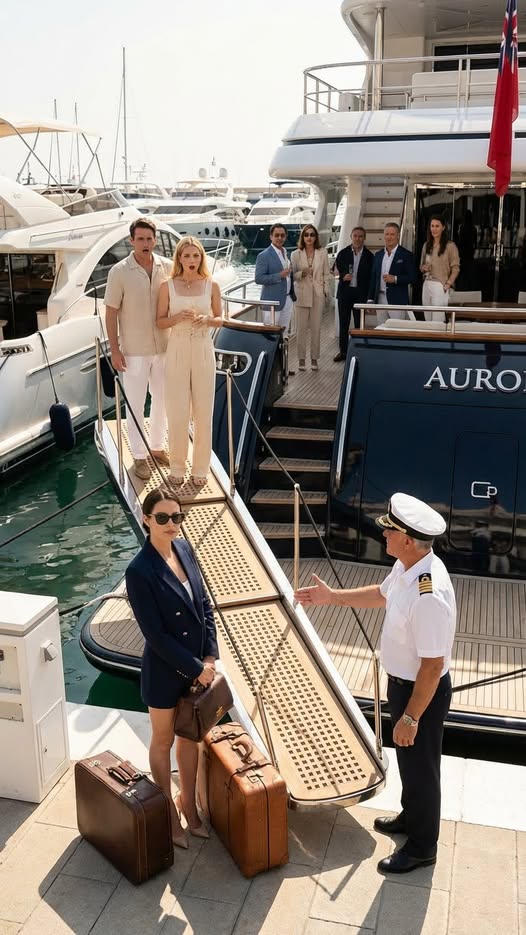
The next morning, the sun hadn’t fully climbed out of the horizon when I stepped out of the car at the marina. The air smelled of salt and money. I wore a simple black dress, structured and severe, with a tan trench coat. No jewelry except my wedding band.
I pulled my suitcase across the dock. The wheels clicked rhythmically on the wood.
Then I saw her.
Valora stood near the boarding gate, holding a champagne flute. She looked up and saw me. For a breathless second, her face stopped moving entirely. Her eyes narrowed. If sound could die, it died right then.
Ophelia turned. Lyall was there, at the perimeter of the circle. He didn’t wave.
As I approached, the group around Valora pivoted their bodies away, forming a social barricade. I didn’t slow down. I stopped just before them, offered no smile, only a single, sharp nod, and walked past.
The staff at the yacht—my yacht—didn’t flinch. A tall woman in a navy blazer stepped aside, bowing slightly.
I walked up the ramp. My heels tapped on the teak deck. I paused at the railing, staring out at the indifferent sea.
Then came the voice. The lead crew member, a man I had hired personally five years ago.
“Welcome aboard, Miss Marjorie,” he announced, his voice projecting clearly across the dock to where Valora stood frozen. “The Owner is now aboard.”
It wasn’t just a greeting. It was a declaration of war.
I didn’t turn around to see Valora’s face, but I could feel the heat of her rage radiating against my back.
“We’ve been waiting for your clearance before departure,” the crew member said softly.
I met his eyes. “Proceed.”
I walked through the lounge, past Valora’s floral arrangements, past the hierarchy of place settings, and down the hall to the master cabin. I set my suitcase down and gripped the railing of the private balcony.
I wasn’t a guest. I wasn’t an afterthought. I was the gatekeeper.
And the show was just beginning.
I stayed seated in the lounge longer than necessary. Not because I was tired—God knows adrenaline alone could have powered the engines—but because it was strategically useful to watch people try to recover from a loss they didn’t see coming.
Valora hadn’t said a word to me since we left the dock. She had made eye contact exactly once, a glare that could have peeled paint, before storming off to the upper deck. She was pacing now. I could hear her heels clicking back and forth above me.
Her husband, Tom, made weak attempts at small talk with the other guests, but the laughter was brittle, manufactured. I sipped lemon water, legs crossed, perfectly at ease. Callista, a cousin-in-law and a journalist with ears like a bat, sat beside me thumbing through her phone.
“I give it ten minutes before she tries to hijack the narrative,” Callista whispered without looking up.
“Let her,” I replied.
Right on cue, Valora stepped onto the upper deck, phone held high in selfie mode. From my vantage point, I could see her angling for the best light, the yacht’s sleek wake framing her hair. Her voice turned syrupy, the pitch rising an octave.
“Hi everyone! We are so excited to share a little slice of our family tradition today. There’s nothing like the open water to remind you who you are. Family is everything. Legacy. Loyalty. Love.”
I nearly smiled at the word loyalty.
“The people who are here,” she continued, “well, they understand what it means to build something that lasts. Not just wealth, but memory.”
Behind her, a crew member walked by, carrying a tray of iced towels. Unaware of the livestream—or perhaps, very aware—he spoke clearly.
“Glad to have you aboard again, Ms. Marjorie. The owner’s suite is prepped.”
The camera didn’t swing, but Valora’s face… oh, her face. It froze. The digital broadcast hung in a weird silence, capturing the exact moment her reality fractured.
Callista leaned toward me. “That’s going viral in three, two…”
Sure enough, the comments on my phone screen started rolling in under her stream.
Wait, SHE is the owner?
Damn, that shift.
Tell us more, Ms. Marjorie.
Valora frantically tapped her screen, killing the feed. She stormed down the stairs and found me near the port hallway ten minutes later.
“You planned that?” she hissed, veins prominent in her neck.
I met her gaze, unbothered. “Planned what? A man doing his job?”
“Don’t play dumb, Marjorie. You don’t belong here.”
I stood slowly, smoothing my dress. “That’s the thing, Valora. I don’t need to belong. I bought my place.”
She blinked like I’d slapped her, then turned and fled.
Dinner that evening was a masterclass in tension. The dining salon glowed with soft light, vanilla bean panna cotta served on gold-rimmed plates. Valora stood to give her closing toast, her voice polished, trying to salvage the wreckage of the day.
“I just want to thank everyone for being here,” she began, avoiding my eyes. “It’s not just about luxury. It’s about the people who keep our family story alive. Who uphold its integrity.”
I waited for the murmurs to settle. Then, without raising my voice, I stood.
“I’d like to contribute something to this conversation about legacy,” I said.
Valora froze, glass mid-air.
I reached into my leather folder, pulled out a printed transcript on company letterhead, and laid it flat in the center of the table.
“It’s from a Zoom call dated last month,” I said, my voice steady. “Between Valora and the Preston legal consultant.”
My finger tapped a highlighted sentence. “She’s not blood. She shouldn’t own a family asset.“
Nobody moved. Valora’s face drained of color.
“And yet,” I continued, sliding a second sheet onto the table. “This is the purchase agreement for the yacht. Initial down payment made by Marjorie Wells, Sole Investor. Legal Co-Owner. Listed First.”
Lyall opened his mouth, then closed it. He looked like a man waking up from a long coma.
“I’m not bringing this up for drama,” I said to the table. “I’m bringing it up because I’m tired of being spoken about in closed rooms as if I’m not standing in the next one.”
Ophelia cleared her throat, looking ready to intervene. But I wasn’t done.
“For years, I’ve let things slide. Snubbed invitations. Comments said just out of earshot. But let me be clear. This isn’t about being included anymore. It’s about being visible.”
“Valora, why?” Lyall’s voice broke the silence. He looked at his sister with genuine horror.
“I… I was protecting the family!” Valora stammered. “I didn’t think…”
“You thought I’d stay quiet,” I said softly. “And you were almost right.”
“No,” said a voice from the far end of the table. It was Harold, a family friend. “I think we’ve all been told a different version of things.”
Heads nodded. The alliance was splintering.
I looked at Valora one last time. “You can keep building your version of the story, Valora. But not on top of my name.”
I gathered the documents and walked out.
“If you want to know the truth,” I called back over my shoulder, “don’t ask the loudest voice in the room. Ask the one who has the receipts.”
The silence that followed was heavy, absolute, and utterly satisfying.
The only sound left that night was the soft pulse of ocean water brushing the hull. I walked the outer deck barefoot, holding my shoes in one hand. There were no dramatic confrontations, just avoidance. Small groups scattered, their alliances broken.
As I passed the lower deck cabins, I heard Valora’s voice through a sliver of an open door. Not loud, but venomous.
“She took it. It was always meant to be mine.”
I didn’t stop. I didn’t knock. She hadn’t said she was sorry, only that she had been caught.
Later, back in our cabin, Lyall stood by the dresser, folding a shirt he hadn’t worn.
“I think I always knew,” he said finally, his voice thick. “Not the extent of it. But I saw things. I should have said something.”
“You let her write the script because you didn’t want to ruin the show,” I said.
He nodded. “I know.”
I walked past him and slid into bed. I didn’t offer absolution. Sometimes the sharpest sentences are the ones left unsaid.
The next morning, the yacht felt different. The fog had lifted, but the social hierarchy had been razed. Breakfast was quiet. Valora didn’t appear. But Lyall’s cousin Maddie lingered near the coffee bar.
“I should have spoken up a long time ago,” she said, not quite making eye contact.
Ophelia brought me an extra spoon for the sugar. She didn’t speak, but the gesture was a surrender.
Upstairs, I found Callista with her laptop. She turned the screen toward me. An essay titled: The Woman They Tried to Erase: A Lesson in Ownership.
“My name is in the byline,” she said. “Did you want me to take it down?”
“No,” I smiled. “It’s record-keeping.”
That afternoon, Lyall found me on the stern.
“I spoke to Ronald, the lawyer,” he said. “We can restructure the ownership. Make it solely yours. You’ve earned it a hundred times over.”
I looked at him, long and steady. “This was never about a title, Lyall. It was about being seen.”
He nodded. “Thank you for staying. You could have walked.”
I rested my hand on his. It wasn’t forgiveness, but it was a start.
When we returned to shore, I unpacked slowly. I found a note from my father tucked into an old book in the hallway. Don’t fight for a seat. Build your own table.
A week later, I hosted Sunday brunch. My house. My table—a second-hand oak piece I had refinished myself. Lyall made coffee. Callista brought lemon bars. Ronald showed up with his wife.
I didn’t invite Valora. I didn’t invite Ophelia. I didn’t try to fill the room with people who shared the Preston name. I filled it with people who knew how to sit at a table and be real.
“Not everyone needs to come,” I told Lyall as he poured coffee. “Just the ones who belong by spirit, not blood.”
There were no speeches that day. No toasts about legacy. Just laughter that didn’t need a camera to validate it.
I looked around the room and smiled. I used to believe that if I played by the rules and stayed quiet, I’d earn a place at someone else’s table. But the truth is, you don’t need to be invited when you’ve already built your own.
Silence isn’t weakness; it’s strategy. And legacy doesn’t come from who your family is. It comes from what you create when no one is looking.
Healing doesn’t sound like an apology. It sounds like peace.