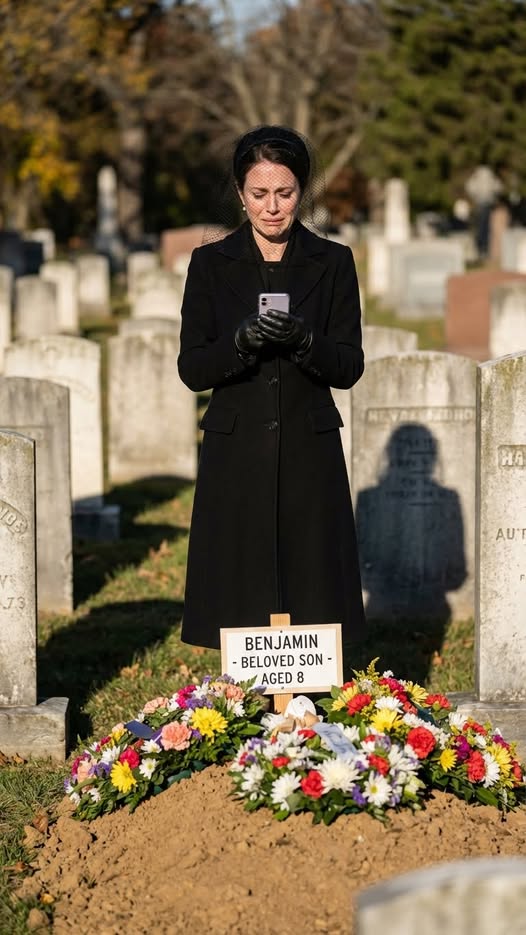
I buried my eight-year-old son, John, alone under the relentless Savannah sun. The air was so thick with humidity it felt like breathing through a damp towel, each inhalation a struggle. Sweat ran down my back in rivulets beneath my black dress, soaking into the fabric like a second skin of grief.
I kept looking toward the cemetery gates, squinting against the glare, waiting for a car. A text. Anything.
But there was nothing. No mother. No father. No sister. Just me, the oppressive heat, and the awful, ringing silence of a grave that felt far too small for the life it now held.
I thought they were stuck in traffic on I-95. I thought maybe my sister’s flight from Atlanta was delayed. I made excuses for them—mental bargaining chips to stave off the reality—until the first shovel full of red dirt hit the wood of the casket. Thud.
Then my phone buzzed in my purse.
I pulled it out, my hands trembling, hoping for an apology. A frantic message explaining a flat tire or a medical emergency.
Instead, I saw a notification from my mother, Amber. It wasn’t a text. It was a shared link. A Zillow listing for a sprawling, five-bedroom estate on the coast.
I stared at the screen, my vision blurring from the sweat and the tears. The price was listed right there in bold black font: $1.5 million.
The exact amount of my son’s life insurance payout and his trust fund combined.
While I was putting my child in the ground, my family wasn’t grieving. They were shopping.
I drove home in silence, the air conditioning in my old sedan blasting against the sweat drying on my skin, turning it cold and clammy. The back seat was filled with the flower arrangements from the service—white lilies giving off a scent so thick and cloying it made my stomach turn. It smelled like a funeral parlor, like finality, like the end of the world compressed into a two-mile drive.
When I unlocked the door to my apartment, the quiet didn’t feel peaceful. It felt heavy, like the air before a thunderstorm. I walked into the kitchen, threw my keys on the counter, and stared at the empty space where John used to sit for breakfast, his legs swinging, milk mustache on his upper lip.
I waited for the breakdown. I waited for the knees to buckle, for the sobbing to start, for the grief to swallow me whole.
But it didn’t come.
Instead, a strange, icy clarity settled over me. It started at the base of my spine and worked its way up, cooling the heat of the Savannah sun, sharpening my vision until everything in the room looked high-definition and hard-edged.
I opened my laptop. I needed to know.
I logged into the florist’s website, the one my mother used for every birthday and anniversary. I had her password because I was the one who usually ordered the gifts she took credit for. I found the order for the funeral spray—the “Deepest Sympathies” arrangement that had sat near the podium.
There was the date stamp. Order placed: 14 days ago.
They hadn’t missed the funeral because of a last-minute crisis. They hadn’t been delayed by traffic or a sudden illness. They had pre-ordered the flowers two weeks in advance. They had known, fourteen days ago, that they wouldn’t be standing beside me while I buried my son. They had scheduled their absence like a dentist appointment.
I didn’t scream. I didn’t throw the laptop across the room. I just sat there, and the last little piece of hope I had been holding onto—the childish hope that my mother loved me, that my father protected me—snapped. It was a clean break, like a dry twig under a boot.
I opened a new tab: my banking portal.
I pulled up the joint credit card I had shared with my sister, Destiny. I had added her as an authorized user three years ago when she claimed she needed help building credit. I scrolled through the recent transactions.
While I was at the funeral home picking out a casket, she had spent $400 at a Sephora in Atlanta. While I was writing my son’s eulogy, trying to find words for the impossible, she had dropped $200 at a sushi restaurant.
I clicked Remove Authorized User. Confirmed. The card was dead.
Next, I navigated to the smart home app for the family vacation cabin in the Blue Ridge Mountains. They called it the “family cabin,” but my name was the only one on the deed. I had bought it with the settlement from my divorce, a place for John to see snow for the first time. My parents used it every other weekend to host their friends, playing the wealthy retirees while I paid the property taxes.
I selected the digital lock. Change Access Code.
I deleted my father’s code. I deleted my mother’s code. I deleted Destiny’s code.
I set a new master PIN. Access denied.
I kept going. Streaming services. Amazon Prime. The shared cloud storage where they kept their photos. I went down the list methodically, severing the digital tendrils they had wrapped around my life.
I remembered what my mother had said to me just a week ago when I told her I was struggling to organize the service. She had looked at my drafting table, covered in my botanical illustrations.
“Sarah, you just aren’t equipped for the real world,” she had said, her voice dripping with that fake sympathy. “You play with your coloring books while the adults handle the business.”
Coloring books. That’s what she called my career. That’s what she called the work that paid her mortgage when she “forgot” to send the check.
I looked at the screen. All the accounts were locked. All the cards were cancelled. All the access points were closed.
They thought I was weak. They thought grief had made me soft, pliable, a broken thing they could mold into whatever shape they needed. They were about to find out that grief doesn’t always break you. Sometimes it burns away everything that isn’t essential, leaving you harder than diamond.
I closed the laptop. The apartment was still silent, but it didn’t feel empty anymore. It felt like a war room.
I sat in the dim light of my kitchen, the laptop screen casting a cold blue glow across my hands. My fingers hovered over the keyboard, but my mind was drifting back, replaying the highlight reel of my life in this family.
I needed to understand why. Why had I let it go on this long? Why had I paid their bills, fixed their messes, and swallowed their insults for thirty-two years?
I pulled up a spreadsheet I had hidden deep in my hard drive. I called it The Ledger.
It started four years ago, right after my father, Andrew, retired early because he “deserved a break.”
Row 1: $96,000. That was the total I had paid toward their second mortgage. Every month, like clockwork, $2,000 left my account and went into theirs. I remembered the first time I sent it. My mother, Amber, had called me in tears, saying they were going to lose the house. “We sacrificed everything for you girls,” she had sobbed. “And now we have nothing.”
I had just landed my first major contract illustrating a rare plant guide for a university press. I felt rich. I felt guilty. So, I paid. And when I told them, my father didn’t say thank you. He just nodded and said, “Good girl. At least you’re making yourself useful.”
Making myself useful. That was my currency. That was the rent I paid for occupying space in their lives.
I scrolled down.
Row 12: The Influencer Trip. Destiny had wanted to go to Tulum for her birthday to “build her brand.” She couldn’t afford the flight. My mother had cornered me at Sunday dinner. “Your sister is so talented, Sarah. She just needs a break. You have savings. Don’t be selfish.”
Selfish. The word they used whenever I tried to keep something for myself. I paid for the flight. Destiny posted thirty photos from that trip. I wasn’t tagged in a single one.
Row 24: The Car Accident. Destiny had totaled her BMW while texting. My father had co-signed the loan. He was panicking about his credit score. I paid the deductible, $500.
It wasn’t just the money; it was the way they trained me. It was like they were feeding a stray dog. They starved me of affection for weeks, months, making me feel invisible. And then, just when I was about to walk away, they would throw me a scrap. A compliment on my hair. A hug that lasted two seconds too long. A text that said, “Thinking of you.”
And I would eat it up. I would wag my tail and come running back, thinking, See? They do love me. If I just try harder, if I just give a little more, it will stay like this.
Psychologists call it intermittent reinforcement. It’s the most powerful way to condition a behavior. It’s how you train a rat to push a lever until it dies of exhaustion. You don’t give it a pellet every time. You give it a pellet randomly. The unpredictability keeps the hope alive, keeps you addicted to the possibility of love.
But looking at The Ledger now, seeing the cold, hard numbers, the addiction broke.
My eyes landed on the most recent entry. Two days after John died, a package had arrived at my door. My mother had texted me: “Sent you something to help. Love you.”
I had opened it with shaking hands, thinking maybe it was a photo album or a blanket—something to comfort me.
It was a box. Inside was a stack of envelopes: past-due notices, credit card bills, a foreclosure warning for the beach house, all addressed to Destiny or my parents. And on top, a yellow sticky note in my mother’s handwriting:
Do the right thing, Sarah. Family helps family.
That was their condolence gift. A bill. They didn’t see a grieving mother. They saw an inheritance. They saw a payout.
I closed the spreadsheet. The shame I had felt for years—the shame of not being enough, of not being like Destiny—evaporated. It wasn’t shame anymore. It was fuel.
I had spent my life building them a safety net, stitching it together with my own money and self-worth. Now I was going to cut the ropes and watch them fall.
The banging on the door started at 2:00 in the afternoon the next day. It wasn’t a polite knock. It was the heavy, entitled pounding of people who believed they owned the building.
I checked the peephole. Andrew and Amber. My parents.
I unlocked the deadbolt. I didn’t have time to say hello before my father pushed past me, the heat of the Savannah afternoon following him in like a wave. He didn’t look at me. He walked straight to the kitchen, opened the refrigerator, and started pulling things out.
“Expired,” he muttered, tossing a carton of milk into the trash. “Wilted,” he said, throwing away a bag of spinach.
He was performing a “wellness check,” but it felt like a raid. He was building a case. She can’t even buy groceries. She can’t function.
My mother stood in the hallway, staring at the walls. I had hung my latest series there—intricate, large-scale watercolors of decaying magnolias.
“It’s so dark in here, Sarah,” she said, her voice trembling with a rehearsed fragility. “And these drawings… they’re obsessive. It’s not healthy. You’re spiraling.”
I leaned against the doorframe, crossing my arms. “What do you want?”
“We want to save you,” she said, turning to me with wide, wet eyes. “We spoke to a specialist. He agrees. You’re displaying signs of a psychotic break. The isolation, the aggression, cutting off your sister…”
She reached into her designer handbag and pulled out a thick document clipped with a blue backing. She placed it on the coffee table.
“It’s a voluntary conservatorship,” she said. “Just for the financial side. Just until you’re stable again. We’ll manage John’s trust. We’ll make sure the bills get paid. You don’t have to worry about a thing.”
I looked at the papers. They wanted control. Not just of the money, but of me.
“And if I don’t sign?” I asked, my voice flat.
Andrew slammed the fridge door shut. “Then we call the authorities,” he said, wiping his hands on his pants. “We file for an involuntary 5150 hold. We tell them you’re a danger to yourself. We have the neighbors’ statements. We have the emails you sent Destiny.”
I froze. I hadn’t sent Destiny any emails. They were forging evidence.
I looked at my mother. She wasn’t wringing her hands anymore. She was watching me with a terrifying serenity.
This is what psychologists call the Savior Gaslight. It’s a specific form of narcissism where the abuser convinces themselves they are the martyr. They don’t see themselves as thieves stealing a dead child’s insurance money. In their minds, they are the heroic parents stepping in to rescue their “broken” daughter from her own wealth. They have to believe I’m crazy because if I’m sane, then they’re just monsters. And their egos can’t handle that reality.
“We just want what’s best for you,” Amber whispered. “Do the right thing, Sarah. Sign the papers. Don’t make us have you committed.”
I walked to the window. Outside, parked in the fire lane, was Destiny’s white Range Rover. She wasn’t coming inside. She was sitting in the driver’s seat, her phone mounted on the dashboard, the ring light reflecting in her sunglasses.
She was live-streaming.
I could practically see the caption: Intervention Day. Pray for my family. #MentalHealthAwareness.
She was monetizing my breakdown in real-time. She was building the public narrative that I was unhinged so that when they took the money, the world would applaud them for stepping up.
They had it all planned. The legal threat, the social proof, the emotional blackmail. They had trapped me in a corner where my only options were to hand over the money voluntarily or be dragged away in a straightjacket while they took it anyway.
I turned back to them. I needed them to leave before I did something that would actually prove them right.
“I need to think,” I said.
“You have twenty-four hours,” Andrew said. “Tomorrow at noon. Or we call the police.”
They left the papers on the table. As they walked out, my mother paused and touched my cheek. Her hand was cold.
“We love you, Sarah,” she said. “We’re doing this because we love you.”
I locked the door and slid the chain into place. I looked at the conservatorship documents. They thought they had checkmated me. But they forgot one thing.
They were playing checkers. I had hired a Grandmaster.
I picked up my phone and dialed Eric.
Eric’s office felt more like a bunker than a law firm. Servers hummed along one wall, cooling the room to a crisp sixty degrees. Kelly, my late husband’s aunt and a retired federal judge, sat at the head of the table, sharp-eyed and unsentimental.
“We found out why they’re desperate,” Eric said, sliding a tablet across the polished wood. “It wasn’t just debt. It was a ledger from an illegal Atlanta gambling ring.”
I looked at the screen. Destiny’s name was everywhere.
“She owes $400,000,” Eric said flatly. “Your parents co-signed the markers. These aren’t banks, Sarah. These are loan sharks. They have forty-eight hours, or it gets violent.”
Everything suddenly made sense. The panic, the threats, the sudden “concern” for me. They didn’t want to save me. They wanted my son’s trust fund to save their own skins.
“And they’re ready to destroy you to get it,” Kelly added. She opened a folder. “They prepared court filings claiming you’re suicidal. Fake emails, affidavits from ‘friends’ we can’t locate.”
I pulled out my phone. “They built a story,” I said. “I have data.”
My smartwatch showed I was in deep sleep the night they claimed I was manic. Security footage from my apartment building proved I was quietly painting when they said I was destroying furniture.
Eric smiled. “If they submit those lies to a court, it’s felony perjury.”
“We need a sting,” Kelly said.
“I’ll give them what they want,” I replied. “I’ll pay.”
The next day, I went to my parents’ house. I played defeated. I slumped my shoulders; I kept my eyes down. Andrew lectured me about responsibility. Amber smiled coldly, serving tea. Destiny waited impatiently by the laptop, tapping her acrylic nails on the table.
“I transferred $450,000,” I said quietly.
They toasted with cheap champagne. They hugged. They had won.
Then Andrew’s phone rang. He looked at the screen, frowned, and answered. His face went white.
“All our accounts are frozen,” he whispered. “Federal hold.”
I straightened my spine. I looked at them, really looked at them, for the last time.
“Yesterday, I filed an IRS whistleblower report,” I said. “The gambling ledger flagged your accounts for money laundering investigation. That transfer I just made? It triggered an automatic freeze on everything connected to your names.”
Destiny screamed. “The loan sharks! They’ll see the money came in and then got frozen!”
“Exactly,” I said. “You’re trapped between the IRS and the mob.”
I walked out as the screaming started.
The fallout was swift. My parents lost the house to asset forfeiture. Destiny fled the state, chased by debts she couldn’t outrun. I received a whistleblower reward, enough to start over in a new city.
I used the rest of my son’s trust to create the John Morgan Astronomy Scholarship.
I didn’t lose my family. I stopped carrying them. And that was how I finally learned to let go.