When you hit sixty-six, you learn that silence isn’t just golden; sometimes, it is the only thing keeping you alive.
As I drove home from Sunrise Hospital that blistering June afternoon, the doctor’s warning was still ringing in my ears like tinnitus. “Thomas, your blood pressure spikes when you get agitated. You are walking a tightrope. You need to avoid stress, or the next one won’t be a warning.”
I turned off the air conditioning, despite the dashboard reading 105°F. Sometimes, physical discomfort clears your head better than comfort ever could. Charleston Boulevard stretched ahead of me, a ribbon of gray asphalt shimmering in waves of distortion. The desert heat pressed against the glass, a heavy, suffocating blanket.
Traffic crawled through the intersection at Rainbow Boulevard. I stopped at the red light, my hands resting loosely on the wheel, my mind drifting to nothing in particular—just the hum of the engine and the rhythmic thrum of the heat.
That’s when I saw her.
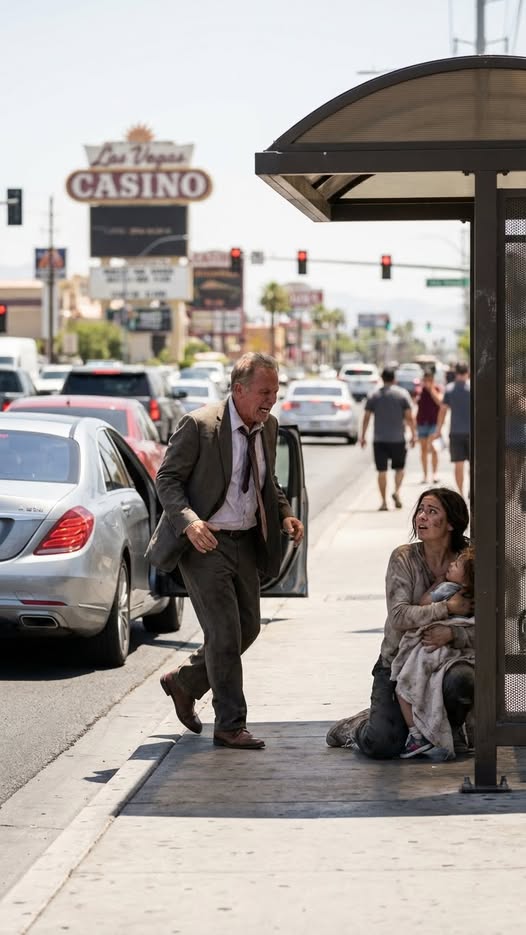
A woman was moving between the idling cars, thin and ragged, a specter in the midday sun. Her clothes were stained and torn, hanging off a frame that looked too brittle to withstand a stiff wind. She was barefoot. On asphalt hot enough to fry an egg, she was barefoot.
She carried a baby strapped to her chest with a dirty scarf—a tiny thing with flushed, fever-bright cheeks and a head that lolled weakly against her shoulder. The woman moved from window to window, not with the practiced rhythm of the regulars, but with a frantic, jerky urgency. She was counting coins in her palm, her lips moving in a silent, desperate calculation.
I should have looked away. Las Vegas has plenty of lost souls asking for help at intersections. But something made me look closer. Maybe it was the way she held her head, a tilt that sparked a memory deep in my lizard brain.
She bent down to pick up a dropped quarter, and for a split second, her hair fell back, revealing her face.
My chest seized. The air left my lungs in a painful rush.
It was Jessica. My daughter.
“Jessica!” The word exploded from my throat, raw and tearing.
I threw the car door open, ignoring the blare of traffic. She looked up, and her eyes went wide—not with relief, not with joy, but with absolute, unadulterated terror.
“Dad, no,” she whispered, backing away as if I were a monster. “You can’t be here. You have to go. Please.”
“Get in the car,” I said, my voice shaking, fighting the black spots dancing in my vision. “Right now.”
“Dad, they’re watching!” She scanned the parking lot of the strip mall nearby, her eyes darting like a trapped animal’s.
“I don’t care who is watching.” I shoved the passenger door open. “Get inside.”
She stood frozen, clutching the baby—my granddaughter, Sophie—tighter. The infant whimpered, a dry, weak sound that tore through my heart.
“Jessica,” I softened my voice, pleading. “Please. Let me help you.”
Her resistance crumbled. Tears cut clean tracks through the grime on her cheeks. She glanced around one last time, then stumbled toward the car. She climbed in, the smell of sweat and old fear filling the cab. Sophie’s little arms hung limp, drained by the heat.
I pulled the car forward just as the light turned green, ignoring the chorus of horns behind me. For several blocks, neither of us spoke. Jessica’s shoulders shook with silent sobs. She rocked the baby gently, whispering words I couldn’t catch.
I had a thousand questions, but one burned hotter than the desert sun. One question that turned my confusion into a shard of ice in my gut. I glanced at this woman who looked like a ghost of the girl I’d raised, the daughter I’d given everything to ensure she would never know this kind of struggle.
“Jessica,” I said quietly, my voice cutting through the hum of the tires. “Where are the house and the Mercedes I bought you?”
She closed her eyes. Her whole body trembled, a leaf in a storm.
“They took them, Dad,” she whispered. “And if you don’t keep driving, they’re going to take Sophie, too.”
I drove without a destination, instinct telling me to put miles between us and that intersection. Jessica sat hunched over, protecting Sophie with her body, as if she expected a blow to come from the dashboard.
“Tell me,” I said. “Start from the beginning.”
Her voice was barely audible, a rasp of shame and exhaustion. “The house is gone, Dad. The car. All four hundred thousand in savings. Everything you gave me.” My jaw clenched so hard I thought a tooth might crack. “Kyle. Patricia. And Garrett.”
She wiped her face with a filthy hand. “Three days after Sophie was born, Kyle came home with a gift. A silver bracelet engraved ‘Sophie’s Mom.’ I cried. I told him he was the most thoughtful husband in the world.”
She let out a bitter, jagged laugh. “Then he pulled out papers. He said he was setting up an insurance policy for Sophie, to protect her future. He said he just needed my signature to finalize the trust.”
She looked at me with hollow, haunted eyes. “I was exhausted, Dad. Sophie had been screaming with colic all night. I hadn’t slept in seventy-two hours. I trusted him. I signed without reading.”
“What did you sign?” I asked, though the cold dread in my stomach already knew.
“Power of Attorney,” she said, the words tasting like ash. “Durable and absolute. I gave him control of everything. The house, the accounts, my legal rights. All of it.”
“And then?”
“Then they put me to work.” Her hands trembled violently. “Every morning for two weeks, his brother Garrett or his mother Patricia would drive me to different intersections. They’d leave me there with Sophie. They told me if I didn’t make twenty dollars in an hour, I wouldn’t eat that night.”
“They made you beg?” My voice was a low growl.
“They watched me, Dad. Patricia would park her car nearby, just watching through her sunglasses. At night, they’d lock me in the back room of the house—my house. They took my phone. They said if I contacted you, they’d take Sophie and vanish, and I’d never see her again.”
I had to pull the car over. My hands were shaking too hard to grip the wheel. “Why didn’t you run? Why didn’t you find a police officer?”
“Because they told me you’d have a heart attack if I showed up like this.” Fresh tears spilled over. “They said you’re sixty-six with high blood pressure. They said the shock would kill you, and it would be my fault.”
“Jessica…”
“But that’s not the only reason.” She covered her face. “The truth is… I was too ashamed. You warned me about Kyle. Two years ago, when I brought him home. You said, ‘I don’t trust him, Jessica. He asks too many questions about money.’ And I called you paranoid. I pushed you away.”
“You fell in love,” I said, gripping her hand. “That is not a crime. Greed is a crime. Fraud is a crime.”
“I lost everything.”
“You are alive. Sophie is alive.” I started the engine again. “And I am going to fix this. But first, we need to go underground.”
I drove us to Henry Walsh’s Motel on Boulder Highway. It wasn’t the Ritz, but Henry was an old friend from my days in construction, a man who knew how to keep his mouth shut and his ledger offline.
Henry took one look at Jessica and the baby, saw the look in my eye, and handed me a key to Room 12 at the back. He brought water, fresh towels, and a few sandwiches, then disappeared.
Jessica sank onto the bed. In the cooler air of the room, Sophie finally relaxed, her tiny chest rising and falling in a rhythm that wasn’t desperate.
I spent the first night sitting in a chair by the door, watching the parking lot through a crack in the curtains. I didn’t sleep. My mind was a battlefield, mapping out logistics. Kyle wasn’t just a thief; he was a predator. And predators don’t stop hunting just because the prey slips the trap.
Day two passed in a tense quiet. Jessica showered—the water running black with grime—and fed Sophie with formula I’d bought at a Walmart three towns over. I watched the life slowly return to my granddaughter’s eyes.
But the peace was a lie.
On the morning of the third day, just after I’d returned with coffee, three sharp raps echoed on the motel door.
Knock. Knock. Knock.
Jessica froze, the bottle halfway to Sophie’s mouth. Her face went white. “Dad,” she mouthed.
I held up a hand. Stay quiet.
“Mr. Graham?” A voice came through the wood—smooth, friendly, the kind of voice that sells you a lemon car. “My name is Brett. I’m here on behalf of Kyle Richardson. There’s been a family misunderstanding, and we’d like to talk it through.”
I moved to the door but didn’t open it. “There is nothing to talk through.”
“Sir, I understand emotions are running high, but Jessica is Kyle’s wife. Sophie is his daughter.”
“Jessica doesn’t want to see him.”
A pause. When Brett spoke again, the veneer of friendliness had vanished.
“Mr. Graham, Kyle has legal rights. If you are harboring Jessica and preventing her from returning to her custodial home, that is interference. We can have the police here in ten minutes.”
“Kyle kicked them out,” I said, my voice steady despite the rage boiling my blood.
“That’s not how Kyle tells it,” Brett replied coldly. “He says Jessica left voluntarily. He says she abandoned the marriage due to mental instability. He’s very concerned about Sophie’s welfare, especially given that Jessica was found begging on the streets.”
They were spinning the narrative. They were already ahead of us.
“Get off my property,” I said.
“We’ll find them again, Mr. Graham,” Brett said, his voice dropping an octave. “And next time, we might not be so polite.”
I listened to his footsteps retreat, then the sound of an engine starting. I turned to Jessica. She was trembling so hard the bed frame shook.
“They know,” she whispered.
“Not for long,” I said. “Pack the bag. We’re leaving.”
We were running, but I knew we couldn’t run forever. If I wanted to save my daughter, I had to stop playing defense. It was time to hunt the hunters.
Henderson felt like a different world from the grimy motels of Boulder Highway. I moved us into a secure apartment complex arranged through a favor from an old colleague. Key card access. Cameras at every corner.
“Don’t open this door for anyone but me,” I told Jessica. “I’m going to get help.”
Samuel Porter’s law office was a fortress of mahogany and leather near the Clark County Courthouse. I’d known Sam for fifteen years; he was a shark in a suit, a man who viewed the law not as a shield, but as a sword.
He took one look at my face and said, “Who do I need to bury?”
I told him everything. He listened without blinking. When I finished, he picked up his phone. “We need Kenneth Morris.”
Kenneth was a financial investigator who could find a penny dropped in the ocean. Twenty minutes later, he was in the room, listening to the abbreviated version.
“Four hundred thousand doesn’t vanish,” Kenneth said, pulling out a tablet. “It leaves footprints. I need Jessica’s social, the approximate dates, and the VIN of that Mercedes.”
“She signed a power of attorney,” I said. “She thought it was insurance.”
“That’s fraud in the inducement,” Sam noted, scribbling furiously. “But we need to prove intent.”
“What about Sophie?” I asked. “They threatened to call the cops for kidnapping.”
“Let them try,” Sam said, his eyes hard. “But we need to move fast. Kyle is going to control the narrative.”
As if summoned by his words, my phone buzzed. A text from an unknown number.
Your daughter is famous. Better check Facebook.
I opened the link. My stomach dropped through the floor.
It was a video, shaky and vertical, filmed from a car window at the intersection of Charleston and Rainbow. There was Jessica, looking ragged and insane, holding a crying Sophie.
The caption read: This is my wife, Jessica Richardson. She abandoned our family, took our daughter, and disappeared into drugs. She refuses help. If you see her, contact me immediately. I just want my baby home safe.
Posted by Kyle Richardson. 15,000 views in two hours.
The comments were a cesspool. “What a monster.” “Call CPS.” “She looks like a junkie.” And there, at the top, a comment from Patricia: I’ve tried so hard to help her. We gave her everything. Praying for Sophie.
I showed the phone to Sam.
“He’s weaponizing public opinion,” Sam said grimly. “He wants you to react. He wants you to scream and yell so he can paint you as the unhinged father enabling the addict daughter.”
“So we do nothing?” I demanded.
“No,” Sam said. “We let him think he’s won. We let him get comfortable. And while he’s busy playing the victim on Facebook, Kenneth is going to gut his financial life.”
I went back to the apartment that night, feeling the weight of the world. Jessica saw the video. I couldn’t hide it. She collapsed, sobbing that everyone thought she was a monster. I held her until she fell asleep, then sat by the door, refreshing the page. 50,000 views.
The next morning, Kenneth called.
“Thomas,” he said, his voice lacking its usual calm. “You need to sit down.”
“I’m sitting.”
“I got into the records. I found where the money went—offshore accounts in the Caymans under a shell company linked to Patricia. But that’s not the worst part.”
“What could be worse?”
“I found a life insurance policy,” Kenneth said. “Kyle filed it three days after Sophie was born. Five hundred thousand dollars on Jessica. Beneficiary: Kyle Richardson, 100%.”
The room went very still.
“He took out life insurance on her,” I said slowly, “and then forced her to stand in 105-degree heat all day with no food?”
“Exactly,” Kenneth said. “They weren’t just waiting for her to break, Thomas. They were waiting for her to die. Heat stroke, dehydration, getting hit by a car… any accident would pay out half a million dollars.”
It wasn’t just theft. It was a slow-motion execution.
“Send me the files,” I said, my voice cold as the grave. “All of them.”
“I’m sending them to Sam now. Thomas… be careful. These people are desperate.”
I hung up. I looked at my daughter, sleeping on the couch, unaware that her husband had priced her life at half a million dollars.
I wasn’t just going to sue them. I was going to destroy them.
We needed a confession. The documents were strong, but a jury loves a villain they can hear.
I arranged a meeting. I sent a text to Patricia: I’m tired. I can’t take care of them anymore. Let’s talk terms.
She took the bait instantly.
We met at a Starbucks on West Sahara Avenue. Neutral ground. Public. I arrived early; Sam was already there, sitting three tables away, looking like a remote worker with headphones on. He wasn’t listening to music; he was monitoring the wire taped to my chest.
Patricia walked in at 11:00 AM sharp, wearing a white linen blazer and oversized sunglasses. Kyle trailed behind her, looking smug, the grieving husband act dropped the moment he saw me alone.
“Mr. Graham,” Patricia said, sitting down without offering a hand. “I’m glad you finally came to your senses.”
I slumped my shoulders, playing the part of the defeated old man. “I just want to understand. The house I bought her… the $700,000 house. Where is it?”
“That’s family property now,” Patricia said crisply. “Jessica signed the transfer. Everything was legal.”
“And the Mercedes?”
“Family property,” Kyle said, leaning back. “Liquidated for business investments.”
“Four hundred thousand dollars,” I whispered. “Gone?”
“Jessica made her choices,” Patricia said, patting my hand with a cold, dry touch. “She signed the documents. She’s mentally unwell, Thomas. Now, bring us Sophie, and we won’t press charges for kidnapping.”
“You want the baby,” I said. “But what about Jessica?”
“Jessica needs… institutional help,” Kyle said, a dark glint in his eye. “We’ll take care of her.”
I knew what that meant. They’d take care of her until the policy paid out.
“I need time,” I said, standing up slowly.
“Don’t take too long,” Kyle warned. “My patience is wearing thin.”
I walked out. Sam followed me to the parking lot.
“Did we get it?” I asked, my heart hammering against my ribs.
Sam held up his phone, a vicious smile on his face. “Every word. ‘Family property.’ Admitting they liquidated the assets. We have them.”
My phone buzzed. It was Kenneth.
Lauren Reed found. She has photos of Patricia watching Jessica beg from her car. And I found the notary who stamped the forged deeds. He’s ready to flip on Garrett.
“We have the trifecta,” Sam said. “Fraud, conspiracy, and thanks to the insurance policy, attempted murder. Let’s go get your life back.”
Kyle Richardson walked into Samuel’s office two days later, expecting a surrender. He brought Garrett with him this time. They looked like vultures coming to pick a carcass.
Kyle sat down, adjusting his expensive tie. “So, where is my daughter?”
Samuel didn’t speak. He simply turned his laptop around and pressed Play.
Patricia’s voice filled the room, clear and damning. “That’s family property now. Everything was legal.”
Kyle’s face froze.
Then Kenneth stepped forward and dropped a stack of papers on the desk. The thud echoed like a gunshot.
“Bank records,” Kenneth recited. “Four hundred thousand transferred. Unauthorized.”
“Jessica gave me access!” Kyle shouted, standing up.
“No,” Kenneth said calmly. “She signed a Power of Attorney under duress, disguised as insurance paperwork. And here…” He slapped another document down. “…is the $500,000 life insurance policy you took out on her life three days before you forced her onto the street.”
Kyle went pale. Garrett looked at the door.
“And this,” Kenneth pointed to a photo, “is Patricia sitting in her car, watching Jessica beg. We have GPS data placing her there for fourteen days straight.”
“This is entrapment,” Garrett stammered.
“This is the end of your life,” Sam said. “We filed a civil suit this morning. We also handed this entire packet to the District Attorney. They are very interested in the forgery on the house deed. Garrett, that’s your signature, isn’t it?”
Garrett looked at Kyle. “You said this was airtight.”
“Shut up,” Kyle hissed.
I stood up then. I walked around the desk until I was inches from Kyle’s face.
“You tried to erase my daughter,” I said, my voice low and dangerous. “You stole her dignity. You stole her home. You treated her like cattle to be slaughtered for a payout.”
Kyle tried to step back, but he hit the wall.
“You’re done,” I said. “Get out.”
They fled. But they couldn’t run far enough.
Three months later, I drove past the intersection of Charleston and Rainbow. The October air was cooling, the brutal summer heat finally breaking.
The lawsuit had been a landslide. The house was returned to Jessica’s name. The Mercedes was recovered. The money was mostly gone, spent on their lavish lifestyle, but the court seized Patricia’s assets to repay us.
Garrett had been arrested trying to cross state lines into Arizona; he was currently in county lockup awaiting trial for forgery. Patricia and Kyle were out on bail, but their assets were frozen, their reputations incinerated by the viral truth that Nathan Clark, a journalist friend of mine, had published.
I stopped at the red light. I glanced to my right.
And there they were.
Kyle was holding a cardboard sign. Homeless. Anything Helps. His tailored suit was gone, replaced by dirty jeans and a t-shirt. Patricia sat on the curb behind him, her face buried in her hands, her white blazer stained gray.
I thought about rolling down the window. I thought about saying something.
Kyle looked up. Our eyes met. Recognition flickered in his gaze, followed by a crushing wave of shame. He looked away, turning his back to me.
The light turned green. I didn’t smile. I didn’t gloat. I just drove on. Karma had arrived, and she didn’t need my help.
Twenty minutes later, I pulled up to a small, clean apartment in Henderson. Jessica opened the door before I could knock. She looked healthy. Her hair was clean, her eyes bright. Sophie came toddling across the room, arms outstretched.
“Papa!” she squealed.
I scooped her up, burying my face in her soft hair. All the anger, the fear, the sleepless nights—it all melted away in the warmth of her hug.
“Thank you, Dad,” Jessica said softly, leaning against the doorframe. “For fighting for us.”
“You don’t need to thank me,” I said.
“Yes, I do. You could have said ‘I told you so.’ You could have turned away. But you didn’t.”
I looked at my daughter, and then at my granddaughter dancing in my arms with her stuffed bear.
“You’re my daughter,” I said. “There was never a choice.”
We aren’t keeping the big house. Too many bad memories. Jessica is selling it to start fresh, maybe go back to school. We’re rebuilding, brick by brick.
But every time I hit a red light, I say a small prayer of thanks. I thank God for the delay that day. I thank God I looked. And I thank God that when the devil came for my family, I was ready to send him back to hell.
Family isn’t just about blood. It’s about who shows up when the world is burning. And if you’re reading this, remember: silence is survival, but action is love. Never assume someone else will save the day. Sometimes, you are the only thing standing between a loved one and the abyss.