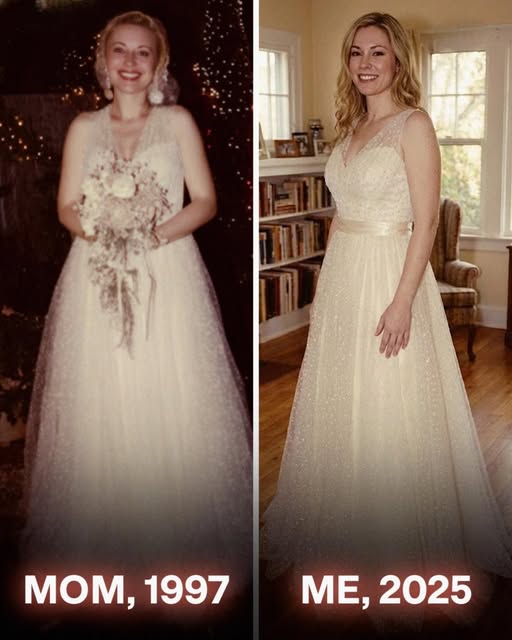
Grief is a thief that steals in stages, but for me, Rachel, the greatest theft wasn’t the initial loss—it was the slow, systematic erasure that followed. I was fourteen when my mother passed away, a loss that turned the vibrant colors of my childhood into a muted, terrifying silence. My mother had been the heartbeat of our home; she was the woman who hummed while she cooked and braided my hair with a rhythmic tenderness that made the world feel safe. When she died, I clung to her scent on the curtains and the neat cursive in her recipe books like a lifeline.
Hidden in the sanctuary of her closet, I discovered the ultimate artifact of her life: her wedding gown. It was a masterpiece of satin and lace, timeless and regal. Holding it to my chest, I made a silent vow that one day, I would walk down the aisle wrapped in that same fabric. It was my way of ensuring she would be there for the most important moment of my life.
Three years later, my father remarried a woman named Sandra. She arrived with cool lipstick and a practiced grace that masked a predatory instinct for domestic control. Sandra didn’t attack our memories all at once; she eroded them. It began with a framed photo moving from the mantel to a drawer “for safekeeping,” followed by the “accidental” breaking of Mom’s favorite vase. Slowly, the floral curtains Mom chose were replaced by sterile gray drapes, and the hand-stitched pillows I had cherished were tossed out as “old-fashioned.” My father, buried in his work and blinded by a desire for a fresh start, never saw the quiet war being waged against my mother’s ghost.
But I kept the dress secret. I hid it in the deepest recesses of my closet, checking on it like a sacred relic. When I finally met Daniel—a man whose warmth mirrored the kindness my mother had always valued—and he asked me to marry him, there was never a doubt about what I would wear.
The first time I tried on the gown, the fit was divine. I stood before the mirror and didn’t just see a bride; I saw my mother’s legacy staring back at me. I was startled out of my reverie by Sandra, who stood in the doorway with a look of pure disdain. She called the dress a “relic” and a “rag,” claiming I would shame the family by wearing something so outdated. I stood my ground, but the look in her eyes suggested she wasn’t finished.
The morning of my wedding began with a nightmare. I opened my closet to find the garment bag limp and empty. Sandra had waited until the final moment to strike. When I confronted her, she was leaning against the doorframe, smug and remorseless. “It’s in the trash, Rachel,” she said. “I did you a favor.” The world collapsed. I sat on the floor, clutching the empty bag, ready to cancel the ceremony. I couldn’t imagine facing the altar without that singular connection to my mother.
Then came a knock on the door that changed everything. Our elderly neighbor, Mrs. Carter, appeared on the threshold, clutching a heavy garment bag. She had seen Sandra hauling the dress to the bin and knew instinctively that such beauty didn’t belong in the refuse. The dress was smudged and grayed at the hem, but Mrs. Carter, armed with baking soda, vinegar, and a grandmother’s patience, meticulously restored the satin to its original shimmer. As she worked, she didn’t just clean the fabric; she cleaned away my despair.
By the time the church doors opened, the atmosphere was electric with anticipation. Sandra sat in the front pew, her chin tilted high, waiting to see me in some last-minute boutique dress she expected me to have scrambled for. Instead, the organ swelled, and I stepped into the light wearing the very lace she thought she had destroyed.
The ripple of gasps was audible. I saw my father’s hand fly to his mouth, his eyes filling with a decade’s worth of repressed memory. Daniel looked at me as if I were a miracle. But it was Sandra’s face that provided the most visceral reaction. Her mask of composure shattered into a million pieces. The whispers began immediately—guests recognizing the dress, people wondering why Sandra had told them it was “lost.”
During the reception, the victory moved from the visual to the verbal. My father stood for his toast, his voice thick with an emotion he hadn’t allowed himself to feel in years. He spoke of my strength and admitted that seeing me in that dress had opened his eyes. He realized that love and legacy aren’t things you can simply throw away to make a room look “modern.” He apologized to me in front of everyone, acknowledging that he had allowed my mother’s memory to be sidelined for far too long.
The weight of the room shifted entirely against Sandra. She was no longer the sophisticated new matriarch; she was a woman caught in a petty, cruel act of sabotage. Realizing her social capital had evaporated, Sandra did the only thing she could: she fled. She pushed back her chair and walked out of the hall, leaving the marriage and our lives as abruptly as she had entered them.
In the days that followed, the house began to breathe again. My mother’s photos returned to the walls; her cookbooks were restored to their place of honor. My father and I sat on the porch, finally talking about the woman we had both missed so desperately. He promised he would never fail to protect her memory—or me—again.
Sandra had tried to erase my mother, but her malice only served to prove how indelible my mother’s love truly was. By trying to destroy the dress, she forced the truth into the light and reunited a father and daughter who had been drifting apart in the silence. I walked into my marriage not just with a husband, but with a reclaimed history and a father who finally saw the truth. My mother’s dress was more than just satin and lace; it was a suit of armor that won a war Sandra never realized she was fighting.