I am Payton Sullivan, and today I buried the only person in this world who truly knew me.
My grandmother, Margaret Ellis, was seventy-eight years old. We said our final goodbyes at a small, windswept cemetery on the outskirts of Seattle, where the grey sky seemed to mirror the hollow ache in my chest. The air smelled of wet wool, damp earth, and the cloying scent of lilies that were already beginning to wilt in the drizzle.
As the mourners began to drift away toward their cars, shielding themselves with black umbrellas, my grandmother’s lawyer, Henry Caldwell, intercepted me. He was a man of few words, usually stoic, but today his face was etched with a grim tension that unsettled me more than the funeral itself. He didn’t offer a platitude or a handshake. Instead, he leaned in close, his voice barely audible over the patter of rain.
“Your grandmother didn’t die naturally, Payton,” he whispered, the words landing like stones in my gut. “If you want the truth, come to my office after everyone leaves. But whatever you do, don’t tell your parents or your brother. You could be in danger.”
He didn’t wait for a reaction. Before I could stammer a question, he turned and walked away, his trench coat blending into the gloom, leaving me standing there with my heart hammering against my ribs.
I wanted to dismiss it. I wanted to believe it was just the ramblings of an old man distraught over a client’s death. But as I lingered near the row of parked cars, pretending to fumble with the buttons of my coat, I saw them.
My father, Daniel, and his wife, Laura, were standing near the fresh mound of dirt. They thought they were alone. They stood a little too close to the grave, not in reverence, but in conference. I couldn’t hear every word, but the damp air carried fragments of their conversation with chilling clarity.
“If she went at the right time…” Laura’s voice was low, urgent, lacking the tremble of grief I had seen her display publicly only moments before.
“The papers have to be done before anyone starts asking questions,” Dad muttered back, his eyes darting around the empty lawn.
The words hit me like a cold wind, stripping away the numbness of the funeral and replacing it with a sharp, jagged fear. Papers. Timing. Questions. It felt wrong—like a business transaction happening over a corpse.
I turned away before they could spot me, my mind racing back to the subtle shifts in Grandma’s behavior over the last few months. The way she had started locking a drawer she used to leave open. The new deadbolt on her bedroom door. The cryptic warning she gave me last week: “If anything happens to me, Payton, promise you’ll look after yourself. Don’t let them rush you.”
I waited until the taillights of my father’s sedan disappeared around the bend. Then, with shaking hands, I got into my car and drove straight to Henry Caldwell’s office.
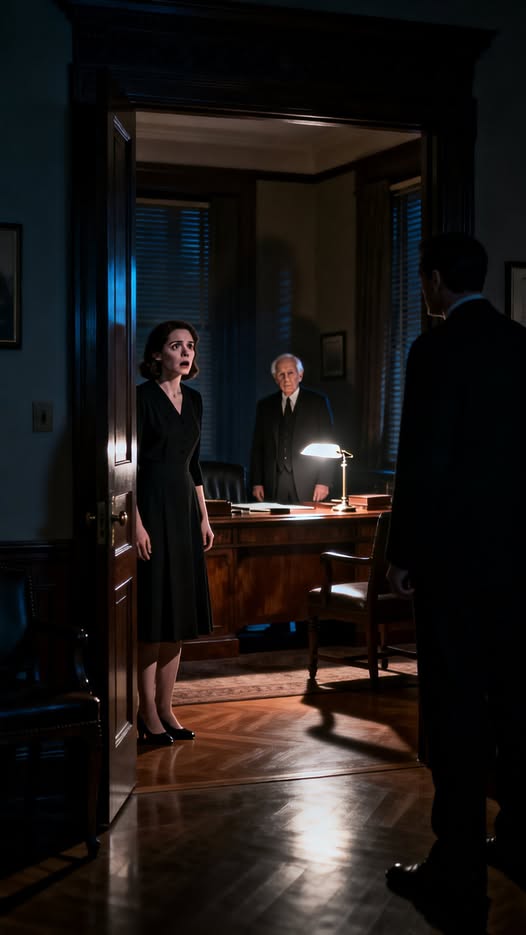
When I arrived, the building was a monolith of shadow, save for a solitary light burning in the lobby. I pushed through the heavy glass doors, the silence of the hallway amplifying the click of my heels on the marble floor.
Henry was waiting. But he wasn’t alone.
Standing in the shadows by the door was a man I had never seen before. He had the weary posture of someone who had spent a lifetime looking into dark corners, and eyes that seemed to dissect me the moment I walked in.
I froze, my hand hovering over the doorknob. I didn’t know who this stranger was, but as the door clicked shut behind me, sealing us in, I knew that the life I had known—the safe, predictable narrative of my family—was about to shatter.
“Payton, this is Marcus Reed,” Henry said, gesturing to the stranger. “Your grandmother hired him three months ago.”
Marcus didn’t smile. He gave a sharp nod, skipping the pleasantries. “She came to me because she was terrified, Ms. Sullivan. She was worried about her daily routine. Specifically, her morning tea.”
I sank into the leather chair opposite Henry’s desk, the room spinning slightly. “Her tea?”
“She drank an herbal blend every morning for forty years,” Marcus explained, his voice gravelly and precise. “Recently, she noticed it tasted… off. Bitter. Metallic. She didn’t want to accuse anyone without proof, so she sent samples to me for private testing. She was terrified of breaking up the family if she was wrong.”
He opened a manila folder on the desk and slid a single sheet of paper toward me. It was a lab summary from a private toxicology service. The text was dense, but one line was highlighted in neon yellow: Unidentified substance detected; inconsistency with organic herbal composition. High toxicity indicators.
“It’s not a murder conviction yet,” Marcus said, watching my face carefully. “But it’s enough to validate her fears. She told me that if she died suddenly, I was to show this to you. She said you were the only one with the spine to handle it.”
“My dad…” I choked out, the denial rising instinctively. “He loved her. He carried her groceries. He laughed at her jokes. He wouldn’t.”
Henry placed a gentle hand on my shoulder. “She didn’t want to believe it either, Payton. That’s why she didn’t go to the police immediately. She wanted to be sure. But looking at the timeline, and knowing about your father’s debts…”
“Debts?” I asked, looking up.
“Real estate deals that went south,” Marcus supplied. “Laura pushed him to borrow from loan sharks to cover the losses. The interest compounded. They are drowning, Payton. Your grandmother bailed them out twice, but she refused to do it a third time. She suspected Laura was manipulating Daniel.”
The picture was forming, ugly and jagged. The urgency at the graveside. The whispered conversations.
“She left instructions,” Henry said, walking to the wall safe. He spun the dial, the mechanical clicks sounding like gunshots in the quiet room. He pulled out a thick envelope with my name on it in Grandma’s shaky, elegant script.
Inside was a notebook and a flash drive.
I opened the notebook. It wasn’t just a diary; it was a log of her slow poisoning.
May 12: The tea tasted like copper today. My hands won’t stop shaking.
May 20: Laura insisted on making the pot herself. I poured half of it into the plant when she turned her back.
June 2: I don’t feel safe. If I go suddenly, check the tea. Protect Payton.
Tears blurred my vision. She had been fighting a war in her own kitchen, all alone, just to protect me and my brother, Ethan.
“What do we do?” I asked, my voice hardening. “We take this to the police.”
“Not yet,” Marcus said sharply. “This notebook is hearsay. The lab report is from a private entity, not a coroner. If we go now, they might lawyer up, claim senility, or destroy the remaining evidence. We need to catch them in the act.”
“How?”
“You have to go back there,” Marcus said. “You have to act like the grieving daughter. You need to let them think they’ve won so they get careless. And we need to get cameras into that house.”
I felt a cold dread coil in my stomach. Go back to the house where she died? Sit at the table with the people who killed her?
“They want you to sign papers, don’t they?” Henry asked knowingly.
I nodded. “Dad mentioned it. Power of attorney. Health directives.”
“That’s the trap,” Henry said. “If you sign those, they control your inheritance and, legally, your medical decisions if you’re ‘incapacitated.’ It’s the same playbook they used on Margaret.”
“I have to sign them,” I realized, the strategy clicking into place. “If I stall, they’ll get suspicious. If I sign, they’ll think I’m neutralized.”
Marcus handed me a small, black device. “This is a wide-angle lens. We need it in the kitchen. Can you get us a window of time?”
“I can try,” I whispered.
I left the office with the evidence tucked into my bag. The rain had stopped, but the streets glistened like slick oil. As I drove back to the house—the house that was now a crime scene disguised as a home—I realized I wasn’t just mourning anymore. I was hunting.
The house smelled of casserole and deception.
When I walked in, Laura was in the kitchen, wiping down counters that were already spotless. Her eyes darted to my bag, then up to my face, searching for any sign that I knew.
“You were gone a long time,” she said, her smile tight, lacking warmth. “Everything okay?”
“Just needed to clear my head,” I lied, forcing my shoulders to relax. “I went for a drive. I’ve been thinking… about the papers.”
Dad looked up from the living room, his phone in hand. “Oh?”
“I’ll sign them,” I said. The relief that washed over their faces was almost comical, if it weren’t so sickening. “But not tonight. Tonight, I want to do something for Grandma. I want to make her favorite roast chicken. And I want to do it right—fresh herbs, organic ingredients. Let’s go to the downtown market. All of us.”
Laura hesitated. “The downtown market? That’s forty minutes away. The local store is fine.”
“Grandma always said the local stuff was wilted,” I pressed, injecting a tone of fragile grief into my voice. “Please? I just… I need this to feel like we’re honoring her.”
Dad stood up, pocketing his phone. “Of course, sweetheart. If it helps, we’ll go.”
Laura’s jaw tightened, but she nodded. “Okay. Let’s go.”
As we walked out to the car, I texted Marcus one word: GO.
The trip to the market was an exercise in torture. I dragged it out, moving sluggishly through the aisles, smelling every bundle of rosemary, debating the merits of different olive oils. Laura was practically vibrating with impatience, checking her watch every five minutes. Dad followed me like a lost puppy, his guilt manifesting in over-eagerness to agree with everything I said.
I bought us two hours. Two hours for Marcus’s team to slip into the empty house and plant the eyes I needed.
When we returned, the house was dark and silent. I scanned the kitchen discreetly. Nothing looked out of place. The spice rack was slightly askew—Marcus’s handiwork, hiding the lens.
“Well,” Dad said, clapping his hands together. “That was… nice. But maybe we should handle the paperwork now? Before it gets too late.”
“Sure,” I said. “Let’s get it over with.”
We sat in the living room. The stack of documents sat on the coffee table like a guillotine blade. Ethan, my younger brother, came downstairs, rubbing sleep from his eyes. He looked between us, sensing the tension but understanding none of it.
“What’s going on?” he asked.
“Just adult stuff, Ethan,” Laura said quickly, her voice sickly sweet. “Go back up, honey. We’ll call you for dinner.”
Ethan looked at me, confusion knitting his brow. I gave him a reassuring nod, though my heart was breaking. I’m doing this for you, too, I thought.
I picked up the pen. The clauses swam before my eyes. Substitute decision-maker… control of assets… It was a death warrant disguised as legalese.
I looked at Dad. He was watching the pen, not me.
I signed.
“There,” I said, setting the pen down. “Done.”
Laura snatched the papers up a little too quickly. “Good. This is for the best, Payton. You’ll see.”
I stood up, feigning exhaustion. “I’m going to bed. I’ll make the chicken tomorrow.”
I went to my room and locked the door—a new habit. I pulled up the app on my phone. The feed was grainy, but clear enough. I had a direct view of the stove and the tea tin.
Now, I just had to wait for them to try and kill me.
Morning came with a suffocating silence. I lay in bed for ten minutes, staring at the ceiling, rehearsing my movements. Today had to be perfect. One slip-up, and I would either be dead or they would get away with it.
I went downstairs at 7:00 AM. Dad was gone—likely sent away by Laura to establish an alibi or just to get him out of the line of fire. Laura was alone in the kitchen, the morning light filtering through the blinds, illuminating the dust motes dancing in the air.
“Morning, Payton,” she chirped. She seemed lighter today, buoyant. The signed papers were likely already filed or in a safe. She thought she had won. “You look tired. Want some tea? I can make Margaret’s blend.”
My blood ran cold. Here it is.
“That sounds nice,” I said, sitting at the table. “Just like she used to make.”
I pulled my phone out, hiding it behind a cereal box, ensuring the screen was recording the live feed from the hidden camera.
Laura moved to the counter. I watched her back. She filled the kettle, set it on the stove, and reached for the tin. The whistle of the kettle seemed deafening in the quiet house.
Then, I saw it.
She shifted her weight, blocking the view from the living room but exposing her side to the spice rack—and the camera. She reached into her pocket and pulled out a small glass vial. With a practiced flick of her wrist, she tapped a fine white powder into the teapot before pouring the water.
My heart slammed against my ribs so hard I thought she might hear it.
She swirled the pot, let it steep for a moment, and then poured two cups. She brought them to the table, a smile plastered on her face.
“Here you go,” she said, placing the steaming cup in front of me. “Careful, it’s hot.”
I looked at the liquid. It was a pale amber, innocent and deadly.
“Thanks, Laura,” I said. I lifted the cup. The steam hit my face, carrying the scent of chamomile and mint—and something else. Something faint and metallic.
I brought the rim to my lips. Laura was watching me, her eyes unblinking, a predator waiting for the trap to snap shut.
I let my hand tremble. A genuine spasm of fear that I channeled into clumsiness.
“I…” I started, then jerked my hand.
The cup tipped. The tea splashed across the table, dripping onto the floor.
“Oh god!” I cried, jumping up. “I’m so clumsy today. I’m so sorry!”
Laura’s face contorted. For a split second, the mask slipped, revealing pure, unadulterated rage. “Payton! Look at this mess!”
“I’m sorry, I’m sorry,” I stammered, grabbing napkins. “I’m just… so shaky.”
She took a deep breath, forcing the smile back into place. It looked rigid now, like cracked porcelain. “It’s fine. Accidents happen. Let me clean this up. I’ll make you another one.”
“Please,” I said, pushing my luck. “I really need it to calm down.”
She went back to the stove. This time, her movements were sharper, agitated. She didn’t care as much about hiding. The vial came out again. A second dose.
She poured the second cup and slammed it down in front of me slightly harder than necessary. “Drink up.”
I stared at the cup. The camera had captured both attempts. We had the footage. It was over. But I needed them to know. I needed to see the realization in their eyes.
I picked up the cup. I held it for a long moment, letting the silence stretch until it was screaming.
“You know,” I said, my voice dropping the facade, becoming cold and steady. “Grandma said the tea started tasting bitter right before she died.”
Laura froze. “What?”
“She wrote it down,” I continued, setting the cup down untouched. “In a notebook. She tracked the dates. She tracked the symptoms. And she tracked you.”
Laura’s face drained of color. “I don’t know what you’re talking about.”
“And the camera in the spice rack,” I pointed to the corner, “captured you putting the powder in the pot. Twice.”
Laura spun around, staring at the hidden lens. Panic, raw and ugly, flooded her features.
“Daniel!” she screamed, her voice cracking. “Daniel!”
But Dad wasn’t there.
I stood up, holding my phone. “The police are already on their way, Laura. Marcus sent the footage to the precinct three minutes ago.”
She lunged for me. It was a desperate, animalistic move. She reached for the cup, maybe to throw it, maybe to destroy the evidence, but the front door crashed open.
“Police! Show me your hands!”
The shout filled the entryway. Officers in tactical gear flooded the kitchen, weapons drawn. Laura screamed, dropping to her knees, her hands flying to her head.
Ethan came running down the stairs, his hair messy, wearing only pajama pants. He stopped dead on the bottom step, staring at the chaos—Laura on the floor, me standing over the poisoned tea, the police swarming the room.
“Payton?” he whispered, his voice trembling. “What is happening?”
I walked over to him, shielding him from the sight of Laura being handcuffed. “It’s over, Ethan. They can’t hurt us anymore.”
The back door opened, and two officers led Dad in. He had been sitting in his car down the street, just as I suspected. When he saw Laura in cuffs, he didn’t fight. He slumped, his entire body deflating.
“I told you,” Laura shrieked as they hauled her up. “I told you it wouldn’t work! He made me do it! It was Daniel’s debt! He made me!”
Dad looked at me. His eyes were red, rimmed with a pathetic sort of sorrow. “Payton… I didn’t want… I just…”
“Save it,” I said, my voice devoid of emotion. “You let her kill your mother. And you let her try to kill me.”
“No,” Ethan gasped, looking at Dad. “Dad, tell them she’s lying.”
Dad looked at the floor. That silence broke my brother’s heart more than any confession could have.
Marcus walked in behind the detectives, looking calm amidst the storm. He nodded to me. “We got the vial. And the notebook. It’s enough.”
I watched them drag my father and stepmother out into the flashing lights of the patrol cars. The neighbors were gathering on their lawns, watching the spectacle.
I felt empty. The adrenaline was fading, leaving behind a deep, aching exhaustion. Ethan sat on the stairs, burying his face in his hands, sobbing quietly. I sat beside him and wrapped my arm around his shoulders.
“I didn’t know,” he choked out. “I swear, Payton, I didn’t know.”
“I know you didn’t,” I whispered, resting my head on his. “Grandma protected you. She protected both of us.”
Six months later, the courtroom in Seattle felt colder than the cemetery had that day in the rain.
The judge’s voice was a monotone drone as he read the sentencing. Daniel Ellis: Life imprisonment without parole. Laura Ellis: Twenty-five years, reduced for cooperation, though her testimony mostly just confirmed her own greed.
They didn’t look at us. Dad stared at the table; Laura stared at the wall. They were strangers to me now—ghosts of a family that never really existed.
Ethan gripped my hand so tight his knuckles were white. We walked out of the courthouse into a rare, sunny afternoon. The air smelled of exhaust and freedom.
“Are you leaving today?” Ethan asked.
“Yeah,” I said. “The moving truck is already in Portland. I need a fresh start.”
“And the house?”
“I’m keeping it,” I said. “But not for us.”
I had spent the last few weeks working with a local nonprofit. Grandma’s house—the place where she had been silenced—was going to find its voice again. We were turning it into The Margaret Ellis Safe Haven, a transitional shelter for women escaping domestic abuse. The kitchen where Laura had mixed poison would be used to cook healing meals. The garden where Dad had plotted would be a place for children to play.
“She would have liked that,” Ethan said, a small, sad smile touching his lips.
“She would have,” I agreed.
I drove to the house one last time before heading south. It was empty of furniture, but it felt full of purpose. I walked into the kitchen and placed a single object on the windowsill: Grandma’s old ceramic teapot. The one with the chipped handle.
I touched the cool ceramic.
“We won, Grandma,” I whispered.
Greed had tried to burn this family to the ground, to bury the truth under layers of legal paper and fresh soil. But they forgot that tea leaves, when steeped in hot water, release their true nature.
I walked out the front door, locking it behind me. I didn’t look back. The road to Portland was long, but for the first time in forever, the view ahead was clear.