Christmas dinner was supposed to feel warm. That was the lie I told myself while setting the table, smoothing the white tablecloth, lighting the red candles, arranging the plates just so. I wanted this evening to be perfect—for my husband, for his parents, and most of all, for our seven-year-old son, Noah.

Noah wore his favorite red sweater with the little white snowflakes. He had chosen it himself that morning and kept asking if Grandpa would like it.
“He’ll love it,” I said, even though something in my stomach twisted when I said the word love.
My father-in-law, Richard, arrived exactly on time. He always did. Everything in his life ran on precision—his schedule, his rules, his expectations. He greeted everyone with the same stiff nod, kissed my mother-in-law on the cheek, shook my husband’s hand, and gave Noah a brief pat on the shoulder, like one might acknowledge a piece of furniture.
Dinner began quietly. Too quietly. Forks clinked. Plates passed from hand to hand. Conversation stayed safe—weather, traffic, the tree in the living room. Noah sat beside me, feet not quite reaching the floor, swinging them gently beneath the table.
Then it happened.
Noah reached for his glass of water.
His elbow bumped the edge.
The glass tipped.
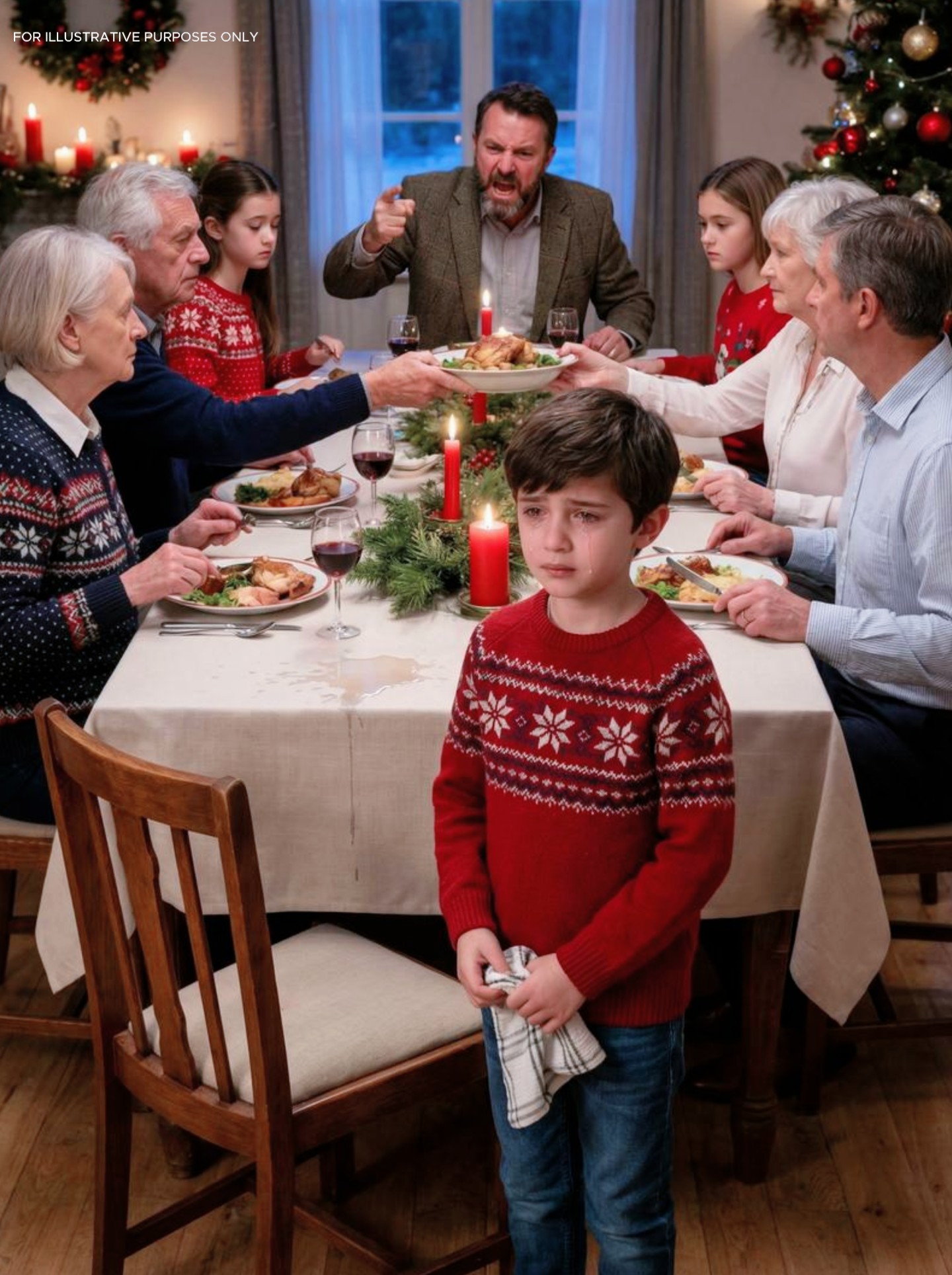
Water spilled—just a little—onto the tablecloth, forming a small, dark stain near his plate.
The room froze for half a second.
“I’m sorry,” Noah whispered immediately, eyes wide. He grabbed his napkin, trying to blot the water, hands trembling.
Before I could say a word, Richard’s chair scraped loudly against the floor.
“For God’s sake,” he snapped. “Can you not manage one simple thing? This is exactly what happens when children aren’t taught discipline.”
His voice cut through the room like a slap.
Noah went completely still.
“I— I didn’t mean—” my son stammered, his lower lip shaking.
Richard pointed at the wet spot as if it were evidence of a crime.
“Look at this mess. Christmas dinner, ruined. Always careless. Always.”
I felt my chest tighten. My instinct screamed at me to stand up, to shield my child, to say something—anything.
But no one else moved.
My mother-in-law reached for the serving dish and passed it to my sister-in-law without looking up. My husband stared at his plate, jaw clenched, silent. The grandparents at the other end of the table continued eating, as if this were background noise—something unpleasant but ignorable.
Noah’s eyes filled with tears, but he didn’t let them fall. He pushed his chair back carefully, like he was afraid even that would be wrong.
“I’ll clean it,” he whispered.
He slipped down from his chair, clutching the damp napkin in his small fists. His shoulders hunched forward, making him look even smaller than he was. When he reached my side, I noticed his hands shaking.
“I’m sorry, Mommy,” he murmured, not looking at me.
Something broke inside me.
I stood up.
“Enough,” I said. My voice surprised even me—steady, low, but unmistakably firm.
Every head turned.
“It was an accident,” I continued. “He apologized immediately. He’s seven.”
Richard scoffed. “That’s exactly the problem. You excuse everything. That’s how children grow up weak.”
I looked at him then—really looked. At the rigid posture. The tight mouth. The way control mattered more to him than kindness.
“No,” I said. “Children grow up weak when they’re taught that love is conditional. When they’re humiliated for being human.”

The table was silent now. Even the candles seemed to flicker more softly.
I turned to Noah and knelt in front of him. I took his face gently in my hands.
“Look at me,” I said.
His eyes met mine, glossy with unshed tears.
“You did nothing wrong. Do you understand me?”
He nodded faintly.
“Accidents happen,” I said, loud enough for everyone to hear. “And no one gets to make you feel small for that. Not ever.”
A tear slipped down his cheek then. I wiped it away with my thumb and pulled him into my arms. He clung to me, pressing his face into my shoulder.
I stood up, still holding him.
“We’re leaving,” I said calmly.
My husband finally looked up. “Wait—”
“No,” I said, meeting his eyes. “You can come with us. Or you can stay. But I won’t teach our son that silence is the price of peace.”
We walked out into the cold night air. The door closed behind us with a soft click.
In the car, Noah sniffed quietly. After a moment, he whispered, “Did I ruin Christmas?”
I reached back and took his hand.
“No, sweetheart,” I said. “You didn’t ruin anything. You showed me exactly what matters.”
That night, at home, we reheated leftovers, sat on the couch in our pajamas, and watched Noah’s favorite movie. He laughed again—softly at first, then freely.
And I realized something important.
Some tables look full, but they’re empty of warmth.
Some traditions aren’t worth keeping.
And sometimes, the bravest thing a parent can do… is stand up, even when everyone else stays seated.