Chapter 1: The Terminal of Lost Souls
They say blood is thicker than water, but in the sterile, fluorescent glare of Dubai International Airport, I discovered that blood can freeze just as easily as it can flow. At sixty-eight years old, I stood in the center of Terminal 3, a discarded relic of a life I no longer recognized. The ventilation system exhaled a frigid, recycled breath that prickled against my skin, carrying the heavy, cloying scents of duty-free perfume and charred coffee beans.
My daughter, Ranata, stood five paces away. She didn’t look like a monster; she looked like a shampoo commercial—her blonde hair catching the overhead lights, her expensive trench coat draped perfectly over her shoulders. But her eyes were chips of blue ice. She held my vintage brown leather handbag—the last gift my mother ever gave me—clutched to her chest like a trophy of war.
“You’re a parasite, Mother,” she whispered, her voice a sharp blade beneath a practiced, public smile. “You’ve drained my energy, my bank account, and my patience for the last time. Dad died because he couldn’t stand the sight of your mediocrity. He was trying to escape you.”
The words hit with the force of a physical blow. My husband, George, had died twenty-five years ago in a car accident. For a quarter-century, I had carried the weight of her resentment, believing I was the anchor that had dragged him down.
“Ranata, my passport… my phone is in that bag,” I stammered, my voice trembling like a dry leaf in the wind.
She leaned in close, her breath smelling of peppermint and malice. “Consider this your retirement from my life. Have a wonderful stay in Dubai. Alone.”
With a final, chilling smile, she turned and walked toward the security gates. I watched her silhouette merge with the crowd, vanishing into a world I couldn’t enter. I was a woman with no identity, no currency, and a heart that was rapidly failing. My fingertips tingled—a warning sign of my climbing blood pressure. The world began to tilt, the golden arches and luxury boutiques spinning into a kaleidoscope of terror.
I approached a security guard, my English fracturing under the weight of panic. He looked at me with a mixture of suspicion and boredom. I was just another elderly woman losing her mind in a foreign land.
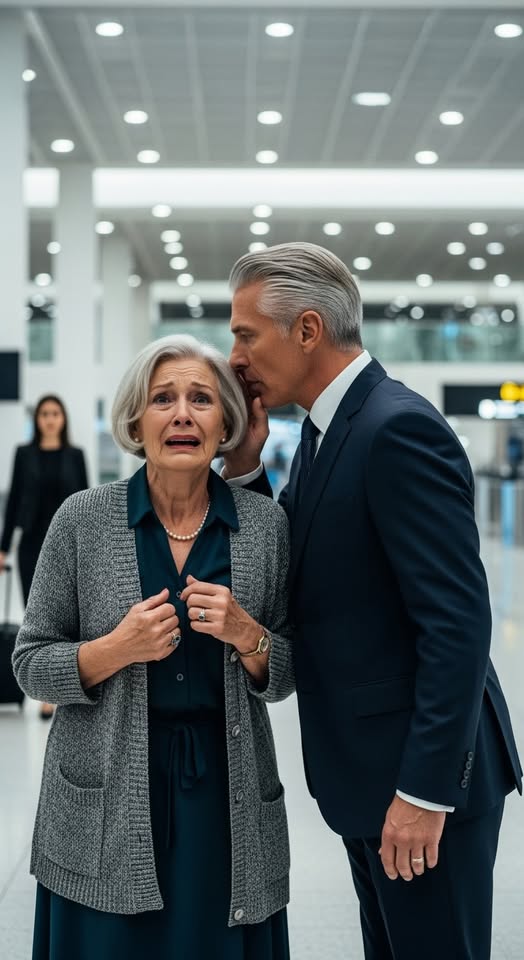
Then, the air changed. A shadow fell over me, smelling of sandalwood and ancient desert rain. A man with impeccably groomed silver hair and a suit that cost more than my house stepped into my line of vision. His amber-brown eyes held a depth of recognition that stopped my breath.
“Pretend to be my wife,” he whispered, his voice a low, commanding rumble. “My driver is about to arrive. Do not hesitate.”
I looked at him, a stranger with the bearing of a king, and then at the guards who were reaching for their radios. “Why?” I gasped.
He leaned closer, his gaze fixing on the spot where Ranata had disappeared. “Because your daughter will regret leaving you here. I promise you that. But only if you take my hand right now.”
In that moment, I realized I had spent my entire life waiting for the people who supposedly loved me to save me. They had all failed. I reached out and gripped his hand. It was warm, steady, and felt like the first solid ground I had touched in decades.
“Take me with you,” I said.
Chapter 2: The Architect of Shadows
The car was a sleek, obsidian Mercedes-Benz Maybach. The interior was a sanctuary of cream-colored leather and polished walnut. As the airport lights blurred into streaks of gold in the rearview mirror, the reality of my recklessness crashed down upon me. I was in a car with a man who could be anyone.
“Take a deep breath, Denise,” he said, not looking at me. “Your heart is racing loud enough for the driver to hear.”
“How do you know my name?” I demanded, my voice regaining some of its steel.
“I saw the tag on your suitcase before your daughter kicked it aside,” he replied calmly. “My name is Khaled Rasheed. I am seventy-two years old, a widower of eight months, and the chairman of a global import-export empire. And currently, I am a man in desperate need of a partner who understands the art of the mask.”
He turned to me then. I saw the thin scar above his eyebrow and the weary lines around his eyes. This wasn’t a man playing a game; this was a man fighting a war.
“My son, Rasheed, is attempting a coup,” Khaled explained, his voice tightening. “He is painting me as a grieving, senile old man to the board of directors. Tomorrow, I have a dinner with Sheikh Ibrahim and a consortium of conservative investors. They do not trust widowers. They believe a man without a wife is a man without an anchor. They think I will make emotional, erratic decisions.”
“So you want an actress,” I said, a bitter laugh escaping my throat.
“I tried actresses,” he countered. “They have plastic souls. But you… I saw the way you looked at your daughter. You have the eyes of a woman who has lost everything but her dignity. They will believe you because there is truth in your pain.”
He offered me a deal: a room in his villa, a phone to contact my sister, legal protection, and fifteen thousand dollars—five months of my pension—for a few days of performance.
“And my daughter?” I asked.
“My legal team will begin tracking her the moment we reach The Palm Jumeirah,” Khaled said. “By the time she lands in the States, she will find that the world she thought she stole from you has begun to shrink.”
As the car swept onto the man-made island, the city of Dubai rose up like a glittering jewel against the velvet black of the Persian Gulf. I looked at my reflection in the window—a wrinkled, beige-clad woman who had been left for dead.
“I have one condition,” I said. “I don’t just want my life back. I want to know why she hates me. I want the truth about my husband’s death.”
Khaled nodded slowly. “The truth is a dangerous guest, Denise. But I will provide the key. Whether you choose to open the door is up to you.”
The car pulled up to a villa that looked like a modern palace of white marble and turquoise light. As I stepped out, a new phone was placed in my hand.
I immediately called my sister, Eleanor, in Ohio. Her voice was a frantic sob. “Denise! Thank God! Ranata called… she said you disappeared! She’s filing for emergency guardianship! She says you’ve lost your mind!”
“I haven’t lost it, Eleanor,” I said, my voice cold and clear. “I’ve finally found it.”
But as I hung up, a text message arrived from an unknown number. It was a photo of my family ranch in Ohio, with a ‘Sold’ sign pinned to the gate. My heart stopped. Ranata hadn’t just left me; she was erasing my history.
Chapter 3: The Empress of the Burj
The next morning, the “mediocre” woman Ranata had discarded was buried under layers of navy silk and South Sea pearls. Mara, Khaled’s housekeeper and confidante, worked with the precision of a restorer of fine art. When I looked in the mirror, I didn’t see a victim. I saw a woman who had managed four-star hotels for thirty years, a woman who knew how to command a room.
“You look like a queen, Mrs. Denise,” Mara whispered.
“I feel like a soldier,” I replied.
The dinner took place at Al Mahara inside the Burj Al Arab. We arrived in a Rolls-Royce Phantom, the ultimate symbol of excess. Khaled held my hand as we entered, his grip firm. We were the picture of a seasoned, powerful couple.
The investors—Ibrahim, Mahmoud, and Faisal—were hawks in white thobes. They watched me with predatory curiosity. The conversation stayed on logistics and shipping routes until Faisal turned his sharp gaze toward me.
“Khaled tells us you were the silent engine behind his hospitality interests in the West,” Faisal said, his English perfect. “What is your take on the Oman Project? Our advisors say the risk is too high.”
I felt Khaled tense beside me. This wasn’t in the script. I took a slow sip of sparkling water, letting the silence stretch just long enough to assert dominance.
“Your advisors are looking at spreadsheets, not people,” I said calmly. “The Oman coast is undervalued because it lacks the ‘theatre’ of Dubai. But the European market is tired of theatre. They want authenticity. If you build a boutique experience there, focusing on heritage rather than heights, your occupancy will hit ninety percent within two years. I saw the same trend in Florida thirty years ago. History repeats itself for those who aren’t paying attention.”
The table went silent. Ibrahim let out a booming laugh and slapped the table. “Khaled! You never told us your wife was a shark!”
“She is the sea itself,” Khaled said, looking at me with genuine wonder.
The deal—a four-hundred-million-dollar investment—was signed before the dessert arrived. As we walked back to the car, Khaled leaned in. “That wasn’t acting, Denise. That was brilliance.”
“I was a manager, Khaled. I just forgot I still had the keys.”
But the triumph was short-lived. When we returned to the villa, Khaled’s lead attorney, Mr. Harrison, was waiting in the study. He laid out a folder of documents that turned my blood to lead.
“Your daughter didn’t just sell your house, Denise,” Harrison said. “She forged your signature on a power of attorney three months ago. She has been systematically draining your accounts. But there’s something else. We pulled the original police report from your husband’s accident in 1999.”
He handed me a grainy, yellowed document. I read the words, and the world collapsed.
“George wasn’t escaping me,” I whispered, the paper fluttering to the floor. “He was drunk. Four times the legal limit.”
“He went bankrupt, Denise,” Khaled said softly. “The project he was working on collapsed. He didn’t leave because of you. He left because he was a coward who couldn’t face his own failure. Your daughter has been worshipping a ghost built on a lie.”
Just then, my phone buzzed. A message from Ranata: “I’m in Dubai. I know where you are. I’m coming to get what’s mine, and no ‘billionaire’ is going to stop me from putting you where you belong: in a ward.”
Chapter 4: The Glass Fortress
Ranata didn’t ring the bell; she breached the villa like a storm surge. I heard her screaming my name in the foyer, her voice a jagged glass edge that cut through the peaceful hum of the house.
I descended the marble staircase slowly, each step a deliberate act of war. I was wearing an ivory linen suit, my hair swept back in a severe, elegant bun.
“Get out of this house, Mother!” Ranata hissed, her face contorted with a rage that bordered on mania. She looked disheveled—her hair unwashed, her eyes rimmed with red. “You’ve humiliated me for the last time! Marrying this… this scam artist? I’ve already contacted the embassy. I’ve filed the paperwork to have you deported as a mental incompetent!”
“Sit down, Ranata,” I said, my voice as calm as a frozen lake.
“Don’t you dare use that tone with me!” she screamed, lunging forward. Khaled stepped out from the shadows of the library, his presence an immovable wall.
“You are trespassing, Dr. Ranata,” Khaled said. “And you are being recorded.”
“I don’t care about your cameras!” she shrieked, turning back to me. “You killed him! You killed Dad with your nagging and your small-town dreams! He was a king, and you were a peasant! I’m taking everything back—the house, the money, the dignity you stole from him!”
I walked to the mahogany desk and picked up the folder Mr. Harrison had given me. I threw it at her feet. The papers scattered like autumn leaves.
“Read it,” I said.
“I don’t need to read your lies!”
“Read the toxicology report, Ranata! Read the bankruptcy filings! Read the list of debts I paid off for twenty years by selling my mother’s ranch! Your ‘king’ left us with nothing but a legacy of whiskey and debt. I protected you from the truth because I loved you. I let you hate me so you wouldn’t have to hate him.”
Ranata looked down at the papers. Her hands began to shake. She picked up the forensic report, her eyes scanning the words. “No… no, this is a forgery. You made this up.”
“Check the case number, Ranata. You’re a doctor; you know how to verify a public record,” I said, stepping closer until I could see the sweat on her brow. “You abandoned me at an airport because you couldn’t handle the weight of your own guilt. You projected your father’s failure onto me because I was the only one left to bleed.”
“I… I had to protect the assets,” she stammered, her voice losing its edge. “Matthew said—”
“Matthew is an accomplice to fraud and forgery,” Mr. Harrison said, stepping into the room. “We have the bank records of the six-hundred-eighty-thousand-dollar transfer. We have the notary’s confession regarding the bribed signature. You aren’t here to save me, Ranata. You’re here because you’re terrified of the prison cell that is waiting for you back in Ohio.”
Ranata collapsed onto the silk-upholstered sofa, the folder clutched to her chest. She looked small. She looked like the fifteen-year-old girl who had cried at the funeral, but without the innocence that made that girl worth saving.
“What are you going to do?” she whispered.
I looked at Khaled. I looked at the life I had built in four days—a life based on a lie that had become more real than the twenty-five years of service I had given to a family that hated me.
“I am going to give you exactly what you gave me at the airport,” I said. “Nothing.”
As the security guards stepped forward to escort her out, Ranata looked at me with a sudden, horrific clarity. “Mom… please. I have a career. I have a life.”
“You had a mother,” I replied. “But you traded her for a handbag.”
Chapter 5: The Architect of New Beginnings
The fallout was a slow, methodical demolition. With Khaled’s resources and Mr. Harrison’s legal precision, we didn’t just sue; we dismantled. Ranata was forced to sell every asset she had acquired—the luxury car, the apartment, the investments—to repay the six-hundred-eighty thousand dollars plus interest. Her husband, Matthew, filed for divorce the moment the indictment papers were served, proving that his loyalty was as shallow as his wife’s.
She didn’t go to prison—I blocked the criminal charges at the eleventh hour. Not out of love, but out of a desire for her to live a long, difficult life where she had to earn every cent she spent. She was stripped of her medical license for two years pending an ethics review.
But my story didn’t end with revenge.
Six months after the airport, the contract marriage with Khaled was set to expire. We sat on the balcony of the villa, the smell of jasmine heavy in the evening air.
“The lawyers have the papers ready, Denise,” Khaled said, his voice unusually quiet. “You are a wealthy woman now. You have your own accounts, your own reputation in the hospitality world. You can go anywhere.”
I looked at him. We had become a formidable team. My “New Beginnings” project—a training center for older women to re-enter the workforce—was already flourishing in Muscat.
“Why would I leave?” I asked. “I’ve spent sixty-eight years being what other people needed. A daughter, a wife, a grieving widow, a burdened mother. For the first time, I am Denise. And Denise likes the desert.”
Khaled smiled, a real, radiant smile that erased the weariness from his face. “I was hoping you’d say that. I have a project in the Al Hajar Mountains. A resort built on the site of an ancient village. It needs an Empress.”
“Only if the Empress gets her own wing,” I joked.
“The whole mountain is yours,” he replied.
Two years later, I stood at the opening of the Alismir Boutique Resort. I was seventy years old, my silver hair gleaming in the sun, a tablet in my hand. My phone buzzed. It was a video call from Eleanor.
“She’s here, Denise,” Eleanor said, turning the camera.
In a small, modest apartment in Ohio, Ranata was sitting at a kitchen table. She looked older, her face etched with a humility I had never seen. She held a stack of envelopes—the final payment of the debt she owed me.
“I’m sending the last check today,” Ranata said, her voice steady. “I… I’ve been working at a community clinic. Volunteering. I don’t expect you to call me ‘daughter’ again. I just wanted you to know that the ranch… I bought back the five acres with the old oak tree. It’s in your name.”
I felt a ghost of a shadow pass over my heart. “Thank you, Ranata,” I said. “I hope you find peace with the truth.”
I ended the call and looked out over the mountains. I didn’t feel the need to go back to Ohio. My history wasn’t in the soil of a ranch; it was in the strength of my own spine.
Khaled walked up behind me and placed a hand on my shoulder. “Ready for the ribbon cutting?”
“Always,” I said.
I had been abandoned at an airport with nothing. And in that void, I had found the world. I learned that the most dangerous person is not the one who has everything, but the one who has lost it all and realized they are still standing.
The desert wind caught my silk scarf, pulling it toward the horizon. I didn’t reach for it. I let it fly. I was no longer a woman waiting to be saved. I was the one doing the saving.
Epilogue: The Wisdom of the Sands
As I sit here today, looking out at the turquoise waters of the Gulf, I often think about that woman in the wrinkled beige blouse standing in the airport. I want to tell her that the tingle in her fingertips wasn’t a heart attack; it was the electricity of a new life beginning.
I have learned that forgiveness is not a gift you give to the person who hurt you; it is a gift you give to yourself so you don’t have to carry their poison. Ranata and I speak once a month. It is professional, polite, and distant. The bridge was burned, and while we are building a new one, it is made of stone, not blood.
To those of you who feel invisible, who feel like a burden to the children you raised or the world you served: do not wait for a billionaire to pick you up. Pick yourself up. Change your shoes. Change your story. The world is vast, and the desert is always waiting for a new bloom.
What is the difference between forgiving and forgetting? I believe forgetting is a weakness, but forgiving is the ultimate power move. It means you are so full of your own life that there is no room left for their ghost.
Stay strong. Stay elegant. And never, ever let anyone else hold your handbag.