My stepfather was a construction worker for 25 years and raised me to earn my PhD. Then the professor froze when he saw him at the graduation ceremony…
I grew up in a home that was whole only on paper. My parents separated before I even learned how to write my name. My mother, Elena, brought me back to a quiet farming town in Maple Ridge, a rural community surrounded by endless cornfields and dusty roads. I barely remembered the face of my biological father. But I remembered the hollow feeling of having a place to live, yet no real home.

When I was four, my mother remarried a man named Ben Carter, a construction worker with sun-burnt skin and shoulders bowed from years of lifting more than any human should. He arrived in our lives with nothing—not a house, not a savings account, not even proper work boots. But he brought something my childhood had lacked: steadiness.
At first, I resisted him. He smelled of concrete dust and long days under the sun. He left before sunrise and returned after dark. But the man I once avoided became the first to fix my old bike, the first to quietly repair my torn shoes, the first to kneel beside me when I came home from school crying.
He didn’t raise his voice like my mother did when she was stressed. He simply wiped my tears with his tired hands and said only one sentence during those quiet bike rides home:
“You don’t have to call me Dad. But I’ll stand behind you for as long as I live.”
I never answered. But the next morning, I called him Dad—and his eyes softened in a way I will never forget.
Growing up, my memories of him were always the same: a rusted bicycle leaning by the window, a faded construction uniform draped over a chair, and hands permanently rough from cement and steel.
Every night, he asked the same question:
“How was school today?”
He never understood algebra or poetry, but he believed deeply in the power of education.
“People respect knowledge,” he often said. “You don’t need to be the smartest—just work honestly.”
My mother worked at a local farm, and Dad worked at construction sites across the county. We were poor, but somehow I never felt deprived. Still, when I got accepted into a university in Seattle, my mother sobbed with pride. Dad said nothing. He just sat quietly on the porch, staring at the sunset.
The next morning, he sold his only motorbike. With that and my grandmother’s savings, he handed me the money for school.
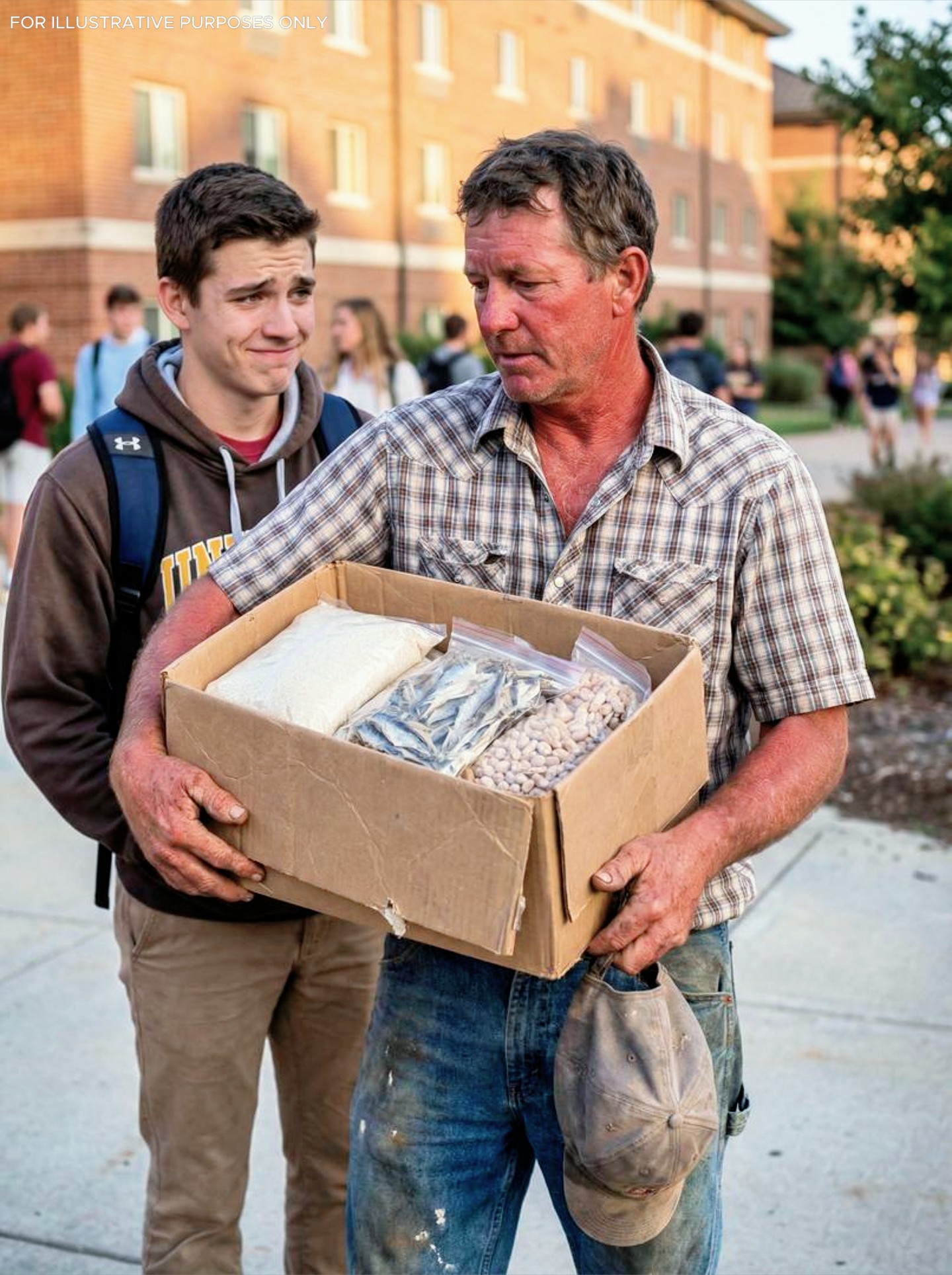
When he brought me to my dorm, he wore an old shirt and carried a box full of “home things”—a jar of dried fish, bags of roasted nuts, and three small containers of rice from our farm town. Before he left, he rested his calloused hand on my shoulder:
“Study well, son. You go farther than I ever could.”

I didn’t cry then. But later, when I unpacked my lunch, I found a small piece of folded paper. In shaky handwriting, he wrote:
“I don’t understand what you’re studying. But whatever it is, I’ll work for it. Don’t worry about me.”
That note carried me through sleepless nights, through exams, through the loneliness of living far from home.
I graduated college. Then I entered graduate school. And Dad kept working. His back curved more. His hands trembled slightly. His breathing grew heavier after long days.
Once, when I visited him, I saw him sitting at the base of a scaffold, chest rising and falling like he’d run a marathon. My heart clenched.
“Dad, please rest,” I begged.
He simply waved me off.
“I’m fine. I’m raising a future PhD,” he said with a grin.
And somehow, that made all his pain worth it.
When the day of my PhD thesis defense arrived, I insisted he come. He refused at first, embarrassed that he didn’t belong among scholars. But I pleaded until he agreed.
He borrowed a suit from a cousin—two sizes too big—and wore shoes that pinched his toes. He even bought a new hat from the local market. He sat in the very back of the hall at the University of Washington, hands clasped tightly, chest rising and falling with nervous pride.
When I finished my defense, the committee applauded. My professor, Dr. Andrew Santos, approached to congratulate me and greet my family.
He shook my mother’s hand.
Then he reached for Dad’s.
But the professor stopped mid-gesture.
His eyes widened.
He leaned in, studying Dad’s face.
“Are you… Ben Carter?” he asked quietly.
Dad froze. “Y-yes, sir. I am.”

A smile slowly spread across the professor’s face—one of shock, recognition, and awe.
“I knew it,” he said. “When I was a boy, you worked on the construction site near our house in Tacoma. One day an accident happened. A man fell from the scaffold. Everyone panicked—but you climbed up, carried him down on your back, even though you were bleeding yourself.”
Dad’s eyes shifted downward. He looked embarrassed, as if heroism was something to hide.
The professor turned to me, voice thick with emotion:
“Your father saved my uncle’s life. The whole neighborhood talked about him. We called him the man with the unbreakable spirit.”
For a moment, I couldn’t speak.
All my life, I thought Dad was just a construction worker who carried loads and swallowed exhaustion quietly. I never knew he also carried people—literally—through the hardest moments of their lives.
The professor extended his hand again, this time with deep respect.
“Sir,” he said to Dad, “it is an honor to meet you again. And now I understand why your son is who he is.”
Dad didn’t cry often.
But that day, he wiped his eyes.
So did I.
Because I finally realized the truth:
Skilled trades training
I wasn’t raised by a man with nothing.
I was raised by a man who gave everything—so I could become something.