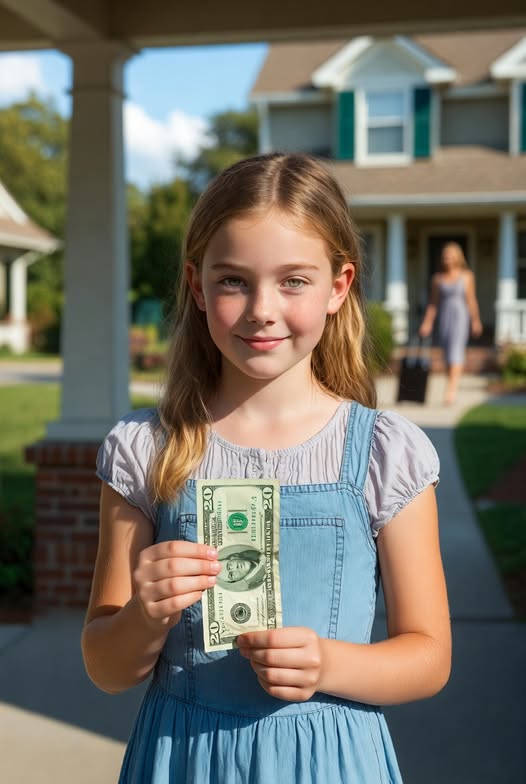
My name is Sydney. I am eleven years old, and last summer, my mother left me with a crumpled twenty-dollar bill and a single word that tasted like ash in my mouth: Independent.
“See, you are independent now,” she had said with a bright, brittle smile, hauling her Samsonite suitcase toward the front door. “You are not a baby anymore, Sydney. Just order food if you need to. I’ll be back before you know it.”
Independent.
That was her word, not mine. I stood in the foyer, staring at the bill in my palm. Twenty dollars. Not a plan. Not a list of emergency numbers. Not even a real goodbye. Just a distracted peck on my forehead, the click-clack of her heels on the hardwood, and the sound of a suitcase rolling down the driveway like thunder.
Then, the front door closed in my face.
“I will be fine,” I said out loud to the empty hallway, testing the weight of the lie.
But my hands were shaking. There was no one else in the house. My father had left three years ago for a “new start” in Arizona, and my mother’s version of parenting had always been… detached. But this was new. This was Europe. For a month.
I tried to pretend this was some kind of challenge I could win. A survivor reality show where the prize was my mother’s approval.
Day One, I told myself, marching into the kitchen. I will prove that I can handle this.
I lined up the few cans in the pantry: creamed corn, black beans, and a dented tin of tuna. I checked the fridge, which was already half-empty—a carton of milk that smelled suspicious, a jar of pickles, and a takeout box of lo mein that had solidified into a brick.
I shoved my fear down as far as it would go, packing it tight into the pit of my stomach. If my mom thought I was independent, then maybe she should see what that really looked like.
Because as that month ticked forward, the twenty dollars in my hand would disappear. The food would run out. And the silence in our house would turn into something darker than loneliness.
When she finally came back, what she saw inside our home made her whisper, “No, no, this cannot be happening.”
But I’m getting ahead of myself. Do you want to know how being left with twenty dollars at eleven turned into the one decision that made my mom regret everything she had done to me?
Stay with me. Because revenge isn’t always loud. Sometimes, it’s just the sound of a pen scratching on paper.
The first problem hit me about ten minutes after the taxi pulled away.
My mom had tossed a shiny emergency credit card on the counter like that would fix everything. Just in case, she’d said. There was just one catch.
It wasn’t activated. And I didn’t know the PIN.
I found that out the hard way, standing at the doorway with my phone in my hand, trying to order a pizza. I watched the delivery app reject the card over and over again. Transaction Declined. Invalid PIN.
So, it was just me, a dead card, and twenty dollars.
For the first two days, I made it a game. I sliced bread so thin you could see through it. I spread peanut butter with the precision of a surgeon, making sure it barely covered the surface. I told myself real survivors made things stretch. I even joked in my head that this would make a good story someday for my autobiography.
By Day Three, it stopped being funny.
The pantry looked like a before picture in a commercial about hunger. A box of cereal with more air than flakes. That jar of pickles I hated. My stomach growled loud enough to embarrass me, even though no one else was there to hear it.
I tried to distract myself. I turned the TV on and let random shows play, the noise filling the room so I didn’t have to hear the house creak. I opened my mom’s laptop and stared at her work emails, stacked up like they were more important than anything else in the world.
At one point, I grabbed my spiral-bound notebook—the one with the unicorn on the cover—and wrote in big, block letters at the top of a page: EVIDENCE.
Under it, I scribbled: Left alone at 11. $20. No food plan. No check-ins.
I didn’t know exactly what I would do with that, but writing it down made something inside me shift. If they thought I was old enough to be alone, then I was old enough to remember everything. To record everything. To show someone someday how they chose a vacation over me.
I picked up my phone and opened the video app. I hit record.
“Day Three,” I said quietly to the camera. My face looked smaller than I expected, pale and pinched. “I am still alone. The card does not work. I ate the last decent thing in the fridge yesterday.”
I paused, swallowing the lump in my throat.
“If you are seeing this, it means someone finally asked what happened to me.”
I saved the clip and locked my phone, heart hammering. Part of me hoped nobody would ever see it. Another part of me wanted that video to explode in my mom’s face when she came home.
I thought about my best friend, Emma, and hovered over her name in my contacts. If I texted her, I would have to admit that my mom had left me. That I was hungry. That I was not okay.
Instead, I sent a message that sounded normal. How was your trip?
No reply. Maybe she was somewhere by a lake, eating burgers with her family, not even checking her phone. My stomach twisted with envy.
By Day Five, the hunger felt like a fog around my brain. I started getting dizzy when I stood up too fast. I found a half-empty box of cereal in the back of the cupboard—stale Froot Loops—and ate them dry from the bag, trying to make every handful last.
I opened my notebook again and added another line.
Day Five: Still no call from Mom. Not even a text.
Then another line.
If I disappear, this will prove it was not my fault.
That was the moment my thinking changed. This was not just about surviving until she came back. This was about what would happen to her when people finally realized what she had done.
On Day Seven, my body felt weak, but my anger was stronger. It burned in my chest, a hot coal that kept me moving.
I shuffled to the front window and peered out at the street. Kids were riding bikes. A dog barked at a delivery truck. A couple walked by holding coffee cups, laughing. Normal lives. Normal parents.
I looked at our empty driveway and whispered, “You chose Europe over me. Do you know what that is going to cost you?”
As if the universe was listening, the doorbell rang.
I froze. Cereal crumbs were still on my fingers. No one ever rang our doorbell. Not really. Neighbor kids just knocked. Packages got dropped.
The bell rang again, followed by three sharp knocks.
My heart pounded as I moved toward the door. For a second, I thought about pretending I was not home. If it was someone selling something, they would go away. But another thought cut through my fear.
What if this is it? What if this is the moment someone finally sees me?
Hand shaking, I reached for the handle. If you were eleven, starving and completely alone, would you open that door? Or would you keep pretending everything was fine?
I cracked the door open just enough to see who was there.
Standing on the porch was a man in a green windbreaker with my school’s emblem stitched on the chest. It took me a second to place him without the classroom behind him.
“Hi, Sydney,” he said gently.
It was Mr. Hughes, the school counselor.
“I have been trying to reach your parents,” he said, his brow furrowed. “They did not pick up. Can I come in for a moment?”
My first instinct was to lie. To say everything was fine, that my parents were just out running errands, that I did not need anything. But my hand loosened on the door. And I stepped back.
“Sure,” I murmured. “I guess.”
He stepped inside and looked around. The silence in the house suddenly felt heavier, suffocating. The dishes piled in the sink, the empty counter, the fruit bowl containing only a shriveled orange—all became evidence I had not meant to stage, but had accidentally left out.
“Are your parents at work?” he asked, scanning the room, clearly expecting someone to appear from the kitchen or the stairs.
“They are in Europe,” I said, surprising myself with how flat my voice sounded.
“For a month?” His eyebrows shot up toward his hairline. “A month? And who is staying with you?”
I swallowed. This was the line. The moment I could choose to protect them or tell the truth. My fingers curled tighter around the edge of my t-shirt.
“Just me,” I admitted. “They said I was old enough.”
Something in his face changed, like a switch flipping. The polite concern turned into something sharper, more serious. He pulled out a kitchen chair and sat down at the table, motioning for me to sit across from him.
“Sydney, how long have you been alone?”
“A week,” I whispered. “Almost.”
“Do you have enough food? Money?”
I let out a small, bitter laugh I did not recognize. “They left me a credit card that does not work. And twenty dollars.”
He stared at me for a long moment. It wasn’t the way teachers stare when you forget your homework. It was something heavier, like he was trying to count all the ways this was wrong.
“This is not okay,” he said finally, his voice low. “You know that, right?”
I shrugged, even though my chest ached. “They said they needed a break. That I am mature. That I should be able to handle it.”
“And how have you been handling it?”
I wanted to say fine. I wanted to keep pretending. But the notebook on the table caught my eye. The word EVIDENCE stared back at me in my own handwriting.
“I have been hungry,” I said instead. “And scared. And I have been writing things down. Just in case.”
“Just in case what?” he asked.
“Just in case something happens to me,” I replied quietly. “So nobody can say they did not know.”
Silence filled the space between us. For a moment, I hated the silence, but then I realized he wasn’t ignoring it. He was feeling it. Really feeling it.
He leaned forward. “Sydney, leaving an eleven-year-old alone for a week—let alone a month—with almost no food and no supervision is not just irresponsible. It is dangerous. It is neglect. There are laws about this.”
My heart thudded in my ears. Neglect. Laws. Words that sounded like they belonged in TV dramas, not in my kitchen.
“What happens if someone finds out?” I asked, my voice suddenly small.
“Agencies get involved,” he said carefully. “Child Protective Services. There could be an investigation. Your parents could face serious consequences.”
There it was. The thing I had not dared to say out loud. The thing that made my anger twist into something sharper.
“Consequences,” I repeated slowly. “For what they did to me.”
He did not rush to comfort me or tell me I was overreacting. Instead, he nodded.
“For what they did to you.”
My mind raced. I imagined my mom’s face when she came home to find strangers in our living room. People asking questions she could not dodge with a fake smile and a joke about independence. I pictured her seeing my notebook, my video clips, my empty pantry.
“Do you want help, Sydney?” Mr. Hughes asked quietly. “Real help. Not just groceries. The kind of help that makes sure this never happens again.”
I hesitated. Part of me wanted to say no. To slam the door on all of this and just wait for my parents to come back and pretend this month never happened.
Another part of me—the part that had been writing the word evidence—was tired of pretending.
“Yes,” I said finally. “But if I say yes, what does that mean for them?”
“It means they will have to answer for their choices,” he said. “It means adults will finally see what you have been going through.”
I looked down at my hands, then back at him.
“Then help me,” I said. “I want them to see exactly what they did. I want them to feel what it is like to lose control.”
He nodded once, firmly. “First, we make sure you are safe. Then, we make sure the right people hear your story.”
As he reached for his phone, a strange calm settled over me. The fear was still there, but underneath it was something new. A quiet, steady determination.
I was not just a kid waiting to be rescued anymore. I was the witness.
Mr. Hughes stepped into the hallway to make a call, leaving me at the table with my notebook open. I could hear fragments of his voice, low and controlled, but the words that floated back to me were enough to make my pulse race.
Alone. Eleven. No guardian. No food in the house.
I traced the ink on the page with my fingertip. Evidence. Suddenly, it did not feel like a secret diary anymore. It felt like a case file.
A few minutes later, he came back.
“I called your neighbor, Mrs. Johnson,” he said. “And I also spoke with someone from the child protection hotline. They are going to send someone to check on you. But first, we need to get you something to eat.”
My cheeks burned at the idea of people checking on me like I was some broken machine. But I also felt something else. A small flare of satisfaction. If they were checking on me, that meant they were also checking on my parents.
“Is… Is Mrs. Johnson mad?” I asked.
He shook his head. “No. She is worried. That is what good neighbors do.”
A knock sounded at the door, softer than his earlier one. Mrs. Johnson stepped inside, her eyes scanning me from head to toe, landing on the notebook, the empty cereal box on the counter, the pale look on my face.
“Oh, Sydney,” she breathed. “Why did you not come to me sooner?”
“Because I did not want to look weak,” I blurted out. “They always tell me I am mature. That I can handle things. I thought asking for help meant I was proving them wrong.”
Her expression softened. “Asking for help is not weakness. It is survival. And sometimes, it is the only way to make adults face what they do.”
That last sentence hit me like a bell. Make adults face what they do.
We all sat down together, and for the first time, I did not feel like a kid being talked over. They asked me to tell them everything, and I did. I told them about the suitcase rolling out the front door. The twenty dollars. The card that did not work. The way my mom laughed when I asked who would be staying with me. “You will be fine. You are my little adult,” she had said, like it was a compliment.
As I talked, Mrs. Johnson’s jaw clenched. Mr. Hughes scribbled notes on a yellow pad he had pulled from his bag.
“Can we show them this?” I asked, pointing to my notebook. “When they come? The people from the hotline?”
“Yes,” he said. “In fact, I want you to keep writing. What you felt. What you ate. When you tried to call them. Everything you remember.”
“So they cannot twist it later,” I murmured. “So they cannot say I am exaggerating.”
“Exactly,” he replied. “You are allowed to protect yourself with the truth.”
The phrase made my chest tighten. Protect myself with the truth. That sounded a lot like revenge, and I realized I did not hate that.
Later, when the caseworker arrived—a woman named Ms. Lopez—she introduced herself and asked to look around the house. I watched her eyes linger on the nearly empty fridge, the trash can with only a few wrappers, the unused emergency credit card on the counter. She did not have to say anything. Her expression said it all.
“How long have your parents been gone?” she asked gently.
“Seven days,” I answered. “They planned a month.”
“And who checks on you?”
“No one. Until today.”
“Do they call?”
“Not since the airport,” I said. “She sent a selfie from Paris with a heart emoji. That was it.”
Ms. Lopez nodded slowly, then turned to Mr. Hughes and Mrs. Johnson. “Thank you for contacting us,” she said.
As they talked, I slipped away for a second and set up my phone on the counter, opening the video app again. I recorded a quiet clip of the empty fridge, the lonely table, the caseworker’s bag resting on the chair.
“This is what our house looked like when they finally noticed I was alone,” I said into the camera. “This is what my mom will walk into when she comes back.”
When I was done, I tucked my phone into my pocket, the recording safely saved. I was not just surviving anymore. I was documenting.
The caseworker came back to me. “For now, you will not be alone again,” she said. “We are arranging for you to stay with Mrs. Johnson while we speak to your parents and figure out the next steps.”
I glanced at my neighbor. She smiled softly and squeezed my shoulder.
“Is that okay with you, Sydney?” Ms. Lopez asked.
I thought about my empty house, the long quiet nights, the way my mom’s last message had been about croissants instead of me. Then I thought about something else. What it would do to my parents when they came home and found not just a lonely kid, but an official report waiting for them.
“Yes,” I said. “I want to stay somewhere I am not invisible.”
The next two days at Mrs. Johnson’s house felt unreal. It was safe. It smelled like vanilla and laundry detergent. We cooked spaghetti together, and I kept the grocery receipts in my notebook. Evidence.
On the third day, Ms. Lopez came to the school and pulled me out of class. We sat in a small office that smelled like dry-erase markers and old coffee.
“Your parents have moved their flight up,” she told me. “They will be home in three days instead of three weeks. We contacted them.”
My heart flipped. Part of me was relieved. Another part of me recognized the reason. They were not coming back for me. They were coming back to protect themselves.
“What happens when they get here?” I asked.
“We will meet them at the house,” she said. “I will be there, along with a supervisor. Mr. Hughes has agreed to attend as a school representative. We want you to be part of the conversation if you feel safe.”
I thought about hiding at Mrs. Johnson’s house. But that felt like going back to being invisible.
“No,” I said slowly. “I want to be there. I want them to see me. I want them to see what they came home to.”
On the morning of their return, we went back into my house. The caseworker placed a thick folder on the kitchen table. Beside it, we put my notebook open to the first page that said EVIDENCE. My phone sat next to it, turned on and ready.
We heard the car before we saw it. Tires on the driveway. Doors slamming. Muffled laughter.
The door swung open, and my mom walked in first, dragging her suitcase. She was wearing a stylish trench coat and sunglasses pushed up on her head. My dad followed, juggling bags.
They both stopped dead when they saw us.
“What is this?” my mom demanded, dropping her suitcase handle. “What are all of you doing in my kitchen?”
Ms. Lopez rose calmly. “Mrs. Carter, Mr. Carter. My name is Ms. Lopez from Child Protective Services. Please have a seat.”
My mom didn’t sit. She stared at me, her eyes hard. “Sydney, what did you tell them?”
For a second, the old instinct kicked in. To shrink. To apologize. But I looked at my notebook.
“I told them the truth,” I said, lifting my chin.
“There has clearly been a misunderstanding,” my dad tried to smooth things over, forcing a laugh. “We left her with food, with money, with a credit card. She is a very mature eleven-year-old.”
Ms. Lopez placed a printed sheet on the table. “This is the activation record for your card. It was never set up with a PIN. It was declined multiple times.”
She tapped another page. “These are photos of your refrigerator one week into your trip. The amount of food was not sufficient for an unsupervised minor.”
My mom finally sat, shock replacing her anger. “Expired food does not mean she was starving. We were only gone a week so far. We checked in.”
“One selfie from Paris,” Ms. Lopez countered. “No calls.”
“We told you to order food, Sydney!” my dad said, looking at me. “We trusted you.”
“You trusted me to survive,” I said quietly. “You did not trust yourselves to be parents.”
My mom looked between us, her eyes narrowing. “This is getting blown way out of proportion. Sydney is dramatic. She likes to write stories.”
Ms. Lopez nodded at me. “Sydney, are you comfortable showing them what you recorded?”
My hands shook slightly as I reached for the phone. I tapped play.
The room filled with my own small voice from days earlier.
“Day Three. I am still alone. The card does not work. I ate the last decent thing in the fridge yesterday. If you are seeing this, it means someone finally asked what happened to me.”
The camera panned across our kitchen, catching the empty shelves, the lonely box of cereal, the silent room.
My mom slapped a hand over her mouth. My dad stared, his shoulders sinking.
“No,” my mom whispered, stepping back. “No, this cannot be happening.”
“It already happened,” I said. “From the moment you left.”
Ms. Lopez folded her hands. “Mr. and Mrs. Carter, based on our investigation, school reports, and Sydney’s own documentation, we have determined that leaving her unsupervised under these conditions qualifies as neglect. Effective immediately, there will be an emergency order in place. Sydney will not be returning to your care until a full hearing is conducted.”
“You cannot take my child!” my mom screamed. “We just needed a break! Do you know how hard we work?”
“I know,” I said, stepping forward. “You tell everyone how hard you work. But when I was alone, hungry, and scared, you didn’t tell anyone about that.”
“Sydney, please,” she begged, tears spilling now. “Tell them you want to come home. We can fix this.”
I wanted to. A part of me wanted to rewind everything. But another part of me knew that going back without change would mean none of it mattered.
“I want to be safe,” I said. “Right now, that is not with you.”
That summer, I learned how to cook more than spaghetti. I learned that help was not weakness, and that telling the truth could be the strongest kind of revenge there is.
My parents didn’t go to jail, but they lost the automatic right to be in my life without someone watching. They lost the assumption that they were the good guys.
My mom still sends messages sometimes—long paragraphs about how much she has changed. Maybe someday we will find a version of normal that does not erase what happened. Maybe we won’t.
But I know this: The day she came home from Europe expecting a month of stories and souvenirs, she walked into something she never saw coming. A daughter who had turned every empty shelf, every unanswered call, and every hungry night into proof.
And when she whispered, “No, this cannot be happening,” I realized something important.
It was her turn to feel alone.