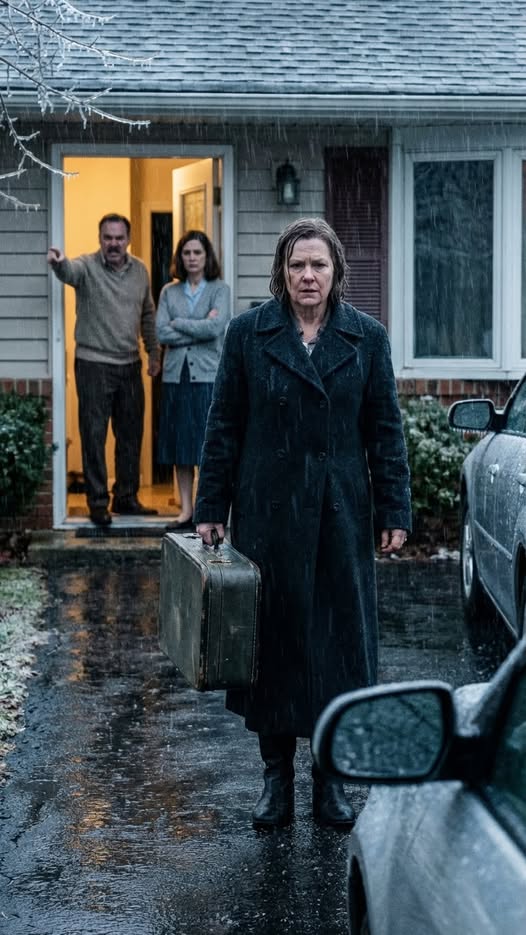
The February rain hadn’t just soaked through my black wool coat; it felt like it had seeped into the marrow of my bones, chilling me from the inside out. My hands were still trembling, a subtle, rhythmic shaking that had started the moment I helped lower Margaret’s casket into the waterlogged earth. I kept rubbing them together as I unlocked the front door, desperate for the warmth of the home I had tended to for twenty-three years.
But the warmth was gone.
I stepped into the foyer, my funeral shoes leaving wet, muddy prints on the hardwood floor—the same floor Margaret had insisted on polishing with lemon oil every Saturday until her wrists became too weak to hold the rag. I looked up, expecting the silence of a grieving house. Instead, I walked into an ambush.
They were all there. My husband, my son, my sister-in-law, and a stranger in a cheap gray suit.
Ryan, my husband of twenty-three years, was sitting in Margaret’s favorite wingback chair. The sight of him there was a physical blow. In ten years, he had never sat in that chair, not even once. It was her throne, the place where she solved crosswords and commanded her small world. Now, he lounged in it with a terrifying ease, his legs crossed, looking at me with an expression I couldn’t place.
“Elena,” he said. He didn’t stand. He didn’t offer to take my wet coat. “We need to talk.”
The air in the living room was thick, suffocating. My son, Daniel, twenty-four years old and usually full of excuses, sat on the couch, staring intently at the carpet. He couldn’t meet my eyes. Beside him sat Chloe, Ryan’s younger sister, a woman who treated family visits like photo opportunities for her social media following. She had a manila folder balanced on her knees.
“Can I at least take off my coat?” I asked, my voice sounding thin and foreign to my own ears. “I’m freezing.”
“This won’t take long,” Chloe said sharply. She was still wearing her oversized designer sunglasses, despite the gloom of the rainy afternoon and the dim interior of the house. She looked like a caricature of grief, utterly devoid of the real thing.
I ignored her, walking to the coat rack Margaret had bought at an estate sale in 1998. I remembered the day she bought it; she had told me the story three weeks ago while I was changing her bedpan, trying to distract her from the humiliation of her failing body. The memory tightened my throat.
“Elena, sit down,” Ryan commanded. There was a new timber in his voice—something cold, something metallic. It wasn’t the voice of the man I slept beside; it was the voice of a landlord speaking to a delinquent tenant.
I sat on the ottoman, the only seat left vacant. In my own home, surrounded by my family, I was relegated to a footstool.
Chloe flipped open the folder with a theatrical snap. “I found Mom’s will,” she announced, her lips painted a severe shade of crimson. “It was in her bedroom, in the nightstand drawer with her medications.”
I felt a constriction in my chest. Margaret and I had discussed her will countless times during the long, sleepless nights of her hospice care. After Ryan had gone to bed, after Chloe had stopped returning calls, after Daniel had moved out to ‘find himself,’ Margaret and I would talk. She had been lucid. She had been explicit.
“She left the house to Ryan,” Chloe continued, running a manicured finger down the document. “Along with her savings, which total about four hundred and eighty thousand dollars.”
The room seemed to tilt on its axis. I gripped the velvet edge of the ottoman to steady myself. “And… and for me?”
Chloe looked up over the rim of her glasses. Her eyes were hard, reflecting my own pale, wet face back at me. “She left five thousand dollars for your service.”
“For my service?” I whispered.
The word hung in the air, heavy and insulting. Ten years. Ten years of setting alarms every three hours to turn her so she wouldn’t develop bedsores. Ten years of pureeing food when she could no longer chew. Ten years of bathing her, dressing her, managing a pharmacy’s worth of medications, driving to chemo, sitting through radiation, holding her hand while she screamed in pain during the final, brutal days.
“Five thousand dollars?” I said, my voice rising. “That’s not possible. Margaret told me… she said the house would be mine. She said it was the only fair thing after everything.”
“Mom was on a lot of morphine, Elena,” Ryan interrupted, his tone dismissive. “She wasn’t always clear about things. Her mind was going.”
“She was clear!” I snapped, the anger finally piercing through the shock. “She was very clear. She knew exactly who was there for her and who wasn’t.”
“There is nothing about you in the will except the five thousand,” Chloe said, tapping the paper with a rhythmic thwack-thwack-thwack. “It’s all here in black and white.”
The stranger in the gray suit finally spoke. He cleared his throat, a dry, dusty sound. “Mrs. Chen, I am Brian Patterson. I have been asked to witness this reading and to inform you that, per the instructions of the primary beneficiary, you have forty-eight hours to vacate the premises.”
“Forty-eight hours?” I looked at my son. “Daniel?”
He flinched but didn’t look up. “Dad says… Dad says this is what Grandma wanted.”
“Your father didn’t visit her for six months before she died,” I said, the words spilling out like acid. “Neither did your aunt. Where were you all when she was crying at 3:00 AM because the bone pain was unbearable? Where were you when she couldn’t remember her own name? Where were you when—”
“Elena!” Ryan stood up, looming over me. He seemed taller than I remembered, or perhaps I had just shrunk under the weight of the last decade. “This is what my mother wanted. You’ll get your five thousand. Daniel is staying with us. You need to pack your things and leave.”
Us. He said us. As if Daniel, Chloe, and he were a new family unit, a tripod of legitimacy, and I was the parasite that had been purged.
“Pack my things,” I repeated numbly.
“You have forty-eight hours,” the lawyer said again, checking his watch as if he had a tee time to catch. “After that, if you haven’t vacated voluntarily, Mr. Chen will be forced to file for immediate eviction.”
I stood up slowly. My legs felt like water, shivering and weak, but I locked my knees. I wouldn’t let them see me fall. Not them.
“I understand,” I said.
The silence that followed was confused. They expected screaming. They expected tears, begging, a scene they could record and laugh about later. But nursing had taught me one crucial lesson: panic kills. When the patient is crashing, you don’t scream. You assess. You plan. You act.
I turned my back on them and walked toward the stairs.
I walked up to the bedroom I had shared with Ryan since we were both forty. It was the room where I had lain awake hundreds of nights, listening to the baby monitor we had repurposed for Margaret, ready to sprint down the hall at the first sound of a cough or a moan.
I pulled my old Samsonite suitcase from the closet. I moved with mechanical precision. I was the responsible one. I was the one who married young and made it work. I was the one who put a promising nursing career on hold when Margaret had her first stroke because Ryan said, My mother needs family, Elena, not strangers.
I packed my scrubs, even though I hadn’t worn them in a decade. I packed the small jewelry box Margaret had given me for my 50th birthday—cheap costume jewelry that she loved. I packed the photo albums Ryan had put in the “throw away” pile because everything is digital now anyway.
And then, from the bottom of my sock drawer, underneath the winter woolens, I pulled out the envelope.
Margaret had pressed it into my hand three days before she died. It was during one of her moments of startling clarity, where the fog of morphine lifted and her blue eyes became sharp as diamonds. She had gripped my wrist with a strength that shocked me.
“Elena,” she had whispered, her voice rasping. “My children… they are not good people. I know that now. I’m sorry I didn’t see it sooner.”
“Don’t say that,” I had soothed, smoothing her thinning white hair. “They’re just busy.”
“Don’t defend them,” she had hissed. “You’ve always defended everyone else. It’s time someone protected you.”
She had pulled the envelope from under her pillow. “Don’t open this until after I’m gone. Promise me.”
I had promised.
Now, I held it in my hand. It felt heavy, charged with a static energy. I placed it at the very bottom of my suitcase, beneath the layers of clothes. I hadn’t opened it yet. I wanted to honor my word, even if no one else in this house honored theirs.
I walked past the living room without looking at them. I walked out into the rain, got into my ten-year-old sedan, and drove away.
I spent the next forty-eight hours in the Super Tom Motel on Route 9. It was a place where dreams went to die. The room smelled of stale cigarettes, industrial bleach, and despair. The heater rattled like a dying engine, keeping me awake through the stormy nights.
I checked my bank account on my phone. Chloe had transferred the $5,000. That was it. That was the sum total of my worth to the Chen family. Five thousand dollars. Five hundred dollars a year for being a nurse, a maid, a chauffeur, and a emotional punching bag.
I used a portion of it to pay for two weeks at the motel and bought groceries from the Dollar General next door—canned soup, crackers, instant coffee.
On the third day, as the sun finally broke through the gray clouds, I sat on the lumpy mattress and opened the envelope.
Inside, there was no money. There was only a single brass key with a yellow tag that read First National Bank – Box 402, and a note written in Margaret’s shaky, spider-web handwriting.
Elena,
I know my children. I prepared for this. Trust me, the real will is in the box. There is a video recording, too. Call Bernard Winters at Winters & Associates. His number is below.
I am so sorry you have to deal with this. You deserve so much better from all of us.
With love,
Margaret
I stared at the note until the words blurred. Trust me.
I grabbed my coat.
Bernard Winters’ law office was located in an old brick building downtown, directly above a bakery that made the cinnamon rolls Margaret used to adore before her swallowing reflex failed. The stairwell smelled of yeast and sugar, a scent that made my stomach turn with nostalgia.
Bernard Winters was a man out of time. He looked to be about seventy, wearing a three-piece tweed suit and spectacles on a chain. He had kind eyes and a handshake that felt like gripping a tree branch.
“Mrs. Chen,” he said warmly, opening the door himself. “I have been expecting you. Margaret said you would come, though she hoped you wouldn’t have to.”
“They kicked me out,” I said bluntly. “They gave me forty-eight hours.”
Bernard sighed, a deep, rumbling sound. “Predictable. Greed makes people terribly predictable.”
He led me into a conference room lined with leather-bound books. On the mahogany table sat a metal safety deposit box. He gestured for me to hand him the key.
“Margaret came to see me eight months ago,” Bernard explained as he inserted his own master key alongside mine. “She had a friend drive her. She was very weak, but her mind? Her mind was sharper than a tack.”
He turned the keys. The box popped open.
Inside lay a thick sealed envelope, a USB drive, and a stack of bound documents.
“Margaret’s official will,” Bernard said, picking up the envelope with reverence, “was executed on June 15th of last year. It was witnessed by myself and two of my paralegals. It has been notarized and filed with the county clerk. It is ironclad.”
He opened it and began to read.
“The house is yours, Elena. Not Ryan’s. Yours.”
I stopped breathing.
“The savings account, totaling four hundred and eighty thousand dollars? Yours. The investments? Yours.”
“And Ryan?” I asked, my voice trembling. “Chloe?”
Bernard looked over his glasses. “Ryan and Chloe each received a bequest of twenty-five thousand dollars. However, there is a very specific condition attached to these gifts.”
He tapped a paragraph on the second page.
“This is what we call a No Contest Clause, or an in terrorem clause. It states that if any beneficiary challenges the validity of this will, or attempts to impede its execution, they forfeit their entire inheritance. They get nothing. Zero.”
“But they have a will,” I said, panic rising again. “Chloe showed me. It looked real.”
Bernard’s expression darkened. “A forgery,” he said quietly. “And a clumsy one at that, I suspect. But Mrs. Chen, you must understand something. Forging a legal document like a will is not just a lie. It is a felony.”
“A felony?”
“Indeed. We are talking about forgery, fraud, and potentially elder abuse if we can prove they coerced her or manipulated documents while she was alive.”
He picked up the USB drive. “But Margaret… she was worried they might try something like this. She knew she wouldn’t be there to defend you. So, she left a testimony.”
He plugged the drive into his laptop and turned the screen toward me.
The video player opened. Margaret’s face filled the screen. She was sitting in this very conference room, wearing the blue cardigan I had knitted for her two Christmases ago. She looked frail, her skin paper-thin, but her jaw was set.
“To whom it may concern,” she said to the camera. Her voice was stronger than I remembered from the end. “I am Margaret Patricia Chen. I am of sound mind, though my body is failing me.”
She paused, taking a breath that rattled in her chest.
“I am making this video to ensure my wishes are crystal clear. My son, Ryan, and my daughter, Chloe, have not been present in my life for many years. They visit on holidays for an hour. They call once a month. They have made it clear that my care is a burden they are unwilling to shoulder.”
Tears pricked my eyes. To hear her say it… to know she saw it all.
“My daughter-in-law, Elena Chen, has been my sole caregiver for ten years. She has bathed me, fed me, and preserved my dignity when I had none left. Elena deserves everything I have to give. The house is hers. She earned it a thousand times over.”
Margaret leaned into the camera, her eyes fierce.
“If my children choose to fight this will, if they try to take from Elena what she has earned, then let the record show: they get nothing. That is my final word.”
The screen went black.
The silence in the room was absolute. Bernard handed me a tissue.
“There is more,” he said gently. He slid a thick binder toward me. “Margaret documented everything. She kept a journal. Every time Ryan missed a visit. Every time Chloe asked for money but couldn’t spare an hour of time. She collected testimonies from the hospice nurses. Every single one confirms that you were the only family present.”
I touched the binder. It was cold, but it felt like a shield.
“What happens now?” I asked.
Bernard leaned back, steepling his fingers. “Now? I file the official will with the probate court. I send a notification to all parties. And I strongly suggest that Ryan and Chloe accept their fate. Because if they present that forged document to a court, they go to prison.”
“They kicked me out of my home,” I said, the anger returning, hotter this time. “They treated me like a servant.”
“Then let’s serve them something they aren’t expecting,” Bernard said with a wolfish smile. “Justice.”
I filed the police report the next morning. The detective, a woman named Miller with sharp, intelligent eyes, took my statement. When I told her about the forged will, she didn’t look surprised.
“Greed makes people stupid,” Detective Miller said, typing efficiently. “Do you have the forged document?”
“No,” I said. “Chloe kept it.”
“That’s fine. We’ll get it. Sit tight, Mrs. Chen. Don’t contact them.”
Three days later, I drove back to the house. My house.
I parked across the street, watching. Two police cruisers were already there, their lights flashing silently in the afternoon sun. I saw the front door open.
Ryan was led out first. He wasn’t wearing his suit today. He was in sweatpants, looking disheveled and small. When the officer turned him around to cuff his hands behind his back, I saw his face. It wasn’t arrogant anymore. It was gray with terror.
Chloe came next. She was screaming, actual tears running down her face now, ruining her makeup. She was shouting about her rights, about her lawyers, about how this was all a misunderstanding. The officers ignored her, guiding her into the back of the second cruiser.
They had been inside sorting through Margaret’s things—preparing to sell everything.
My phone buzzed. It was Daniel.
I stared at the screen for a long moment before answering.
“Mom?” His voice was small, trembling. “Mom, the police… they just took Dad and Aunt Chloe. They said… they said they arrested them for fraud.”
“I know,” I said calmly.
“Mom, I didn’t know,” he stammered. “I swear to God, I didn’t know it was fake. Dad showed me the will, and I just thought… I thought Grandma wanted him to have the house.”
“Did you read it, Daniel?” I asked.
“I… I glanced at it.”
“Did you ask yourself why your grandmother, who I cared for every single day, would leave me homeless?”
Silence stretched over the line.
“I… I thought you were just leaving because you were upset,” he whispered. “I didn’t know they forced you out.”
“You knew I had forty-eight hours,” I corrected him. “You sat there on the couch and watched it happen.”
He started to cry. “I should have said something. I should have stood up for you.”
“Yes,” I said. “You should have. You should have visited your grandmother when she was dying, too. You should have called more than once a month.”
“I know,” he sobbed. “I’m so sorry.”
“Your grandmother left you something, Daniel,” I said, my voice softening just a fraction. “One hundred thousand dollars. In a trust. You get it when you turn twenty-five.”
“She did?”
“She loved you. But she knew you weren’t ready for the money yet. Just like she knew you weren’t ready to hear the truth about your father.”
“Mom, are you coming home?”
I looked at the house. The police cars were pulling away. The driveway was empty. The roses Margaret and I had planted along the fence were beginning to bud.
“Yes,” I said. “I’m coming home. finally.”
The court case dragged on for three months, a slow grinding of wheels that pulverized Ryan and Chloe’s defenses. Faced with the video evidence, the lawyer’s testimony, and the undeniable clumsiness of their forgery, they both pleaded guilty to forgery and attempted fraud in exchange for reduced sentences.
Ryan got eighteen months. Chloe got a year.
It was a scandal that destroyed Chloe’s influencer career overnight. The headlines were brutal: Influencer Arrested for Elder Abuse Scheme, Grandmother’s Revenge from the Grave.
Daniel came to visit me every week. At first, it was excruciatingly awkward. We would sit in the living room—my living room—drinking tea, the silence thick between us. But slowly, we began to bridge the gap.
I told him stories about his grandmother. Real stories. Not the sanitized versions Ryan had told him. I told him about the time she laughed so hard her IV came loose. I told him about the morning she grabbed my hand and said, “Elena, you are the daughter I wish I had raised.”
“Why didn’t she tell me?” Daniel asked one afternoon, staring into his teacup. “Why didn’t she tell me she hated Dad?”
“She didn’t hate him,” I said. “She was disappointed in him. There is a difference. And she didn’t tell you because she didn’t want to poison you against him. She let him do that himself.”
I didn’t sell the house. I had thought about it, especially in those first few weeks when the ghosts of the betrayal seemed to lurk in every corner. But then I realized: this house wasn’t about the structure. It was about the decade of love I had poured into it.
Instead, I did something different.
I used a portion of Margaret’s savings to start a non-profit. I called it Margaret’s House. It was a support network for family caregivers—a place where people drowning in the responsibility of caring for elderly relatives could find legal advice, respite care, and counseling. I ran it from the living room, using Margaret’s old office.
Daniel volunteered every weekend. I watched him help set up chairs for the support groups, pour coffee, and listen to strangers tell their stories. I watched him learn what I had learned: that caring is not a burden. It is a privilege.
One year after Margaret’s death, on the anniversary, Daniel and I were in the backyard. We were planting a new bed of roses—Margaret’s favorites—in the spot where she used to sit in her wheelchair, turning her face to the sun.
“She knew, didn’t she?” Daniel said, wiping sweat from his forehead, leaving a streak of dirt. “She knew exactly what they were planning.”
“She suspected,” I said, patting the earth around a thorny stem. “And she protected me the only way she could. With the truth.”
“I wish I had known her better,” he said quietly.
“You can know her through her actions,” I told him. “She chose justice. She chose to protect the vulnerable. That’s who she was.”
We worked in silence for a while, the smell of damp earth and spring air surrounding us.
“Mom?” Daniel looked up at me, his eyes red-rimmed. “Thank you for not giving up on me.”
I looked at him. He was still a boy in many ways, but he was learning.
“You’re my son,” I said. “Margaret taught me that family isn’t just blood. It’s about who shows up. But she also taught me something else.”
“What?”
“That sometimes, the most loving thing you can do is draw a line. To say ‘no more.’ To protect yourself.”
Daniel nodded slowly. “Do you think you’ll ever talk to Dad again?”
I thought about Ryan, sitting in a cell, wearing orange instead of his precious suits. I thought about the years I had made myself small so he could feel big.
“I don’t know,” I said honestly. “Maybe someday. But not because I have to. Only if I want to.”
“And do you want to?”
I looked at the roses, vibrant and defiant against the soil. I looked at the house that was legally, irrevocably mine.
“Ask me in another year,” I said.
That night, alone in the quiet house, I pulled out the photo albums I had rescued from the trash. I flipped to the very back of the last album. Tucked behind a picture of Margaret and me at a Christmas party, I found one last note.
Dear Elena,
If you are reading this, then my plan worked. You are home. You are safe.
I am sorry I didn’t give you more when I was alive. More recognition. More support. More defense against their selfishness. But I am giving you this now: Permission.
Permission to stop sacrificing. Permission to stop shrinking. Permission to take up space and demand respect.
You have been the architect of everyone else’s comfort for too long. Now, build something for yourself.
With all my love,
Margaret
I cried then, for the first time since the funeral. Not tears of sadness, exactly. It was a complicated release—grief, yes, but also relief. Also gratitude. Also freedom.
I wasn’t the scapegoat anymore. I wasn’t the invisible fixer.
I was Elena Chen, sixty-two years old, owner of a four-bedroom house with a rose garden, director of Margaret’s House, and mother to a son who was finally learning to be a man.
I was the woman who had been loved enough by someone to be fought for, even from beyond the grave.
That was worth more than any house. But as I looked around the warm, candlelit living room… it was nice to have the house, too.