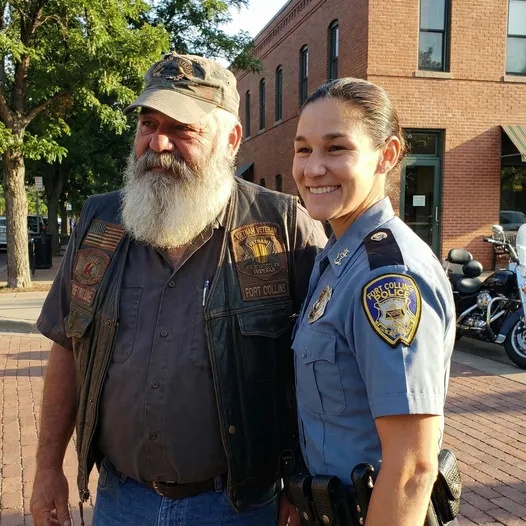
The highway had settled into its usual twilight rhythm when the red and blue lights bloomed behind Robert “Ghost” McAllister’s motorcycle. At 62, he had learned not to flinch at flashing lights or the low hum of authority. He eased the bike onto the shoulder of Highway 49, killed the engine, and removed his helmet with the steady hands of a man who had survived worse than a routine traffic stop. For most motorists, it would have ended with a citation or a warning. For Robert, it became the moment his entire life realigned.
The officer who stepped out of the patrol car walked with calm confidence, boots firm against the pavement. Her badge caught the fading light, and her nameplate was clear: Officer Sarah Chen. The instant their eyes met, something cracked open inside Robert. It wasn’t recognition in a logical sense; it was deeper, instinctive, almost physical. Her face carried echoes of a child he had not seen since she was two years old. The same almond-shaped eyes. The same slight tilt of the head. Even the faint birthmark near her temple that he had memorized decades earlier during sleepless nights filled with regret and unanswered questions.
Sarah spoke professionally, asking for license and registration, unaware that the man in front of her was fighting to keep his breath steady. To her, he was another older biker, maybe tired, maybe distracted. To him, she was the embodiment of a loss that had defined his adult life. Thirty-one years earlier, his daughter had disappeared after a bitter custody dispute that spiraled into silence. Phone numbers changed. Addresses evaporated. Legal paths dead-ended. He had searched when he could, grieved when he couldn’t, and carried the absence like a permanent scar.
As Sarah requested he step aside for a standard sobriety check, Robert complied without hesitation. His hands trembled slightly, though not from fear of arrest. It was the collision of memory and reality. When she leaned closer, he caught a familiar scent — baby shampoo. The same one he used to buy when his daughter was an infant. Without thinking, he murmured a quiet comment about it. Sarah paused for half a second, unsettled by the intimacy of the remark, but continued her procedure. Training took precedence over instinct.
The decision to take him in for further testing was procedural, not punitive. At the station, blood alcohol results came back clean. No charges. No violations. Yet something had shifted. During processing, an old database flagged a surname inconsistency tied to Sarah’s birth records. A supervisor noticed it. Questions followed. Paperwork that had been dormant for decades resurfaced. A sealed adoption record. A name buried in archived files: Sarah Elizabeth McAllister.
The room went quiet when the truth began to surface. Sarah was brought into a private office, expecting clarification, not revelation. Robert sat across from her, his posture rigid, his eyes glassy but focused. When the DNA test results arrived hours later, they didn’t dramatize the moment. They confirmed it with cold, precise certainty. A 99.9 percent match. Father and daughter.
Sarah had grown up believing her biological father had walked away, choosing freedom over responsibility. That story had been told carefully, repeatedly, until it hardened into fact. Robert had lived with a different truth — one of blocked contact, unanswered letters, and years spent chasing a shadow across state lines. Neither story was malicious. Both were incomplete.
They spoke for hours, not as a cinematic reunion, but as two adults navigating a seismic shift. Robert didn’t beg for forgiveness. Sarah didn’t offer instant absolution. They talked about her career in law enforcement, his years on the road, the long stretch of silence that neither had chosen but both had endured. It was raw, restrained, and honest.
By morning, the station windows glowed with early light. They stepped outside together, no longer strangers, not yet family in the conventional sense. What they shared instead was something rarer: truth without pressure. In a world obsessed with instant closure and viral moments, their reunion unfolded quietly, grounded in reality rather than spectacle.
Stories like theirs resonate deeply in modern digital culture, where viral human-interest narratives dominate search trends tied to family reunions, DNA testing breakthroughs, long-lost relatives, and emotional true stories. It’s the kind of real-life connection that cuts through algorithms because it reflects something universally human: the need to know where we come from and the hope that what was lost can sometimes be found.
Robert didn’t ride away that morning with his past erased. Sarah didn’t suddenly rewrite her identity. But both walked forward with something invaluable — the chance to rebuild on their own terms. In an age defined by data, surveillance, and instant information, it was an old highway stop, a routine badge check, and a forgotten name in an archive that brought a father and daughter back into the same story.
Not every miracle arrives loudly. Some arrive under flashing lights on a quiet road, changing lives without ever asking for attention.