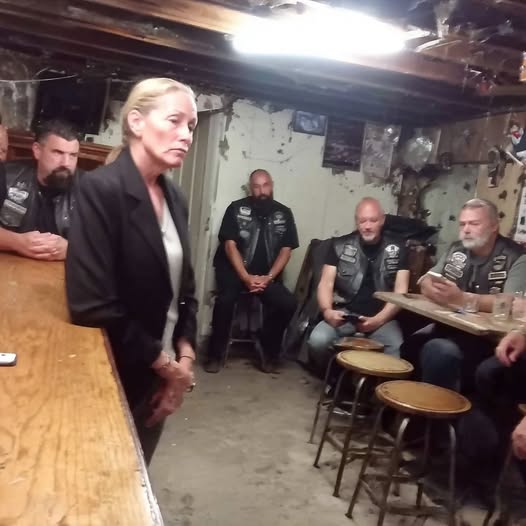
The scent of stale beer, aged leather, and defiance hung thick in the air of the motorcycle clubhouse, a fortress of hardened resolve. Desperation, a potent driver of human action, had led me, a forty-five-year-old suburban real estate professional, straight to this intimidating sanctuary. I clutched a wad of cash—five hundred dollars—a desperate offering for a desperate act. “I need someone hurt,” I declared, my voice trembling but my purpose clear, as I addressed the colossal, bearded man behind the bar. “There’s a man stalking my daughter. The police won’t help. I need him gone.” The silence that followed was heavy, twenty pairs of eyes in leather and denim analyzing the well-heeled woman standing before them. I was bracing for negotiation, for veiled threats, for the embrace of vigilante justice.
The man, whose vest identified him as “Thomas,” the Club President, didn’t touch the money. His response was a shocking departure from the expected script. “Ma’am, why don’t you sit down and tell us what’s really going on.” The demand for dialogue, not destruction, threw me. My narrative spilled out, a frantic tale of my nineteen-year-old daughter, Emma, terrorized by Richard Kelley, a thirty-seven-year-old stalker. He tracked her to her college, her workplace, our home. The terror peaked when he left a photograph of her, taken while she slept, on her car windshield. The police’s hands were tied by the law’s limitations: no explicit threats, no forced entry, just a warning for mere trespassing. A warning against a man who had violated the most sacred boundary of her life.
The sight of Emma’s fear and the impotence of the legal system had driven me to this extreme. When I finished, several bikers stood, the atmosphere shifting from suspicion to focused intensity. Thomas, the President, pushed my money back. “We’re not going to hurt him, ma’am. That’s not what your daughter needs. She doesn’t need her mother in prison for hiring someone to commit assault. She needs something better.” My heart sank, yet his smile—cold and unwavering—promised a different kind of retribution. “Making him understand what it feels like.”
Their plan, brilliant in its psychological simplicity and absolutely legal, was a masterpiece of creative problem-solving. They would stalk the stalker. “We’re going to follow Mr. Kelley. Legally. Publicly. Constantly,” Thomas explained. The rules were strict: never touch him, never threaten him, never speak to him unless spoken to. If engaged, they would be polite, friendly, exercising their freedom of movement—the same freedom Kelley had weaponized against my daughter. They would use the very loopholes that protected him to dismantle his peace. An older biker, a Vietnam Veteran, articulated the strategy with grim satisfaction: “The police told you they couldn’t do anything until he ‘actually did something’? Well, that works both ways.” The room filled with dark, knowing laughter. They understood that the law is a double-edged sword, and they were experts at utilizing its dull side for precision strikes.
Thomas revealed his personal motivation—a similar stalking incident involving his own daughter that had led him to an eight-month jail sentence for assault, a violent act that failed to stop the stalker but succeeded in trapping him in the system. His club’s non-violent, persistent counter-stalking was the strategy that finally forced his daughter’s tormentor to flee. “He lasted nine days before he moved to another state.” They didn’t need my money, only Kelley’s photos and Emma’s schedule. Effective communication and meticulous planning were their true weapons.
The campaign of psychological warfare began the next morning. Kelley’s habitual 7:00 AM departure from his Riverside apartment complex was greeted by two motorcyclists enjoying coffee. They followed him—at a respectful distance—to his job at the downtown hardware store. Emma texted me from her lecture hall, reporting “two bikers are sitting outside the lecture hall. Said they’re making sure I’m safe.” Within hours, Kelley had called the police twice, a biker capturing the futile exchange on video: Kelley’s furious accusations met with Thomas’s calm, legally precise deflection. The police were powerless; no crime had been committed.
For nine relentless days, Kelley’s life was an open prison. He was watched on public sidewalks, in legal parking spots, in his gym, and even in the grocery store aisles. His attempt to file a restraining order against the entire club was met with judicial skepticism and a damning question: if the bikers’ actions were illegal, then what did that make his actions toward Emma? The realization that he was facing his own tactics, amplified and weaponized, broke him. His employer, citing business interference from the constant police presence, suggested a leave of absence.
On day nine, the torment ended. Thomas called. Kelley was packing his car. Fifteen motorcycles followed the white Honda Civic two hundred miles to the state line, a final, undeniable message that his reign of terror was over. The bikers had not only achieved immediate results but a permanent deterrent.
That evening, the entire club arrived at my house. Thomas returned the $500, stating, “We don’t take money for protecting kids.” Emma, for the first time in six months, was genuinely safe. She embraced Thomas, a giant figure of newfound security. The young biker’s quiet addition cemented the long-term risk mitigation: Kelley’s photograph had been distributed to motorcycle clubs in six surrounding states, creating an effective, non-violent geographic blacklist. If he tried his crime again, he would find no peace.
The bikers were, as Thomas put it, fathers and brothers who understood that the system sometimes failed. Their methods were unconventional, and their loyalty was absolute. Their final request wasn’t for compensation, but for a charitable commitment: help with their annual Christmas toy run. My daughter, now free and whole, immediately agreed.
Emma is now healing, attending therapy, and getting her life back. Richard Kelley learned that the reach of this decentralized network was long. His attempts to relocate to Oregon, Nevada, and Arizona were quietly thwarted by the presence of club members who appeared in his new neighborhood, never threatening, just being there. He finally settled in Florida, as far away as possible.
This experience redefined my understanding of justice. It wasn’t always about punishment dispensed by the state. Sometimes, creative legal strategies and psychological deterrence were more effective. It was street justice, delivered by twenty bearded men in leather who knew how to bend the rules without breaking them, proving that the scariest-looking people can be the greatest heroes when they choose to use their power for the innocent. Emma, inspired by their bravery and effectiveness, now plans to get her motorcycle license, choosing to become a protector rather than a victim. The best revenge, I realized, is not illegal, but poetic.