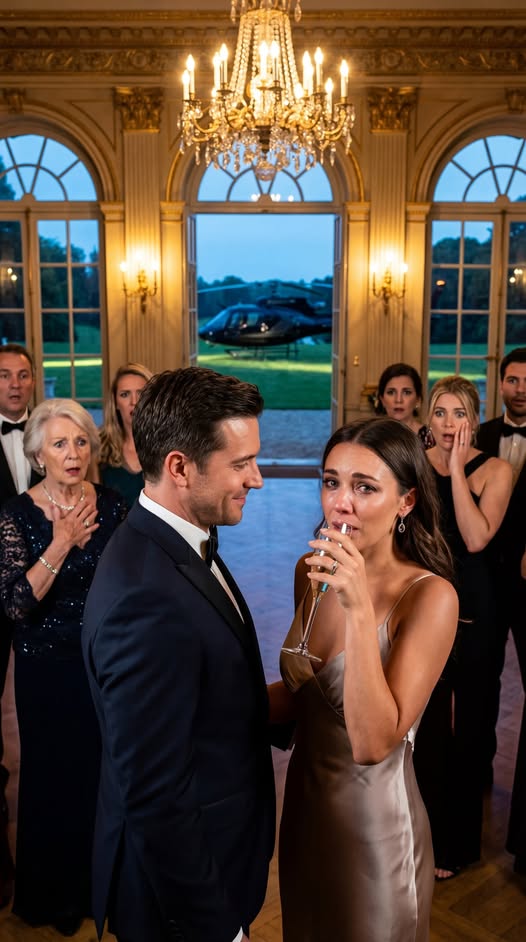
The crystal champagne flute didn’t just tremble in my hand; it vibrated, a fragile tuning fork resonating with the frequency of my own suppressed anxiety. I stood alone at the periphery of the San Jose Country Club’s main ballroom, a spectator at my own family’s triumph. The room smelled ofCasablanca lilies and old money—a cloying, suffocating scent that I had spent the last decade trying to wash out of my hair.
Tonight was my cousin Claire’s engagement party. It unfolded before me like a glossy, two-page spread in Vogue. The lighting was calibrated to flatter the aging donors; the flowers were white, architectural, and obscenely expensive; and the smiles plastered onto my family’s faces were perfect porcelain masks that never quite reached their eyes when their gaze drifted toward me.
I checked my phone for the third time in as many minutes. The screen remained stubbornly dark. No messages from Logan.
I glanced at the sleek, minimalist watch he had given me for Christmas. It was a masterpiece of Swiss engineering, understated and heavy on my wrist. It read 7:45 PM. In Zurich, it was nearly five in the morning. He should have finished the consulting meeting hours ago. A knot of cold dread coiled in my stomach, tighter than the corset of my silk dress.
“Julia, darling.”
The voice sliced through the ambient jazz. My mother, Eleanor Bennett, approached with the predatory grace of a shark gliding through reef water. She was steering an older couple toward me, her hand resting firmly on the woman’s elbow—a gesture that looked affectionate but was actually a method of control.
“This is the Andersons,” my mother announced, her voice carrying that particular, breathless lilt she reserved strictly for public performances. “They are new members of the club, darling. I insisted they meet everyone.”
She turned to the couple, her smile tightening just a fraction. “And this is my daughter, Julia. She’s… currently between paths.”
I bit the inside of my cheek until I tasted metallic tang of blood. Between paths. It was her polite euphemism for “unemployed and delusional.”
“Actually,” I started, my voice steady despite the rapid thumping of my heart, “I’m running my own brand consultancy firm. We just expanded our digital operations.”
My mother let out a light, tinkling laugh—a sound like ice hitting glass. “Oh, Julia. Always the creative soul. And she’s… between relationships right now, too.”
The correction died in my throat. Two years. I had been engaged to Logan for two years. I had worn his ring—a vintage sapphire he’d found in an antique shop in Vienna—every day until tonight, when my mother suggested it was “too gaudy” for Claire’s platinum-themed aesthetic.
“Pleasure to meet you,” Mr. Anderson said, his eyes glazing over as he dismissed me as irrelevant.
“Likewise,” I murmured.
As my mother steered them away toward the bar, I felt the familiar sting of invisibility. To them, I was a ghost. A cautionary tale of a daughter who didn’t marry a lawyer or a doctor, who chased “artistic whims,” and who claimed to be engaged to a man no one in the family had ever seen in the flesh.
I needed air. Or silence. Or perhaps just a place where the air wasn’t thick with judgment. I slipped away toward the corridor leading to the ladies’ lounge, the plush carpet swallowing the sound of my heels.
The hallway offered a blessed reprieve, cool and dim. I leaned against the wainscoting, closing my eyes, willing my breathing to slow. I reached for my phone again to call Logan, just to hear his voicemail, to anchor myself to reality.
Then, I heard it.
Laughter floated from around the corner—sharp, mocking, and unmistakable. It was my mother’s voice, harmonizing with the raspy baritone of Aunt Patricia.
“Two years, Eleanor,” Aunt Patricia was saying, the slur in her voice suggesting she was on her third martini. “Two years engaged to a man no one has ever met. Who does that? It’s pathological.”
“I know,” my mother sighed, a sound of exaggerated fatigue. “I’ve started calling him her ‘imaginary fiancé’ when she can’t hear. It’s easier than explaining that she’s… well, coping.”
“And what is he supposed to be again?” Patricia cackled. “An aviation consultant? Is that what we call flight attendants now?”
“Or a baggage handler,” my brother Tom’s voice joined in, dripping with smug amusement. “Maybe she met him while he was loading her luggage. That would explain why he’s never around. Too busy stacking suitcases.”
“Poor thing,” my mother said, her tone laced with a pity that felt more like venom. “Always trying to keep up with Claire. Claire has the partner, the firm, the future. Julia has… stories.”
I stood frozen in the hallway, the phone slipping from my numb fingers and landing on the carpet with a dull thud. The tears didn’t fall; they burned behind my eyes, hot and searing. It wasn’t just the cruelty that hurt; it was the consensus. They had all agreed on a version of my life that made me a pathetic liar, and they preferred that version to the truth.
I looked down at my phone. The screen lit up. A single text message from Logan.
Landing in 5. Look up.
The message stared up at me, glowing in the dim hallway. Landing in 5.
A sudden, hysterical laugh bubbled up in my chest. I retrieved the phone, my hands shaking not with fear, but with a sudden, overwhelming surge of adrenaline.
My mind flashed back to the first time I met Logan in Zurich. It wasn’t in a boardroom or a gala. It was in a small, cramped coffee shop near the university district where I was desperately trying to fix a corrupted presentation file for a freelance client. I was crying, silently, out of sheer exhaustion.
He had simply slid a fresh cup of coffee across the table and offered me his laptop charger without a word.
Later, after I had made the deadline, we talked for hours. I told him about my branding concepts, expecting the usual glazed-over look I got from my family—the “that’s nice, dear, but is it a real job?” look.
Instead, Logan had listened with an intensity that unnerved me. He asked about market saturation, about color theory, about consumer psychology.
“The work is exceptional,” he had said, looking at my portfolio. “Your family must be incredibly proud of your vision.”
I had laughed then—a bitter, hollow sound. “They think I’m playing at having a career while looking for a husband. They think branding is just… drawing pretty pictures.”
He had reached across the table, his hand covering mine. His skin was warm, his grip solid. “Then they don’t know you at all, Julia. And that is their loss, not yours.”
Unlike the men in my social circle back in San Jose—men like Michael, Claire’s fiancé, who treated conversations like negotiations—Logan was an architect of silence. He built spaces where I could exist without apologizing.
He traveled constantly. He was a “fixer” for failing airline conglomerates, a ghost who moved between Dubai, London, and Singapore, restructuring massive corporations. He was private, bordering on secretive, about his wealth. “Real power,” he once told me, “doesn’t need to shout. It just is.”
I had respected that privacy. I hadn’t forced him to come to the barbecues or the holiday dinners where he would be probed and assessed like livestock. But in doing so, I had inadvertently handed my family the ammunition to destroy me.
Landing in 5.
I wiped the unshed tears from my eyes. I checked my reflection in the hallway mirror. The woman staring back wasn’t the “poor thing” my mother described. She was the woman Logan loved. She was the woman who had built a six-figure consultancy firm from a laptop in a studio apartment.
“Julia!”
Claire’s voice trilled from the ballroom entrance. “We need you for the family toast! Stop hiding!”
I took a deep breath, smoothing the silk of my dress. I walked back into the light.
The ballroom was a sea of expectant faces. My father, Robert Bennett, stood by the stage, checking his watch, looking annoyed at the delay. My mother beamed at me, a warning in her eyes: Don’t embarrass us.
“Come on up, Jules,” Tom jeered softly as I passed him. “Don’t trip.”
I stepped up to the microphone. The feedback whined slightly, silencing the room. I looked out at the crowd—the Andersons, the club members, the family friends who had known me since I was a child and yet knew nothing about me.
My mother nodded encouragingly, expecting the script we had discussed: A toast to Claire, the golden child, and her wonderful Michael.
I gripped the microphone stand. The metal was cold.
“When two people find each other,” I began, my voice clearer and stronger than I expected, “they deserve a foundation of belief. A fortress against the world.”
I looked directly at Claire. She looked bored, twirling her diamond ring.
“Claire and Michael have that foundation in spades,” I continued. “They have the approval, the applause, the public validation.”
The room was quiet. Too quiet. I pivoted, my eyes locking onto my mother’s.
“But some people never receive that support. Some have to build their lives in the shadows, brick by brick, while those closest to them whisper doubts behind closed doors. Some are mocked for their ambitions and ridiculed for their love.”
My mother’s smile faltered. Her fingers tightened around her champagne glass until her knuckles turned white. Aunt Patricia’s mouth hung slightly open.
“So,” I raised my glass, my hand perfectly steady now. “Here is to those blessed with family who believe in them without proof. And here is to those of us who possess the strength to succeed anyway.”
I drank.
The silence that followed was absolute. It was a vacuum, sucking the air out of the room. Someone coughed nervously. My father looked furious, stepping forward to seize the microphone and salvage the moment.
“Julia,” he hissed, “what the hell was that?”
Before he could reach me, a low thrumming sound began to vibrate through the floorboards. It started as a distant hum and rapidly grew into a rhythmic, chest-thumping beat.
The glassware on the tables began to rattle. The chandeliers swayed.
“What is that?” someone shouted.
The sound became a roar. The heavy velvet curtains covering the floor-to-ceiling windows billowed inward as the French doors rattled in their frames.
“It’s a helicopter!” a waiter yelled, pointing toward the garden.
The guests rushed to the windows. My mother’s head snapped up, her expression shifting from anger to confusion. We watched as a sleek, black shape descended from the night sky, its navigation lights cutting through the darkness like laser beams.
It was a Bell 525 Relentless—civilian luxury redefined. The downdraft was immense. It tore through the perfectly manicured lawn, flattening the prize-winning hydrangeas and sending the “perfect” floral arrangements on the patio tumbling into the pool. Linen napkins flew like surrendered flags.
The machine touched down with a heavy, authoritative thud on the putting green, mere yards from the ballroom terrace.
The sheer audacity of it stunned the room into paralysis. This was a noise complaint waiting to happen, a blatant violation of a dozen country club bylaws. It was arrogant. It was magnificent.
The side door of the helicopter slid open.
A figure emerged, ducking under the slowing rotors. He moved with the easy, fluid confidence of a man who owned the ground he walked on. He was wearing a charcoal bespoke suit that I knew cost more than my brother’s car. His dark hair was slightly windswept, his jawline sharp enough to cut glass.
Logan.
He didn’t look at the crowd. He didn’t look at the chaos his arrival had caused. He walked straight toward the terrace doors, which a stunned waiter held open.
He entered the ballroom like a king returning from exile. The silence now was different—it wasn’t awkward; it was awestruck.
He walked straight to me, ignoring the hundreds of eyes tracking his every movement. He stopped inches from me, smelling of cedarwood, jet fuel, and the crisp air of high altitude.
“Sorry I’m late, darling.”
His voice was a low rumble that seemed to vibrate through the floor. He took my face in his hands and kissed me—not a polite peck, but a claiming. Deep, deliberate, and tender.
When he pulled back, he kept his arm securely around my waist, turning to face the room.
“Did I miss your toast?” he asked, loud enough for the back row to hear.
A collective gasp rippled through the crowd. Someone actually dropped a glass; the shatter sounded like a gunshot.
My mother was staring. Her mouth opened and closed, like a fish gasping for air. Tom looked as if he’d been slapped.
“Just finished it,” I said, leaning into him. The support I had spoken of—it was here. It was physical.
Logan smiled, a charming, wolfish expression. He turned his attention to the head table.
“Claire! Thomas!” He corrected himself, looking at Michael. “Sorry, Michael. Congratulations on the engagement.”
He reached into his inner jacket pocket and withdrew a thick, cream-colored envelope. He walked over to the head table and placed it gently in front of Claire.
“A small engagement gift from Julia and myself. We upgraded your honeymoon. The Maldives is beautiful this time of year, but the commercial flight is brutal. You’ll be flying private on one of our fleet jets. Fully staffed.”
Claire stared at the envelope as if it were a bomb. “I… thank you.”
Then, Logan turned to my father.
“Mr. Bennett.” Logan extended his hand. My father, dazed, took it automatically. “It is wonderful to finally meet you. I apologize for the dramatic entrance. We are expanding our presence in the Middle East, and the logistics are a nightmare. Actually, that’s what delayed me—a conference call with the Royal Family in Dubai ran long.”
My mother, who had been clutching her phone like a lifeline, suddenly let out a strangled sound.
“Oh my god,” she whispered.
She held up her phone. On the screen, a breaking news alert from the Wall Street Journal was flashing.
“Bennett Global Branding Secures Historic Middle East Deal: Aviation Tycoon Logan Vance Partners with Julia Bennett for Rebranding Initiative.”
The room seemed to tilt on its axis.
“You…” my mother stammered, looking from the phone to me, and then to Logan. “You never mentioned…”
“I did,” I said, my voice steady, cutting through her stammering like a scalpel. “I told you every Christmas call. Every birthday. I told you about the contracts. I told you about the expansion. You just changed the subject to Claire’s paralegal promotion.”
Logan squeezed my waist, his thumb tracing a comforting circle on my hip. He looked at Aunt Patricia, who was trying to hide behind a potted fern.
“And you must be Patricia,” Logan said, his voice dropping to a frosty politeness. “Julia has told me so much about you. I believe you had some questions about my profession? Something about… peanuts?”
The atmosphere in the room shifted instantly. It was a physical sensation, like the drop in pressure before a storm.
The scorn that had filled the room only minutes ago evaporated, replaced by a desperate, cloying hunger. My brother Tom, who had joked about baggage handlers, suddenly appeared at Logan’s elbow.
“Tom Bennett,” he said, thrusting a business card at Logan, his hand trembling slightly. “I’m in supply chain logistics. I’ve always said aviation is the future. Incredible machine you brought in.”
Logan didn’t take the card. He just looked at it lying in Tom’s palm. “Is that so? Julia mentioned you thought I was imaginary. I suppose business cards are harder to give to ghosts.”
Tom turned beet red and retreated.
I watched Aunt Patricia pulling out her phone. I could see her typing furiously on Facebook. I knew exactly what she was posting. So proud of my successful niece Julia! Global Business Tycoon! Family First!
The hypocrisy was so thick I could taste it. It tasted like bile.
My mother recovered her composure, though her smile was now brittle, terrified. She stepped forward, smoothing her dress, her eyes darting between Logan’s bespoke suit and the diamond watch on his wrist.
“Well,” she fluttered, reaching out to touch my arm. I stepped back, out of her reach. Her hand fell to her side. “This is… wonderful news, Julia. Just wonderful. The country club membership committee meets next month. Your father could nominate you and Logan. Now that you’re… established.”
The word hung in the air. Established.
It was the key to their kingdom. You were only welcome if you were “established.” If you had the money, the titles, the visibility.
“Established?” I repeated, my voice rising. The room went silent again to listen.
“You mean the years you spent telling everyone I was lying about my life? The years you apologized for me?”
“Julia, don’t be dramatic,” my mother hissed, glancing around at the watching guests. “We just wanted the best for you. We were worried.”
“You weren’t worried,” I said, feeling the chains of obligation snapping one by one. “You were embarrassed. You were embarrassed that I didn’t fit your mold. I didn’t invite you here for an apology, Mother. And I certainly didn’t invite Logan here to audition for a country club membership.”
I looked at my father, then at Claire, and finally back to my mother.
“I invited him so you could see the truth. So you would know, without a shadow of a doubt, that I made it. And I did it without your help, without your belief, and despite your mockery.”
I turned to Logan. “I’m ready to go.”
“But the cake hasn’t been cut!” Claire cried out, sensing the ruin of her perfect evening.
“Enjoy it,” I said over my shoulder. “We have a flight to catch.”
Logan guided me toward the terrace doors. The crowd parted like the Red Sea. No one dared to speak. No one dared to stop us.
As we stepped out onto the lawn, the cool night air hit my face. The helicopter blades began to spin up again, a crescendo of power that drowned out the murmurs of the elite.
My mother followed us to the edge of the patio. “Julia! Wait! Where are you going?”
I turned back one last time, the wind whipping my hair around my face.
“Back to my life,” I shouted over the engine’s roar. “The real one.”
Zurich in October is a study in gold and grey.
We stood on the balcony of our penthouse, overlooking the Limmat River. The city lights reflected off the water, shimmering like scattered diamonds. Inside, the fire was crackling, and the smell of roasting chestnuts filled the apartment.
“We could take the apartment in Manhattan,” I mused, leaning against the railing. “The one on 5th. We’d be closer to family… if we wanted.”
Logan came up behind me, wrapping his arms around me, resting his chin on my shoulder. “If we want,” he echoed. “Your choice, Jules. Your terms. Always.”
I thought about that. My terms.
For so long, I had defined myself by their rejection. I had worked hard not just to succeed, but to prove them wrong. But standing there, wrapped in the warmth of the man who had seen me when I was invisible, I realized the anger had faded.
It hadn’t disappeared; it had just become irrelevant. Like a heavy coat I no longer needed to wear.
My phone pinged on the table inside.
I walked over and picked it up. It was an email from my mother.
Six weeks had passed since the engagement party. There had been a flurry of texts initially—panicked, accusatory, then pleading—which I had ignored.
This one was different.
Subject: The Lake House
Julia,
The leaves are turning at the lake house. It’s lovely in October. I found some of your old sketchbooks in the attic. I… I looked through them. They’re quite good. I don’t know why I never looked before.
No pressure. Just know you and Logan are both welcome. Whenever you choose. Just let us know.
Mom.
There was no begging. No guilt trip about “family duty.” Just an open door, and the admission that she had looked—really looked—at something of mine for the first time.
I showed the screen to Logan. He read it, his expression unreadable.
“What do you think?” he asked.
I looked out at the Swiss skyline, at the life we had built. A life of substance, not just appearance.
“I think,” I said, typing a short reply, “that we might go for Thanksgiving. Maybe.”
I hit send.
Thanks, Mom. We’ll check our schedule.
I set the phone down, face down.
I realized then that the greatest revenge wasn’t screaming at them at a party, or dazzling them with helicopters and wealth. It wasn’t proving them wrong.
It was living so fully, so completely, that their approval became a footnote in my story, rather than the headline.
“Champagne?” Logan asked, holding out a glass.
I took it. The crystal didn’t tremble. My hand was steady as a rock.
“To us,” I said.
“To us,” he replied.
And this time, the smiles reached our eyes.