I watched my elderly neighbor’s porch collapse one board at a time while his own children waited for him to die.
What finally broke wasn’t the wood. It was the illusion that family always shows up.
My name is Margaret, and I have lived beside Harold Peterson for more than three decades. Long enough to see a full life unfold. Long enough to know when something sacred has been violated.
Harold is ninety-one years old. A U.S. Navy veteran. A carpenter by trade. The kind of man who spent his younger years fixing roofs for widows, building wheelchair ramps before the phrase “home accessibility” became a policy buzzword, and charging people less if he knew they were struggling. He believed in quiet service, personal responsibility, and dignity earned through work.
He raised three children in the house on Oak Street. I watched them ride bikes, go to prom, move away, and build comfortable lives. And then, one by one, I watched them abandon their father when he needed them most.
Harold’s porch had been unsafe for years. Rotting boards. Crumbling steps. No railing. As his mobility declined, the porch became a hazard instead of a welcome. He fell twice trying to navigate a makeshift plywood ramp. Each fall left him shaken, bruised, and more afraid of his own front door.
Then the city notices came. Code violations. Warnings. Threats of condemnation. The kind of bureaucratic pressure that hits hardest when someone is old, disabled, and living on a fixed income. Harold’s military pension and Social Security totaled just over a thousand dollars a month. Repair estimates were fifteen thousand and up. He had less than nine hundred dollars in savings.
So he did what any parent would do. He called his children.
The responses were chilling in their practicality.
His oldest son, a banker with a luxury electric car and a mortgage bigger than Harold’s entire net worth, told him to “consider assisted living” and hinted the house wasn’t worth saving.
His daughter, a real estate agent, didn’t even bother lowering her voice. She said fixing the porch “didn’t make financial sense” and that the property would be more valuable after Harold was gone.
After you’re gone.
His youngest sent a text. No call. No visit. Just a suggestion to hire someone, as if elder care were a line item instead of a moral obligation.
That evening, I found Harold sitting on the dangerous porch that could have killed him, holding a faded photograph of his late wife. He was crying in a way that comes from shame, not pain.
“She would be ashamed,” he kept saying. “We taught them better than this.”
What do you say when adult children reduce their father’s life to an inheritance calculation? When elder neglect hides behind success and legal distance?
I didn’t know what to say. But I knew where to go.
Three blocks away is a small veterans’ post. No banners. No self-promotion. Just a building and people who understand words like duty, loyalty, and honor without needing to say them out loud. These were active-duty service members, retired soldiers, combat veterans. The kind of people who still answer a call even when no one is watching.
I walked in and told them the truth. About Harold. About the porch. About his children. About time running out.
No one interrupted. No one asked for proof. One man asked a single question.
“What’s his name?”
When I told him, he went quiet. Then he said something I will never forget.
“He built my father’s deck in the eighties. Charged half because my dad lost his legs in Korea.”
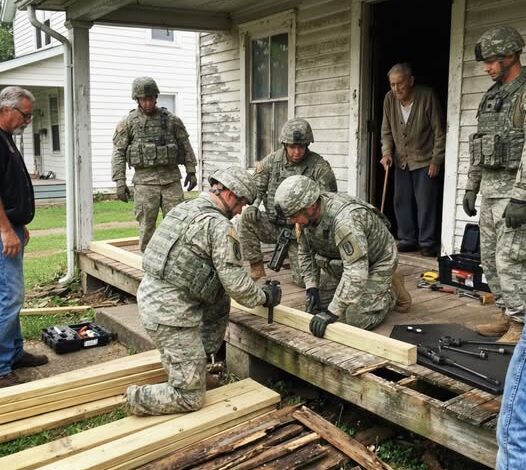
Within hours, soldiers arrived at Harold’s house. They didn’t make speeches. They didn’t ask permission. They assessed the structure the way professionals do. Calm. Focused. Respectful.
By the end of the day, twenty-three men and women had shown up. Lumber was donated. Tools appeared. Skills materialized. Engineers, medics, carpenters, logistics specialists. This was not charity theater. This was coordinated action.
Harold sat in his wheelchair, watching strangers do what his own children refused to do. He cried openly. No one told him to stop.
The porch they built was not just repaired. It was redesigned for safety, accessibility, and dignity. A proper wheelchair ramp. Solid railings. Non-slip decking. Lighting. Weatherproofing. They fixed a leaking roof and replaced the front door. It met every modern standard for aging-in-place home modifications.
When his daughter arrived screaming about property rights and inheritance, she was told to leave. When his son threatened lawsuits, a soldier calmly explained elder law and neglect statutes. They disappeared as quickly as they had arrived.
The soldiers stayed.
They set up a rotation to check on Harold daily. Groceries. Yard work. Companionship. They invited him to meals, Veterans Day events, and community gatherings. They treated him like what he was: a man who had served his country and still deserved respect.
The local news ran the story. Not because the soldiers asked for attention, but because the contrast was too stark to ignore. A neglected veteran. Absent children. Strangers who became family.
Harold rewrote his will the next morning. His estate now supports veteran housing assistance and elder support programs. He said it plainly.
“My children decided I was already dead. These soldiers reminded me I’m still alive.”
Two weeks later, a young woman arrived with two small children. Harold’s granddaughter. She had seen the story. She hadn’t known the truth. She brought his great-grandchildren into his arms for the first time.
That porch did more than keep him safe. It brought life back into his house.
Harold turned ninety-two last month. The soldiers threw him a birthday party. Veterans, neighbors, city leaders. He stood, steady behind the railing they built, and spoke.
“My children waited for my death. These men and women gave me my life back.”
The porch cost money. The labor was free. What they gave him was dignity, community, and proof that honor doesn’t expire with age.
Every morning now, Harold wheels himself onto that porch and waves at the street. Sometimes his children drive by. They don’t stop.
He doesn’t seem to mind anymore.
He knows exactly who his family is.