Chapter 1: The Vanishing Act
The silence in our house wasn’t peaceful; it was heavy, like a held breath waiting to exhale.
It started with a text message, delivered twelve hours after my mother walked out the door two days before Christmas. “I’ll be gone for a week. Watch the kids.” That was it. No instructions, no money left on the counter, no “I love yous.” Just a digital command and then, radio silence.
A week turned into two. Then four. Then nine.
My name is Hannah. I am nineteen years old, and I am currently the captain of a sinking ship manned by five children who have been taught that adults are unreliable at best and dangerous at worst. My siblings are sixteen, thirteen, twelve, nine, and seven. We live with our Nan, but calling her a guardian would be a generous overstatement. She exists in the periphery, a ghost in her own home, leaving the chaos to me.
I realized around week five that Mom wasn’t coming back. She wasn’t dead; the sporadic, guilt-ridden bank transfers proved that. She was simply… done. She had resigned from motherhood without giving two weeks’ notice.
“Is she coming back for Easter?” my seven-year-old sister, Sophie, asked me one evening. She was clutching a dirty muslin cloth—one of her “lovies”—so tight her knuckles were white.
“I don’t think so, bug,” I whispered, brushing hair out of her eyes. “But we’re going to be okay.”
I was lying. I didn’t know if we were going to be okay. I was terrified. The fear of social services was a cold knot in my stomach, a phantom pain from my own childhood stints in foster care. I knew the system. I knew that six kids meant separation. It meant strangers. It meant the end of us.
So, I made the call. Not to the police, but to my older brother, Matt. He was twenty-two, living hours away, trying to build a life that didn’t resemble the wreckage of our childhood.
“She’s gone, Matt,” I told him, my voice cracking for the first time in weeks. “She’s effectively abandoned us. If I don’t get custody, they’re going into the system.”
There was a pause on the line, heavy with the weight of a life-altering decision.
“I’m coming home,” he said. His voice was steady, the anchor I desperately needed. “But Hannah, if I come back, she doesn’t get to return. I refuse to be around her.”
“Deal,” I breathed.
When I finally got Mom on the phone, I didn’t cry. I didn’t beg. I threatened. I told her I wanted legal custody or I was calling the police to report child abandonment. We argued for an hour—her gaslighting me, me holding the line—until she finally snapped, “Fine. Take them. I have a life to live.”
Just like that, I became a mother of five.
Chapter 2: The Cleanup Crew
Matt moved back within the week. His presence shifted the atmosphere immediately. He brought a male energy that wasn’t violent or volatile—something my little brother, Jay, desperately needed. But the transition from a “feral house share” to a functioning family was brutal.
We were undoing years of neglect. The kids were malnourished, constipated, and behind on vaccines. The house ran on chaos. Bedtimes were suggestions; meals were whatever you could scavenge.
“We need a total overhaul,” Matt said one night, looking at the mountain of laundry. “Structure. Discipline. Real food.”
“I don’t know how to parent,” I confessed, feeling small. “I grew up feral, Matt. How do I teach them to be civilized?”
“We learn,” he said. “We break the cycle.”
The resistance was immediate. The sixteen-year-old, Chloe, hated me. To her, I was just her bossy big sister trying to ruin her life. She fought me on curfews, on chores, on breathing. The twelve-year-old, Jay, would disappear on his skateboard until 10:00 PM on school nights.
But the hardest battle was the nights. Sophie, the seven-year-old, had forgotten how to sleep. She would scream, a terrified, guttural sound that tore through the walls. She had night terrors about Mom coming back, or Dad taking her away.
“I can’t sleep,” she sobbed one night, her small body shaking against mine. “I don’t feel safe.”
“I’m here,” I soothed, holding her in a death grip because that was the only way she’d settle. “I am your real mommy now. I’ve looked after you your whole life, and I won’t ever leave.”
“You promise?”
“I swear.”
We realized quickly that “Kinship Care” was our lifeline. It offered financial support without the threat of strangers taking the kids. We went through the home inspections, the interviews, the background checks. It was invasive, but necessary.
Slowly, painfully, we made progress. Jay started doing homework with Matt, desperate for male approval. The nine-year-old, Lily, started eating vegetables without gagging. We were surviving.
Then, the universe decided to test us.
Chapter 3: The Ghost Baby
Nine months after Mom left, I got a call that nearly broke me.
Mom had birthed another baby. A girl.
She hadn’t told us she was pregnant. She hadn’t come home. She had the baby alone, somewhere in the city, and the infant had contracted meningitis. Mom was gone again, vanished into the ether, leaving a premature, sick newborn in the hospital.
“We can’t take her,” my oldest sister, Sarah, argued over the phone. She lived interstate and dealt with her trauma by keeping a safe distance. “Hannah, you are drowning. You cannot bring a newborn into that chaos. Let her be adopted.”
I looked at Matt. We were exhausted. We were broke. We were barely keeping the current five alive.
“If she goes to foster care,” I whispered, the old fear clawing at my throat, “I will spend the rest of my life wondering where she is. I will torture myself wondering if she’s hungry, or cold, or unloved.”
Matt rubbed his face, looking ten years older than twenty-two. “We go see her. We don’t decide yet. We just go see her.”
The baby looked like an alien. She was tiny, wired up to machines, with a cannula in her head. She looked fragile and broken, much like the rest of us. But when I put my finger in her hand, she squeezed it.
“She’s a Martinez,” I said, tears blurring my vision. “She’s ours.”
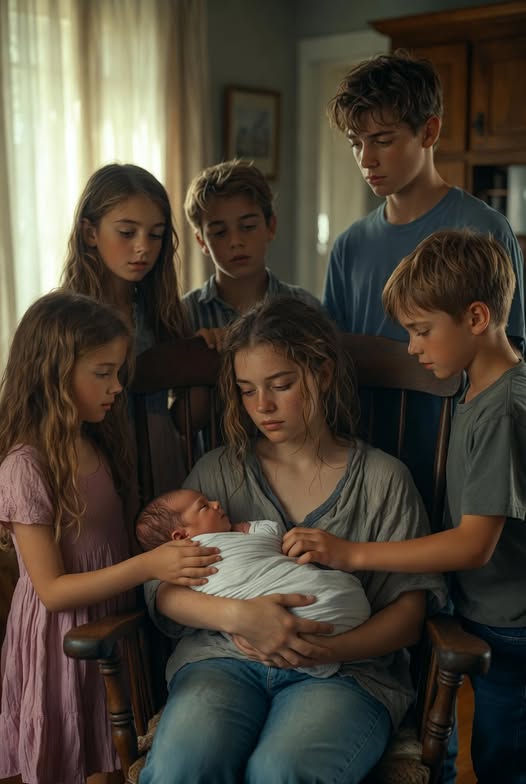
We named her the name I had always saved for my own future daughter, though for months, we just called her “The Baby.” Bringing her home was terrifying. I was twenty years old, feeding a baby every three hours, dealing with bottle sterilization and formula tracking, while also refereeing teenage fights and soothing Sophie’s night terrors.
The house was a pressure cooker. My Nan was toxic, undermining us at every turn, telling the kids we were trying to erase their mother. We had to move. Matt found us a rental in Western Australia—thousands of miles away from the bad memories, the toxic grandparents, and the ghost of our mother.
The flight was a nightmare. The baby cried. Lily vomited. Chloe rolled her eyes so hard I thought they’d stick. But when we unlocked the door to the new house, something shifted. It was empty, clean, and ours.
“We’re safe here,” Jay said, dropping his bag in the hallway. It was the first time I realized he hadn’t felt safe before.
Chapter 4: The Belt and The Breakthrough
Life in the new house settled into a rhythm, but trauma doesn’t vanish just because you change zip codes.
The fourteen-year-old, Maya, had been spiraling. She was the one who remembered the “good times” with Mom—the fleeting moments of affection before the abuse restarted. She resented me for stepping into the role.
It culminated over a phone. I confiscated it after she bullied Chloe over text. Maya didn’t take it well.
She walked into my bedroom one afternoon, holding a leather belt in her hand. Her eyes were red, her face twisted in a mix of rage and desperation.
“Just hit me,” she screamed, throwing the belt at my feet. “Do it! Hit me so I can have my phone back! That’s how it works!”
I froze. I stared at the belt, a symbol of everything we were trying to escape. My father used an electric cord. My mother used her fists. Maya was begging for the only currency of forgiveness she understood: pain.
“I am not going to hit you,” I said, my voice trembling with suppressed emotion.
“Why?” she yelled, tears streaming down her face. “You hate me! Just get it over with!”
I wanted to scream. I wanted to shake her. Instead, I sat on the edge of my bed. I swallowed my anger, my exhaustion, my own trauma. I looked at this fourteen-year-old girl who was so broken she thought violence was a transaction.
“Come here,” I said softly.
She fought me at first, stiff and angry, but I pulled her into my lap like she was a toddler. I wrapped my arms around her and just held her. She sobbed. It wasn’t a tantrum anymore; it was grief.
“I’m mad at you,” she choked out into my shoulder. “But in a sad way. Not an angry way.”
“I know,” I whispered, stroking her hair. “I know. But we don’t hit in this house. We talk. And you’re not getting the phone back yet, but not because I hate you. Because I’m responsible for you.”
That night, she didn’t get her phone back. But she did stay in my room, curling up at the foot of the bed while I fed the baby. It was a breakthrough. A crack in the armor.
Chapter 5: A Real Christmas
December approached like a storm front. The anniversary of Mom leaving was Christmas Eve. The trauma anniversary combined with the pressure of the holidays made the house volatile.
The teenagers, cynical and protective, tried to crush the younger ones’ hopes.
“Don’t expect presents,” I heard Chloe snap at Sophie. “Just because we got some last year doesn’t mean it happens again. Mom might come back and ruin it.”
I had to intervene, gentle but firm. “We are having Christmas. Mom doesn’t know where we are. Santa knows the new address.”
Sophie, now eight, was skeptical. She asked for a specific purple hippo toy, convinced she wouldn’t get it. She spent the days leading up to Christmas checking the locks, asking if I was going to disappear too.
Christmas morning was chaos. But it was happy chaos.
When Sophie opened the purple hippo, she stopped breathing for a second. She hugged it so hard I thought it would pop. Lily opened a box of Bluey custard pouches—her obsession—and screamed with pure joy.
“It looks like a movie Christmas,” Jay whispered to Matt, looking at the modest pile of gifts.
We ate seafood. We went to the beach. The baby—now a chubby, laughing one-year-old—ate cake and mashed it into her hair.
There were meltdowns, of course. Sophie cried because the day had to end. Maya got moody because she missed her old friends. But nobody was hit. Nobody was screamed at. Nobody was abandoned.
Later that night, after everyone was asleep, I sat on the back porch with Matt. The silence of the new neighborhood was different—it was peaceful.
“Do you regret it?” Matt asked, handing me a soda. “Taking the baby? Taking all of them?”
I thought about the sleepless nights. The suppositories. The hospital visits for burns and broken teeth. The screaming matches. The fact that I was twenty-one and my friends were out partying while I was researching sensory processing disorders and toddler nutrition.
I thought about Sophie calling me “Mommy.” I thought about Jay asking Matt for help with homework instead of running the streets. I thought about the baby, safe and loved, sleeping in my bed.
“No,” I said. “I don’t regret it. I’d do it again.”
“Me too,” Matt said.
Chapter 6: Avocado and Baby Yoga
A few months later, I found myself in a community hall, sitting on a yoga mat with the baby. Around me, other mothers—women in their thirties with husbands and careers—were cooing over their infants.
“She’s so alert,” one mom said to me. “You’re a natural. Did you have an easy birth?”
I froze. I usually just nodded and smiled, letting them assume I was a young mom. It was easier than explaining the complex web of trauma, incestuous family trees, and legal battles.
“It was… complicated,” I said vaguely.
“Well, you’ve bounced back amazing,” she smiled.
I looked down at the baby. She was eating a piece of avocado. Avocado. We used to eat instant noodles three nights a week. Now, this child was eating healthy fats and doing baby yoga.
It struck me then—the sheer distance we had traveled. If the seven-year-old version of me could see this, she would think we were rich. She would think we were royalty.
We weren’t rich. We were living off kinship payments and Matt’s salary. But the fridge was full. The clothes were clean. The screaming had stopped.
I wasn’t “free.” People on the internet kept telling me I should give the kids up, that I should “live my life.” They didn’t understand. This was my life. My freedom wouldn’t be a holiday; it would be a prison of guilt.
I watched the baby clap her hands, shouting “Wada!” (Well done!) because that’s what I always told her.
“Wada,” I whispered back.
Epilogue: The New Normal
The baby is walking now. Sophie is sleeping through the night—mostly. Chloe is applying for jobs.
We recently had a “Secret Santa” for the kids. I gave them each a small amount of money to buy a gift for a sibling. I expected them to buy candy for themselves, but they took it so seriously.
Sophie spent an hour in the dollar store, agonizing over which stickers Lily would like best. Jay bought Matt a mug that said World’s Okayest Dad (a joke, but also, not really).
There was a moment yesterday. I was cooking dinner—actual pasta bake, not noodles. The house was loud. The TV was blaring K-Pop because the ten-year-old is obsessed. The baby was banging a spoon on the high chair. Matt was helping Jay with a science project.
I looked around the kitchen. It was messy. It was loud. It was exhausting.
But for the first time in my life, I didn’t feel the urge to run.
My phone buzzed. It was a text from a number I didn’t recognize. I knew, instantly, it was my mother. She had found a way to bypass the block.
I miss my babies. Tell Sienna I love her.
Sienna. The name she decided the baby should have, months after abandoning her to die.
I looked at the message. I looked at the baby, whose name was definitely not Sienna, laughing as she threw peas at the dog.
I didn’t feel fear. I didn’t feel anger. I just felt… done.
I deleted the message. I blocked the number.
“Dinner’s ready!” I yelled.
The stampede of footsteps sounded like thunder. It was the best sound in the world.