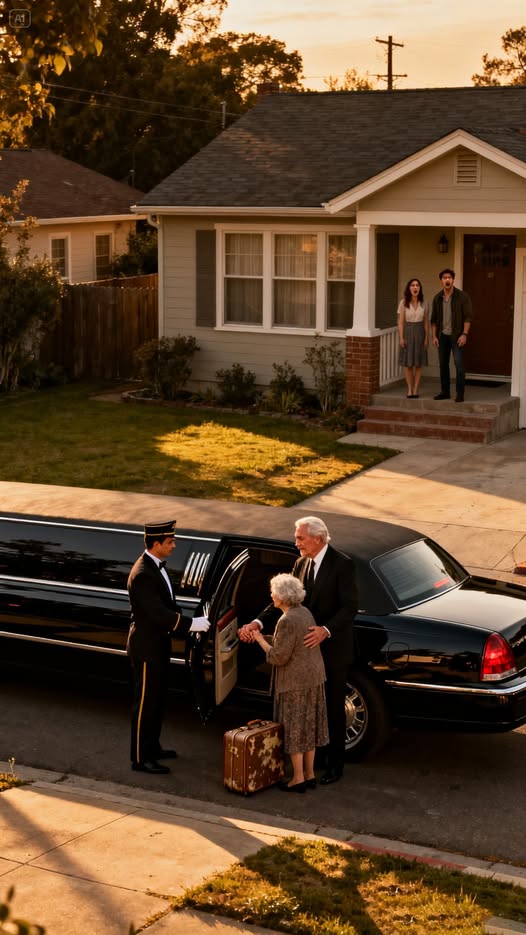
“If you don’t want to move into a nursing home, then pack your things and get out of my house.”
Those were the words my son, David, shouted, his face twisted into a mask of cruel impatience I barely recognized. He looked straight into my eyes, searching for fear, for pleading. I stayed silent, only managing a faint, sad smile.
I folded my clothes carefully, the fabric of my blouses soft under my calloused fingertips. I tucked away the old photographs—black and white memories of a life that felt like it belonged to someone else—and closed my suitcase with a decisive click.
An hour later, a sleek black limousine pulled up to the curb, its polished surface reflecting the gray afternoon sky. When my son opened the front door and saw who had come to pick me up, the smug smile vanished from his face. It was as if the ground had fallen out from under his feet.
That feeling—when you look at the child you once held, once nursed, once taught to walk, and realize you no longer recognize the stranger standing before you—that’s exactly what I felt when David threw me out. No, to be precise, out of my own house.
The house bought with money I saved over thirty-two years of pricking my fingers, sewing wedding dresses for other women’s happy endings. Every stitch carried my sweat. Every yard of lace paid for a brick in that house.
But on that Sunday afternoon in March, none of that mattered.
I was at the kitchen sink, washing the lunch dishes as I always did because, according to Emily, my daughter-in-law, I was “better in the kitchen.” The front of my floral dress was damp, my hands trembling slightly as I scrubbed a stubborn stain on a plate.
David walked in wearing that same frown he’d had since he was a boy getting scolded by his father. But my husband, Albert, had been gone for thirteen years. And the forty-two-year-old man standing before me was no longer that boy.
“Mom, we need to talk.”
I dried my hands on an embroidered towel given to me by an old friend, turned around, and offered a tired smile. “What is it, dear?”
Emily stepped in behind him. Red nails, sleek hair, dark lipstick that looked like a wound. She crossed her arms and leaned against the doorframe, like someone settling in for a show.
“We’ve decided,” David said, avoiding my eyes, focusing on a spot on the floor. “This house feels a bit cramped. The kids need more space, and you’re getting older. Maybe it’s time you found a place that fits you better.”
My heart thudded hard against my ribs. I knew what was coming. “A place that fits me better?” I repeated slowly. “You mean a nursing home?”
“Mom, there are some really nice ones nearby. They have friends, activities, nurses to take care of you.”
“A nursing home?” I cut him off. The words shot out like bullets. “You’re trying to send me to a nursing home?”
The silence in the kitchen grew heavy, suffocating. Emily pretended to scroll through her phone, her thumb flicking aggressively.
Finally, David looked at me. In his eyes, I saw something I’d never seen before. Coldness. Absolute, unfeeling ice.
“Not a nursing home, Mom. An upscale assisted living community.”
“The only difference,” I said evenly, my voice steady despite the earthquake inside me, “is that you’re trying to get rid of me.”
David shouted then, his patience snapping. “Then go! If you don’t want to move into a nursing home, pack your bags and leave my house!”
His yell echoed through the kitchen, bounced off the walls I had painted, through the hallway where I hung family pictures, and up the staircase I had cleaned every day for three years.
Emily tried to hide her smirk behind her hand, but I saw it.
That was the moment something inside me broke. Not my heart—that had shattered long ago. It was the final thread connecting me to the illusion that I still had a family.
I took a deep breath, looked at the son I no longer knew, and did the last thing he expected. I smiled.
“Alright, David. I’ll pack my things.”
His face shifted. Confusion mixed with fear. He had expected tears, begging, a scene. But there was only a chilling calm.
I walked upstairs to the small room at the back of the house where I slept—a space so tiny it looked like a storage closet. I took out my old leather suitcase, the same one I’d brought with me three years ago when I moved in after selling my apartment to “invest” in David’s business.
I folded my clothes neatly. Every blouse, every dress, every scarf I’d sewn myself. I took out a small wooden box filled with photographs. Albert and me on our wedding day. David as a baby. My mother in her garden.
I didn’t shed a single tear.
An hour later, I carried the suitcase downstairs. David sat on the couch I had bought. Emily beside him, wearing that triumphant expression.
When the doorbell rang, David got up with an annoyed sigh and opened the door. The look on his face is something I will never forget.
A sleek black limousine waited outside. The driver, impeccable in a suit, opened the back door. Out stepped a man in his seventies, silver hair neatly combed, dressed in a deep navy suit that screamed power and elegance.
It was Henry Montgomery. Albert’s former business partner, the owner of Montgomery Holdings, and the wealthiest man in the city. And he had come for me.
David froze, mouth agape. Emily turned pale.
Henry walked past them, heading straight toward me as if my son didn’t exist. “Catherine,” he said warmly, his eyes crinkling at the corners. “Are you ready?”
I picked up my suitcase and gave David one last look. “Thank you for everything, David. The house is all yours now.”
I stepped outside. The smile on his face vanished completely. Through the limousine’s rear window, I saw him standing motionless on the porch, small and insignificant, watching his mother leave in luxury.
For the first time in three years, I felt free.
Inside the car, the faint scent of genuine leather and expensive cologne filled the air. Henry sat beside me, keeping a respectful distance as the car glided down the avenue. I held tightly to the suitcase handle, my knuckles white.
“Catherine, are you alright?” Henry asked softly.
I wanted to say I was fine. To pretend I was in control. But what came out was a weary sigh that seemed to carry the weight of the last three years. “I don’t even know how I feel, Henry. It’s all too new.”
He nodded. We sat quietly, watching the city drift by—cars, billboards, pedestrians—the world moving on as if my life hadn’t just imploded.
When we reached his building, a luxurious glass tower downtown, I needed Henry’s arm to help me step out. The security guards bowed respectfully. He smiled back, while I felt invisible to them. Just an old woman in a simple dress.
The mirrored elevator reflected a sixty-eight-year-old woman with gray hair tied back neatly, eyes swollen from holding back tears.
“You still look beautiful, Catherine,” Henry said gently, as if reading my thoughts. “You always have.”
I wanted to laugh, to tell him he needed glasses, but the sincerity in his eyes silenced me.
His apartment was on the twenty-third floor—a penthouse overlooking the entire city. When the doors opened, I stopped in awe. Marble floors, high ceilings, sunlight flooding through floor-to-ceiling glass walls.
“Your room is upstairs,” Henry said, carrying my suitcase effortlessly. “You have your own bathroom, closet, and balcony. Make yourself at home. This is your house now.”
My house now.
Those words echoed in my head as I climbed the polished wooden stairs. The bedroom was a sanctuary—twice the size of the one I’d had at David’s. A king-size bed covered in crisp white sheets. Golden sunlight filtering through linen curtains.
I sat on the edge of the bed, and the tears finally came. Not from sadness, but from exhaustion. From the sheer relief of being safe.
I didn’t know how long I cried. When I looked up, the city was glowing under the night lights. My phone vibrated on the nightstand. David Calling.
I let it ring. Then again. I declined.
Notifications flooded in. 47 missed calls. 23 messages.
Mom, where are you?
Please answer.
Who was that man?
Can we talk?
Mom, I’m worried.
I laughed quietly into the empty room. Worried about me? After throwing me out like garbage? I turned off the phone.
A soft knock came at the door.
“Catherine, I made some tea,” Henry said, walking in with a silver tray. He sat by the window, pouring the amber liquid without a word. The scent of chamomile and melissa filled the room—my favorite blend.
“How did you know?” I asked.
“Albert told me,” he said gently. “He said you always drank it before bed.”
The mention of Albert made my heart ache. My husband. The man I loved more than life itself.
“Why did you come for me today, Henry? How did you even know?”
He paused, looking out at the city. “I didn’t know. Pure coincidence. I happened to drive by and saw your grandson playing in the yard. I thought of stopping to say hello, but something told me to come back later. When I saw you walking out with that suitcase… and the look on your son’s face… I understood everything.”
“He threw me out,” I said, my voice flat. “My own son.”
Henry set his cup down, fingers intertwined. “Catherine, I need to tell you something. But first, there’s something I’ve kept to myself for many years.”
My heart started racing. His eyes held both peace and a deep, ancient sorrow.
“I’ve always loved you,” he said quietly.
The silence that followed was so deep I could hear the hum of the city far below.
“From the day Albert introduced you as his fiancée. You were twenty-three, wearing that yellow dress with little flowers. Your smile lit up the whole room. I knew I had missed the one chance of my life.”
I stared at him, my mind blank.
“Albert was my best friend, and you loved him. So, I kept my feelings to myself. I turned them into respect, into friendship. I married Laura, had children, built my life. But Catherine…” He stopped, his voice catching. “You’ve always been the only one in my heart.”
Tears fell again. “Henry…”
He stood, stepped closer, then knelt before me—a seventy-three-year-old billionaire kneeling before a discarded mother.
“Today, when I saw you leaving that house with the grace of a queen, I knew I couldn’t lose you again. You don’t have to say anything. Just know that you’re not alone anymore. You’ll never be alone again.”
He kissed my forehead—a promise in the form of a touch—then quietly left the room.
The next morning, Henry knocked on my door. “Put on something nice,” he said with a mysterious smile. “We have an appointment.”
An hour later, we arrived at a sleek office building downtown. The sign on the door read Samson & Associates, Corporate Law.
His lawyer, Dr. Oliver Samson, shook my hand with unusual respect. “Mrs. Catherine, it’s an honor.”
Henry pulled out a chair for me. “Oliver, go ahead.”
The lawyer opened a blue folder and looked directly at me. “Mrs. Catherine, Mr. Montgomery has an offer for you. He wishes to grant you minority ownership shares in three of Montgomery Holdings’ projects. This would provide you with an estimated monthly income of about $100,000.”
I blinked. “I’m sorry. What did you say?”
Henry smiled. “You’ll never have to depend on anyone again. Not on me. Not on an ungrateful son. Not on anyone.”
At that moment, I understood. My life had changed completely.
David kept calling. 47 calls turned into 200. I never answered. But what David didn’t know was that the limousine wasn’t the biggest surprise. His real nightmare was only just beginning.
Two days later, Henry took me back to Dr. Samson’s office. This time, the atmosphere was different. Heavier.
“Trust me,” Henry said in the elevator.
Dr. Samson was waiting with a different blue folder. On it, written neatly, was a name: Albert Montgomery.
My heart stopped.
“Mrs. Catherine,” Oliver said. “Did you know that your late husband was a co-founder of Montgomery Holdings?”
“I did. Albert and Henry started it together.”
“And did you know that when he passed away, his shares were supposed to be divided among the legal heirs?”
“Yes. My son David told me everything belonged to him. The lawyers advised it because I didn’t understand business.”
Henry and Oliver exchanged a dark look.
“Mrs. Catherine,” Oliver said, pulling out a document. “Your son lied to you.”
The world stopped.
“Albert left a notarized will. 40% of the shares belong to you. 40% to David. 20% to charity. Here is the document, dated three months before he died.”
My hands trembled as I touched Albert’s signature.
“But David said I signed a power of attorney…”
“You signed for him to manage it,” Oliver corrected firmly. “Not to steal it. Those are two very different things. You are still the legal owner of 40%.”
“There’s more,” Henry said, his jaw tightening. “Two years ago, David sold all the company’s shares to an investment group. He forged your signature and kept all the money.”
“How much?” I whispered.
Oliver glanced at a paper. “Your share, with interest and valuation adjustments, is roughly $2,300,000.”
Two million dollars. While I was sleeping in a storage closet. While I was cleaning his floors. While he was throwing me out.
“I want to sue,” I said, my voice steady. “I want every cent back.”
Oliver smiled—a shark scenting blood. “The lawsuit is ready. Sign here.”
I signed three copies. Each stroke of the pen was a declaration of war.
Three weeks later. David had aged ten years.
I knew this because Henry had hired a private investigator. Strategy.
That Saturday, I turned my phone on. He picked up immediately.
“Mom! Thank God! We need to talk! This is a huge misunderstanding!”
“Grant’s Restaurant. Tonight, 8:00 PM. You and Emily. Don’t be late.”
I hung up.
I wore a black dress I had sewn years ago but never dared to wear. Heels. Red lipstick. When I walked into the restaurant, heads turned.
David and Emily were already seated in the corner, looking terrified. When they saw me—not the old maid, but me—their faces drained of color.
I sat down, crossing my legs. “A glass of red wine, please.”
“Mom,” David stammered. “About the lawsuit…”
“Oh, that?” I smiled. I pulled a brown envelope from my purse and slid it across the table. “Open it.”
David tore it open. Inside were copies of the forged documents, my falsified signature, and bank statements showing the transfer of $1.6 million into his account.
“Where did you get this?” he whispered.
“Your father was a careful man, David. He kept copies.” I lied. “I just never thought I’d have to use them against my own son.”
“We can explain,” Emily squeaked.
“Be quiet,” I snapped. “You have no right to speak to me. You stole my grandmother’s jewelry. You turned me into a maid. You planned to put me in a home to turn my room into a closet.”
Emily gasped. “How did you…?”
“Houses have ears, Emily. And you talk too loud.”
David buried his face in his hands. “Mom, I’m sorry.”
“You’re sorry because you got caught. Because you have to give it back.” I stood up. “Your lawyer will deal with mine. Return what is mine, or go to prison. One more thing, David. When I die, don’t come to my funeral.”
I walked out, leaving them in the wreckage of their greed.
But the story wasn’t over. Emily wasn’t done.
A week later, Henry came to my room with a look of disgust. “The investigator found something. About Emily.”
He opened an envelope. Photos of Emily entering a hotel with a man. A younger, muscular man. Ethan Carter, fitness trainer.
“She’s been seeing him for a year,” Henry said. “And here’s the kicker. Remember your mother’s jewelry? She sold it for $23,000 and put the money in a joint account with him. And those ‘girls’ trips’ to Cancun? Honeymoons with Ethan, paid for by David’s credit card.”
“Does David know?”
“He found out six months ago. She cried, he forgave her. He’s afraid of losing her.”
My son was a coward. But Emily was a criminal.
“Give everything to Oliver,” I said. “This changes the case. That’s fraud.”
Two days later, I went to David’s house. It felt like a tomb.
I confronted him in his office. “I know about Ethan. I know she sold Grandma’s jewelry. You’re a coward, David. She uses you, cheats on you, and you throw me out?”
David broke down sobbing. “I’m scared, Mom. Scared of being alone.”
“If you stay with her, you’ve already lost,” I said.
I walked out, passing Emily in the hall. “Hope you enjoyed Cancun, Emily. Your next trip will be to prison.”
Emily fought back dirty. She filed for a restraining order, claiming I threatened her life. She petitioned to block me from seeing my grandchildren, Peter and Alice, claiming I was “psychologically harmful.”
The judge granted it temporarily. No contact with the kids.
I broke down in Henry’s arms outside the courthouse. “She won,” I sobbed.
“She hasn’t won,” Henry whispered. “This is just a battle.”
That night, Henry handed me a folder. “David’s business is bankrupt. He owes over half a million dollars. I bought his debt. I can close him down tomorrow.”
“You did this for me?”
“Now you decide his future.”
I called Oliver. “I want a forensic accounting of David’s company. Find out where the money went.”
A week later, Oliver returned. “David isn’t a thief. He’s incompetent. $340,000 was siphoned out of the company in three years. Transfers to fake accounts. All leading to Emily and Ethan.”
And then, the investigator’s report on the kids. Photos of Peter waiting alone at school for hours. Alice crying with a sunburn. Neglect.
I had the arsenal.
“I’ll give him one chance,” I told Henry. “He divorces her, pays me back, and goes to therapy. Or I destroy them both.”
The meeting was at Oliver’s office. David looked like a corpse. Emily looked terrified.
Oliver projected the evidence on the wall. The theft. The affair. The neglect of the children.
“You bought a house with him? With my money?” David whispered, staring at the screen showing the apartment Emily bought with Ethan.
“And your children,” I said, showing the photos of Peter and Alice alone. “While you were stealing, they were suffering.”
David stood up. “Enough.”
He looked at Emily. “You destroyed this family. You stole my company. You betrayed me.”
He signed my agreement. “I’ll do it. Divorce. Therapy. Everything.”
Emily screamed as security dragged her out. David collapsed, sobbing.
I walked over and put a hand on his shoulder. “Now we start over.”
Six Months Later.
I sit on the balcony of Henry’s penthouse, sipping coffee. The September sun is warm.
Emily lost everything. The beach condo was auctioned. Ethan disappeared when the money ran out. She is doing community service.
David lives in a small apartment in Brooklyn. He works for a logistics company—just an employee, but he sleeps at night. We are rebuilding, slowly.
The doorbell rings. It’s Saturday.
“Grandma!” Alice runs into my arms, missing two front teeth. Peter follows, hugging me tight.
“We brought ingredients for cake!”
David stands at the door, looking healthier. “Good morning, Mom.”
Henry steps out of the kitchen with an apron on. “Ready to bake, my little chefs?”
The kitchen turns into a chaotic, happy mess of flour and chocolate. David whisks batter beside me.
“Thank you, Mom,” he says softly. “For not giving up on me.”
“I’m your mother,” I say. “I can be angry, but I never leave.”
Later, Henry and I sit on the balcony while David takes the kids to the park. Henry takes my hand.
“You did it, Catherine. You rebuilt everything.”
“We did it,” I say.
“What do we become after we break?” he asks.
I smile, looking at the city. “Diamonds. We become diamonds. We don’t break anymore. We only shine.”