Chapter 1: The Silence of Maple Lane
Mornings in Cedar Grove possess a particular quality of silence, a heavy, velvet stillness that seems to cling to the dew on the grass. Nowhere is this more profound than on Maple Lane, where I have resided for over fifty years. At seventy-eight, I have grown to appreciate, and perhaps rely upon, this quietude. It is a companion of sorts.
My house, a Victorian structure of peeling white paint and groaning floorboards, serves as a museum of a life fully lived. It holds every memory of my existence with Frank, my late husband. The oak bookshelf in the corner, currently groaning under the weight of his encyclopedias, was built by his own hands during our first winter here. The third step on the front porch still squeaks—a distinct, high-pitched complaint that Frank promised to fix every Sunday for twenty years. He never did. And then, on a rainy Tuesday eight years ago, his heart gave out, and the promise remained unkept. Now, that squeak is the only voice left to greet me when I return from the market.
Our children, Mason and Clara, were raised within these walls. The hallways once echoed with their laughter, their petty squabbles, and the thundering of running feet. But time acts as a cruel erosion. These days, Clara visits perhaps once a month, always checking her watch, her eyes darting to her phone, her body physically present but her spirit already halfway out the door. Mason stops by more frequently, but his visits are transactional. He comes for a signature on a document, a “temporary” loan, or a favor. He never sits. He never asks about the garden.
Only Liam, my grandson, comes without an agenda.
Liam is in his junior year of college now, a boy who grew into a man seemingly overnight. He is tall, with a kind-hearted clumsiness that reminds me so viscerally of Frank that it sometimes catches in my throat. He brings me stories of his professors, his confusing romantic entanglements, and, invariably, a voracious craving for my blueberry pie.
It was a Wednesday, the sky the color of bruised plums, when I heard his familiar, rhythmic gait on the porch steps. Thump, squeak, thump.
“Hi, Grandma,” Liam called out as he stepped inside, shaking raindrops from his jacket. The scent of cinnamon and baking pastry had already wrapped around him.
“It’s still warm,” I said, bypassing the pleasantries and placing a steaming plate on the kitchen island. “I made it just for you. I know the dining hall food is dreadful.”
He grinned, that lopsided smile that could forgive a thousand sins, and dug in. He was halfway through his second slice, the blue filling staining his lip, when he looked up innocently.
“So,” he began, fork poised in mid-air. “Have you decided what you’re going to wear on Friday?”
I paused, my hand frozen on the handle of the ceramic teapot. I turned slowly. “Friday? What happens on Friday?”
Liam looked at me, his brow furrowing in genuine confusion. “You know. Mom and Dad’s anniversary dinner. Thirty-five years. It’s a huge milestone.” He took another bite, oblivious to the chill that was rapidly spreading through my chest. “They booked a private room at Riverbend. The fancy room with the view of the water.”
Something cold and heavy, like a stone swallowed whole, washed over me. I tried to force a smile, but I felt the corners of my mouth trembling. “Your father… he didn’t mention anything to me.”
Liam blinked, the fork lowering slowly to the plate. “Oh. I just assumed… well, he told me he was coordinating the rides. I thought he was picking you up.”
I shook my head gently, turning back to the stove so he wouldn’t see the sudden moisture in my eyes. “No one said a word, Liam.”
The kitchen went silent, save for the ticking of the wall clock. Liam grew quiet, his appetite seemingly vanished. He sensed the fracture in the air, the jagged edge of a secret he wasn’t supposed to spill.
Later that afternoon, the telephone rang. The caller ID flashed Mason.
I stared at the device for a long moment, my heart hammering a frantic rhythm against my ribs. I took a deep breath, composing myself, answering with a smile in my voice that I did not feel. I wanted to believe there was a misunderstanding. I wanted to believe they hadn’t simply discarded me.
“Hey, Mom,” Mason said. His voice was too loud, too cheerful—a brittle veneer of enthusiasm. “How are things at the house?”
“Fine, Mason. Just fine,” I said. “To what do I owe the pleasure?”
“Just wanted to give you a heads up,” he said, the lie coming smooth and practiced. “We were thinking about doing something for the anniversary on Friday, but we’re canceling. Cora has come down with something nasty. The flu, maybe. Doctor says bed rest for at least a week.”
My grip on the receiver tightened until my knuckles turned white. “Oh no,” I said, my voice steady despite the turmoil within. “That’s terrible. Do you need anything? I have plenty of chicken stock. I can drop off some soup…”
“No, no,” he cut in quickly, a little too sharp. “We’re covered. We just want to keep the house quarantined. Just thought I’d let you know so you didn’t wonder why we weren’t doing anything.”
“I see,” I whispered. “Well, tell Cora I hope she recovers… miraculously.”
“Yeah, thanks, Mom. Talk soon.”
He hung up before I could respond.
I sat there in the fading light of the kitchen, the dial tone droning in my ear like a flatline. If the dinner was canceled, why hadn’t he told me sooner? Why did Liam think it was still on? And why did Mason sound like a man trying to convince himself as much as me?
Something was wrong. I wasn’t just forgotten; I was being handled. I was an obstacle they had actively maneuvered around.
That night, sleep was a stranger. I sat in my wingback armchair, the one facing the window, flipping through old photo albums. I traced the faces of my children when they were small, when they clung to my legs and cried when I left the room. I wondered, with a profound and aching sorrow, at what specific moment I stopped being the center of their world and started becoming a burden they merely managed.
Chapter 2: The Dress and the Deed
The next morning, the sun rose with a mocking brilliance. I dressed with mechanical precision and went to the market. I needed air. I needed to see faces that didn’t hide behind lies.
In the produce aisle, inspecting a crate of gala apples, I ran into Martha Jean. She was a longtime friend, a woman who wore her heart on her sleeve and possessed a laugh that could shatter glass. She also worked part-time at Petals & Vines, the floral shop frequented by Clara’s daughter-in-law.
“Eleanor!” she beamed, clutching a bundle of kale. “Big celebration tomorrow, huh?”
I froze, an apple in my hand. I turned to her, feigning ignorance. “Celebration?”
“Don’t play coy with me,” she winked. “Clara was in the shop yesterday. She told me she’s taking the evening off for the anniversary. Thirty-five years is a big deal, Eleanor. Not many make it that far these days.”
I stared at her, the world narrowing down to her brightly lipsticked mouth. “Oh,” I said, my voice sounding distant to my own ears. “I thought… I thought it was canceled. Mason said Cora was ill.”
Martha looked puzzled, her brow furrowing. “Canceled? No, honey. The order for the centerpieces is confirmed. Deliver to Riverbend, private banquet room B, 6:00 PM. White lilies and red roses. Expensive ones, too.”
The confirmation hit me like a physical blow. I thanked her, mumbled something about my memory failing me, and walked home. I didn’t feel the pavement beneath my shoes.
The dinner was still happening.
They had lied.
It wasn’t a white lie to spare my feelings. It was a calculated, strategic deception. They went out of their way to ensure I would not be there. Was I too old? Did I eat too slowly? Was I an embarrassment to their wealthy friends? Or was it simply that they wanted to celebrate their lives without the reminder of the past sitting at the head of the table?
I didn’t cry. Tears are for the confused, and I was no longer confused. I was clarified.
I walked into my house, the silence no longer comforting but suffocating. I stood in the center of the living room, looking at the crown molding Frank had installed, the fireplace we had gathered around for forty Christmases.
If they do not want me in their lives, I whispered to the empty room, then I need to see exactly why.
But I wouldn’t just go to the dinner. I would go prepared.
I spent the next four hours making phone calls. My voice did not shake. I called Mr. Henderson, our family attorney for three decades. I called the aggressive real estate agent who had been leaving flyers in my mailbox for years, begging to buy the “historic charm” of 42 Maple Lane.
“Yes,” I told the agent, cutting off his sales pitch. “I’m ready to sell. But it has to be done today. Cash offer. As is. I know you have buyers waiting.”
By 4:00 PM, a notary was at my kitchen table. Papers were signed. The deed was transferred. The heavy, final scratch of my pen across the paper sounded like a guillotine dropping.
When they left, the house felt different. It was no longer mine. I was a ghost haunting a structure I had already surrendered.
I went to the master bedroom closet and pulled out the dress. It was navy blue silk, simple, dignified, with a high collar and long sleeves. I hadn’t worn it since Frank’s funeral. I laid it on the bed, smoothing the fabric.
“Tomorrow,” I said aloud, my eyes hard in the vanity mirror. “Tomorrow, we see the truth.”
Chapter 3: The Uninvited Guest
Friday evening arrived cloaked in gray clouds, a drizzle of rain misting the windows. It was fitting.
At 5:00 PM, I called a taxicab. I did not ask Mason for a ride. I did not call Clara.
“Riverbend,” I told the driver, a young man with tired eyes.
The drive took twenty minutes. We wound along the river, the tires hissing on the wet asphalt. When we arrived, the restaurant stood like a fortress of brick and ivy, twinkling lights glowing warmly from within. It was a place of celebration, of joy—a place I was explicitly told to avoid.
“Wait here for me,” I told the driver, handing him a fifty-dollar bill. “Just in case.”
“You want me to keep the meter running, ma’am?”
“Yes. I don’t intend to stay long.”
I didn’t go through the front entrance immediately. I walked around the side, my heels clicking softly on the pavement, toward the guest parking lot. I needed to see the evidence with my own eyes.
And there they were.
Mason’s silver sedan, gleaming under the streetlamps. Clara’s beige SUV, parked crookedly. And Liam’s dusty old Honda, tucked in the back.
They were all here. No mistake. No flu. No cancellation.
I kept walking until I reached a set of ground-floor windows, partially obscured by heavy velvet curtains. Through a gap in the fabric, I peered inside.
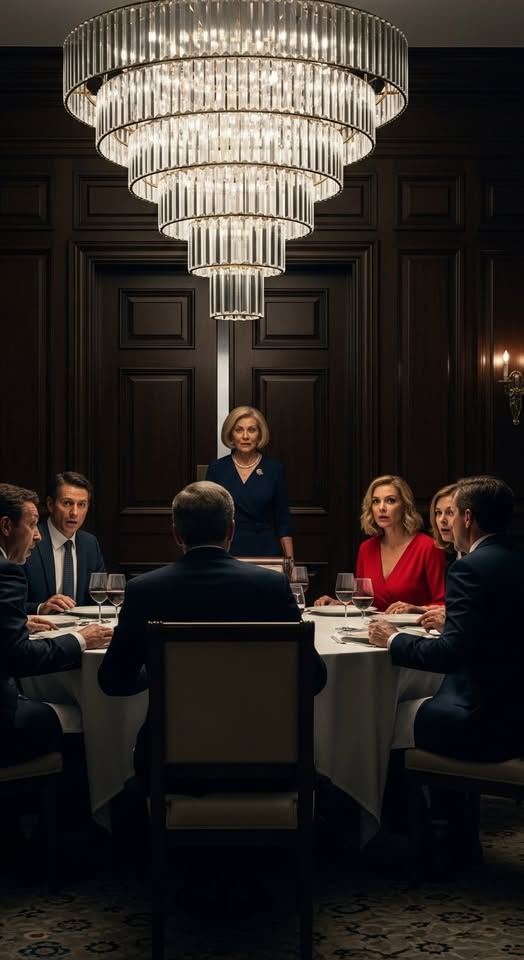
The room was bathed in golden light. A large round table dominated the center. I saw the crystal goblets sparkling. I saw the waiters pouring champagne. And I saw them.
Cora, beaming in a tight red dress, looking perfectly, radiantly healthy. She was throwing her head back, laughing at something Clara said. Mason stood at the head of the table, tapping a spoon against his glass, preparing for a toast. Even the grandchildren were there, scrolling on their phones.
They were a portrait of a happy, successful family. A family that had surgically removed its matriarch.
A knot tightened in my chest, threatening to cut off my breath. For a moment, I wanted to turn around, get back in the cab, and vanish. I wanted to spare myself the humiliation.
No, Frank’s voice seemed to whisper in my ear. Stand your ground, El.
I straightened my shoulders, smoothed the front of my navy dress, and walked around to the main entrance.
The heavy oak doors swung open. The maître d’, a tall man in a navy vest holding a leather-bound book, looked up.
“Good evening, ma’am. Do you have a reservation?”
“No,” I said, my voice crisp and clear. “But I believe the Hayes family is celebrating tonight in the private room. I’m Eleanor Hayes. Mason’s mother.”
The man blinked, scanning his list. “I… I don’t see an extra seat listed, Mrs. Hayes. But…” He looked at my face, saw the steel in my eyes, and his expression softened. “Of course. Please, come in. Let me guide you.”
Just then, a deep voice called out from the shadows of the coat check. “Eleanor?”
I turned to see him—Lewis Hartman. He was the owner of Riverbend, a man I had known since we were both children scraping our knees on the pavement of Cedar Grove. He looked older now, silver streaking his beard, but his eyes were as kind as ever.
“Lewis,” I nodded.
He walked over, his brow furrowed. He looked at the maître d’, then back at me. “Did they not invite you?” he asked, his voice low, lacking any pretense of politeness.
I met his gaze. “They lied to keep me away, Lewis. They told me the dinner was canceled.”
A long silence stretched between us. Lewis looked toward the banquet hall, his jaw tightening. “That,” he said, “is a damn shame.”
He offered his arm, a gesture of old-world chivalry that nearly undid my composure. “Well, Eleanor. Let’s not keep them waiting.”
I slipped my hand into the crook of his arm. It felt solid. Grounding.
“Are you ready?” he asked.
“I have never been more ready,” I replied.
Together, we walked down the corridor toward the double doors of the banquet hall, marching toward a truth none of them were prepared to face.
Chapter 4: The Truth on the Table
The moment Lewis pushed the double doors open, the sounds of the party spilled out—clinking glass, laughter, the murmur of conversation—only to be instantly strangled into silence.
A hush rippled through the room, starting from the door and spreading like a frost to the head of the table. Silverware paused mid-air.
Mason, who had just finished his toast and was raising his glass, choked. He actually choked, coughing into his hand, his face draining of color until he looked like a wax figure.
Cora’s smile froze, then shattered. Her eyes went wide, darting from me to Mason. Clara, who was sipping wine, set her glass down so hard the stem nearly snapped. Her hand trembled visibly.
Liam was the first to react. He stood up quickly, his chair scraping loudly against the parquet floor. “Grandma?”
I gave him a small, sad nod. “Hello, Liam.”
I turned my gaze to the rest of them. The silence was heavy, suffocating.
Mason pushed his chair back, stumbling slightly. “Mom! You… you’re here!” He forced a laugh that sounded more like a bark. “You said you weren’t feeling well!”
The audacity of the lie took my breath away for a split second.
“No, Mason,” I said, my voice projecting clearly across the room without shouting. “I did not say that. You told me the dinner was canceled. You told me Cora was sick with the flu. You said the doctor ordered bed rest.”
I turned my eyes to Cora. “But here you are. Looking quite radiant in red. A miraculous recovery.”
Cora stammered, flushing a deep crimson that matched her silk dress. “I… I felt better this morning. It was… a twenty-four-hour bug.”
“How convenient,” I replied.
The room went silent again. The waiters, sensing the tension, retreated into the shadows. Lewis pulled out the empty chair at the foot of the table—the space clearly not intended for anyone—and I sat down. I folded my hands in my lap, composed, terrified, and furious.
“I didn’t come to ruin your evening,” I said, looking at each of them in turn. “I came to see it for myself. I needed to be sure it wasn’t a mistake. That you hadn’t simply forgotten to pick me up. But no. You planned it this way. You coordinated the lies.”
Clara opened her mouth, tears welling in her eyes. “Mom, please. We just wanted one night where we didn’t have to worry about… about logistics.”
“Logistics?” I repeated the word. “Is that what I am? A logistical problem?”
“I’m speaking now,” I said, cutting off Mason’s protest. I reached into my purse and pulled out a white, legal-sized envelope. It was thick. Heavy. “I brought a few things with me. Housekeeping, you might say.”
Mason’s eyes darted to the envelope. He knew the shape of legal documents. Greed flickered in his eyes, warring with his fear.
“This,” I said, sliding the first document across the polished tablecloth, “is the confirmation of sale.”
“Sale?” Mason whispered. “Sale of what?”
“The house. 42 Maple Lane. The house you grew up in. The house you’ve been pestering me to sign over to you for the last five years so you could ‘manage my assets.’”
Clara gasped, her hand flying to her mouth. “You sold the house? Mom, you can’t! That’s… that’s our inheritance!”
“It was my home,” I corrected her. “I signed the closing papers at 4:00 PM today. It’s gone. A young couple with two small children bought it. They close in two weeks.”
Mason looked like he had been punched in the gut. “For how much?”
“Market value,” I said. “Nearly half a million dollars.”
“Well,” Mason said, trying to recover, licking his lips. “That’s… that’s a lot of liquidity. We can put that in a trust. We can invest it for your care.”
“And this,” I said, pulling out the second document, ignoring him, “is the wire transfer confirmation.”
I placed it gently on top of the sale deed.
“The proceeds from the sale have been donated, in their entirety, to the Cedar Grove Public Library.”
The silence that followed was absolute. You could have heard a pin drop on the carpet.
“What?” Mason croaked.
“They are naming the new children’s wing after your father, Frank Hayes,” I said softly. “He loved that library. He spent more time there than he did anywhere else. It seemed fitting.”
Someone across the table dropped a fork. It clattered loudly against a china plate.
“I’m not finished,” I said gently. I placed the final document down. “My revised will.”
I looked at Liam. He was standing there, pale, eyes wide, looking at me with pure devastation—not for the money, but for the pain in the room.
“What little remains—my personal savings, my jewelry, the contents of the house—goes to Liam. He is the only person at this table who ever visited me because he wanted to see me, not because he wanted something from me.”
Mason’s face turned a violent shade of purple. Cora stared down at the tablecloth, refusing to look up. Clara was openly weeping now, black mascara running down her cheeks.
I looked at them all, not with anger anymore, but with a terrifying clarity.
“You wanted a party without me,” I said. “And now you have one. But you also have the truth. You thought I was a burden to be managed. You forgot that I am a person. You taught me that love can fade when it’s not convenient.”
I stood up, smoothing my dress. My legs felt shaky, but I locked my knees.
“But I’ve learned something, too,” I said. “I’ve learned that love without dignity isn’t love at all. It’s dependence. And I am done depending on people who do not want me.”
“Grandma,” Liam said softly, stepping toward me. “I didn’t know. I swear I didn’t know they lied to you.”
“I know, sweetheart,” I replied, reaching out to cup his cheek. His tears were hot against my thumb. “This isn’t about you. You are a good man. Stay that way.”
Mason cleared his throat, standing up. He looked small. Defeated. “Mom, I think we should talk about this. Just not here. Please.”
“No,” I said. “You’ve done enough talking. I heard the lies. I saw the truth. I don’t need more words, Mason. I need respect. And since you couldn’t give it to me, I had to take it for myself.”
I turned to Lewis, who had been watching from the doorway, his arms crossed, a grim satisfaction on his face.
“Would you mind calling that cab again?” I asked.
“Already did,” he said, stepping forward with a hint of a smile. “It’s waiting right outside the main doors.”
“Thank you, Lewis.”
“Eleanor,” Clara sobbed. “Please don’t go like this.”
“I’m not leaving ‘like this,’ Clara,” I said, turning my back on the table. “I’m simply leaving.”
As I walked away, the silence behind me said more than their apologies ever could. For the first time in decades, I wasn’t chasing anyone’s approval. I wasn’t waiting by the phone. I had chosen myself.
And as I pushed through the doors into the cool, rainy night, I realized I was finally free.
Chapter 5: Spring
Three months have passed since that night at Riverbend.
The sky outside my new apartment glows with the gentle, hazy gold of spring. From my third-floor window, I have a clear view of the town square. If I squint, I can see the brick facade of the Cedar Grove Public Library, where construction crews are putting the finishing touches on the west wing.
My life is different now. Smaller. Simpler. But infinitely lighter.
My apartment is a cozy one-bedroom in a complex specifically for seniors. I brought only what mattered—Frank’s books, the photo albums, and the armchair. The rest I sold or gave away. I do not miss the squeaky step. I do not miss the empty echo of the hallways.
I volunteer at the library three mornings a week reading to the toddlers. Their laughter fills the spaces in my heart that I didn’t know were empty.
Mason calls now. At first, it was daily, frantic attempts to “fix” things, to talk about the will, to explain away the anniversary. I didn’t answer those calls. Now, he calls every few days, his voice softer, talking about the weather or his job. I listen. I am polite. But the bridge is burned, and while I may one day throw a rope across the chasm, I will never rebuild the structure that was there.
Clara came by once. She brought flowers—expensive lilies. She sat on my beige sofa and looked around the small apartment as if trying to understand how I had built a life without them. She cried again. I made her tea. I don’t shut them out completely, but I don’t let them in too easily, either. Trust is a currency, and they are bankrupt.
Lewis has become a constant. He stops by the library on Tuesdays with herbal tea and stories about the restaurant business. We’ve gone to the community theater twice. It is nothing more than companionship—two people who remember the same world—but for the first time in years, I have allowed someone new into my circle.
Today is a special day.
At three sharp, the buzzer rings. It’s Liam. He is holding a bouquet of wildflowers, stems wrapped in newspaper.
“You ready for your big moment, Grandma?” he grins, offering me his arm.
“It’s not a big moment, Liam. Just a ribbon and a plaque.”
“No,” he says, his face serious. “It’s more than that. It’s a legacy.”
When we arrive at the library, a crowd has gathered. The mayor is there. Lewis is standing near the front, wearing a suit. The air smells of fresh mulch and hope.
The ceremony begins. The mayor speaks of community and generosity. Then, the head librarian calls me to the podium.
I stand behind the microphone, looking out at the sea of faces. I see Liam beaming. I see Lewis nodding encouragement. I see Mason and Clara in the back, standing apart from the crowd, looking humble.
“Thank you all,” I begin, my voice strong. “This wing is named after my husband, Frank, who believed in the magic of stories. He believed that a book could save you when the world felt too small.”
I pause, looking at the brick building.
“My hope is that this place becomes a sanctuary. For children to learn, to wonder, to grow. Because I have learned, quite recently, that life isn’t measured by what you own, or the house you live in, or the expectations of others. It is measured by what you give. And more importantly, by what you refuse to compromise.”
The crowd applauds. Liam helps me hold the oversized scissors. The red ribbon falls. The cloth over the plaque is pulled back.
There it is, gleaming in the sunlight: The Frank Hayes Children’s Wing.
As the crowd disperses to tour the new rooms, Lewis appears beside me, holding two paper cups of lemonade.
“To beginnings,” he says, clinking his cup against mine.
I look at the name on the wall, then at Liam laughing with the librarian, and finally at the blue sky above.
“To choosing yourself,” I reply.
And that is exactly what I have done. I do not know if Mason and Clara will ever truly understand the depth of the wound they inflicted, but I am no longer waiting for their understanding. I am no longer waiting for anything.
Because this life… it is mine now. And I intend to live every last page of it on my own terms.