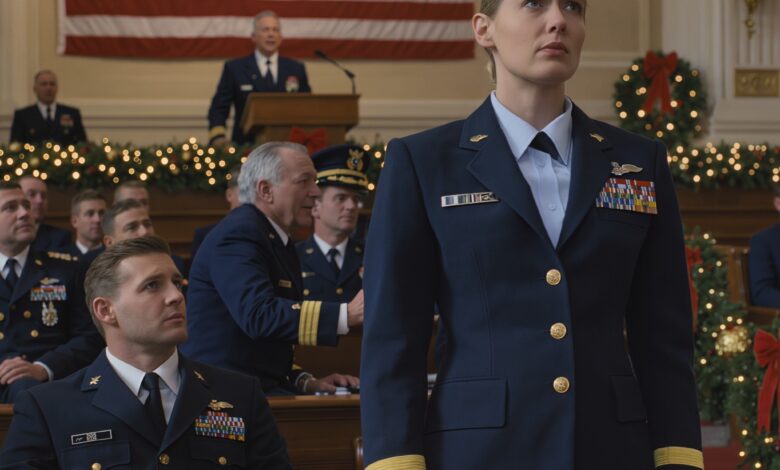
The Navy captain stepped into the auditorium without slowing, scanning the room like time itself was the enemy.
“I need a marksman with special clearance,” he said, voice flat and urgent. “Now.”
Two hundred officers froze in place. Air Force, Army, Navy, Marines. Every rank from senior enlisted to general officers. The kind of request that narrowed the room to almost no one.
I stood.
Before I could take a step, a laugh cut through the silence.
“Sit down,” my father said from the elevated seating. “You’re a nobody.”
The words landed hard. Public. Dismissive. Confident.
I didn’t sit.
I’m Major Cassandra Hartley. Thirty-three years old at the time. Air Force. And I’d spent my entire career making sure no one could ever accuse me of riding on my father’s rank. Especially him.
I grew up on military bases, moving every few years as my father climbed from colonel to general. Discipline was the air we breathed. Praise was rare. Expectations were constant. Achievements were “baseline.” Mistakes were lessons. Emotions were distractions.
He taught me how to stand, how to speak, how to read insignia and hierarchy. What he never taught me was how to feel seen.
When I chose the military, he assumed I’d take a visible, traditional path. Logistics. Admin. Intelligence analysis. Something respectable but quiet. Something that didn’t challenge his legacy.
Instead, I chose a route most people never hear about.
Reconnaissance. Precision long-gun work. Joint tasking. Programs that don’t show up in brochures or retirement speeches. Months of additional schools. Years of classified deployments. Evaluations written in language that never makes it into family conversations.
By the time I made captain, I was already working with units my father didn’t have clearance to ask about. I learned to calculate wind, elevation, and distance instinctively. I learned to stay calm when everything else went loud. I learned how to disappear into work that mattered without needing applause.
Somewhere along the way, I earned a call sign.
Ghost-Thirteen.
It wasn’t dramatic. No ceremony. A Navy SEAL watched me complete a mission in conditions most people wouldn’t believe and said, “You move like a ghost.” Thirteen was the number of critical operations I’d supported without compromise. The name stuck in the circles that mattered.
At home, it meant nothing.
To my father, I was still “my daughter.” Still doing “intel or something.” Still falling short of the version of success he recognized.
He missed my promotions. Skipped ceremonies. Dismissed my assignments. Once introduced me to another general as “Cassandra, she does support work.” I was in uniform. Wearing captain’s bars.
I kept trying anyway. Sending updates. Showing up. Hoping the next achievement would finally register.
It never did.
The briefing at MacDill was the breaking point.
Joint operations. High-level audience. Real work. When the Navy captain walked in asking for a marksman with compartmented clearance, I knew exactly why he was there. I knew I was qualified.
So I stood.
My father laughed.
“You’re a nobody.”
For a moment, the room didn’t breathe.
The Navy captain looked at me, then past me, then back again.
“Call sign?” he asked.
“Ghost-Thirteen,” I said, clear and steady.
The color drained from my father’s face.
He knew the name. Not the details—those were beyond his clearance—but the weight. The reputation. The kind of work associated with that call sign.
The Navy captain nodded once. “She’s with me.”
That was it.
No debate. No explanation. No appeal to rank.
I walked down the aisle and out of the auditorium, the silence behind me louder than any applause. I didn’t look back.
In the hallway, the captain slowed. “Your father?” he asked.
“Yes, sir.”
“He didn’t know.”
“No, sir.”
He studied me for a second. “Hell of a way to find out.”
Six hours later, I was wheels-up on a three-day operation that went exactly as planned. Clean. Precise. Effective. When it was over, my commander forwarded the after-action note with a single line.
Well done, Ghost.
My father didn’t speak to me for weeks.
When he did, it wasn’t an apology. It was confusion. Then anger. Then demands. He tried to go around me, calling my chain of command, asking questions he had no authority to ask.
The system didn’t bend.
My commander shut it down. Professional. Final.
For the first time in my life, my father couldn’t use rank to control the narrative.
That changed something.
I stopped calling weekly. Stopped reporting milestones. Stopped translating my worth into language he understood. I did my job. I let my record speak.
The consequences didn’t come all at once. They came quietly.
Peers began to question his judgment. Stories circulated. A general who didn’t even know his own daughter’s role. A public dismissal that backfired. Command climate issues. Early retirement whispers.
I didn’t celebrate. I didn’t intervene. I didn’t need to.
I promoted to major. Took on more responsibility. Built a reputation that had nothing to do with my last name. Operators requested me by call sign. Units trusted me without explanation.
That was enough.
Years later, after retirement, my father asked to meet. Not as a general. As a man who’d finally realized the cost of his certainty.
“I misjudged you,” he said. “I needed you to be less than me. I didn’t know how to handle the idea that you weren’t.”
I didn’t rush to forgive him. I didn’t soften it.
“You humiliated me,” I said. “Publicly. That doesn’t disappear because you understand it now.”
“I know,” he said. “I’m not asking for forgiveness. I’m asking for honesty.”
We rebuilt something smaller. Boundaried. Careful. Real.
Ten years after that briefing, I’m a lieutenant colonel commanding a joint reconnaissance unit. Forty-three personnel. Three specialties. A mission that matters. My call sign follows me like a shadow—less used now, but never forgotten.
My father speaks to cadets about leadership failures. About confusing authority with respect. About underestimating the quiet professionals in the room.
He tells the story without naming me.
That’s fine.
I don’t need my name attached to his lessons anymore.
The moment he called me a nobody didn’t break me. It freed me.
It forced the truth into the open. Forced me to stop shrinking. Forced him to confront a reality he’d avoided for decades.
Power isn’t rank. It isn’t volume. It isn’t humiliation dressed up as authority.
Power is clarity. Boundaries. Competence that doesn’t ask permission to exist.
That day, when I stood and gave my call sign, I wasn’t proving anything.
I was done asking to be seen.
And that made all the difference.