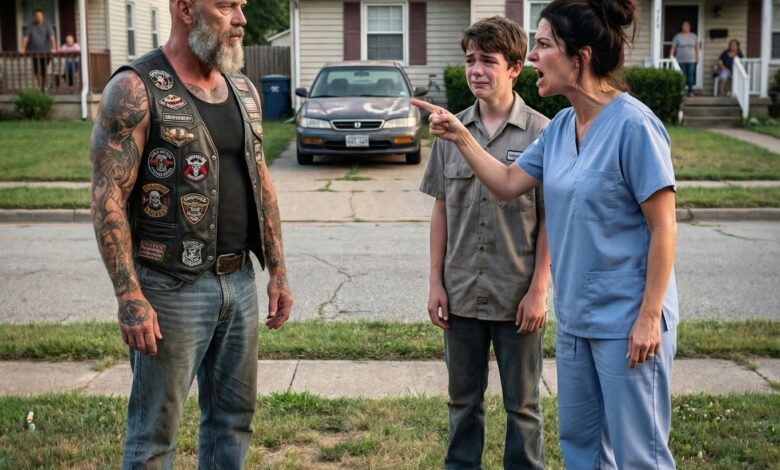
Michelle had spent eight months treating me like a problem she needed to solve. She was a nurse working brutal double shifts, a single mother drowning in responsibility, and in her eyes, I was the neighborhood threat—an aging biker with a loud Harley and too many tattoos living next door to her fourteen-year-old son. She didn’t know my name. Didn’t care to. She complained to the HOA, to the police, to anyone who would listen. She warned her son Tyler to stay away from me, told the neighbors I was dangerous, and made it clear she wanted me gone.
Funny thing is, the only reason her kid is alive right now is because he ignored every word she said.
My name’s Robert. Sixty-one. Retired Army. Divorced. Spent more nights talking myself out of a bottle and a bullet than I care to remember. I moved into this quiet, manicured neighborhood because I needed a place to start over. I didn’t expect much from the people here. They didn’t expect much from me either—mainly trouble.
Three months ago, I was in my garage working on my bike when I heard someone crying. Not loud. Not dramatic. Just a slow, defeated kind of sobbing that sounds like giving up. I followed the sound to the bushes between our houses and found Tyler sitting in the dirt, hugging his knees like he was trying to hold himself together.
“Hey, kid,” I said. “You alright?”
He looked up, eyes swollen, face blotchy. “Please don’t tell my mom.”
So I sat down—not too close—and said, “Alright. But if you’re out here crying in the bushes, something’s wrong. You want to talk?”
That was the start of it. He came to my garage after school almost every day. Sometimes he talked. Sometimes he just sat while I worked. Sometimes we didn’t say a word. It didn’t matter. I recognized that kind of silence. The kind that fills the space when someone is slipping into a place too dark to see their own way out.
It took weeks before the truth came out. Kids at school had been tormenting him for a year—shoving him, cornering him, stealing his things, blasting him online with messages telling him he should kill himself. Hundreds of them. Tyler kept it hidden because his mom was working herself to death and he didn’t want to add more weight to the pile she was already carrying.
“She’s tired all the time,” he told me. “She works so hard. I don’t want to make things worse.”
That line hit me harder than any punch I ever took in the service—this kid calling himself a burden while he was being destroyed piece by piece.
He showed me the messages one day. The things those kids wrote made my blood boil. But anger wasn’t going to help him. So I told him about my own darkness, the nights when PTSD crawled into my head and told me I’d be better off gone. The two times I almost listened. And about the men in my veteran biker club who refused to let me fall apart.
“Those voices lying to you?” I told him. “You don’t listen. You don’t ever listen. You matter. You hear me? You matter.”
From then on, he’d call me during the worst nights. Twice at three in the morning. Crying. Shaking. Telling me he couldn’t do it anymore. Both times, I stayed on the phone until he fell asleep. Until the demons in his head quieted down enough to let him breathe again.
I kept pushing him to tell his mom. He kept saying no.
“She sees the good kid who gets good grades. If she knew I was… like this… she’d be disappointed.”
Fourteen years old and convinced that the worst mistake he could make was being honest.
Then came the Tuesday everything blew apart.
Michelle came home early because of a scheduling mix-up. She caught Tyler walking out of my garage and watched him wave goodbye to me with a smile on his face—the first I’d seen from him in months.
She exploded.
By the time I stepped out front, she was already in full attack mode, screaming loud enough to rattle windows. “Stay away from my son! I told you never to talk to him! What are you doing with him?”
Tyler was begging her to stop. “Mom, no, it’s not like that!”
She didn’t hear a word. She was terrified and furious and lashing out at the nearest monster she could see—and in her mind, that was me.
Neighbors came outside. Phones came out. People recorded. Of course they did. Because it’s easier to believe a tattooed biker is a predator than to consider something more complicated.
She shoved her finger in my chest. “What could you possibly have to say to a fourteen-year-old boy? What are you doing with him?”
I kept my voice steady. My hands visible. “Ma’am, I haven’t touched your son. We talk, that’s it.”
“Talk about WHAT?” she screamed.
And that’s when Tyler cracked.
“He saved my life!” he yelled.
Everything stopped. Michelle froze mid-scream. The neighbors lowered their phones. Even the wind seemed to shut up.
Michelle whispered, “What did you say?”
Tyler’s hands shook as he pulled a folded piece of paper from his pocket. He held it out to her like it burned to touch.
“I wrote this two months ago,” he said quietly. “The night I was going to do it. And Robert is the only reason I didn’t.”
Michelle took the paper, opened it, and started reading. I saw her face drain, her knees buckle, her whole soul collapse. I recognized that expression—pure, raw devastation.
She read her fourteen-year-old son’s suicide note on the front lawn.
“I can’t do this anymore… the kids won’t stop… I’m just a burden… you’ll be better off without me…”
“No,” she whispered. “Tyler… no… baby, no…”
She crumpled into the grass, sobbing. Tyler panicked, dropped beside her, crying with her.
“Why didn’t you tell me?” she choked out.
“You work so hard,” he cried. “You’re always tired. I didn’t want to ruin everything.”
“Ruin everything?” she sobbed. “Losing you would’ve destroyed me. You’re my whole world. How could you think you were a burden?”
I turned to leave and give them space, but Michelle called my name.
“Robert.”
She walked toward me holding her son’s hand, tears streaming down her face. She wrapped her arms around me—a woman who had spent months trying to get rid of me—and cried into my chest.
“I’m so sorry. I judged you. I thought you were dangerous. And you were the only person paying attention to my baby. Thank you. Thank you for saving him.”
Over the next weeks, everything shifted.
Michelle cut her hours and took a better job. She and Tyler started therapy. The school finally stepped in. The bullies faced consequences. Tyler kept coming to my garage, but now with his mom’s blessing. Sometimes she even joined us, lemonade in hand, listening while we talked about life, bikes, or whatever was on his mind.
She admitted something one night: “I was scared of the wrong things. Scared of you because you looked rough. But the real danger—the one that was killing my son—I didn’t see at all.”
“None of us see everything,” I told her. “We just try to do better when we learn.”
Last week Tyler handed me a framed letter. His handwriting messy, the way a fourteen-year-old writes when his heart is full.
“Robert, you taught me broken doesn’t mean worthless. You taught me asking for help isn’t weak. Thank you for seeing me. Thank you for hearing me. Thank you for saving my life. I love you.”
I hung it right above my workbench.
I’m not his father. Never will be. But I’m something. A steady voice in the darkness. A worn-out biker who’s been through hell and lived long enough to help someone else climb out of it.
Michelle still apologizes sometimes. I always tell her the same thing:
“You weren’t wrong to protect your kid. You were wrong about who the danger was.”
And Tyler? He’s healing. Talking. Laughing again. Learning to work on bikes. Thinking about becoming a counselor someday so he can help other kids survive the dark the way he did.
He’s alive.
That’s the only thing that counts in the end.
Sometimes the people who look like monsters turn out to be the only ones paying attention.
Sometimes the biker next door is the reason a child lives to see another day.