The view from the forty-fifth floor was a lie. I stood before the floor-to-ceiling glass of the living room, watching the city of San Francisco glitter like a spilled jewelry box below me. It was beautiful, yes, but it was a cold beauty. This penthouse, with its Italian marble floors and the bespoke chandelier that looked like frozen rain, was supposed to be our sanctuary. Instead, it had become the gilded cage where I kept a pet who believed he was a king.
I was working late, as usual. The blue light of my laptop screen was the only warmth in the room until I heard the heavy oak door creak open. The scent hit me before he did—Le Labo Santal 33, a cologne that cost three hundred dollars a bottle. I knew the price intimately because I had seen the notification on my credit card statement just yesterday.
“Honey?” Mark’s voice was a low purr, the kind of tone a cat uses right before it knocks a glass off the table.
He came up behind me, his hands sliding onto my shoulders. His fingers dug into the knots of tension at the base of my neck. For a fleeting second, I leaned back, desperate for the touch to be genuine. I wanted to be the wife being comforted after a fourteen-hour shift at the firm, not the benefactor being prepped for a withdrawal. But then came the shift—the subtle tightening of his grip, the way his breath hitched just slightly. He wasn’t massaging me; he was priming the pump.
“The Investment Club is meeting tomorrow morning,” Mark whispered against my ear, his lips brushing the skin. “I need a little boost, Lena. Just to show them I’m serious. The guys are talking about a new crypto venture. You know I’ll double it for us by next month. This is the big one.”
I sighed, the sound loud in the cavernous silence of the room. I rubbed my temples, trying to push back the headache that had been throbbing there since noon. “Mark, we just put ten thousand into your wallet last week. You said that was for the ‘buy-in.’ Is this really necessary?”
He pulled away, the warmth vanishing instantly. He walked around the sofa, placing himself in my line of sight. He was handsome, undeniably so—with the kind of rugged jawline and practiced smile that opened doors. But lately, I had started to notice the faint lines of petulance around his mouth when he didn’t get his way immediately.
“It’s for our future, babe,” he said, spreading his hands in a gesture of open innocence. “Don’t you trust me? I’m doing this so you don’t have to work these crazy hours eventually. I’m trying to build our empire.”
Our empire. The words tasted like ash. The deed to this penthouse was in my name. The mortgage was paid from my salary as a Chief Financial Officer. The luxury car he drove, the clothes he wore, the vacations we took—ninety percent of it flowed from my bank account. Mark’s “consulting business” had been in the “startup phase” for five years. Yet, I nodded. I was tired. I was so incredibly tired of fighting about money, and part of me—the foolish, romantic part—still wanted to believe that he was trying to be the partner I needed.
“Okay,” I said, my voice hollow. I picked up my phone, the screen illuminating my face. “How much?”
“Five thousand,” he said quickly. “Just five.”
I hesitated. My thumb hovered over the banking app. A strange knot tightened in my stomach—an intuition, sharp and primal, warning me to stop. It was the same gut instinct that saved me from bad mergers, but here, in my own living room, I ignored it. I wanted peace more than I wanted the money.
“This is the last time this month, Mark,” I warned, though the threat lacked teeth.
“I promise, babe. You’re the best.” He was already checking his watch, his eyes darting to the door.
I tapped the screen. Transfer Successful.
Mark kissed my forehead—a dry, perfunctory peck—and grabbed his jacket. “I’m meeting the guys for a strategy session. Don’t wait up.”
As he walked away, whistling a tune I didn’t recognize, I stared at the “Transfer Successful” notification. I felt a wave of nausea. I didn’t know it yet, but that button press hadn’t just moved money. It had cost me my marriage, but it had just purchased my freedom.
Thirty minutes later, the silence of the penthouse was oppressive. I had moved to the kitchen to pour a glass of water, trying to wash down the lingering taste of resentment. My phone sat on the marble island, the screen dark. I realized I hadn’t given Mark the transaction reference number he usually asked for “for his records.”
I dialed his number. He answered on the second ring, but he didn’t say hello.
“Yeah, hold on, I think it’s her,” he said, his voice muffled, as if the phone was pressed against his chest.
“Mark?” I said.
Silence. Then, a rustling sound. He must have put the phone down on a table, thinking he had hung up. The connection was still open. The “End Call” button burned red on my screen, but I didn’t press it. I heard the unmistakable clatter of glassware and the thrum of bass-heavy music. He wasn’t at a strategy session. He was at a bar.
“Did she send it?” a male voice asked. I recognized it—Jason, his best friend, a man who smiled at me at dinner parties and drank my wine.
“Instantly,” Mark’s voice boomed, clear and raucous now. He must have been leaning over the table. “I told you, man. My wife is stupid. She’s a mobile ATM. I just need to flatter her a bit—call her ‘babe,’ talk about ‘our future,’ give her a little shoulder rub—and boom, money for the mistress is secured.”
The world stopped.
The air in the penthouse seemed to drop twenty degrees. I gripped the edge of the kitchen island so hard my knuckles turned white. I wasn’t breathing. I was listening.
“You’re a legend,” Jason laughed. “Doesn’t she suspect anything? You’re going to Cabo with Chloe next week, right?”
“She thinks I’m going to a crypto conference in Miami,” Mark scoffed, the sound dripping with arrogance. “She actually thinks I’m investing! She’s funding her own replacement, bro. Once the ‘business’ takes off—or once I squeeze enough out of her retirement accounts—I’m trading her in for a newer model. Chloe is twenty-four and doesn’t nag me about receipts.”
“To the Mobile ATM!” someone shouted. Glasses clinked.
I sat there, frozen. The woman reflected in the dark window opposite me wasn’t crying. She wasn’t screaming. She was unnaturally still. The humiliation should have crushed me. Hearing the man I loved call me stupid, realizing that every affectionate touch was a calculated transaction, knowing that I was literally paying for the woman he was sleeping with—it should have broken me.
But it didn’t. Instead, something inside me clicked shut. It was the sound of a vault door locking.
I looked at the phone. The timer read 04:12. I pressed the “Record” button on my other device, capturing the last minute of their conversation, archiving his confession, his mockery, his cruelty.
“Make sure you get her to pay for the upgrade to First Class,” Jason joked.
“Oh, she will,” Mark bragged. “She’s desperate for me to love her. It’s pathetic, really.”
I ended the call.
The silence that followed was different. It wasn’t empty anymore; it was heavy with potential. I walked to the master bedroom and looked at the bed we shared. I felt a wave of physical disgust so potent I nearly retched. I saw his clothes in the closet—suits I bought, watches I insured.
“Pathetic,” I whispered to the empty room, testing the word.
I walked to my desk and opened my laptop. I didn’t open my work email. Instead, I pulled up the deed to the penthouse, the registration for his car, and our joint savings account ledger. I looked at the numbers. They were vast, accumulated over fifteen years of my blood and sweat.
“Okay, Mark,” I said softly, my voice devoid of any tremor. “Let’s see how the ATM works when you smash the screen.”
The next morning, Mark “left for Miami.” He kissed me on the cheek, grabbed his suitcase—the Louis Vuitton one I bought him for Christmas—and smiled that practiced, boyish smile.
“I’ll miss you, babe. I’ll call you when I land,” he lied.
“Safe travels,” I said. I didn’t smile. I didn’t frown. I was a mirror, reflecting nothing.
The moment the elevator doors closed, the timer started. I had seven days. Seven days to dismantle a life.
I didn’t go to work. I called in and took my first week of personal leave in five years. Then, I went to war. My first call was not to a lawyer, but to Mr. Sterling, a real estate investor I knew from my network who specialized in high-end, rapid cash acquisitions.
“I want to sell the penthouse,” I told him over coffee at a small cafe three blocks away. “Fully furnished. As is. I need the deal closed and funds wired within five days.”
Sterling raised an eyebrow. “That will require a significant discount, Lena. You know the market.”
“I don’t care about the market,” I said, my voice steady. “I care about speed. Twenty percent under market value. Cash.”
He extended his hand. “Done.”
Next was the bank. I walked into the branch where we held our joint accounts. As the primary contributor, the legalities were simple, though the teller looked concerned as I filled out the withdrawal slip.
Account Balance: $500,000.
Transfer to: Lena Global Holdings (Singapore).
Amount: $499,950.
I left fifty dollars. Enough for a cab ride he wouldn’t be taking.
The days blurred into a montage of silent, lethal efficiency. I didn’t pack clothes. I didn’t pack mementos. I wanted nothing that had touched this life. I contacted a relocation specialist and secured a serviced apartment in Singapore—a city I had always loved for its strict laws, clean streets, and distance from Mark. It was the financial hub where I could restart, anonymous and untouchable.
Wednesday night, the movers came. But not for me. I hired a junk removal service. I watched as they hauled away the Italian leather sofa Mark loved to lounge on. I watched them take the sixty-inch television where he played video games while I worked. I had them strip the guest room where he likely chatted with Chloe.
By Friday afternoon, the penthouse was an echo chamber. The floors were bare. The closets were empty. The only thing remaining was the Eco-thermostat on the wall, which I set to ninety degrees, and a single folding chair in the center of the living room.
I stood in the lobby with two suitcases containing only my tailored suits and my laptop. My phone buzzed. It was a text from Mark.
Hey babe, hotel deposit was higher than expected. Miami prices are crazy! Can you send a little more? Love you.
I stared at the screen. The audacity was almost impressive. He was currently in Cabo, likely ordering champagne with my money, asking for a refill.
I smiled, a cold, sharp expression that frightened a passing neighbor. I popped the SIM card out of my phone and dropped it into the metal trash can by the concierge desk. I slid a new, international SIM into the device.
“Taxi,” I signaled to the doorman. “International Terminal, please.”
Mark returned on Sunday evening. The sun was setting, casting long, bruised shadows across the city. I wasn’t there to see it, but I can imagine the scene with cinematic clarity. I had rehearsed it in my mind a thousand times during my fourteen-hour flight.
He would be tanned, smelling of sunscreen and someone else’s perfume. He would be humming, perhaps a little hungover, dragging his suitcase toward the private elevator. He would feel invincible. He had just spent a week cheating on his wife on her dime, and he was coming home to a luxury apartment she paid for, ready to spin a tale about the “crypto conference.”
He stepped off the elevator on the forty-fifth floor. He reached for his key, the heavy brass one he kept on a keychain I gave him. He slid it into the lock.
It stopped halfway.
He frowned, jiggling it. He pulled it out, blew on it, and tried again. Nothing. The lock had been changed three days ago by the new owner’s locksmith.
“What the hell?” he muttered, banging on the door with his fist. “Lena! Open the door! The lock is jammed!”
He waited. Silence.
He banged again, harder this time. “Lena! Stop playing around!”
The door opened. But it wasn’t me.
Standing there was Mr. Henderson, the new owner—a large man with a thick neck and zero patience, wearing a bathrobe and holding a spatula.
“Can I help you?” Henderson asked, his voice gravelly.
Mark blinked, stepping back, confused. “Who are you? Where is my wife? This is my house!”
Henderson looked him up and down, taking in the Hawaiian shirt and the entitlement. “I don’t know who your wife is, buddy. But this isn’t your house. I bought this apartment on Wednesday. Closed on Friday. All the paperwork is filed.”
“Sold?” Mark’s voice cracked. “That’s impossible. She can’t… she’s…”
“She’s gone,” Henderson said, stepping forward to close the door. “And she left the place empty. I suggest you leave before I call security. They have a photo of you at the desk. ‘Do Not Admit,’ I believe the note said.”
The door slammed shut in his face. The sound echoed like a gunshot in the hallway.
Mark stood there, staring at the wood grain. The reality hadn’t hit him yet. It was too big, too sudden. He frantically dug for his phone, his fingers trembling. He dialed my number.
“The number you have dialed is no longer in service.”
Panic, cold and sharp, finally pierced his drunken haze. He opened his banking app. He needed to book a hotel. He needed a drink. He needed to fix this.
He logged in.
Access Denied. Account Closed.
He tried the joint credit card. Card Deactivated.
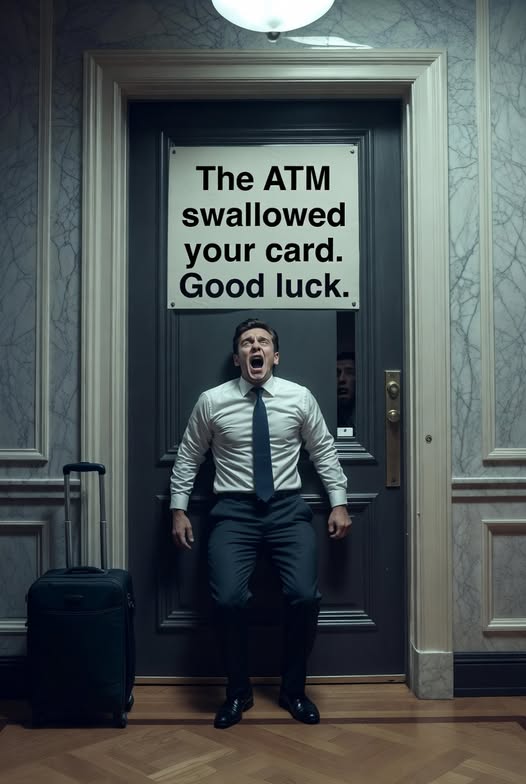
He slid down the wall, his expensive suitcase tipping over beside him. The hallway was silent, air-conditioned, and indifferent to his ruin. He was a king without a kingdom, a parasite whose host had just died.
I was standing on the balcony of my new apartment in Marina Bay when the notification came through on my secure line. I had set up a one-way text relay, a digital dead-end that allowed me to send one final message without revealing my location.
The humidity of Singapore wrapped around me like a warm blanket, a stark contrast to the sterile air conditioning of the penthouse. The city lights below danced on the water. I held a glass of Sauvignon Blanc, my hand perfectly steady.
I imagined Mark in the hallway. I imagined him calling Jason. I imagined him calling Chloe.
Cut to Mark:
He sat on his suitcase in the lobby, the security guards eyeing him with suspicion. He had just called Chloe, begging to come over, explaining there was a “banking error.”
“You have no money?” she had asked, her voice turning ice cold. “Mark, I’m not running a shelter. Don’t call me again.” Click.
His phone pinged. A message from a blocked number.
He stared at the screen, his eyes widening as he read the words. It wasn’t an apology. It wasn’t a plea for reconciliation. It was a receipt.
“The ATM has swallowed the card. Good luck.”
The realization hit him like a physical blow. She knew. She had heard everything. The “stupid” wife, the “mobile ATM,” the woman he thought he could manipulate with a shoulder rub—she had outplayed him. She hadn’t just left; she had erased him.
Back to Lena:
I deleted the relay app. I took a deep breath, inhaling the scent of rain and frangipani. The heavy weight that had sat on my chest for years—the pressure to provide, to please, to be enough for a man who saw me as an object—was gone.
I opened my banking app. The balance was intact. In fact, without Mark’s daily bleeding of funds, my projected savings for the year had already tripled.
I turned back to the living room. It was sparse, furnished with only a few pieces I had chosen myself in the last two days. It wasn’t a showpiece. It was a home.
But as I went to close the balcony door, a shadow of hesitation crossed my mind. I had won. I was safe. I was rich. But I looked at my reflection in the glass, and for a moment, I didn’t see a woman. I saw a mechanism. A device that had engaged a defense protocol.
“Can I ever trust again?” I whispered to the night. “Or have I become too good at being a machine?”
One Year Later
The boardroom was silent as I finished my presentation. The projected growth for Lena Global Holdings was projected on the screen behind me—a steep, upward trajectory.
“Excellent work, Lena,” the Chairman said, nodding. “Your risk assessment was flawless. As always.”
I smiled. “Thank you. Calculated risks are the only ones worth taking.”
I walked out of the high-rise office into the blinding tropical sun. Singapore bustled around me, a symphony of commerce and life. I was different now. My hair was shorter, sharper. My suits were bolder. I walked with the stride of a woman who owned the ground beneath her feet.
I hadn’t heard from Mark in six months. The last update I received from a mutual friend—before I cut them off too—was that he was living in a studio apartment in Oakland, working in sales, and trying to sue me for “financial abandonment.” The case had been thrown out of court in less than ten minutes. The judge had apparently found the “Mobile ATM” recording quite compelling.
I didn’t destroy him. I just stopped saving him. And that, it turned out, was the same thing.
I walked toward my favorite lunch spot, a small noodle stall that served the best laksa in the city. As I waited for the light to change, I saw a couple standing near the curb. The man was on his phone, his voice raised, yelling at someone on the other end.
“I told you, I need the money now! What do you mean you can’t transfer it? You’re my wife, you’re supposed to support me!”
I froze. The words were different, but the cadence was the same. The entitlement. The venom.
The woman standing next to him looked tired. She was rubbing her temples, her posture slumped in defeat. She looked like she was fading away, bit by bit.
I wanted to stop. I wanted to shake her and tell her to run. I wanted to hand her a burner phone and a plane ticket.
But I didn’t. I couldn’t save everyone. I watched as she sighed, pulled out her phone, and tapped the screen. Transfer.
The light changed. I stepped off the curb, moving forward.
“They say revenge is a dish best served cold,” I thought, adjusting my sunglasses. “I disagree. Revenge is simply removing your warmth from those who don’t deserve it.”
I crossed the street, leaving the shadow of the skyscrapers behind me. The cycle continued for others, perhaps. But for me? The machine was permanently out of service.
I walked into the sun, and for the first time in a long time, I didn’t feel like an ATM. I felt like a woman who finally knew the price of everything, and the value of herself.