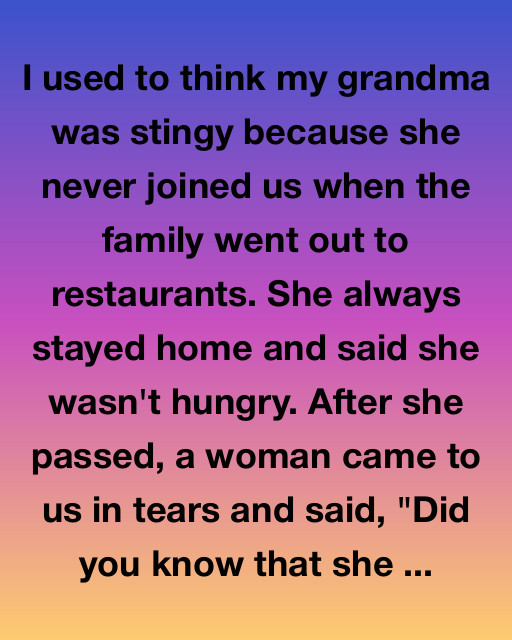
I used to think my grandmother was simply frugal — the kind of woman who would rather stay home in worn slippers than join us for dinner at a restaurant. She’d smile, wave us off, and insist she “wasn’t hungry,” settling back into her old cardigan like she preferred the company of silence over a crowded table. I rolled my eyes more times than I can count. I thought she didn’t like going out, didn’t want to spend the money, didn’t care about being part of the bustle of family life. I had no idea she was out there quietly propping up other people’s lives while we assumed she was just being her eccentric self.
After she died, the truth stepped right through the front door.
A woman none of us recognized stood on our porch clutching a crumpled photo and crying so hard she could barely speak. Her name was Janine. She lived three blocks away, in the cramped apartment complex behind the church. And the words she managed to get out knocked the breath out of us.
“Did you know she bought groceries for my kids every month for three years?”
We didn’t know. We knew nothing. The living room still smelled like Grandma’s lavender soap, and suddenly we realized how little we understood the life she lived outside our house.
Janine told us about the afternoon Grandma first stopped for her — how she found her sitting on the curb with a crying baby, a nearly empty grocery bag, and tears of her own tucked behind exhaustion. My grandmother didn’t pry. She didn’t ask what happened or why. She simply pressed a sealed envelope into her hand with a note inside that read, “Feed them. They deserve more.”
That was how it began. One envelope. One quiet act. It never stopped.
She slipped out of the house on “walks,” came back empty-handed, claimed she didn’t feel like eating out. Meanwhile, she was filling someone else’s pantry. Paying electric bills when the red notices arrived. Leaving Christmas presents in their mailbox like a secret guardian who refused credit.
And Janine wasn’t the only one.
The door opened again, and again, and again. A man in a wheelchair told us she visited him in the nursing home every week to play checkers and talk baseball. A teenager said she helped him fill out college applications and gifted him my grandfather’s old briefcase “for luck.” A grocery store clerk remembered her slipping him ten dollars after a long shift, telling him he was doing a good job. Every person who showed up carried a story folded neatly inside their hands.
When we sorted through her things, we found the notebooks — ordinary spiral pads with extraordinary entries. Pages filled with small notes: “Paid electric bill for J.” “Brought soup + bread.” “Lonely man on porch waved today — good sign.” There was a list titled, “People to pray for when I can’t sleep.” Our names were there. So were names we didn’t recognize. She prayed over strangers the same way she prayed over us.
I remembered snapping at her once, frustrated with the thin-soled shoes she refused to replace. “Let me buy you a new pair!” I’d insisted. She chuckled and tapped the worn toe.
“These shoes have more to walk.”
I thought it was stubbornness. Now I know it was purpose.
Bit by bit, we retraced her path. At the nursing home, there was a corner chair everyone called “Lourdes’ spot.” At the library, a girl remembered her Tuesday story times. At the grocery store, someone smiled when they saw us and said, “You must be her family. She made this place kinder.”
In the attic, we found a tin labeled “Rainy Day Fund.” Inside was $872 and a note: “For whoever needs it most. Trust your heart.” We argued about what to do — donate it, save it, use it for memorial flowers. Then Janine called. Her oldest son had been accepted to community college. He needed $870 for registration. The number matched so perfectly it felt like direction.
We handed her the money. She brought a homemade pie two days later with a note: “Thank you for finishing what she started.”
On the porch that evening — Grandma’s favorite spot — the quiet felt different. Not empty. Full. I realized I’d spent years missing what was right in front of me: a woman who believed in small, stubborn kindness more than anything else. A woman who didn’t need applause to measure her worth. A woman who built a life around noticing who needed help and stepping in before anyone asked.
I started a habit of my own. Instead of going out for brunch on Sundays, I’d pick someone to help — a sandwich for a man who looked like the morning had defeated him, bus fare for a woman stuck at a broken card reader, groceries for the single mother juggling too many bags. Nothing dramatic. Just the quiet kind of help Grandma specialized in.
Then my life spun. The company downsized. I packed the contents of my desk into a cardboard box and tried to pretend the knot in my throat wasn’t fear. I didn’t tell my family. Pride is a slick thing, easy to choke on. One morning, hunched over a job board in a café, a young woman approached.
“Are you Lourdes’ grandson?”
I braced myself, tired and raw, expecting another story I didn’t have room for.
Instead she smiled softly. “You have her eyes,” she said. She told me Grandma used to read to her at the library while her mother filled out forms. Then she handed me a plain sealed envelope.
“She told me kindness is a seed,” the woman said. “You plant it, and one day it grows back to you when you need it. She told me to wait for the right moment. I think this is it.”
Inside was a check for a thousand dollars.
I cried right there in the café. Ugly, grateful tears. That check paid my rent and bought me time. Two weeks later, I had a new job. I sent flowers to the woman with a note that said, “Your seed bloomed.”
Now I understand the life my grandmother lived. Some people build legacies with speeches and spotlights. Others do it with quiet steps and worn shoes. They slip groceries into hungry hands, write names in notebooks, and make the world bearable in ways that never make the news.
You might be thinking of someone like that in your own life — a quiet hero who kept your lights on once, or read to you when no one else had time, or made sure you didn’t drown without ever saying the word “help.” And maybe you’ve been that person for someone else, without expecting anything in return.
If so, consider this me, standing on my grandmother’s porch, telling you that it mattered.
You don’t need wealth to be generous. You don’t need a platform. You need eyes that notice and a heart that doesn’t look away. Buy the sandwich. Pay the fare. Leave the note. Wave to the lonely man on the porch.
It may feel like a pebble in your hand, but to someone else, it’s the bridge that gets them across.
My grandmother wasn’t stingy. She was rich in all the ways that count. And every time I step into a pair of shoes that “have more to walk,” I get to carry that wealth forward.
That’s more than enough for me.