Chapter 1: The First Drowning
Sometimes, love arrives like a gentle breath of destiny, stirring the air so softly you don’t even realize the wind has changed until you are already soaring. Other times, it leaves without warning, a violent gale that strips the world bare, leaving behind a silence so deafening it seems impossible to ever fill again.
This is the story of surviving the gale. It is a chronicle of a heart that believed it had found its “forever” at twenty, only to learn that “forever” is a promise time does not always keep. Among memories that ache like old fractures and promises interrupted by the screech of tires, a slow, delicate journey of reconstruction was born. A journey where the past never truly disappears, but the future insists, with stubborn grace, on seeking its own space.
My name is Aubrey. And the first time I drowned, it was in Oliver’s gaze.
I was only twenty years old. The world still possessed that golden, shimmering hue that only youth can perceive—as if every sunrise was a personal invitation and every sunset a promise kept.
We met in a bookstore, the kind with dusty floorboards that creaked like old bones and the scent of vanilla and aging paper hanging heavy in the air. He was looking for a gift for his mother, fingers trailing along the spines of biographies. I was absent-mindedly leafing through a leather-bound classic I knew I couldn’t afford and would probably never finish.
Our fingers collided as we both reached for the same copy of Great Expectations.
The contact was brief—a brush of skin against skin—but it sent a jolt of electric current up my arm that I wasn’t prepared to feel. I jerked my hand back.
“Sorry,” he murmured quickly, withdrawing his own hand. But he didn’t look sorry. A shy, crooked smile lingered on his lips, reaching eyes that were the color of warm amber.
I shook my head, feeling the heat rise in my cheeks. “It’s okay. You can have it. You grabbed it first.”
He hesitated, looking from the book to me, then back to the book. “How about we share the blame?” he offered, his voice dropping an octave. “And have a coffee?”
It was that simple. Like the wind changing direction, our lives intertwined.
We sat in the corner of a nearby café for three hours. Our conversations flowed like water finding its path downhill—effortless, inevitable. We talked like old friends who had merely lost touch for a few lifetimes. Oliver had hands that gestured enthusiastically when he spoke about his dreams of teaching history, of making the past come alive for bored teenagers. I, with my brown hair tied in a messy bun and my passion for ancient myths, felt perfectly, terrifyingly at home beside him.
In less than a year, we were married.
It was a small ceremony in a garden overgrown with wildflowers, fairy lights strung from the branches of ancient oaks like captured stars. Oliver’s mother, Margaret, cried silently during our vows, clutching a lace handkerchief. William, his father, remained steady, though his eyes shimmered with unshed tears.
Grace, Oliver’s younger sister, hugged me so hard I thought my ribs might crack. “Welcome, little sister,” she whispered into my ear, smelling of jasmine and champagne.
We rented an apartment that was too small for two people, let alone the dreams we were stuffing into it. The bills were always tight, a constant juggling act of priorities. But there was a reading nook by the bay window where the afternoon sun pooled like melted butter, creating the perfect setting for our Sunday afternoons.
Oliver got a job at a local high school. I worked part-time at an art gallery, surrounded by colors that couldn’t compare to the life we were building. Everything seemed to follow the script of those movies where happiness is simple, enduring, and invincible.
Then, three years later, Lily arrived.
Our little world expanded to contain the entire universe. She was a beautiful baby with rosy cheeks and curious eyes that, from day one, seemed to absorb everything around her with silent wonder. Oliver spent hours just looking at her, whispering stories about kings and queens and dragons, even when she was too young to understand anything but the tone of his voice.
“She will be an avid reader like you,” he would say, tracing the curve of Lily’s button nose with his fingertip.
“And stubborn like you,” I would reply, adjusting the knitted blanket around her.
We had plans. A bigger house with a yard for a dog. Maybe another baby. Trips to Italy during school vacations. The kind of common, beautiful dreams that seem so within reach when you are twenty-five and your heart is full of promises.
But destiny has a peculiar taste for abrupt interruptions.
On an ordinary Sunday morning, the sky a bruised purple before dawn, Oliver went out to buy fresh bread at the corner bakery. It was our ritual. He kissed Lily, who was still sleeping in her crib, a small bundle of warmth. Then he kissed me on the forehead.
“I’ll be right back,” he whispered. “Do you want anything special?”
“Only you,” I mumbled sleepily, pulling the duvet tighter.
I didn’t know those would be the last words I would ever say to him.
The accident was swift, according to witnesses. A distracted driver running a red light. A late breaking. The sickening crunch of metal on bone. The impact that forever altered the course of so many lives.
When the police knocked on my door an hour later, I was humming a lullaby to Lily, who had just woken up. I didn’t scream. I didn’t faint. I didn’t have any of the dramatic reactions one expects from a tragedy. I just stood there, the blood draining from my face, holding Lily against my chest as if the small weight of my child was the only anchor preventing me from floating away and disappearing into the ether.
The following days were a blur of faces, casseroles covered in foil, and words of comfort that fell flat against the bubble of silence surrounding me. Margaret held my hand during the funeral, a pillar of silent strength even as her own heart broke. William stood a few steps behind us, gray and shaken. Grace took on the burden of the practical details—the paperwork, the flowers, the coffin—that I couldn’t bear to face.
But the nights were the worst.
When Lily finally fell asleep, and the house was engulfed in that heavy, suffocating silence that only absence can create, I would sit at the edge of the bed. It felt too large now. A vast, empty continent. I could still catch a faint trace of Oliver’s cologne—cedarwood and rain—on his pillow.
And I allowed the tears to come. Silent, deep, tectonic sobs that seemed to tear pieces from my soul.
Chapter 2: The Scar of Longing
The months turned into years, marked not by grand milestones but by the small, persistent routines that kept life moving forward.
Preparing oatmeal for Lily. Braiding her unruly hair. Reading bedtime stories until my voice grew hoarse. Calling Margaret on Sundays. Visiting William and Grace on holidays. I returned to work full-time at the gallery, finding solace in the abstract shapes and vibrant colors that demanded nothing from me but observation.
Lily grew up under my watchful eye and the constant, protective love of her paternal family. She was a girl with easy laughter and complex questions, carrying the same intense curiosity in her amber eyes that Oliver had possessed.
At six years old, she was already creating elaborate stories about dragons and warrior princesses, dictating them to me while I patiently transcribed them into small, spiral-bound notebooks.
“Mama, would Dad like my stories?” she asked one night, her voice small in the darkness of her room.
I tucked the blanket under her chin, my throat tightening. “He would love them, my dear. Your father loved stories more than anything in the world.”
“More than he loved us?”
I smiled, a sad, reflex action. “No. That was impossible. We were his favorite story.”
As Lily grew, the weight of the absence shifted. It didn’t get lighter, exactly, but it distributed differently. The sharp, jagged pain of the early years gave way to a duller, more bearable longing. It was like an old scar that aches when the rain comes—a reminder of the wound, but no longer bleeding at the touch.
I clung to the memory of Oliver like a precious artifact in a museum. I curated his life for Lily, keeping alive the stories, the habits, the small traditions. Margaret, William, and Grace remained steadfast pillars. On Sundays, we gathered for lunches where stories about Oliver flowed naturally, laughter mixing with the clinking of silverware. Lily absorbed these tales like a sponge, constructing a mosaic of a father she knew only through the eyes of others.
It was Helen, my childhood friend, who first dared to suggest that perhaps it was time to look forward.
“I’m not saying to forget, Al,” she explained one rainy Tuesday, nursing a mug of coffee in my kitchen. “I’m saying that you’re only thirty-two. Life goes on. And I’m sure Oliver would want to see you happy.”
I shook my head, vigorously wiping a counter that was already clean. “I’m happy with Lily. We’re fine just like this.”
“I know you are. But what if you could be… more?”
The seed of that thought was planted, burrowing deep into the soil of my mind against my will. In the following nights, I found myself looking at the empty space beside me. I imagined what it would be like to feel the warmth of another body again. To hear a gentle breath in the dark. To wake up to a smile meant just for me.
Then, the guilt would crash over me like a rogue wave. How could I want that? It felt like betrayal. Treason against the memory of the only man I had ever loved.
But Helen was persistent. A month later, she came with a concrete proposal.
“I know someone,” she said, cutting straight to the chase. “He’s a good man, Al. Kind, intelligent, stable. He works at the publishing house with me as a proofreader. He loves literature as much as you do.”
“Helen, I don’t know…”
“Just a dinner. A casual meeting. No commitment. No expectations. Just… coffee and conversation.”
I hesitated. My heart raced, a hummingbird trapped in my ribcage. Not from fear, but from the terrifying possibility of hope.
“I’ll think about it.”
That night, during my weekly call with Grace, I casually mentioned Helen’s suggestion. To my surprise, my sister-in-law practically shouted with enthusiasm.
“You should go, Aubrey! It would be wonderful to see you taking this step.”
“I’m not sure if I’m ready, Grace. And there’s Lily…”
“Lily is eight years old now. She would understand. Besides,” Grace paused, her voice softening into a whisper, “Oliver would have wanted this for you. He always said the most special thing about you was your ability to love. It would be a shame to let that lie dormant forever.”
Grace’s words resonated within me for days.
When I finally agreed to the date, I felt like a teenager again. Nervous. Insecure. Awkward. I stood in front of my mirror for an hour, smoothing down a simple blue dress that Grace had given me last Christmas. I tied my hair into a loose bun—just like the old days—and applied a light coat of lipstick.
“You look beautiful, Mommy,” Lily commented from the doorway, holding her favorite stuffed dragon.
“Thank you, my love.” I turned to her, anxiety fluttering in my stomach. “Remember the rules while I’m away, okay? Aunt Helen is going to stay with you. Brush your teeth.”
“And go to bed on time,” Lily finished, rolling her eyes with a smile that was all Oliver. “Go have fun, Mom. You deserve it.”
Those simple words, coming from my eight-year-old daughter, felt like absolution.
Chapter 3: The Ghost at the Table
The restaurant was cozy and discreet, bathed in soft amber light. Tables were spaced far enough apart for private conversations, the air humming with low jazz.
Daniel was already there when I arrived. He stood up promptly to greet me—a gentleman. He was tall, with broad shoulders and dark hair greying at the temples. He had a gentle smile that crinkled the corners of his eyes.
“Aubrey,” he said, extending a hand. “It’s a pleasure to meet you. Helen talks a lot about you.”
“I hope good things,” I replied, my voice shaking slightly as I took his hand. His grip was warm, solid.
The first few minutes were filled with the awkward, polite formality of two strangers trying to find common ground. Questions about work. Comments about the unseasonably warm weather. Small remarks about the wine list.
Daniel was polite, attentive. He listened with genuine interest, maintaining a steady flow of conversation. He was everything Helen had promised: intelligent, kind, stable.
But as dinner progressed, I realized something horrifying.
I was responding to every single one of his questions with a story about Oliver.
When Daniel asked about my work at the gallery, I launched into how Oliver had encouraged me to apply, how he had framed my acceptance letter. When the conversation turned to books, I couldn’t help but recall the evenings Oliver and I read aloud to each other, doing silly voices for the characters. When we spoke of Lily, every anecdote was intertwined with the shadow of the father she barely knew.
I saw the subtle change in Daniel’s posture. The slight withdrawal. The way his smile became fixed, polite but strained. The way his eyes began to drift to his watch.
The realization hit me like a bucket of ice water. I was ruining it. I was bringing a ghost to a first date.
“Sorry,” I murmured after an awkward pause, putting down my fork. “I guess I’m not good at this.”
Daniel offered an understanding smile, but it didn’t reach his eyes. “It’s okay, Aubrey. It really is.”
But it wasn’t. The discomfort grew between us, a third, invisible presence sitting at the table, eating all the air.
Finally, after a particularly painful attempt to discuss current events, Daniel placed his napkin on the table. He looked at me with a mixture of pity and resignation.
“Aubrey,” he said gently. “I think I need to be honest with you. You seem to be a wonderful person. Truly. But I don’t think you’re ready for this yet.”
My stomach dropped. “Daniel, I’m sorry. I—”
“Don’t apologize,” he interrupted softly. “Sometimes, the right time just hasn’t come yet. You’re still… occupied.”
He stood up. “Thank you for your company. I sincerely hope you find peace.”
Before I could respond, he placed cash on the table and walked away.
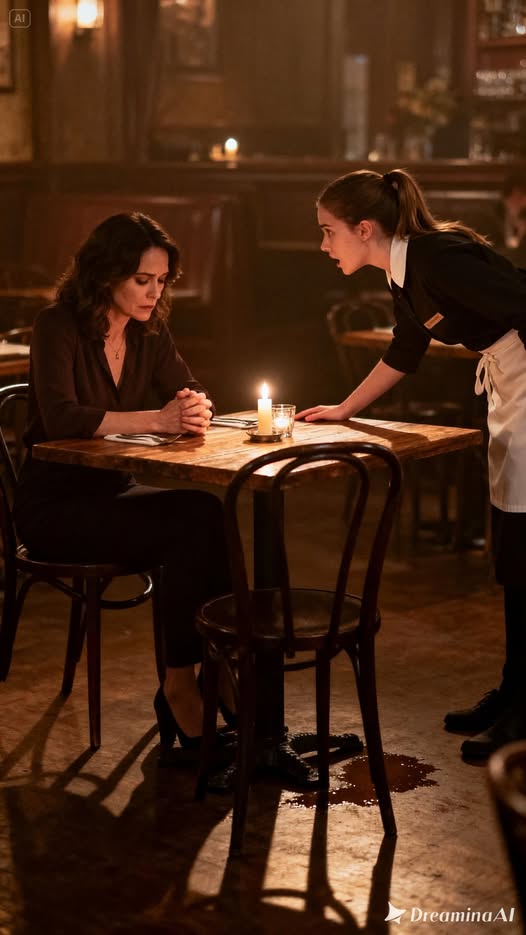
I sat there, alone in the candlelight, feeling the crushing weight of failure. I looked at my half-eaten pasta, the nearly full glass of wine. There was something deeply humiliating about being left in the middle of a date. It felt like a diagnosis: Terminally Broken.
Tears began to well up, hot and stinging. I signaled to the waitress, desperate to escape.
“The check, please,” I requested, my voice thick.
The young waitress leaned in discreetly, her eyes kind. “Don’t leave yet, ma’am. Someone has come for you.”
I froze. Panic spiked in my chest. Had something happened to Lily? Was Helen hurt?
I turned slowly toward the entrance.
Standing there, in a wool coat and clutching her purse, was Margaret.
My mother-in-law.
She spotted me and walked over, her expression a mix of determination and gentleness.
“Margaret?” I stammered, standing up. “What are you doing here? Is Lily okay?”
“Lily is fine,” Margaret said calmly. “Grace called me. Daniel called her after he left. He was worried about you. I thought maybe… maybe we needed to talk.”
I felt my face burn with shame. “He called Grace? He told her I was a disaster?”
Margaret smiled, a sad, knowing expression. She took my hand. “Let’s take a walk, dear.”
Chapter 4: The Heart’s Capacity
We walked to a small park nearby, the gravel crunching under our boots. The night was clear, an almost full moon bathing the benches in silver light.
We sat down. For a long time, we just watched the stars.
“You know,” Margaret began, her voice soft against the chirping of crickets, “when I lost my first husband, I thought I would never be able to move on.”
I turned to her, stunned. “I didn’t know you were married before William.”
“Robert,” she said, the name sounding like a prayer. “He was a firefighter. He died trying to save a child in an apartment fire. A hero, everyone said. But to me… he was just the man who left an empty space on my side of the bed.”
Tears pricked my eyes again. “You never told me.”
“Because I didn’t want you to think that I claimed to understand your specific pain. No one truly understands another person’s loss, Aubrey. It is a fingerprint. Unique.”
She turned to face me, taking both my hands in hers. Her skin was paper-thin but warm.
“I met William two years later. At first, I felt sick with guilt. Every time I smiled at his jokes, I felt like I was cheating on Robert. Every time he held my hand, I felt like a traitor.”
“That’s exactly how I feel,” I whispered, the confession tumbling out.
“What I discovered,” Margaret said firmly, “is that the heart doesn’t work like a room with limited occupancy. We don’t have to evict one love to make space for another. The love for Robert never diminished. It just… transformed. It became a cherished memory, a foundational stone. And that foundation was strong enough to build a new house upon.”
I let the tears flow freely now, weeping for the first time in years not out of grief, but out of confusion and hope.
“I don’t know if I can do it, Margaret.”
“I’m not saying it has to be now. Or with this Daniel. Or anyone specific. I’m saying it is okay to allow life to move on. Oliver wouldn’t want to see you stuck in the amber of your grief.”
“I’m afraid,” I admitted, my voice trembling. “Afraid of forgetting what his laughter sounded like. His scent. The way he looked at me.”
Margaret squeezed my hands tight. “You will never forget, dear. Those things are woven into your DNA now. But you can add new memories. New joys. Lily deserves to see her mother happy. And you… you deserve more than just to survive.”
There, under the starry sky, something released inside me. A knot that had been pulled tight for eight years finally began to loosen. It wasn’t immediate healing. But it was permission.
Chapter 5: A New Season
In the weeks that followed, I began to make small changes.
I went into the closet and finally took out the boxes of Oliver’s belongings I had been hoarding. I didn’t throw them away. Instead, I organized them. I made a memory album for Lily—photos, ticket stubs, letters. I created a small, dignified space on the living room shelf for his photos. An altar of memory that honored the past without dominating the present.
It was a way of saying: He was here. He was loved. But life continues.
Helen continued to encourage me. I started accepting invitations. Dinners. Art exhibitions. School events. Gradually, the world started to expand again.
It was at an art exhibition six months later that I met Noah.
He wasn’t a setup. He was just a dad.
He was standing in front of a chaotic abstract painting, looking perplexed, while two little girls ran circles around him. One was his daughter, Emma. The other was Lily.
“They’ve been friends for months,” he said, extending a hand as I approached to collect my daughter. He had gentle eyes and laugh lines etched deep around his mouth. “I don’t think we’ve formally met. Noah Carter.”
“Aubrey Miller,” I said. “Lily talks a lot about Emma. I think she’s found a literary soulmate.”
“And Emma won’t stop talking about Lily’s dragon stories.”
Noah was a widower. Four years. We didn’t bond over trauma immediately; we bonded over parenting pre-teens and the baffling nature of modern art.
Our relationship grew in the spaces between school drop-offs and birthday parties. He didn’t try to take up space; he simply stood beside me. When I talked about Oliver, he listened without flinching. When he talked about his late wife, Sarah, I didn’t feel jealous.
There was something deeply comforting about being with someone who understood that the past wasn’t a competitor. It was just… history.
A year later, during a picnic in the park, Noah turned to me while the girls were chasing a frisbee.
“I don’t know if it’s too soon, or too late,” he said, looking nervous. “But I’d like to ask you out. Just the two of us. Dinner. No kids.”
My heart raced. But this time, it wasn’t the frantic panic of the past. It was the steady thrum of possibility.
“I think I would like that,” I said.
When I told Margaret, she smiled with the wisdom of a woman who had walked this path before.
“He seems like a good man, Aubrey. He respects the place Oliver has.”
“He does.”
“Then accept this blessing. The past is safe. Take care of the present.”
Chapter 6: Coexistence
The relationship with Noah blossomed slowly, with the care of a garden planted after a long winter.
He never tried to be Oliver. He was Noah. He cooked terrible lasagna but told excellent jokes. He was patient when I had bad days, days when the grief would sneak up on me.
Two years after that first picnic, Noah proposed.
It wasn’t a grand gesture on a jumbotron. It was in my kitchen, while we were chopping vegetables for dinner. Lily and Emma were arguing about homework in the living room. The house was noisy, messy, and alive.
“I don’t want to replace what you had,” he said, putting down the knife and taking my hands. His palms were rough and warm. “I just want to build something new by your side. If you’ll let me.”
“Yes,” I said. “Yes.”
The wedding was small. Lily, now eleven, carried the rings with solemn pride. Margaret, William, and Grace sat in the front row, their eyes shining. They didn’t look like they were losing a daughter-in-law. They looked like they were gaining a son.
That night, after the girls were asleep, I sat on the edge of the bed I now shared with Noah.
I looked at the photo of Oliver on my bedside table. Next to it sat a new frame—a photo of me, Noah, Lily, and Emma, laughing on a beach, windblown and happy.
There was no contradiction. No betrayal. Just the extraordinary capacity of the human heart to expand.
Noah entered the room silently. He sat beside me. He didn’t ask what I was looking at. He just took my hand.
“Thank you,” I whispered.
“For what?”
“For understanding that some loves never end. And for showing me that doesn’t prevent new ones from beginning.”
Noah kissed my forehead. “The heart is the only place where the past and present can coexist in peace, Aubrey. Yours is big enough for all of us.”
At that moment, I finally understood. True love never competes. It simply learns to harmonize.
Sometimes love leaves a silence that seems impossible to fill. But if you listen closely, eventually, the music starts again. Different, perhaps. But just as beautiful.