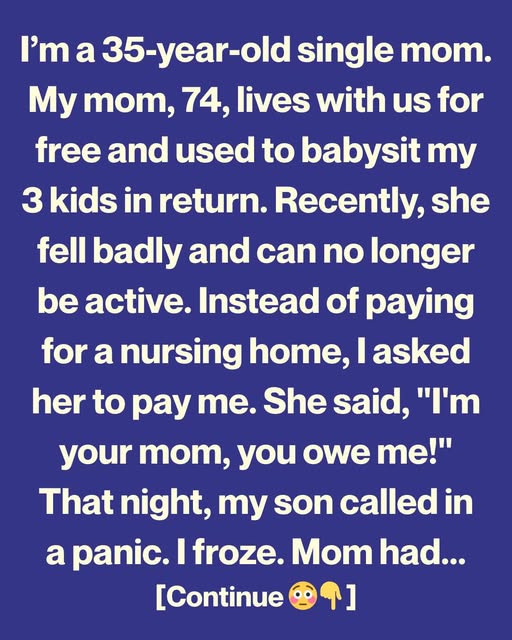
My name is Nancy. I’m thirty-five, raising three kids on my own — a seven-year-old, a three-year-old, and a baby who still wakes twice a night. Life has been a storm for as long as I can remember, but I kept moving through it the way mothers do: one bill, one meal, one crisis at a time. My mother, seventy-four and stubborn as ever, lived with us. She helped with the kids, and in return she stayed here without paying rent. It wasn’t perfect, but it was our uneasy little ecosystem, held together by routines, exhaustion, and the kind of love you don’t talk about because you’re too busy surviving.
Then she fell.
A simple slip in the kitchen — just water on tile — but the consequences were anything but simple. Pain tore through her back and hip, leaving her unable to move without wincing. Overnight, I became the caretaker of four: three children and a mother who needed help getting out of bed. I wanted to be everything for everyone, but the truth was brutal. I was drowning.
The house shifted into a triage unit. Feed the baby. Help my mother to the bathroom. Break up a tantrum. Answer emails from work. Hold my mother upright long enough for her to eat. Fold laundry while rocking the baby with my foot. Wipe tear-streaked faces — sometimes theirs, sometimes mine. My energy — that fragile thread I’d been living on — frayed faster than I could tie it back together.
I suggested a nursing home gently, not as rejection but relief. She refused instantly.
“I’m not being dumped somewhere to die,” she snapped.
So I tried compromise. “Mom, could you help financially? Just enough so I can hire someone part-time? I can’t do this alone. I need to be able to work.”
Her face went rigid. Then her voice, sharp and wounded, cracked open.
“I’m your mother. You owe me. After everything I’ve done.”
The words hit like a slap. Not because they were cruel, but because I’d spent my whole adulthood pretending love wasn’t secretly measured in debt and sacrifice.
We didn’t argue further. We just drifted apart inside the same house. For the next few days, she barely spoke. I walked on eggshells, terrified of making things worse.
Then everything collapsed at once.
That night I was feeding the baby when my seven-year-old came running downstairs, shaken.
“Mom! Grandma’s leaving!”
I bolted upstairs. Through the window, headlights splashed across the driveway. A nursing-home transport van. My mother was outside, clutching her purse, one hand trembling on the rail. She had called them herself.
I was halfway down the stairs when I noticed something was off. The hallway felt emptier. Too empty.
Her door stood open.
Half the house was bare.
Her belongings were gone — every box, every plaid scarf, every framed photo. But not just hers. The baby’s crib was missing too. The one she had gifted us, years ago. She had taken it back along with anything she considered “hers,” as if reclaiming proof that she mattered.
Movers had come while I’d been out buying groceries. She hadn’t said a word.
I ran outside, heart pounding. “Mom, what are you doing? Why didn’t you talk to me?”
She stared straight ahead, refusing to meet my eyes. “This is what you wanted,” she said coldly. “You asked me for money because you want to get rid of me. So I did the work for you.”
“That’s not true,” I choked out. “I was trying to make it sustainable. I can’t be a full-time nurse and a full-time mom and still keep a roof over our heads.”
She finally turned, her expression a mixture of hurt and pride. “I cared for your children for years. I gave you a place to breathe when your husband walked out. And the moment I become a burden, you ask me to pay for the privilege of staying. You are ungrateful, Nancy. Ungrateful.”
Her voice cracked, just once, revealing the fear hiding underneath the anger — that age had stolen her usefulness, that being unable to help meant she was no longer wanted.
And then the van door closed. The engine started. And she was gone.
The house felt dislocated after that — quieter, heavier, haunted by absences. The kids asked when Grandma was coming home. I didn’t know how to answer. I didn’t know if she’d ever step back through the door again.
I walked from room to room that night, staring at the missing crib, the hollow spaces on shelves, the emptiness where her slippers used to sit. Grief and anger twisted together so tightly I couldn’t tell one from the other.
Had I pushed too hard?
Had she misunderstood everything?
Or had love between us calcified over time into something that looked like obligation instead of connection?
The truth that kept climbing into my chest was this: my mother wasn’t acting out of cruelty. She was acting out of terror. Losing independence felt like losing identity. Losing usefulness felt like losing worth. Asking her to contribute financially — even out of necessity — pierced something deep and old inside her.
But there was another truth too. I wasn’t acting out of selfishness. I was exhausted. I was drowning. I was trying to keep food on the table, care for three small humans, and stay upright long enough to survive the day. I needed help, not guilt. Support, not a lecture on debts that could never be repaid.
Love had stretched too thin between us, torn open by fear on both ends.
Now she sits in a room somewhere being cared for by strangers, and I’m here trying to keep our home from collapsing without her steady presence. Neither of us wanted this outcome. Neither of us knew how to stop it.
So I replay the last few weeks constantly, asking myself the same impossible questions: Was I wrong to ask for help? Or was she wrong to turn love into a ledger?
Maybe the answer is that no one was wrong. Maybe we were simply human — flawed, scared, tired beyond measure. Two women in different stages of life, each carrying weight the other couldn’t fully understand.
And maybe this — this heartbreak disguised as anger, this silence filled with longing — is what love sometimes looks like when it’s been stretched past its breaking point.
Not cruelty.
Just two people who loved each other desperately, and could not find the right words before everything gave way.