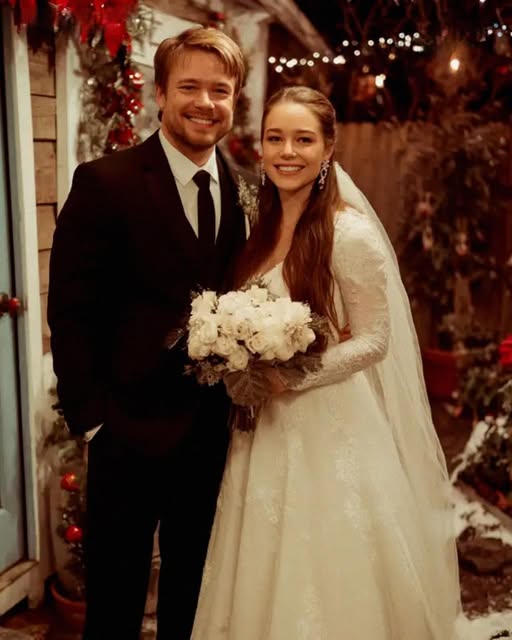
I married Matthew in the very house he once shared with his late wife. I told myself it didn’t bother me — that love could overwrite old memories, that I could build something new inside walls that had already witnessed a lifetime before I arrived. But on our wedding night, while the house was quiet and Matthew was tucking his daughter into bed, I opened the nightstand drawer and found a letter taped to the underside. The envelope was old, the handwriting delicate, and the first line chilled me to the bone.
“If you’re reading this, he didn’t tell you the truth.”
For a moment, the room felt like it shifted under my feet.
I’d met Matthew the previous spring at a cookout. The attraction hit fast — he was gentle, surprisingly open, and carried his grief like someone who’d learned how to walk with pain instead of collapsing beneath it. He told me early on that his wife had died in a car accident. He said it quietly, almost apologetically, and my heart clenched for him. But he also talked about his five-year-old daughter, Mia, with such tenderness that it made me fall for him even faster.
Our relationship moved naturally, steadily. He was careful with me in ways that felt rare. He never pretended he was healed, never hid that some days still hurt. By the time he admitted he was falling in love with me, I already knew I was just as far gone.
The first time I walked with him and Mia, she slipped her hand into mine. It was such a small thing, but in that moment, I pictured our future — messy, hard, imperfect, but real. When Matthew proposed, I didn’t hesitate. And now, standing in the bedroom we were supposed to share as husband and wife, I held a letter written by the woman who’d lived this life before me.
I carefully slid out the note.
“I know my time is running out,” it read. “And if Matthew has remarried, I pray you found this before he hid the rest of what happened to me.”
Time running out? Matthew had always said she died suddenly — a car accident, nothing more. My chest tightened. I kept reading, but before I reached the second paragraph, a loud crash echoed down the hall. A glass breaking. Mia crying. Matthew calling for me.
I shoved the letter back into the drawer, my hands shaking, and rushed out.
In the kitchen, a shattered glass glittered across the floor. “It’s just a mess,” I called. “I’ll clean it up.”
But my mind was still upstairs, on the letter taped inside a drawer — a letter that implied Matthew had rewritten the past.
When the glass was cleaned and the house was calm again, I hurried back to the bedroom. The drawer was closed. I hadn’t left it like that. I opened it slowly.
The letter was gone.
A cold ripple spread through my stomach. Matthew must have gone into the room while I was cleaning and discovered it. And he didn’t say a word. Didn’t ask. Didn’t explain. Just… made it disappear.
The next morning, the tension in the house was thick enough to choke on. Matthew picked at his breakfast, offering me a weak smile that didn’t reach his eyes. Mia didn’t speak at all. She just stared at her cereal, her shoulders tight.
After Matthew left for work, I stood in the quiet kitchen wondering if everything I’d believed about our marriage had been a half-truth built on a bigger lie. Should I confront him? Could I even trust what he’d say?
Then Mia made a small sound behind me.
She was drawing at the table. I walked over to look.
The picture showed a woman lying on a bed holding a big rectangular object — a letter — and beside her stood a tiny figure with an X scribbled over her mouth.
A chill swept through me.
“What’s this?” I asked gently.
Mia’s voice trembled. “It’s a secret.”
My heart cracked. “Honey, secrets that make you sad aren’t ones you should keep.”
Her eyes filled with tears. “Daddy said not to tell. He said it hurts his heart. But it hurts my heart too.”
I knelt beside her. “You can tell me, sweet girl.”
She took my hand and led me to the basement.
She pointed to an unlabeled plastic storage tub. My hands shook as I opened it.
Inside were oxygen tubes, prescription vials dated two years ago, and a portable concentrator — medical equipment for someone who had been very, very sick.
Not a car accident.
“Mommy’s things,” Mia whispered. “Daddy said we shouldn’t talk about it.”
And then she held out something else — the letter.
“This is Mommy’s. I took it. I wanted to keep the secret.”
Tears stung my eyes. She had been trying to protect her father. My suspicion, my fear — they’d been aimed at the wrong person.
I unfolded the letter and read it fully.
“If you’re reading this, Matthew couldn’t bear to tell you the truth. I’ve been sick for over a year. He tried everything. He never stopped hoping, even when I knew hope wouldn’t help anymore. When I realized I was dying, I wrote this because I knew he would rewrite the story to survive the grief. Please don’t be angry at him. He protects people by pretending. Even me. Take care of him. Take care of our little girl. He’ll love you with a hurting heart, but he will love you well.”
By the time I finished, I was crying too hard to speak.
This wasn’t a warning. It was a plea from a dying woman who loved him enough to worry about the woman who’d come after her.
That evening, when Matthew came home, I was waiting in the living room. The storage tub was open on the table. The letter lay folded beside it.
He stopped when he saw them. His breath caught.
“You lied to me,” I said quietly.
His face crumbled. “Lila… I couldn’t tell it again. I couldn’t relive it. I wanted a fresh start with you. I didn’t want to bring all that pain into our future.”
I stepped closer, pressing the letter into his hands.
“You don’t have to carry it alone anymore.”
He broke. Shoulders shaking, tears streaming — not a man caught in a lie, but a man finally letting the grief he’d been suffocating for years surface.
“I just wanted to start over,” he whispered.
“Then let’s start with the truth,” I said. “We’ll build from there.”
And as he leaned into me, sobbing into my shoulder, I realized something simple and profound:
I was finally being allowed to love all of him — even the parts he’d been too afraid to show.