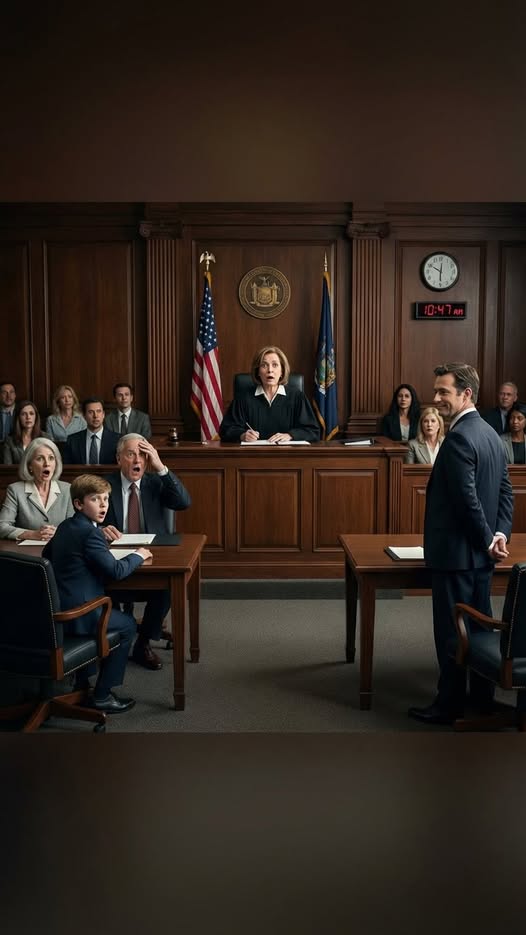
Chapter 1: The Defendant’s Table
“We’re finally shutting down your embarrassing little business.”
My brother, Vincent Moretti, announced this to the bankruptcy courtroom, straightening his silk tie with the smug satisfaction of a man who believed the war was already over. He didn’t look at me. He looked past me, as if I were a stain on the mahogany paneling he couldn’t wait to have polished away.
My parents nodded approvingly from the gallery. My mother, draped in black as if attending a funeral, dabbed at dry eyes with a lace handkerchief. My father, Antonio, sat with his jaw set in righteous judgment, the patriarch whose honor had finally been restored.
I stood at the defendant’s table, silent. I let Vincent’s lawyer present the fraudulent petition. I let him drone on about insolvency, mismanagement, and debts that existed only in the fevered imagination of my family’s greed.
I waited.
Judge Margaret Holloway, a woman known for a gavel that struck like thunder and a tolerance for nonsense that measured in the negative, was reading the file. Her pen scratched across the paper, a rhythmic sound in the hushed room.
Then, she froze.
Her pen suspended mid-stroke. Her eyes widened, scanning the company name at the top of the filing.
“Counsel, approach the bench,” she said. Her voice wasn’t loud, but it carried the weight of a falling guillotine.
Immediately, both lawyers moved forward. My lawyer, Patricia Okuno, walked with the confident stride of someone holding a royal flush. Vincent’s lawyer, a sweaty man named Fletcher, shuffled.
The judge’s voice dropped to a harsh whisper that echoed in the sudden silence of the room. “Is this the same Apex Defense Systems that just secured the $189 million Department of Defense contract? The one featured in the Wall Street Journal last week?”
Fletcher stammered something unintelligible.
Judge Holloway looked up. Her eyes met mine. There was disbelief there, yes, but beneath it, a growing, incandescent anger.
“I’m going to need to see extensive documentation before we proceed,” she said, her voice rising to a dangerous calm. “Because either this petition is the most incompetent filing I’ve seen in thirty years on the bench, or someone is attempting to commit fraud in my courtroom.”
I watched my brother’s confident smile begin to crack, a fault line appearing in the foundation of his arrogance.
Here we go, I thought. Burn it down.
Chapter 2: The Architect of Silence
I founded Apex Defense Systems eight years ago in a garage that smelled of damp concrete and desperation. I had $3,000 in savings and a chip on my shoulder the size of a continent.
The Moretti family didn’t do garages. We did Prestige. We did Luxury.
My father ran a chain of high-end car dealerships that catered to people who thought dropping six figures on a vehicle was a casual Tuesday. Vincent was the golden boy, groomed from birth to take over the empire. My younger sister, Carla, had married into old money and spent her days on charity boards, perfecting the art of the polite snub.
And I? Gabriella. The middle child. The disappointment. The one who had thrown away a business degree from Wharton to pursue what my father sneeringly called “playing with electronics.”
I remember the day I told him my plans. I was twenty-four, standing in his office, the air conditioning humming a low, expensive note.
“That’s a job, not a business,” he’d scoffed, not even looking up from his paperwork. “Get a real career, Gabriella. Work for a bank. Meet someone appropriate.”
“Defense technology has massive growth potential,” I’d argued, my voice shaking. “Cybersecurity is the future.”
“You’re twenty-four years old. You don’t know anything about building companies. You’ll fail, and then you’ll come back expecting us to clean up your mess.”
“I won’t fail.”
He finally looked at me then, his eyes cold and flat. “They all say that. You will.”
I left his office that day and never asked for his approval again.
The first five years were a brutal, lonely grind. I lived on ramen and instant coffee. I worked twenty-hour days, my eyes burning from staring at lines of code until they blurred into gray static. I learned the defense contracting world through painful trial and error. I made mistakes that nearly destroyed me—bad partnerships, missed deadlines, a contract dispute that ate through my savings like termites.
My family watched from a distance, vultures waiting for the carcass to cool.
“Still playing with computers?” Vincent would ask at holiday dinners, his tone dripping with condescension as he swirled a glass of expensive Barolo.
“Still working on your little hobby?” Dad would add.
“We worry about you,” Mom would say, placing a hand on my arm. “We’re embarrassed by you,” was what she meant.
I stopped attending holidays after year three. The energy I spent defending my existence was better used building my company.
And build it I did.
Apex Defense Systems developed specialized cybersecurity protocols for military communications. We created a system that could detect and neutralize intrusion attempts in milliseconds—faster than a human could blink. We won our first government contract in year four. Our second in year five.
By year seven, we had forty-seven employees, $12 million in annual revenue, and a reputation as one of the most innovative defense tech startups in the country.
The big one—the $189 million contract—came through six weeks ago. A multi-year agreement with the Department of Defense to implement our technology across three military branches. It was the deal that would transform Apex from a successful startup into a titan.
The Wall Street Journal ran a feature. Defense industry publications profiled our technology. Investors were suddenly knocking down my door.
My family had no idea.
I’d kept my success deliberately quiet, using my married name, Gabriella Santos, for all public appearances. The few relatives who’d stumbled across news about Apex Defense didn’t connect “G. Santos, CEO” with the daughter they dismissed as a failure.
I preferred it that way. Their approval wasn’t currency I traded in anymore.
But apparently, their interference was a tax I still had to pay.
The bankruptcy petition arrived three weeks after the contract announcement. It was filed by Vincent, claiming that Apex Defense Systems owed him $2.2 million from an investment he allegedly made in year two. The petition claimed I had defaulted on repayment terms, that the company was insolvent, and that creditors needed court protection.
Every word was a lie. A fabrication woven from spite and greed.
Vincent had never invested a single dollar in Apex. He’d never even visited the office.
The documentation accompanying the petition was clumsy forgeries—contracts I’d never signed, loan agreements I’d never seen. It was fraud, pure and simple. But it was the kind of fraud that could destroy a company if left unchallenged. It could tie up assets, scare off investors, and jeopardize the government contract that required absolute financial stability.
I called Patricia immediately.
“They’re trying to force you into proceedings,” she said, her voice tight. “It’s incredibly stupid. A forensic exam will expose this in hours. But in the meantime, the filing creates legal complications that could delay the DoD implementation.”
“That’s the point,” I said, staring out my office window at the Virginia skyline. “Vincent knows I have something big happening. He wants to sabotage it.”
“How would he know?”
“My mother’s cousin works at a law firm that handles some of our compliance filings. She must have seen something. Mentioned it at a family gathering.” I sighed, a sound of weary resignation. “They don’t know the scale. They just know I have a government contract and decided to interfere.”
“Why?” Patricia asked. “Why destroy your success?”
“Because my success proves they were wrong. Some people would rather burn down a palace than admit they don’t own the throne.”
Chapter 3: The Trap is Sprung
The court date was a Thursday. I arrived early, dressed in the kind of understated professional attire I favored—expensive, but not flashy. Commanding, without screaming for attention.
Patricia joined me at the table with three heavy boxes. Inside was the ammunition for the execution.
Vincent arrived with our parents, staging an entrance. He wore a tailored suit I recognized from his promotional photos at the dealership. Mom was in her somber colors. Dad carried himself with the stiff gait of a man who believed the world owed him deference.
They didn’t acknowledge me. Not a glance. Not a nod. I was a problem to be solved, an obstacle to be bulldozed.
“Finally facing consequences,” Vincent muttered to Fletcher, loud enough for me to hear. “Should have happened years ago.”
The gallery had a few spectators—court regulars, a journalist covering bankruptcy proceedings, some people waiting for later cases. None of them knew they were about to witness a spectacular implosion.
Judge Holloway entered. I’d researched her. Thirty years on the bench. Zero tolerance for games. If there was anyone who would see through Vincent’s charade, it was her.
The proceedings began. Fletcher presented the petition, outlining the alleged debt, the supposed default.
“Your Honor, the defendant has systematically avoided repayment of a substantial family loan, choosing instead to fund an unprofitable venture that has never demonstrated financial viability.”
Judge Holloway held up her hand. “The company name. Apex Defense Systems. Based in Alexandria, Virginia?”
“Yes, Your Honor.”
She pulled up something on her computer. Typed briefly. Went very still.
That was when she called the lawyers to the bench. The whispered conference lasted several minutes. I watched Vincent’s confidence erode in real time, like a sandcastle facing the tide. Fletcher looked pale. My father leaned forward, his expression shifting from smugness to concern.
Finally, Judge Holloway spoke.
“We’re going to recess for thirty minutes. During that time, I want both parties to prepare comprehensive documentation of their positions. Counsel for the petitioner…” She fixed Fletcher with a stare that could freeze nitrogen. “I strongly suggest you verify every document you’ve submitted. Because if I discover fraudulent filings in my courtroom, the consequences will be severe.”
The gavel came down. Bang.
Vincent practically ran to Fletcher’s side. “What’s happening? What did she say?”
I used the recess to arrange my documentation. Patricia spread the evidence across our table like a tarot reading of doom.
- Actual financial statements showing $12 million in revenue.
- The redacted DoD contract.
- Letters from investors.
- Tax returns. Audit reports. Eight years of legitimate business records.
- And finally, the forensic analysis of Vincent’s petition.
Document experts had examined his loan agreements. They found digital metadata proving they’d been created six days ago. The signatures were clumsy digital pastes. The financial figures were fantasy.
Thirty minutes later, Judge Holloway returned.
“I’ve done some preliminary research during the recess,” she announced. “Apex Defense Systems is not a failing company. It appears to be a highly successful defense contractor that just secured one of the largest cybersecurity contracts in the current fiscal year.”
She looked at Fletcher. “Would you like to explain why you filed a bankruptcy petition against a company with no apparent financial distress?”
Fletcher shuffled papers nervously, sweat beading on his forehead. “Your Honor, my client provided documentation of a debt… documentation that, even on cursory examination, appears inconsistent with the company’s public filings.”
Judge Holloway turned to me. “Miss Santos—or should I say Miss Moretti, since the petitioner seems to be your brother—would you like to respond to these allegations?”
I stood up. I didn’t tremble. I didn’t hesitate.
“Your Honor, there is no debt. There was no investment. Every document submitted by the petitioner is fraudulent. My brother has never been involved with Apex Defense Systems in any capacity. He is filing this petition to sabotage my company because my success embarrasses him.”
“That is a serious accusation,” the Judge said.
“I have serious evidence.”
I nodded to Patricia. She distributed copies of our documentation.
“These are our actual financial records, prepared by certified accountants and verified by annual audits. This is the forensic analysis of the documents submitted by the petitioner, showing they were created less than a week ago using templates inconsistent with standard business agreements. And this…” I held up a folder. “…is a timeline of my brother’s public statements about my company over the past eight years, demonstrating a consistent pattern of dismissal and hostility.”
Vincent shot to his feet. “This is ridiculous! She’s my sister! I have every right to collect the debt she owes!”
“What debt?” I asked, turning to face him for the first time. My voice was calm, cutting through the room. “Name the date of the supposed loan. Name the bank account from which funds were transferred. Provide a single piece of evidence that doesn’t evaporate under scrutiny.”
He couldn’t. Because there was no evidence. There was only greed and spite dressed up in legal filings.
Judge Holloway examined the documentation for twenty minutes. The courtroom was silent. Vincent’s lawyer looked like he wanted to dissolve into the floorboards. My parents had stopped their theatrical performance, replaced by the dawning realization that the script had been rewritten.
Finally, the judge spoke.
“I’ve reviewed the materials. The forensic analysis is compelling. The metadata clearly shows the petitioner’s documentation was created recently, not years ago as claimed. The financial records submitted by the defendant show a company with substantial assets and no outstanding debt.”
She turned to Vincent.
“Mr. Moretti, I am dismissing this petition. But that is not the end of your involvement with this court. Filing a fraudulent bankruptcy petition is a federal crime. I am referring this matter to the U.S. Attorney’s Office for investigation of potential perjury and fraud.”
Vincent’s face went white. “Your Honor, there’s been a misunderstanding—”
“There is no misunderstanding. You submitted forged documents. You claimed debts that don’t exist. You attempted to force a successful company into bankruptcy proceedings through fraud.”
She removed her glasses.
“Did you know that interfering with a Department of Defense contractor can trigger additional federal charges? The government takes a very dim view of people who jeopardize national security assets.”
“National security?” Vincent squeaked. “It’s just my sister’s little tech company.”
“Your sister’s ‘little tech company’ provides critical cybersecurity infrastructure to the United States military,” Judge Holloway said, her voice dripping with disdain. “Sabotaging it isn’t just fraud. It is potentially an issue of national security.”
She turned to me. “Miss Santos, I apologize for the court’s time being wasted by this frivolous filing. Your company’s reputation should not be affected by this proceeding, and I will ensure the record reflects the fraudulent nature of the petition.”
“Thank you, Your Honor.”
“Case dismissed.”
The gavel banged. It sounded like a gunshot.
Chapter 4: The Implosion
The aftermath was chaos. Court officers approached Vincent and Fletcher regarding the criminal referral. My parents tried to slip out quietly, like rats fleeing a sinking ship, but I caught my father’s eye as he reached the door.
His expression was unreadable. Shame? Anger? Or just the inability to process how thoroughly his worldview had shattered?
“Mr. and Mrs. Moretti,” I said. I kept my voice even. “I assume you knew about this.”
Dad turned slowly. “Gabriella… this was Vincent’s idea.”
“You were in the gallery, nodding along while he tried to destroy my company. Don’t pretend you weren’t part of it.”
“We thought we were helping,” Mom said, her voice thin.
“Helping whom? Helping your son commit federal crimes? Or helping yourselves feel better about betting against me for eight years?”
Mom stepped forward, hands wringing. “We didn’t know it would go this far. We thought… we thought the company was actually struggling. Vincent said…”
“Vincent said what he wanted to believe. And you believed him because that’s easier than admitting you were wrong about me.”
I gathered my files. I held them like a shield.
“The $189 million contract? That’s real. The forty-seven employees who depend on Apex? They’re real. The technology we’ve developed that protects American soldiers? That’s real, too. You tried to destroy all of it because my success made you uncomfortable.”
“Gabriella…” Dad started.
“I’m done,” I said. “Whatever happens to Vincent legally is his own problem. Whatever you tell yourselves to sleep at night is yours. But don’t contact me again. Don’t pretend you’re my family. Family doesn’t try to bankrupt each other with forged documents.”
I walked out of the courthouse. The sun was shining. The air smelled of exhaust and freedom. I didn’t look back.
Chapter 5: The Architect of Her Own Life
The federal investigation moved quickly.
Fletcher, facing disbarment, cooperated fully. He revealed Vincent had approached him with the scheme, claiming Apex was a “failing company” that needed to be put out of its misery before it could “embarrass the family further.”
Charges were filed within six weeks. Bankruptcy fraud. Perjury. Attempted interference with a government contractor.
Vincent faced up to fifteen years. My father used his connections and a substantial amount of money to secure a plea deal that reduced the sentence to three years. Vincent would serve time in a minimum-security facility, lose his position at the family business, and carry a felony conviction for the rest of his life.
The dealership chain survived, but Dad had to step back. The reputational damage of having a son convicted of federal fraud made him toxic to the high-end clients they depended on. Last I heard, he was “consulting” while younger managers ran the actual business.
Mom sent a letter six months after the trial. It was full of justifications and non-apologies. “We never meant for things to go this far. Family should forgive each other. Surely you can understand our perspective.”
I didn’t respond. I burned it.
Apex Defense Systems celebrated its tenth anniversary last month. We’ve grown to 156 employees. Our contracts with the DoD have expanded to $340 million over the next five years. We’ve opened a second facility in Colorado.
The Wall Street Journal ran a follow-up piece titled “The Defense Startup That Survived a Family Sabotage Attempt.”
I gave one interview. The journalist asked why I thought my brother had done it.
“Some people can’t tolerate being wrong,” I said. “They’d rather destroy something successful than admit they misjudged it.”
“Do you have any relationship with your family now?”
“I have an excellent relationship with the family I’ve built,” I smiled. “My employees. My partners. My husband. The people who believed in me when I had nothing but a garage and an idea.”
“And your biological family?”
“They made their choice. I’ve made mine.”
The interview ended there.
Last week, I received a letter from my sister, Carla. She had always been peripheral to the drama, too focused on her own social climbing. But apparently, the scandal had affected her standing in her precious country club circles. People whispered about her brother, the felon.
“I know you probably don’t want to hear from any of us,” she wrote. “But I wanted you to know that I never agreed with how they treated you. I was too cowardly to say anything, but I always thought you’d prove them wrong.”
It was a half-apology, weighted with self-interest. She wanted to distance herself from the catastrophe, to position herself as the sister who’d “secretly supported” me.
I wrote back a single sentence.
Support given in silence when it would have mattered is just complicity. But thank you for the letter.
I meant it. I didn’t forgive her, but I acknowledged the gesture. Growth has to start somewhere.
My daughter was born three months ago. Her name is Elena, after my grandmother—the only Moretti who ever believed in me, who died before Apex became what it is but told me on her deathbed she knew I would succeed.
I hold Elena in the nursery I built in my home—a home I purchased with money I earned, in a neighborhood I chose, far from the family that tried to destroy me.
I tell her stories. Not fairy tales. I tell her about resilience. About determination. About the difference between people who lift you up and people who try to tear you down.
“Your grandmother and grandfather, my parents… they won’t be part of your life,” I told her last night, rocking her as she slept. “That’s not punishment. It’s protection. You deserve to be surrounded by people who see your potential, not people who need you to fail.”
She blinked at me with those newborn eyes that don’t quite focus yet.
“You’re going to do amazing things, Elena. And when you do, I’m going to be your biggest champion. That’s what family means. Not shared blood. Shared belief.”
I put her in her crib and watched her sleep. This tiny person who would never know the family that rejected her mother. She’d know the family that chose her mother instead.
That’s enough. That’s more than enough.
They forced me into bankruptcy court expecting to finally prove I was the failure they’d always claimed. Instead, they proved themselves frauds—literally and figuratively. The judge recognized my company’s name because we’d built something worth recognizing.
The courtroom wasn’t their victory lap. It was their exposure.
And now, while Vincent serves his sentence and my parents fade into irrelevance, Apex Defense Systems keeps growing. Keeps building. Keeps proving that the only thing more powerful than family doubt is personal determination.