I arrived home to a silence so profound it felt like a physical weight pressing against my eardrums.
My name is Daniel Cooper. I am thirty-eight years old, a Senior Sales Manager at Cloud Tech Solutions, and for the last four years, I believed I was the luckiest man in Seattle. I had rebuilt a life from the ashes of tragedy. My first wife, Emily, had died in a car accident when our daughter, Lily, was barely two. For years, it was just the two of us against the world—until I met Jennifer.
Jennifer was the miracle. She was the light that broke through the gray Pacific Northwest drizzle. She met me in a coffee shop downtown, charming, patient, and possessed of a maternal warmth that Lily gravitated toward instantly. We married within a year. I thought I had found a second chance. I thought I had found a mother for my child.
I was wrong. I hadn’t found a wife; I had invited a predator into my sanctuary.
I had been gone for three days—a standard sales conference in Minneapolis. I had called every night. Jennifer had been brief, dismissive. “Lily is just tired,” she’d said. “You know how six-year-olds get. Probably coming down with a flu.”
When I dropped my suitcase in the foyer, the sound echoed too loudly. “Jennifer? Lily?”
No answer.
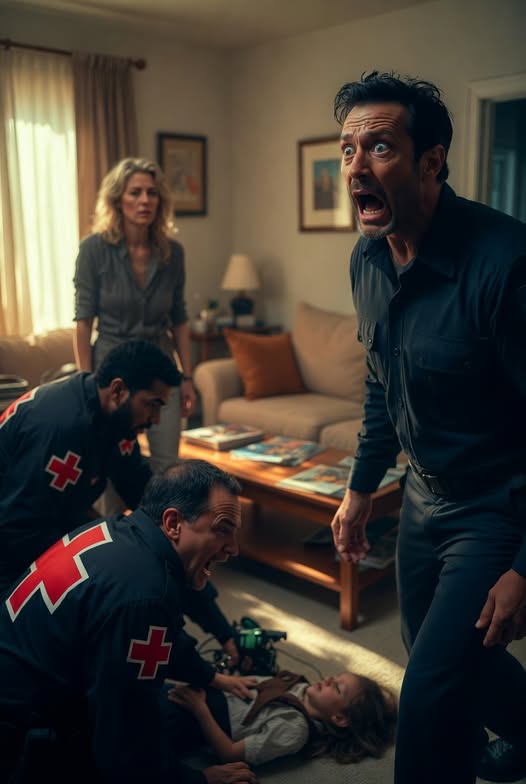
I walked past the kitchen. Empty. I turned toward the living room, and my heart hammered a frantic rhythm against my ribs. There, lying on the hardwood floor by the front door, was my daughter.
She didn’t look like she was sleeping. She looked crumpled. Like a marionette whose strings had been severed by a cruel pair of shears. Her small body was curled in an unnatural angle, her skin the color of old parchment.
“Lily!” I screamed, dropping to my knees.
I touched her hand. It was cold. Not cool—cold.
“Jennifer!” I roared, my voice tearing through the house.
Jennifer appeared from the kitchen, drying her hands on a floral dish towel. Her expression was terrifyingly placid. She looked at me, then at Lily, with the mild annoyance one might reserve for a spilled glass of milk.
“Oh, stop yelling, Daniel,” she said, her voice smooth and unbothered. “She’s just being dramatic. I disciplined her earlier for throwing a tantrum. She’s fine.”
I checked for a pulse. It was there, but it was thready, fluttering like a trapped moth. I brushed the hair from Lily’s face and froze. A bruise, dark and blooming like a toxic orchid, covered her left cheekbone.
“What did you do to her?” My hands were shaking so hard I could barely dial 911.
“She was out of control,” Jennifer said, shrugging. “Screaming, throwing things. I gave her some Benadryl to calm her down. She’s just sleeping it off.”
“How much?” I snapped, the phone pressing into my ear.
“I don’t know. A few pills. She needed to settle down.”
I stared at her. A few pills?
The operator’s voice cut through the fog. “911, what is your emergency?”
“My daughter… she’s unconscious. Barely breathing. I think she’s been overdosed.”
The next eight minutes were a blur of agony. I sat on the floor, cradling Lily’s head, whispering promises I wasn’t sure I could keep. Jennifer stood in the corner, arms crossed, watching us with eyes that were the color of glacial ice—cold, blue, and utterly void of humanity.
Then, the paramedics burst in.
The lead EMT was a man named Martinez. His badge identified him as a twelve-year veteran of King County Fire. He moved with practiced urgency, checking vitals, lifting Lily’s eyelids.
“Pupils are pinpoint,” Martinez barked to his partner. “Respiration is six per minute. We need to bag her. Load her up, now.”
He stood up, wiping sweat from his forehead, and turned to ask me a question about allergies. That was when he saw Jennifer.
The transformation in Martinez’s face was instantaneous. The professional veneer cracked, replaced by a look of visceral shock—recognition mixed with a deep, primal fear. He took a step back, his eyes locked on my wife.
“Sir,” Martinez whispered, not looking at me. “Is that… is that really your wife?”
“Yes,” I stammered. “That’s Jennifer. Why?”
“What is her maiden name?”
“Morrison. Jennifer Morrison.”
Martinez pulled out his phone. His hands were trembling. He tapped the screen rapidly and then turned it toward me. “Look at this.”
It was a news article from Portland, Oregon, dated November 2021. The headline read: WOMAN ARRESTED IN CHILD ABUSE CASE. STEPSON HOSPITALIZED WITH SUSPICIOUS INJURIES.
The photo was undeniable. It was Jennifer. Same blonde hair, same sharp nose, same dead eyes. But the caption didn’t say Jennifer Morrison. It said Sarah Jensen.
“She’s Sarah Jensen,” Martinez said, his voice tight with suppressed rage. “I worked that case two years ago in Oregon. Her stepson, Dylan, almost died. Severe dehydration, unexplained bruising, sedatives in his system. She walked on a technicality regarding evidence custody.”
My blood turned to ice. The room seemed to spin.
“That’s ridiculous,” Jennifer said. She hadn’t moved. She didn’t look scared. She looked bored. “I’ve never been to Oregon. This man is clearly confused.”
“I am not confused, lady,” Martinez spat. “I testified at your preliminary hearing. I saw what you did to that boy.” He turned to his partner. “Get the girl in the rig. Priority One. Possible overdose and abuse. I’m calling PD.”
“I’m coming with her,” I said, standing up.
“Sir, follow in your car,” Martinez directed. “We need room to work.”
As they wheeled Lily out, I looked back at the woman I had married. She was already looking at her phone, her thumbs flying across the screen, texting someone with the calm focus of a woman making a grocery list.
The Diagnosis
The drive to Seattle Children’s Hospital took seventeen minutes. Seventeen minutes of replaying every interaction, every strange silence, every time Lily had seemed to shrink away when Jennifer entered a room.
I sat in the waiting room for hours, a statue of misery. I called my mother. I called my boss. I did not call Jennifer.
At 11:47 PM, Dr. Patricia Chen, a veteran of pediatric emergency medicine, walked out. Her face was a mask of grim determination.
“Mr. Cooper,” she said, sitting opposite me. “We need to talk.”
“Is she…”
“She is stable, but critical,” Dr. Chen said. “We found massive amounts of Diphenhydramine—Benadryl—in her system. Levels consistent with an adult dosage for a 150-pound man. But that isn’t all.”
She opened a folder.
“Lily is severely dehydrated and malnourished. She has lost eight pounds since her last checkup six months ago. And the bruising… Mr. Cooper, she has contusions on her torso and legs in various stages of healing. This wasn’t a one-time discipline. This has been happening for months.”
I put my head in my hands. “I travel,” I whispered. “I travel for work two or three times a month. That’s when… that’s when she must have done it.”
“Abusers are masters of timing,” Dr. Chen said softly. “They wait for the isolation.”
A police officer, Detective Raymond Foster, arrived shortly after. I told him everything. The paramedic’s recognition. The alias. The timeline.
“She’s at the house,” I told him. “2847 Maple Avenue.”
Foster left to question her. I went to Lily’s bedside.
She woke up around 2:00 AM. Her eyes were groggy, confused. When she saw me, she flinched.
“I’m sorry, Daddy,” she rasped, her voice broken. “I didn’t mean to be bad.”
My heart shattered into dust. I kissed her hand, weeping. “You are not bad, baby. You are perfect.”
“Jennifer said I was bad,” she whispered, tears leaking from her eyes. “She said I deserved the medicine. She said… she said if I told you, nobody would believe me because I’m just a kid and she’s the grown-up.”
“I believe you,” I vowed, a fire igniting in my chest. “I believe you completely. And she is never, ever going to hurt you again.”
But the law, I learned, moves slower than justice requires. Detective Foster called me at dawn. Jennifer—or Sarah, or whoever she was—had refused to speak without a lawyer. Without definitive proof linking her to the past alias or immediate physical evidence of the administration of drugs (since no one saw her do it), they couldn’t hold her indefinitely. They had to release her pending investigation.
She texted me at 3:15 AM.
Dan, please. I know you’re upset. Lily has behavioral issues. I was just trying to help. You’ve been too soft on her since Emily died. We need to present a united front.
I stared at the phone. She wasn’t sorry. She was managing the narrative. She was a monster, but she was a calculated one.
The Ghost in the Machine
At 6:00 AM, I called Marcus Chen. Marcus was my college roommate, now the owner of a boutique cybersecurity firm that specialized in digital forensics and background checks for high-net-worth individuals.
“Marcus,” I said, my voice gravel. “I need you to find everything on Jennifer Walsh. Born 1985. Married me in 2019.”
“What’s going on, Dan?”
“She tried to kill Lily.”
Marcus went silent. “I’m on it.”
Two hours later, he called back. “Dan… are you sitting down?”
“Tell me.”
“Your wife doesn’t exist.”
“What?”
“Jennifer Walsh didn’t exist before 2018,” Marcus explained. “No credit history. No social media. No tax records. Her driver’s license was issued in Washington in 2018. It’s a clean skin. A synthetic identity. She appeared out of nowhere.”
“Can you find who she really is?”
“If she’s sloppy. Or if she’s been caught before. Give me time.”
I didn’t wait. I went to the internet. I searched for “Sarah Jensen Portland Abuse.”
There she was. The mugshot was younger, the hair darker, but the eyes were the same. The case details matched what Martinez had said. Charges dropped due to chain-of-custody errors on the blood work. The victim: Dylan Martin, age 8.
I kept digging. I searched for similar cases in neighboring states. I found another.
Phoenix, Arizona. March 2019. A woman named Rachel Morrison arrested for child endangerment. Her stepdaughter, 7, found unresponsive at school. The charges were dropped when the father refused to testify, claiming his daughter was a liar. The case was sealed, but I found the father’s name in a civil filing: Robert Morrison.
I found a phone number for Robert Morrison. I left a voicemail.
He called back within minutes.
“Is your daughter okay?” Robert asked immediately. His voice was rough, scarred by years of regret.
“She’s alive,” I said. “But she’s hurt.”
“It’s her, isn’t it? Rachel? Or whatever name she’s using?”
“She calls herself Jennifer now.”
Robert let out a bitter, broken laugh. “She’s a chameleon, Dan. She finds single fathers—widowers usually, men who are grieving and desperate for help. She plays the perfect partner. Then, once she’s married, once she’s in the house… she starts the erasure.”
“Why?” I asked. “Why does she do it?”
“Power,” Robert said. “She told me once, right before she vanished, that children are manipulative and need to be broken to be fixed. She gets off on the control. She drugs them to keep them compliant, starves them to make them weak. And she times it perfectly for when you’re away.”
“She disappeared on you?”
“Day before the trial. Used a fake ID to board a bus to Nevada. I never saw her again. Dan… my daughter is twelve now. She still has nightmares. Don’t let her walk away.”
“I won’t,” I said.
Marcus called back an hour later. He had found two more.
Las Vegas, 2017. Julia Martinez. Child neglect.
Sacramento, 2016. Michelle Chen. Abuse.
Five states. Five aliases. Five destroyed families. She was a serial predator who moved from state to state, harvesting the trust of grieving men and feeding on their children.
I realized then that the police investigation would take too long. She was a flight risk. If she sensed the walls closing in, she would run again. She would disappear, change her hair, find a new name, and find a new father.
I needed to trap her. And I needed to do it publicly.
The Gala
My company, Cloud Tech Solutions, was hosting its annual charity gala that Saturday night at the Fairmont Olympic Hotel. It was a high-profile event—two hundred attendees, C-suite executives, investors, and local media. We were raising money for, ironically, Seattle Children’s Hospital.
Jennifer lived for these events. She loved the gowns, the attention, the networking. It was where her mask was most firmly in place.
I called her. It was the first time I had spoken to her since the ambulance ride.
“Dan?” Her voice was breathless, feigning concern. “Oh my god, I’ve been so worried. Where are you?”
“I’m at the hospital,” I lied. “Listen, Jennifer. I’ve been thinking.”
“Yes?”
“Maybe… maybe you’re right. Lily has been acting out. Maybe I overreacted.”
Silence. I could hear the gears turning in her head. She was calculating.
“I just want us to be a family,” she said softly.
“Me too,” I said, fighting the bile rising in my throat. “But we have a problem. The Gala is Saturday. The company expects us both there. With the rumors… with the ambulance coming to the house… people are talking. I need you there, Jennifer. I need us to present a united front. To show everyone we’re stable.”
“Of course,” she said instantly. “I’ll do whatever it takes. The blue dress?”
“The blue dress,” I said. “Meet me there at 7:00 PM.”
I hung up. Then I made the real calls.
I called Detective Foster. “I can give you her on a silver platter, but you need to be at the Fairmont on Saturday.”
I called Chris Martin in Oregon. I called Robert Morrison in Arizona. I bought them plane tickets.
I called Marcus. “I need a projector setup. And I need you to hack the ballroom’s AV system.”
Saturday arrived. The Fairmont was glittering with crystal chandeliers and ice sculptures. The air smelled of expensive champagne and denial. I wore my tuxedo like armor, smiling, shaking hands, playing the role of the successful executive.
Jennifer arrived at 7:47 PM. She was breathtaking in midnight blue silk, her hair swept up, her makeup flawless. She looked like the perfect wife. She walked up to me, kissed my cheek, and squeezed my hand.
“Thank you for this,” she whispered. “We’ll get through this, Dan. I promise.”
I looked at her—really looked at her—and saw the abyss behind her eyes. “Yes,” I said. “We will.”
At 9:15 PM, the awards ceremony began. My boss, Karen, took the stage.
“And now,” Karen said, “I’d like to invite our Senior Manager, Daniel Cooper, to say a few words about why this charity means so much to him.”
I walked to the stage. Jennifer stood near the front, beaming, holding a glass of champagne.
I took the microphone. The room went quiet.
“Thank you all for coming,” I began. “Child safety is personal to me. Especially this week. Because six days ago, I came home from a business trip to find my six-year-old daughter unconscious on our floor.”
Jennifer’s smile faltered. A flicker of confusion crossed her face.
“She had been drugged,” I continued, my voice gaining strength. “She had been starved. She had been beaten. All while I was in Minneapolis selling software.”
A murmur rippled through the crowd. Jennifer took a half-step back, her eyes darting to the exits.
“I also learned something else this week,” I said. “I learned that monsters are real. And sometimes, they wear blue silk dresses.”
Jennifer’s face went white. She lunged toward the stage. “Daniel! Stop it! He’s having a breakdown!”
“I learned,” I shouted over her, “that my wife isn’t Jennifer Walsh.”
I nodded to Marcus in the sound booth. The massive screen behind me lit up.
A photo appeared. It was Jennifer, but the caption read: SARAH JENSEN. ARRESTED 2021.
“This is Sarah Jensen,” I narrated. “Arrested in Oregon for poisoning her eight-year-old stepson.”
Another slide. RACHEL MORRISON. ARRESTED 2019.
“This is Rachel Morrison. Arrested in Arizona for putting a seven-year-old girl in a coma.”
Another slide. JULIA MARTINEZ. LAS VEGAS.
Another. MICHELLE CHEN. SACRAMENTO.
The room was dead silent. Two hundred people stared at the screen, then at the woman standing in the center of the ballroom. Phones were out. Recording.
“This woman,” I said, pointing a shaking finger at her, “is a serial predator. She targets single fathers. She targets grieving families. And she tortures children for sport.”
“He’s lying!” Jennifer screamed, her voice shrill and ugly. “He’s crazy! That’s not me!”
“That’s my stepson she almost killed,” a voice boomed from the back.
Chris Martin stood up. Next to him was a ten-year-old boy, Dylan. Dylan pointed a trembling finger at Jennifer. “She locked me in the closet,” the boy said, his voice carrying in the silence. “She made me eat the pills.”
Robert Morrison stood up on the other side of the room. “She destroyed my daughter,” he shouted.
Jennifer looked around, wild-eyed. The mask was gone. In its place was pure, animalistic panic. She turned and ran, her heels clicking frantically on the marble floor.
She didn’t make it to the door.
Detective Foster, along with three uniformed officers, stepped out from behind the heavy velvet curtains.
“Sarah Jensen,” Foster said, his voice booming. “You are under arrest for child endangerment, fraud, identity theft, and felony assault. You also have an outstanding warrant in the state of Oregon.”
Jennifer fought. She screamed, she kicked, she spat. As they cuffed her, she locked eyes with me. The loving wife was gone. The monster was loose.
“Your daughter deserved it!” she hissed, her face twisted into a snarl. “She was a whiny little brat! I should have finished the job!”
The entire room gasped. The cameras captured every second.
The Sentence
The video of the arrest had five million views by noon the next day. The story—“The Chameleon Stepmom”—was national news.
Jennifer—or Sarah, as she was charged—sat in King County Jail without bail. The mountain of evidence was insurmountable.
The trial took place four months later. Jennifer’s lawyer tried to claim I had framed her, but the sheer volume of victims made that defense laughable.
Dylan testified. Robert’s daughter testified via video. And my brave, beautiful Lily testified. She sat on the stand, clutching a stuffed bear, and told the jury exactly what “Mommy Jennifer” did when Daddy wasn’t home.
The jury deliberated for three hours. Guilty on all counts.
Judge Patricia Moreno, known for her zero-tolerance stance on abuse, delivered the sentence two weeks later.
“In my twenty-six years on the bench,” Judge Moreno said, looking down at Jennifer, “I have never seen such a calculated, systematic campaign of cruelty. You exploited the grief of widows. You tortured the vulnerable. You are a predator in the truest sense of the word.”
She sentenced her to 48 years in prison. No possibility of parole for twenty years.
Jennifer showed no emotion. She simply stared at the wall, her face a blank slate.
Epilogue: The Letter
Lily is in therapy now. She’s healing. She smiles again—a real smile, not the terrified grimace she wore for a year. We moved out of that house; I couldn’t breathe the air there anymore. We have a small place near the water now. Just us.
Six months after the sentencing, I received a letter from the women’s correctional facility in Gig Harbor. The handwriting was neat, precise, familiar.
I almost threw it away. But curiosity is a dangerous thing. I opened it.
Daniel,
You think you won? You didn’t. I’ll be out in twenty years. I’ll be 58. That’s not old. I’ll still have time.
You got lucky. You had money. You had resources. Most of them don’t. Most of the fathers are too tired, too lonely, or too stupid to notice. I’ve hurt more kids than the five you found. Try ten. Maybe twelve. I’ve been doing this since I was twenty-two.
You only caught the recent ones. The sloppy ones. The others? They still think their kids are just… difficult. They still think I was the best thing that ever happened to them.
Sleep well.
My hands shook as I read it. A final attempt to plant a seed of terror. A final manipulation.
I took the letter to Detective Foster. He didn’t see it as a threat; he saw it as a confession. They are reopening cold cases in three other states based on her timeline. That letter will likely add another decade to her sentence. Even in her arrogance, she defeated herself.
Last week, Lily and I went to the park. She ran to the swings, laughing as she pumped her legs, soaring higher and higher.
“Daddy, watch me!” she yelled.
“I’m watching, baby!” I called back. “I’m always watching.”
I thought about the monster sitting in a concrete cell. She thought she was untouchable because she preyed on silence. She thought she could outsmart a father’s love.
She was wrong.
Lily jumped off the swing, landing in the woodchips with a stumble and a giggle. She ran to me, wrapping her arms around my legs.
“I love you, Daddy.”
“I love you too, sweetheart.”
“Is Jennifer ever coming back?” she asked, her voice small.
I knelt down, looking into her eyes—eyes that were bright, clear, and safe.
“Never,” I promised. “The bad dream is over.”
We walked home together, hand in hand, leaving the shadows behind us. Jennifer had taken years from us, but she wouldn’t take a single second more.
We were free.