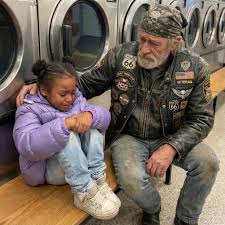
Every Tuesday at 4 PM, without fail, a little girl climbs into my arms at the laundromat and cries like her heart is breaking. She’s seven, maybe eight, small enough to vanish inside her too-big coat, with eyes that look older than mine even though I’m sixty-eight.
My name’s Ray. I’m the kind of old biker people cross the street to avoid—leather vest full of patches, hands scarred from decades of wrenching on bikes, a beard that could hide a raccoon. Strangers assume I’m trouble. Most kids steer clear of me.
But Destiny runs straight to me like she’s sprinting for higher ground during a flood. Every week she leaps into my lap, buries her face in my vest, and breaks. Sobs that shake her whole body. The kind of crying that comes from a place no kid should ever have to know.
People stare. Whisper. Film. One woman even called the cops because she thought I was luring a child. The manager vouched for me. He knows. And like me, he can’t say a damn thing.
If the truth gets out, they’ll take Destiny away from the only person she has left. And that person is dying.
It started three months ago. I’d just finished a 300-mile ride and figured I should wash the road dust out of my clothes. I was sitting by the dryers when Destiny walked in dragging a trash bag bigger than she was. No adult. No help. Just a bag stuffed with what looked like a stranger’s wardrobe.
She tried to hoist it into a washer. Too heavy. Tried again. Failed again. On the third try the bag toppled and she crumpled to the floor, tears spilling faster than she could wipe them.
I walked over and crouched next to her. “Need help, little one?”
“I’m a big girl,” she whispered. “Mama said I can do it.”
She couldn’t. Not physically. And the moment she realized that, she shattered.
I lifted the bag one-handed and started loading the clothes. They weren’t kids’ clothes. All adults’. Women’s. They smelled like hospital sheets and disinfectant, the sour smell of chemotherapy and sickness.
“Where’s your mama?” I asked gently.
“In the car,” she said too fast. “She’s tired.”
Kids don’t lie well. And scared kids lie worst of all.
I kept quiet, helped her start the load, paid for her wash, and handed her a granola bar from my saddlebag. She nodded like someone twice her age and begged me not to tell anyone she needed help.
The next Tuesday she came back. Same trash bag. Same clothes. Same fragile smile.
But this time she had bruises on her arms. Not from hands—bruises from hard floors, from cold nights, from sleeping where a child shouldn’t have to sleep.
“Destiny,” I said quietly, “is your mama really in the car?”
Her lip quivered. “Please don’t tell. They’ll take me away. Mama says if they find out, they’ll split us up.”
And then everything poured out of her in choking sobs.
Her mama was in a homeless shelter two blocks away. Stage four breast cancer. Too weak to walk. Too weak to lift anything. They’d been evicted when she got too sick to work. Lost their home. Lost everything. Some nights they slept in their car, some nights on cots in a room full of strangers.
The shelter didn’t have laundry facilities. Her mama didn’t have the strength. So Destiny dragged a trash bag to the laundromat every week because she wanted her mama to have clean clothes in the time she had left.
Her daddy died in Afghanistan. Her grandmother last winter. Destiny had no one left but her mother—and her mother was running out of road.
I held that child while she cried for a world collapsing under her feet. And in that moment I made a promise.
“You’re not alone,” I told her. “I’ll be here every Tuesday. Same time. You don’t do this by yourself anymore.”
“Why?” she whispered. “You don’t even know me.”
I took out the picture I’ve carried in my wallet for forty years—a smiling girl missing her two front teeth. “This was my daughter, Sarah. She died of leukemia when she was eight.” My throat tightened. “I couldn’t save her. But maybe I can help you.”
So that’s what we did. Every Tuesday, she’d show up. I’d help with the laundry. We’d fold together. I’d stash bills inside the clothes so her mama never felt like she had nothing to give. I’d bring extra sandwiches, jackets, gloves “that didn’t fit me.”
Destiny would tell me about school. About her mama’s good days and bad days. About pretending she wasn’t scared so her mama wouldn’t worry.
And every week she’d cry in my arms, letting out everything she hid from the world.
Then one Tuesday she didn’t show.
I waited three hours. Fighting off a panic I hadn’t felt since the night Sarah slipped away in a hospital bed.
She came the next week, smaller than before, cheeks hollow, eyes swollen.
“Mama’s in the hospital,” she said. “They said… she might not leave.”
“Where are you staying?”
“A lady from child services. But just until Mama gets better.”
We both knew that wasn’t happening.
That’s when I gave her the envelope I’d been carrying. “I got certified last month,” I told her. “Emergency foster license. If something happens, you don’t have to go with strangers. You can come live with me.”
Her eyes went wide. “But… why?”
“Because you deserve a home. And because a long time ago, I lost a little girl I couldn’t save. Maybe life’s giving me another chance.”
Two weeks later her mama passed. I was there. Held Destiny while she said goodbye. Held her mother’s hand as she whispered thank you with her final breath.
The state approved my emergency custody request within hours. Destiny moved in three days later.
My apartment looked like a cave carved out by a lonely old man—which it was. My motorcycle club brothers came by with wood, paint, stuffed animals, and tools. Their wives transformed my office into a pink, twinkling, princess-themed sanctuary.
Destiny still wakes up crying some nights. Still curls against me on the couch when the world feels too big. But she also laughs now. Reads to me in the evenings. Sits at my kitchen table doing homework while I overcook spaghetti.
She calls me Dad.
The first time she said it, my knees nearly buckled.
We still go to the laundromat every Tuesday at 4 PM. Not because we need to—we’ve got a washer and dryer now—but because that’s where our lives collided. Where a dying mother placed her daughter’s future in the hands of a stranger who looked like a threat but turned out to be the safest person in her world.
Destiny doesn’t cry in my arms anymore. Now she helps other kids who come in alone. Shows them how to use the machines. Shares her snacks. Tells them her dad is a biker who doesn’t look scary once you know him.
I’m seventy now. Adopting a seven-year-old at my age isn’t what anyone expects.
But Destiny isn’t a burden. She’s a second chance carved straight out of the broken places of my life. She’s proof that sometimes God—or fate, or luck—drops the right person into your world when you’re convinced you’ve got nothing left to offer.
In a few weeks, the adoption becomes official. Destiny will legally be my daughter.
Truth is, she already is.
And every Tuesday at 4 PM, I thank her mama for trusting me with the greatest gift of my life:
The chance to be a dad again.