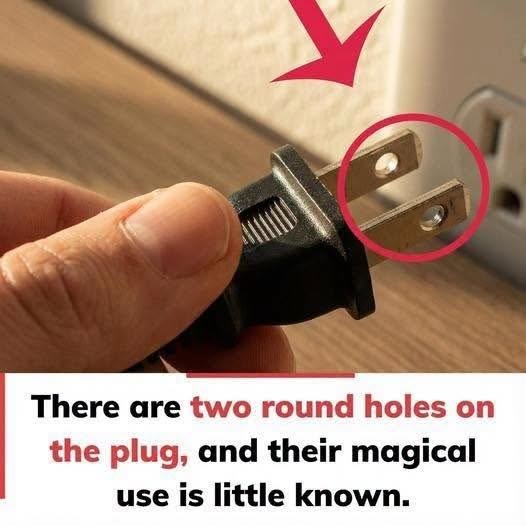
Have you ever looked closely at an ordinary electrical plug and noticed the two tiny holes near the tips of its metal prongs?
They’re easy to overlook. Most people simply insert a plug into an outlet without giving those little openings a second thought. But have you ever wondered why manufacturers put them there?
Are they decorative? Do they help electricity flow? Or do they serve a practical safety purpose?
The answer is surprisingly interesting. Those two small holes are not accidental, and they are not simply there to make the plug look different. They are part of a design that has been used in many electrical plugs for decades.
Let’s take a closer look at what they actually do.
1. They Help the Plug Stay Securely in the Outlet
One of the main purposes of the holes is to work with small retaining features inside certain electrical outlets.
Some outlets contain small bumps or spring-loaded mechanisms that can fit into the openings on the plug’s metal prongs.
When the plug is inserted, these features can help hold it in position and reduce the likelihood of it slipping out accidentally.
This is particularly useful in outlets that experience frequent plugging and unplugging.
However, not every outlet uses this mechanism. Many modern outlets rely on the pressure of their internal contacts to hold the plug securely.
2. They Were Designed to Work With Certain Manufacturing and Assembly Systems
The holes can also serve practical purposes during the manufacturing process.
Depending on the plug design, they may help manufacturers hold, position, or handle the metal prongs during production.
This makes the openings useful beyond their visible appearance.
The exact manufacturing purpose varies between plug designs and manufacturers.
3. They Can Be Used for Electrical Testing
Electrical plugs must meet safety and performance requirements before they reach consumers.
In some plug designs, the holes can provide convenient access for testing equipment or electrical testing arrangements during manufacturing and quality control.
This helps manufacturers verify that the plug meets the required specifications.
However, the holes themselves are not universal testing ports, and their presence does not mean that every plug is tested through them.
4. Do the Holes Help Electricity Flow?
This is one of the most common misconceptions.
The two holes do not make electricity flow better, increase the voltage, or improve the electrical performance of the plug.
Electricity travels through the conductive metal prongs and the electrical contacts inside the outlet.
The openings are simply part of the physical design of certain plugs.
In other words, a plug without these holes can work perfectly well if it is properly designed and compatible with the outlet.
5. Are They a Safety Feature?
They can contribute to the mechanical design of a plug, particularly when used with compatible retaining mechanisms.
However, they should not be confused with the main electrical safety features of a plug.
Important safety features include:
- Proper insulation around the prongs.
- Correct electrical ratings.
- Secure internal wiring.
- Grounding where required.
- Appropriate construction and certification.
Never assume that a plug is safe simply because it has two small holes.
6. Why Don’t All Electrical Plugs Have These Holes?
You may have noticed that some plugs have two holes, while others have completely solid metal prongs.
There are several reasons for this difference.
Electrical plug designs vary between countries, manufacturers, and product types.
For example, the familiar North American Type A plug often has two flat prongs with small holes near their ends. Other plug designs use different shapes and mechanisms.
Some manufacturers include the openings because they are part of a traditional or standardized design, while others use solid prongs.
Both designs can function correctly when manufactured according to the applicable electrical standards.
7. Should You Ever Put Something Into Those Holes?
Absolutely not!
Although the holes may look harmless, you should never insert pins, wires, or other objects into an electrical plug or use them to manipulate a plug while it is connected to an outlet.
Never modify electrical prongs or attempt to repair a damaged plug yourself.
If a plug becomes loose, cracked, overheated, or damaged, stop using it and have it replaced or inspected by a qualified professional.
The Interesting Detail Most People Overlook
The next time you unplug a household appliance, take a moment to look at the metal prongs.
Those tiny holes are a reminder that even ordinary household objects often contain design details that serve practical purposes.
In certain electrical plug designs, they can help with retention, manufacturing, and testing. They are not there to improve the flow of electricity, as many people assume.
Sometimes, the smallest details in everyday objects have the most interesting explanations!
Now we’re curious: Had you ever noticed the two little holes on an electrical plug before? Did you know what they were for, or did you always assume they were just part of the design?