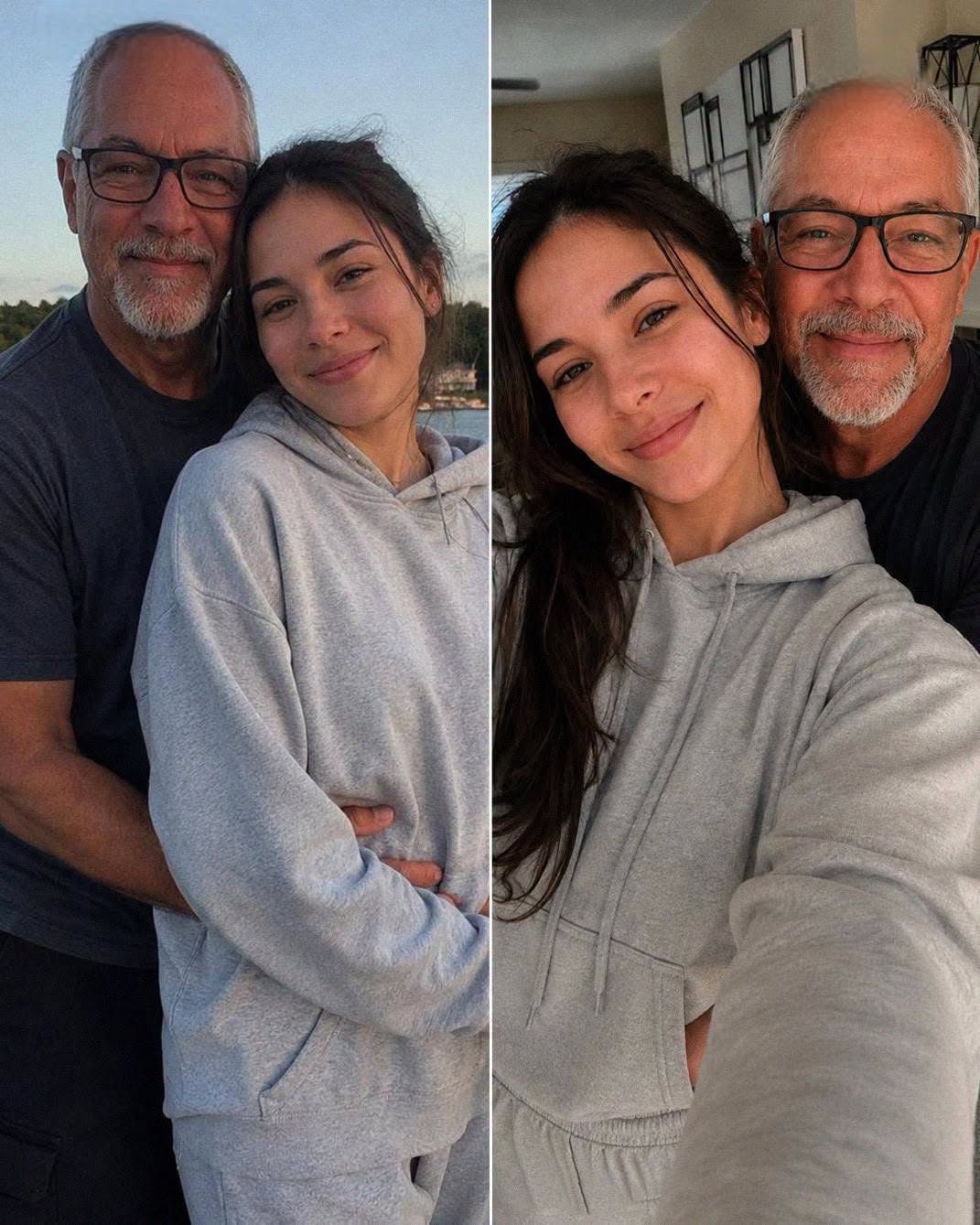
I was ready to brand my daughter a disgrace the moment I saw the photograph. There she was, my brilliant, kind, twenty-two-year-old Chloe, standing on a London sidewalk with a man who looked old enough to be her grandfather. The silver hair, the deep lines, the expensive coat—it all screamed of a transaction. I felt a cold, sharp bitterness take root in my chest. I had sacrificed everything to send her to nursing school, working double shifts and skipping meals, only for her to trade her future for a billionaire’s comfort. I called her a gold digger, and in that moment, I meant it with every fiber of my being. I was so incredibly wrong.
My name is Elena, and for as long as I can remember, it was just the two of us. I grew up cleaning houses and scraping by, fueled by the singular hope that Chloe would never know the hardness of my life. When she was accepted into a prestigious nursing program in London, I emptied every emergency fund, every coffee tin, and every hidden savings stash to make it happen. It was our dream. But after she left, the calls grew short and distant. The silence between us became a breeding ground for my deepest, ugliest fears. When the photo finally arrived, my world tilted on its axis. She hadn’t just met someone; she had married him.
When she returned home, the girl who walked through the arrival gate was not the pampered socialite I had feared. She was thin, her skin had a sickly, gray pallor, and her shoulders were gaunt. The “luxury” I imagined had clearly not touched her. I cornered her in our small kitchen, my voice trembling with the accusation that had haunted me for weeks. “Did you marry him for his money?” I demanded, desperate for a confession that would validate my anger. Chloe didn’t yell back. She simply pulled a chair out, her movements sluggish with exhaustion, and set a yellowed, faded hospital receipt on the table between us.
“Read the name,” she whispered. I picked up the paper, the edges crinkling in my shaking hands. It was a receipt from the very hospital where I had received my cancer treatment a decade ago. Halfway down the page, a note stood out in stark, formal ink: Paid in full by donor. Beside it was a signature I barely remembered, a sharp, slanted scrawl with a strange flourish under the final letter. My blood ran cold as the pieces began to click into place. Chloe explained that during her clinical rotation, she had been assigned to a wealthy, difficult patient suffering from late-stage heart failure. His name was Arthur.
Arthur was the anonymous donor. He had funded the emergency grants that saved my life ten years ago—a quiet, systematic charity with no name and no reward. When Chloe discovered this connection, she didn’t just see a patient; she saw the man who had given her mother a future. But the reality of his life was a nightmare. His three adult children, already wealthy and desperate for more, were circling him like vultures. They were actively working to declare him mentally incompetent, intending to drag him away from his home and into a substandard facility just to gain control of his estate.
“He was dying, Mom, and he was completely alone,” Chloe told me, her voice breaking. “His children called him a burden in the hallways. They didn’t want him to heal; they wanted him to expire so they could seize his assets.” She hadn’t married him for his wealth; she had married him to become his legal guardian. By becoming his wife, she gained the standing to protect his medical directives and shield him from the toxic influence of his own blood relatives. She had married a dying man to ensure he wouldn’t spend his final days surrounded by people who were essentially waiting for him to draw his last breath.
The following week, I met Arthur. He was a frail man in a wheelchair, his hands thin and veined, yet his eyes held a clarity that softened when he looked at my daughter. There was no romance in the sense the gossipers would imagine; there was only a profound, sacred loyalty. I spent weeks in that house, helping with his medication and listening to the cold, legal threats from his children’s attorneys. I watched Chloe navigate a battlefield of malice, holding her ground with a strength I never knew she possessed.
The courtroom was a harrowing display of greed. His children arrived in dark suits, weeping theatrical tears, accusing my daughter of elder abuse and manipulation. They tried to paint her as a predator, a young woman who had swooped in to trap a vulnerable, wealthy man. But Chloe was prepared. She provided meticulous medical evaluations and clear, video-recorded directives of Arthur’s wishes. When Arthur was wheeled before the judge, his voice was thin but steady. He told the court that his children had viewed his death as a financial transaction, while this young woman had seen him as a human being.
The petition was dismissed. His children lost their claim, their control, and their shortcut to the estate. Arthur passed away four months later, in his own home, with the music he loved playing softly and the two of us by his side. In his final moments, he looked at me and whispered that I was worth saving.
Looking back, the shame I feel for my initial judgment is a heavy, permanent weight. I had assumed the worst, projecting my own fears of poverty and survival onto my daughter, failing to see the quiet, incredible goodness she was displaying. I thought I had raised her to be successful, but I hadn’t realized I had raised her to be brave. She didn’t choose the easy path, and she certainly didn’t choose comfort; she chose to be a shield for a man who had once been a stranger’s miracle. My daughter, the woman I once doubted, taught me more about the true nature of love and family than I could have ever hoped to teach her.