When the plane touched down at Portland International Airport,s, the tires hit the runway with a scream so loud that the woman next to me grabbed her armrest.
I didn’t move.
I had stopped flinching at things three days earlier.
My name is Amelia. I’m thirty-five years old. And that morning, in a little village in northern Portugal, I buried my husband, James, in soil that didn’t belong to either of us.
I turned my phone on before the plane even reached the gate. The flight attendant gave me a look. I didn’t care.
My fingers were shaking.
Not from the cold.
From hope. Some small, stupid, desperate part of me still believed my family would be waiting.
I opened our family group chat. It was called The Brandts with a little house emoji. My mother had named it. It had my mom, my dad, my older brother Troy, his wife Kelsey, and me.
I typed:
My flight arrives at 5:00 p.m. Can someone please pick me up?
I hit send before I could change my mind.
The three typing dots appeared almost right away.
For a second, I felt something loosen in my chest. Someone was answering. Someone was coming.
Then Troy’s message popped up.
Troy: We’re overwhelmed today. Just get an Uber.
I read it once. Then again.
A few seconds later, my mother answered.
Mom: Why didn’t you plan this more carefully? You know Tuesdays are difficult for everyone.
I stared at the screen until the words went blurry.
Plan more carefully.
As if I had scheduled my husband’s brain aneurysm.
As if his death had been something I could have put on the family calendar a few weeks ahead, between Kelsey’s book club and Dad’s dentist appointment.
The plane jerked to a stop at the gate. All around me, people stood up and started pulling bags out of the overhead bins. Somebody’s elbow hit my shoulder. A man behind me was on the phone telling someone, “Yeah, babe, just landed, I’ll see you outside in ten.”
I looked down at my phone again.
I didn’t argue.
I didn’t remind them that for the past five days, I’d identified James’s body in a cold room in a foreign hospital. That I’d signed forms in a language I didn’t speak, with a translator who kept apologizing. That I’d chosen a coffin by pointing at a picture in a binder. That I’d stood alone at his grave that morning while an old priest said words I didn’t understand.
I just typed two words.Pages:
Then I put the phone face down on my lap and waited for the aisle to clear.
At the time, I had no idea that in less than twenty-four hours, every person in that group chat would be watching what came next on the evening news.
By the time I got to baggage claim, my phone buzzed again.
My father.
Dad: They’re predicting rain tonight. Be careful driving home.
Driving. I didn’t even have my car. My car was in our garage, where James had parked it the night before we left, because he said the airport lot was a rip-off.
Before I could answer, Mom sent another one.
Mom: Your father and I are having dinner with the Hendersons tonight. We accepted the invitation weeks ago.
I read that one twice too.
The Hendersons. My parents’ friends from church. Nice people. Gary Henderson had a boat and liked to talk about it.
A dinner reservation mattered more than meeting their daughter at the airport the day she buried her husband.
I locked the phone and slid it into my coat pocket.
The luggage belt groaned and started moving.
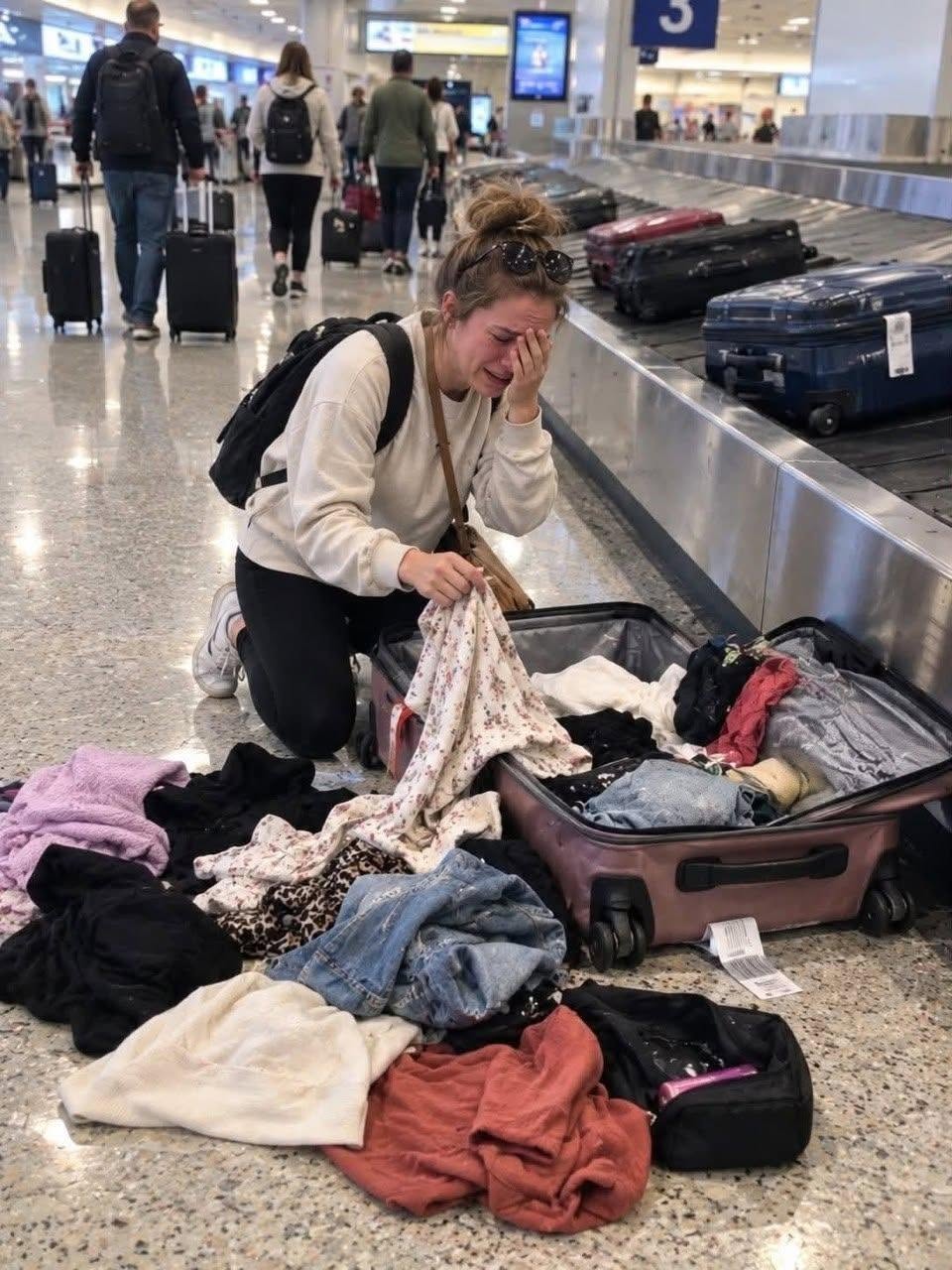
Two big black suitcases came around the corner. Mine and James’s. I’d packed both of them that morning in the hotel room in Portugal, kneeling on the floor, folding his shirts the way he liked them folded. Arms in, then in half, then in half again.
They held almost everything I had left of him.
His shirts. His running shoes. His shaving kit with the cheap razor he refused to replace. The navy tie he wore to our anniversary dinner every single year, because I told him once that it made his eyes look darker, and he never forgot it.
I grabbed the first suitcase and pulled it off the belt. It was heavy. I hadn’t eaten anything real in two days and my arms felt like rope.
I got the second one onto a luggage cart, then stacked the first one on top.
I pushed the cart toward the exit.
One of the front wheels jammed.
The cart stopped dead.
The top suitcase slid forward, tipped, and hit the floor so hard the zipper burst open along one whole side.
James’s things spilled across the polished tile.
Socks. Ties. His gray hoodie. Folded shirts that still smelled faintly like his cologne. A paperback he’d been reading on the flight over, with a boarding pass still stuck in it as a bookmark. Page 211. He never got to page 212.
People stepped around me.
A man in a suit sighed loudly and lifted his roller bag over James’s running shoe.
A teenager glanced at me, then looked away fast, the way you look away from someone crying on a bus.
I dropped to my knees and started grabbing things. Shoving them back into the suitcase. A sock. The book. His hoodie.
Then I picked up the navy tie.
And that’s when I stopped being able to breathe.
I just knelt there on the floor of the Portland airport holding a tie, with my mouth open, making a sound I didn’t recognize.
“Hey. Hey, honey.”
A woman crouched down next to me. She was older, maybe sixty, in pink hospital scrubs with a lanyard around her neck. She didn’t ask what was wrong. She just started picking up shirts and folding them, quickly and neatly, like she’d done it a thousand times.
“These your husband’s?” she asked quietly.
I nodded.
She didn’t say anything else. She didn’t need to. She folded his gray hoodie and laid it on top. She pushed the suitcase closed with her knee and yanked the zipper as far as it would go. Then she pulled a long elastic strap out of her own tote bag and wrapped it around the suitcase twice and buckled it.
“There,” she said. “That’ll hold till you get home.”
“I can’t take your strap.”
“Honey, I’ve got six more. My daughter buys me one every Christmas because she doesn’t know what else to get me.” She helped me stand up. She kept one hand on my elbow. “Somebody picking you up?”
I opened my mouth.
“Yes,” I lied. “They’re outside.”
She looked at me for a long second, like she knew.
Then she squeezed my arm and walked away toward the parking garage.
I never got her name.
My own family was less than an hour away.
A stranger in pink scrubs had done more for me in two minutes than any of them had done in five days.
I should explain about the five days.
James died on a Thursday.
We were in Portugal because of his work. He was a building inspector for the city of Portland, and once a year he went to a conference on building safety. That year, it was in Porto. He asked me to come. He said we’d tack on a few days afterward and drive up to the little village where we’d honeymooned eight years earlier. A place called Ponte de Lima, with a long stone bridge and a river so slow it barely moved.
“We’ll eat too much bread,” he said. “We’ll sit on the bridge. We’ll do nothing.”
On the second morning of the conference, he came back to the hotel room at lunch and said he had a headache.
“A real one,” he said, pressing his palm against his forehead. “Like someone’s standing on my skull.”
I gave him two ibuprofen and told him to lie down.
He lay down.
He said, “I love you, Amelia. Wake me up at three.”
At three, I couldn’t wake him up.
The doctors said it was an aneurysm. A weak spot in a blood vessel in his brain that had probably been there his whole life. It could have burst at any time. When he was ten. When he was eighty. It just happened to burst on a Thursday in a hotel room in Portugal.
“There was nothing you could have done,” the doctor said in careful English. “Nothing anyone could have done.”
People keep telling you that, after. They mean it kindly. It doesn’t help.
I called my family from the hospital hallway that night. I remember the floor tiles were green and white, like a checkerboard. I remember staring at them.
My mother answered on the fifth ring.
“Amelia? It’s almost midnight there, isn’t it? Is everything okay?”
“Mom.” My voice broke. “Mom, James died.”
There was silence.
Then she said, “What do you mean, died?”
I told her. All of it. The headache. Three o’clock. The ambulance. The doctor.
“Oh my God,” she said. “Oh, honey. Oh my God.”
For a moment, it was enough. For a moment, she sounded like my mother.
Then she said, “Well, what are you going to do? Are you bringing him home?”
“I don’t know. I don’t know anything. The man at the funeral home said it could take weeks to bring him back. There’s paperwork. It’s thousands of dollars.”
“Weeks?”
“Mom, can you come? Can someone come? Please. I’m by myself.”
I heard her breathe out. I heard the TV in the background. I heard my father ask, “Who is it?”
“It’s Amelia,” she said, away from the phone. “James passed.”
Then she came back.
“Honey, we can’t just drop everything and fly to Portugal. Do you know what those flights cost on short notice? And your father’s knee. He can’t sit on a plane for fourteen hours.”
“Troy could come.”
“Troy has the kids. And work. You know how his job is.”
I did know how his job was. Troy sold commercial insurance. He worked from home three days a week.
“Look,” my mother said. “You’ll handle the arrangements over there, and then when you get back, we’ll do something here. A nice service. At the church. Okay? Everyone will come to that.”
I stood in that green-and-white hallway and didn’t say anything.
“Amelia? Are you there?”
“I’m here.”
“You’ve always been so capable,” she said. “You’ll be fine.”
So I handled the arrangements.
I learned that bringing James home would take three to five weeks and cost more than we had in savings. I learned that his body would have to be embalmed under rules I didn’t understand and shipped in the cargo hold of a plane, in a sealed metal box, like freight.
And then I remembered something James said on our honeymoon.
We’d been sitting on that stone bridge in Ponte de Lima, eating bread out of a paper bag, with our feet hanging over the river. He’d been quiet for a long time. Then he said, “You know, if I die first, don’t ship me anywhere. I hate that idea. Being mailed. Just put me somewhere with a view.”
“You’re morbid,” I’d said.
“I’m a building inspector. I think about worst cases for a living.” He’d bumped my shoulder with his. “Somewhere with a view, okay? And come visit.”
So I found a small cemetery on a hill above the river. A local priest agreed to bury a stranger. The funeral director drove me up there in his own car and wouldn’t take money for the gas.
That morning, at nine o’clock local time, they lowered James into the ground.
The only people there were me, the priest, the funeral director, and two old men with shovels who took off their caps.
Somewhere with a view.
Then I went back to the hotel, packed his suitcase, and got on a plane.
I ordered the Uber standing outside the terminal under the overhang, while rain started falling in thin gray lines.
The driver’s name was Hassan. He drove a silver Camry that smelled like pine air freshener and coffee. When he saw the suitcases, one of them strapped shut, he jumped out and loaded them himself without being asked.
“Long trip?” he said, smiling, when we pulled away from the curb.
I looked out the window.
“Coming home or visiting?” he tried a few minutes later.
I didn’t answer that one either.
He glanced at me in the rearview mirror. I saw his eyes go to my hands. I was still holding the navy tie. I hadn’t put it back in the suitcase. I’d been holding it the whole time and hadn’t even noticed.
He stopped talking after that. He turned the radio down low. He drove carefully, slower than he had to.
The rain got heavier.
Halfway home, my phone buzzed. I looked at it. Kelsey, Troy’s wife, had sent a message to the group chat.
Kelsey: Sorry Amelia! Crazy day here. Hope you get home ok! 
A heart. She’d sent a heart.
Then my mother sent a photo. It was a picture of the Hendersons’ dining room table, set with white candles and blue napkins. Lovely evening! she wrote under it.
She must have meant to send it to someone else.
Or maybe she didn’t.
I turned the phone off completely and put it in my pocket.
When we turned onto my street, Hassan slowed down. It was a quiet street in Southeast Portland, lined with old houses and big maple trees. Ours was the gray one near the end, with the crooked porch light James always meant to fix.
Every window was dark.
Hassan pulled into the driveway. He looked at the house. Then he looked at me in the mirror.
“Nobody home?” he asked gently.
“No.”
“You want me to bring the bags in? To the door?”
“I’ve got it.”
He got out anyway. He carried both suitcases up the porch steps and set them down by the door. The rain was coming down hard now. His jacket was soaked across the shoulders.
I fumbled with my keys. My hands wouldn’t work right. It took me three tries to get the key in the lock.
Hassan was still standing at the bottom of the steps.
“Ma’am,” he said. “Are you going to be okay tonight?”
I almost laughed. It was such a simple question. Nobody in my family had asked it.
“I’ll be fine,” I said. “Thank you.”
He nodded slowly. He didn’t look like he believed me.
Then he went back to his car. He sat in the driveway for almost a full minute with his headlights shining on the porch before he finally backed out and drove away.
I didn’t know it then, but that minute would end up mattering.
The house was freezing.
We’d turned the heat way down before we left, the way James always did when we traveled. “No reason to heat an empty house,” he’d say. Ten days in October, and the cold had settled into the walls.
I dragged the suitcases inside and left them by the front door. I didn’t turn on the lights.
I don’t know why. I think I didn’t want to see it. The house the way we’d left it, like nothing had happened. His coffee mug in the drying rack. His reading glasses on the side table. His muddy boots by the back door.
In the dark, it could still be any night. He could still be upstairs.
I walked into the living room by feel. My hand found the back of the big brown armchair. James’s chair. It was old and ugly and lumpy, and he’d bought it at a garage sale the first year we were married for twenty dollars. I’d begged him to get rid of it a hundred times.
Every Sunday morning, he sat in that chair with a cup of coffee and the newspaper. He was the last person under sixty in Portland who still got the paper delivered. He read me the weird stories out loud. A man in Ohio who built a house out of bottles. A goat that got elected honorary mayor of some town in Vermont.
I curled up in it with my coat still on and my shoes still on and the navy tie still in my hand.
The cushion still smelled like him. Coffee and cedar and something I could never name.
The silence pressed in from everywhere.
I thought I was completely alone.
Lying there in the dark, I kept thinking about the last normal Saturday we’d had before the trip.
It was three weeks earlier. I’d come home from the grocery store and found James on his knees in the side yard, next to the gas meter, with his face almost touching the pipe.
“What are you doing?” I said.
“Smell that?”
I sniffed. “Smell what?”
“Rotten eggs. Faint. Come here. Get down here.”
I knelt in the wet grass next to him and sniffed again. Maybe. Maybe there was something. It was so faint I couldn’t be sure.
“I don’t know,” I said. “Maybe? It could be the neighbor’s compost.”
“It’s not compost.” He stood up and wiped his knees. “That’s mercaptan. That’s what they add to natural gas so you can smell a leak. I’ve been smelling it on and off for a week. Out here and in the basement.”
“So call the gas company.”
“I did. Tuesday.”
“And?”
He made a face. “They sent a guy. Young guy. He walked around with his little detector for about ten minutes and said everything was within normal range. Said it’s probably just the meter venting. Said it’s an old neighborhood and old neighborhoods smell.”
“Well, there you go.”
“Amelia.” He looked at me. That serious, quiet look he had. “I’ve inspected two hundred houses in this city that had a guy say ‘within normal range.’ Some of them aren’t there anymore.”
I rolled my eyes. I’m not proud of it.
“So what do you want to do? Dig up the street?”
“I want to install a monitored system. Gas detectors in the basement, the kitchen, near the meter. Carbon monoxide too. If it goes off, it calls us, and if we don’t answer, it calls whoever we put on the list, and then it calls 911.”
“Isn’t that expensive?”
“It’s forty bucks a month.”
“For a smell you’re not even sure about.”
He smiled. “Humor me.”
I humored him.
He spent the whole next weekend drilling holes and running wires and swearing at the instruction manual. He put little white sensors near the furnace, under the kitchen sink, by the water heater, and one in the side yard by the meter in a weatherproof box. He stuck a panel on the wall by the front door that glowed soft green.

